
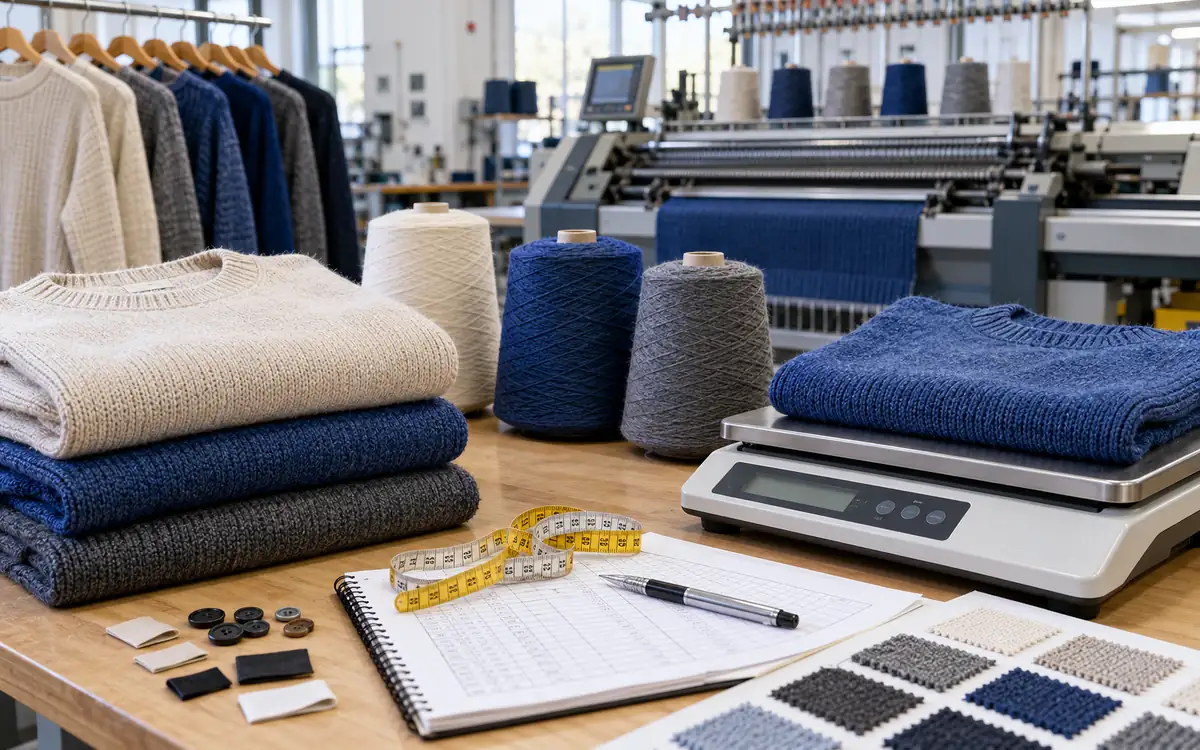
Start with yarn mass, not the complete sample weight
A buyer approves a 368 g sweater. Ordering 368 g of yarn for every piece seems reasonable. Yet the sample includes buttons and labels. It also represents only one size. The knitting process will consume yarn that does not remain in the final garment.
Sweater yarn consumption therefore needs three linked quantities. First is the yarn retained in each accepted garment. Second is the yarn used by the production process. Third is the yarn purchase after stock checks and package rounding. These numbers should not be called the same thing.
A reliable estimate starts with an approved sample that represents the product. It needs a clear weighing basis. Next, account for size and colour. Add measured process needs. Check the result against a controlled pilot run.
All numerical examples in this guide are hypothetical. They show a planning method. Their waste rates are not recommendations for a given fibre, knitting gauge or factory.
Define the sample and the stage of weighing
Record the style, size, yarn identity and structure. Add the program revision, number of yarn ends and finishing state. A sample is useful only when it represents the product to be made.
Distinguish an unwashed knitted panel from an assembled and finished sweater. Finishing can remove processing aids or add materials. It can also change moisture and alter the structure. A lighter finished garment does not necessarily mean the knitting machine used less yarn.
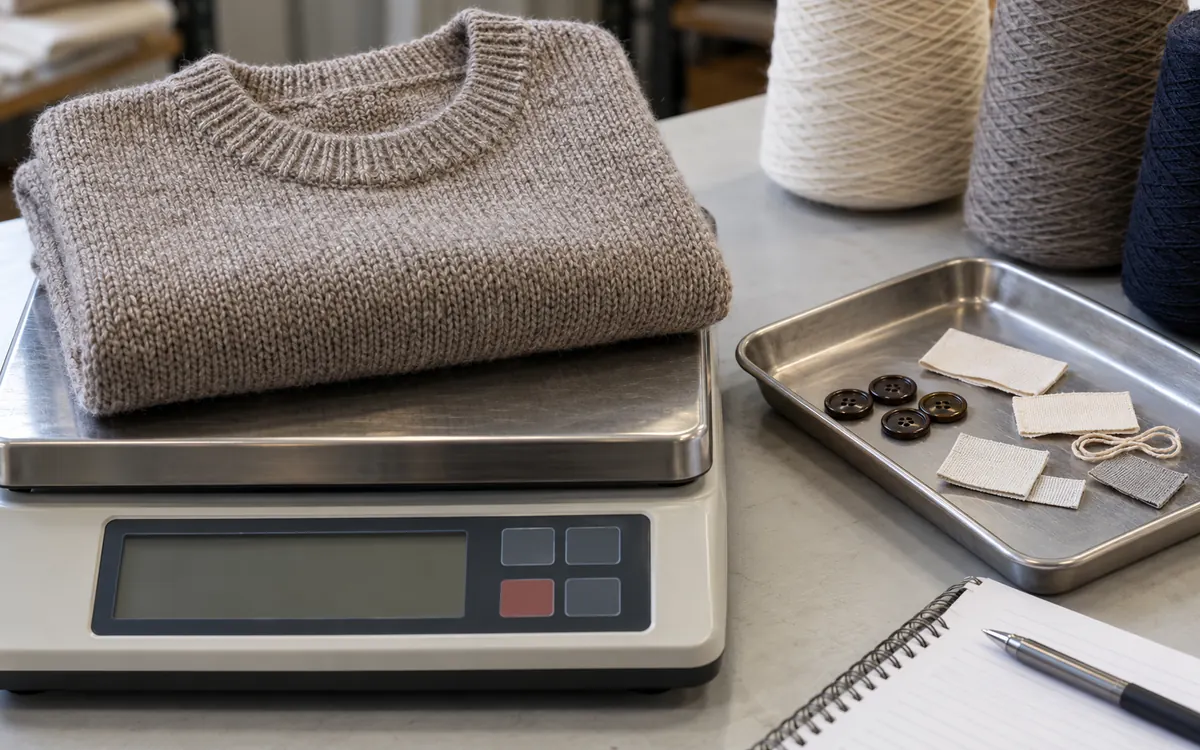
Weigh non-yarn parts separately when they are included in the sample. Keep the mass of buttons, zippers, badges and labels separate. Packaging must also stay outside the knitting-yarn requirement.
For the illustrative 368 g sample, assume identified non-yarn parts total 8 g. The retained knitted-yarn mass on the agreed condition basis is:
368 − 8 = 360 g.
Check that the 8 g represents the actual parts on the sample. Otherwise, the subtraction is not valid. A catalogue trim weight may differ from the attached assembly.
If several knitting yarns or colours are present, total weight is not enough to allocate the purchase. Measure each component or track controlled yarn issues. Validated machine data can also help establish each share.
Use a consistent moisture basis
Textiles exchange moisture with their surroundings. Two identical sweaters may be weighed under different conditions. Their apparent yarn consumption can then differ.
Use the agreed conditioning method for comparison samples. ISO 139 defines standard atmospheres for textile conditioning and testing. It includes an alternative atmosphere that can be used by agreement. Record the method and any relevant amendment. “Room conditions” alone gives too little detail.
Commercial mass is a separate concept. A yarn contract may use an agreed moisture or allowance basis. ASTM D1909 distinguishes commercial regain values from actual measured moisture behaviour. A commercial allowance is not proof of how much water a particular cone contains.
ISO 6741-1 addresses commercial mass for specified homogeneous fibre and yarn consignments. Its scope excludes several categories, including fibre blends. Do not apply its title as a blanket rule for every sweater yarn.
For an illustrative mass comparison, 300 g of dry material plus 45 g of water weighs 345 g. Moisture regain on the dry basis is 45 ÷ 300 × 100 = 15%. Moisture content on the total-mass basis is 45 ÷ 345 × 100 = 13.04%.
Those percentages differ because their denominators differ. State both the purchasing basis and sample basis. Then check whether one can be used to predict the other.
Establish a usable sample weight
Use a suitable, checked balance. Use a clean container if loose parts need support. Record tare. Remove hangers, tickets and temporary packing items. Leave them only if the calculation expressly accounts for their mass.
Sometimes the production decision needs a view of variation. In that case, weigh more than one piece that represents the product. Keep individual results rather than recording only a convenient average.
Suppose three hypothetical medium-size samples contain 356 g, 360 g, and 364 g of knitted yarn on the same basis. Their mean is 360 g. The range is 8 g. That range calls for a check. Do the samples share the same approved construction and condition?
A mean cannot decide which sample is correct if one uses a different program. Verify identity before treating the numbers as process variation.
Weight is also not a substitute for product approval. A sweater can have the correct mass but the wrong shape, structure, or handle. Check that the sample meets the product requirements. Then use its weight to set a consumption standard.
For panel and assembly control, ApparelDiary's sweater manufacturing guide covers the production handovers. This calculation uses the accepted product from that process.
Calculate the order by size
Using the medium sample weight for the whole order is an approximation. Check the evidence before using it. Size grading changes knitted area, shaping, and sometimes local construction.
Measure the required size range. A validated model can also be used if checked against physical samples. Keep the order quantities in the same version as the sales order.
Consider this hypothetical three-size order:
Size | Accepted order quantity | Retained yarn per garment | Net yarn requirement |
|---|---|---|---|
Small | 200 | 330 g | 66.0 kg |
Medium | 500 | 360 g | 180.0 kg |
Large | 300 | 396 g | 118.8 kg |
Total | 1,000 | — | 364.8 kg |
Net yarn by size = garment quantity × retained yarn mass ÷ 1,000.
The order-weighted average is 364.8 g per garment. It differs from the medium sample's 360 g. The size mix is not centred on that one sample.
Using 360 g for all 1,000 garments would understate retained yarn by 4.8 kg. This is before any production loss or sample requirement.
If the size ratio changes, recalculate the order. The approved weight for each size may remain the same while the total yarn requirement changes.
Allocate yarn by colour and quality
A multicolour sweater needs a separate requirement for each yarn code. Equal visible areas do not guarantee equal yarn mass. Floats, jacquard backing and plating can alter the shares. Different yarn counts can also change them.
Use measured or validated quantities for the actual knitting structure. Keep different qualities separate even when they have the same colour name.
For the same hypothetical order, assume the retained masses below:
Size | Yarn A | Yarn B | Yarn C | Total |
|---|---|---|---|---|
Small | 210 g | 90 g | 30 g | 330 g |
Medium | 230 g | 98 g | 32 g | 360 g |
Large | 255 g | 106 g | 35 g | 396 g |
Yarn A requirement = (200 × 210 + 500 × 230 + 300 × 255) ÷ 1,000 = 233.5 kg.
Yarn B requirement is 98.8 kg. Yarn C requirement is 32.5 kg. Together they equal the 364.8 kg retained total.
That reconciliation matters. Compare the colour totals with the complete yarn mass. If they differ, look for missing yarn or an incorrect share. The weighing boundary may also differ.
Avoid assigning every colour the same loss rate by habit. A small contrast section may have many starts. Its process loss may then differ from that of the main ground yarn.
Understand what the knitting system predicts
Knitting software can provide useful yarn estimates when its inputs match the production program. It still needs a physical check.
STOLL's Sintral Check guidance describes the inputs needed before calculating consumption. Assign yarn identity, yarn quality and the number of yarns to each carrier. The result can be reported by carrier and yarn. Missing or incorrect inputs can affect the requirement. The visual design may still look right.
Check the meaning of the report. Does it include only the main pattern? Or does it also include starts, separation sections and other technical knitting? Does it use the actual yarn count and number of ends?
STOLL's design-check documentation identifies technical yarns such as draw, comb, and protection yarns. These may be necessary for the process without remaining in the saleable sweater.
Treat those yarns as separate consumables when appropriate. Do not hide a cheap waste yarn inside the purchase quantity of an expensive main yarn.
Compare predicted use with a controlled run of the actual program. Link each correction factor to the defined yarn, machine and style conditions. It is not a universal percentage for all knitwear.
Check yarn count and the number of ends
Yarn linear density links length to mass. In tex, the value is grams per 1,000 m.
Mass in grams = yarn length in metres × tex ÷ 1,000.
ISO 2060 covers determination of linear density for yarn from packages by the skein method within its stated scope. Use the relevant method and conditioning basis when a count difference is suspected.
For a hypothetical length of 5,400 m at 64 tex:
Mass = 5,400 × 64 ÷ 1,000 = 345.6 g.
If the actual relevant linear density is 66 tex, the same length corresponds to 356.4 g. A software estimate may differ from a weighed sample. A count difference can explain part of that gap.
Confirm whether the entered count describes a single yarn or a folded yarn. Take two identical singles, each Nm 28. Their combined count is about Nm 14 before allowing for twisting effects. The length of the folded yarn is not the sum of the two single lengths.
Count notation varies in trade. State the actual construction and resultant linear density. A slash notation may be ambiguous. Also confirm how many separate ends feed each carrier.
Measure process consumption in a pilot
A controlled pilot connects retained sample mass with yarn issued to production. Define the start and end points before the run.
Record the opening usable yarn at the machine and all new issues. Track transfers in and out. Record returned usable yarn and the closing usable yarn. Keep yarn still in unfinished work separate from yarn consumed by completed garments.
An illustrative pilot starts with 2.0 kg of yarn at the machine and receives another 30.0 kg. At the end, 3.0 kg remains usable on cones. Another 1.0 kg is returned to stores. Unfinished work holds 1.0 kg.
Yarn assigned to completed output and its losses = 2 + 30 − 3 − 1 − 1 = 27 kg.
If 60 accepted garments were completed, the pilot consumption is:
27 ÷ 60 = 0.450 kg per accepted garment.
This figure includes the losses within that defined pilot boundary. It should not receive the same loss allowance again.
Check the output record. Does it include rejected garments, repair pieces and samples? A pilot with unusual development waste may not represent steady production. Separate fixed development use where practical.
Keep loss, reusable stock, and work in process distinct
A partly used cone is not automatically waste. It may remain usable for the same approved yarn lot. Similarly, an accepted spare panel may still be work in process rather than a loss.
Classify the physical material before calculating yield. Separate retained yarn in accepted work from yarn that can be recovered. Record unrecoverable knitting waste and technical yarn. Also identify rejected pieces and samples used in testing.
If rejected work can be reclaimed, record the actual usable recovery after the agreed process. Recovery may be possible in principle. That does not justify crediting the full original mass.
Keep recovery identity clear. Reclaimed yarn may have different condition or approved uses. Some recovered yarn may not suit the order. That quantity must not reduce the order's purchasing need.
When comparing issue and output masses, use compatible conditions and material boundaries. A finished garment may include added softener and trims. Do not subtract its whole mass from raw yarn input and call the gap “knitting waste.”
This is why a controlled pilot and a clear stage map are more useful than a fixed allowance based only on fibre name.
Apply a yield without changing its meaning
Suppose the net retained requirements are 233.5 kg for A, 98.8 kg for B, and 32.5 kg for C. Assume validated planning yields of 94%, 92%, and 90% respectively on the same mass basis.
Gross process requirement = net retained requirement ÷ yield.
Yarn | Net retained requirement | Assumed yield | Gross process requirement |
|---|---|---|---|
A | 233.5 kg | 94% | 248.404 kg |
B | 98.8 kg | 92% | 107.391 kg |
C | 32.5 kg | 90% | 36.111 kg |
The yields are hypothetical. They show how one blanket allowance can give the wrong yarn split for a multicolour order.
A 6% loss of input is not the same as adding 6% to net output. For Yarn A, dividing by 0.94 gives about 248.404 kg. Adding 6% to 233.5 kg gives 247.51 kg, which is lower.
Write the denominator beside the allowance. “Six percent waste” is not sufficiently precise for an order calculation.
Also check whether yield already includes samples, setup, or repairs. Add a separate allowance only for something excluded from the yield basis.
Add fixed needs and package rounding
Assume these process requirements exclude extra samples. The agreed sample allocation is 1.2 kg for A, 0.5 kg for B and 0.3 kg for C.
The totals before package rounding are approximately 249.604 kg, 107.891 kg, and 36.411 kg.
For this example, each yarn can be bought only in whole 1 kg units. The rounded requirements become 250 kg, 108 kg and 37 kg. Total planned supply is 395 kg.
That rounded amount is not the same as expected consumption. Some of it remains as a planned balance if production follows the estimate.
Subtract only usable, approved stock that can actually serve the order. Check yarn code, shade lot, condition, and availability. The warehouse total may include stock reserved for another order. Some stock may also be held for a decision.
Keep commercial minimums separate from technical need. A supplier may impose a minimum dye lot. This can create an excess purchase without changing yarn consumption per garment.
Show that excess clearly so the business can plan its use or accept the cost consciously. Hiding it in a “wastage” percentage makes future estimates less reliable.
Convert to a per-dozen basis carefully
Some sweater quotations use kilograms or pounds per dozen. A dozen is simply twelve garments, but the underlying size basis still needs a name.
For the medium sample's net retained mass:
0.360 × 12 = 4.320 kg per dozen medium garments.
For the order-weighted net mass:
0.3648 × 12 = 4.3776 kg per dozen at the stated size mix.
For the rounded supply quantity in this example:
395 ÷ 1,000 × 12 = 4.740 kg per dozen ordered garments.
All three values can be correct. They describe net medium-size content, net order-average content, and planned supply respectively.
One supplier may quote a gross per-dozen requirement. Another may give net sample weight. Put them on the same basis before comparing. Ask for the size ratio, stage, moisture basis, included losses, and package rounding.
Use unrounded figures for the calculation and round the displayed result to a sensible precision. Early rounding of small colour shares can create a noticeable difference across a large order.
Update demand when production changes
A program revision or yarn count change can alter consumption. So can a new colourway or revised size ratio. Update the affected rows rather than applying an unexplained overall correction.
STOLL's yarn-demand reporting guidance distinguishes total requirements from time-based provision. Its reports rely on yarn and consumption data attached to the program. The same principle applies in a simple workbook: demand needs a defined product version.
If 100 large garments replace 100 small garments in the example, net retained yarn rises by:
100 × (396 − 330) ÷ 1,000 = 6.6 kg.
The added mass is not spread equally across colours. Recalculate each yarn using its size-specific values.
Separate consumption changes from purchasing price changes. A higher yarn bill may reflect a rate increase even when the kilograms per garment improve. Keep quantity and price effects visible.
After a material change, confirm that the existing pilot factor remains appropriate. A visually similar yarn can behave differently in knitting and finishing.
Check cone tare and recoverable yarn separately
A partly used cone is not all yarn. The tube, label, wrap, and any protective cap add mass. Remove this tare when weighing returns. Otherwise, stock can appear larger than it is.
In a hypothetical return, ten cones weigh 4.80 kg together. Their verified empty packages weigh 0.65 kg. Net yarn is therefore 4.15 kg. If purchasing deducts the full 4.80 kg from the next requirement, the plan starts 0.65 kg short.
Use the actual package type for the tare check. A small cardboard cone and a large plastic cone need not weigh the same. Where package weights vary, use a suitable measured approach instead of one old value for every return.
Also separate yarn that is physically present from yarn that can be fed reliably. A short remnant may be useful for a trial but unsuitable for a long, continuous panel. Tangled or contaminated stock needs its own disposition.
Repair requirements deserve a separate record. A failed sleeve does not always require a whole new sweater. If the approved route permits replacing only that sleeve, record its yarn use and the rejected sleeve mass. Conversely, a shade issue may require a matched pair or a complete set of panels.
Track the actual recovery route. First recover and check the yarn from rejected panels. Make it available to production. Only then credit it as usable yarn. An assumed credit can conceal a real shortage while the unusable material remains on the floor.
Reconcile the order before reusing its allowance
At order close, reconcile opening stock and receipts with transfers and returns. Account for closing stock and output. Keep accepted garments, rejected work, samples, and unfinished pieces separate.
Compare actual use with the estimate by yarn code and size mix. A correct total can hide a shortage in one colour and excess in another.
Investigate the largest differences first. Was a technical yarn omitted? Did the size mix change? Were returns recorded with cone tare? Did a sample weight include trims? Did a program change increase floats or starts?
Do not automatically replace the original allowance with the latest result. First decide whether the order is representative. A breakdown, extra sampling request, or unusually high repair load may need a separate explanation.
Save both the original estimate and the actual result. Their difference is useful evidence for the next similar style. A revised number without its cause is much less useful.
Frequently asked questions
Can I order yarn from one buyer sample?
It can support an early estimate if its construction and mass basis are known. A final order needs the intended size mix, yarn allocation and production requirements. It also needs evidence that the sample represents the approved product.
Is there one normal sweater yarn wastage rate?
No single percentage covers every style, yarn, construction, and factory route. Use measured, comparable production evidence and define what the percentage includes. Keep fixed sampling and package minimums separate.
Should knitting waste be added to software consumption?
First establish what the software result includes. Then compare it with a controlled pilot. Add only the process requirements outside the report's boundary, and avoid counting technical sections or rejects twice.
Does a heavier finished sweater always mean more yarn was used?
Not necessarily. Moisture, trims, finishing additions, and sample condition can affect finished mass. Compare the same material and stage before drawing a conclusion about knitting consumption.
Can all leftover cones reduce the next order?
Only if they are usable, approved and available. They must also meet that order's shade and quality requirements. Record the actual net yarn mass and keep any restricted stock separate.
Order from a measured and explainable basis
A useful sweater yarn estimate shows how each kilogram was derived. It begins with a defined sample. It separates non-yarn mass and uses the real size and colour mix. It then applies measured process requirements.
Check the result against knitting data and a controlled pilot. Then account for usable stock, fixed needs, and purchase rounding. This creates a plan that purchasing can act on and production can reconcile when the order is finished.
References
ISO 2060: Yarn linear density by the skein method.
ISO 6741-1: Commercial mass of fibre and yarn consignments.
ISO 139: Textile conditioning and testing atmospheres.
ASTM D1909: Commercial moisture regains and allowances.
STOLL: Knitting time and yarn consumption in the patterning system.

Discussion0
Loading the discussion…