
Control whiteness and fabric damage together
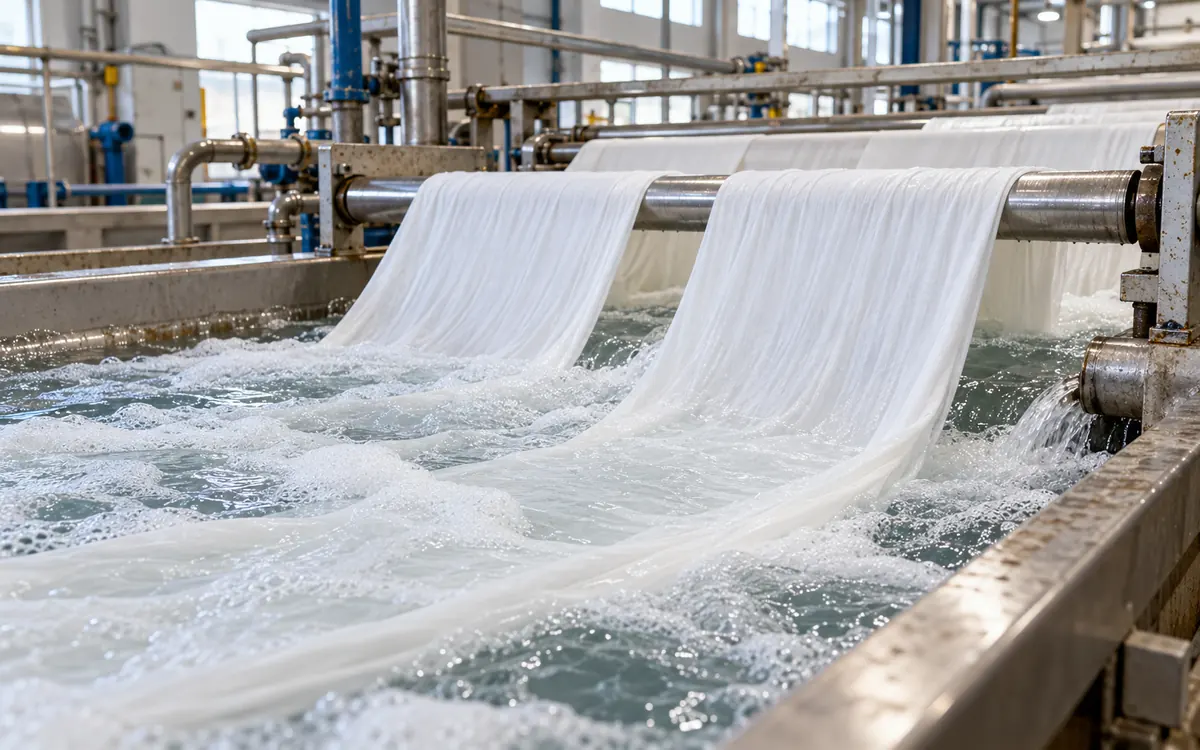
Hydrogen peroxide bleaching prepares a cleaner, more even colour base for cotton. A good process bleaches enough for the next stage. It also preserves the fabric properties the product needs. More peroxide, more heat, or a longer hold does not automatically produce a better result.
A useful control plan starts with the incoming peroxide. It follows the chemical through the bath and checks the treated fabric. It then checks the handover to dyeing. Record the measured process conditions. Link them to whiteness, strength, evenness, and residual-peroxide results.
This guide explains that control plan. All numerical trials are made up for teaching. They show how to calculate results and make decisions. They do not provide a recipe to run on a machine. Set approved limits for the chosen chemicals, equipment, and fibre blend.
Define the white base that the product needs
A pale shade may need a different cotton base from a deep shade. Set the preparation target for that shade. Finished white goods add another need. The prepared fabric must support the final white appearance.
Start with the next process and the buyer's specification. Choose the whiteness or colour measure. State the test conditions and allowed variation. Set limits for strength, absorbency, and residues too.
Cotton Incorporated explains that peroxide bleaching provides a uniform base for light and bright colours. Its dyeing preparation guidance also explains the risk of fibre damage. Control time, temperature, and bath chemistry to limit that risk.
Do not choose a whiteness target because another mill uses it. Record the index used for the number. State the instrument setup, specimen state, and acceptance rule. The number alone is incomplete.
Separate bleaching from optical brightening
Bleaching changes the colour-causing material in the substrate. An optical brightener changes the way the treated fabric responds to light. These are different contributions to appearance.
When comparing bleach routes, measure the fabric before adding a brightener. A finish can hide a weak bleach result.
Datacolor's whiteness and UV calibration guidance explains how to measure fluorescent materials. Control the ultraviolet content of the measuring light. Record that condition when a brightener is present. An unbrightened reference responds differently to light. Understand that difference before comparing the readings.
Understand the jobs within a peroxide bath
A bleaching system needs more than hydrogen peroxide. Its components work together, and a change to one may change the behaviour of the whole bath.
Component or control | Purpose in the process | Question for the mill |
|---|---|---|
Hydrogen peroxide | Supplies the bleaching oxidant. | Is the actual active content known? |
Alkali and pH control | Set the intended reaction conditions. | Did the bath follow its approved pH profile? |
Stabilizing system | Helps control unwanted peroxide breakdown. | Is it suitable for the water, fabric, and equipment? |
Metal control | Controls metals that can disturb the reaction. | What evidence covers water and substrate contamination? |
Wetting and washing system | Helps chemicals reach the fabric. Helps remove released material. | Does the fabric receive even contact and a complete wash? |
Time and temperature | Set the treatment exposure. | What did the cloth actually receive? |
The approved recipe defines the product package and the order of addition. This table is a teaching aid. Check the supplier's advice on which products can be used together.
Trace metals can cause peroxide to break down. Evonik names iron, copper, and manganese in its textile bleaching guidance. Control these contaminants to protect quality and keep the process stable.
Check the incoming peroxide on the correct basis
Commercial hydrogen peroxide is a solution. Its mass is not the same as the mass of active hydrogen peroxide.
Suppose an approved hypothetical laboratory comparison needs 6.0 kg of active peroxide. If the verified product concentration is 35% by mass:
Commercial solution required = active mass ÷ active mass fraction
6.0 ÷ 0.35 = 17.14 kg of solution
At 50% by mass, the arithmetic gives 12.0 kg. This does not approve a product change. A new grade or strength may need different handling and storage. Review the dosing equipment and prove that the new process works.
A dose in litres needs a density value. Use the correct value for that product and its conditions. Do not treat one litre as one kilogram. Do not copy a density from another grade.
ApparelDiary's liquor ratio and dosing guide covers the wider conversion checks. Label each number in the bleach record. Does it mean active chemical or supplied product?
Separate certificate review from local assay
Record the supplier, grade, batch, stated concentration, and receipt date. The quality plan may require a local assay. Trained laboratory staff should use a method proved suitable for that task.
Cefic Peroxygens lists method AM-7157 for industrial peroxide content. This titrimetric method is among its analytical publications. Select the full method that fits the sample and concentration. Some test strips measure low residual levels. Those strips cannot assay concentrated commercial peroxide.
An assay may fall outside the purchase specification. Use the chemical quality system to investigate and decide what happens to the lot. Do not just increase the dose. Record the issue with the supplier too.
Prepare the water, fabric, and machine as one system
A good peroxide certificate does not prove that the bath will behave well. Contamination may enter with the water, fabric, auxiliaries, or equipment.
Record the water source and the relevant quality checks. Confirm how the fabric was prepared. Check visible dirt or marks before bleaching. A local mark needs attention even when the bulk water result is acceptable.
Review recent maintenance and cleaning work. A problem may start just after equipment work. Check what changed. Review the materials, cleaning agents, and flushing.
Do not label every pinhole as peroxide damage. Mark the affected area and inspect the pattern. Keep matched untreated material when available. The cause may be mechanical damage, input defects, or chemical damage. Each needs a different remedy.
Use a controlled reference
Keep a reference fabric or lot that gives stable results in the approved route. Use it when checking a new input. Process both under the same controlled laboratory conditions.
If both fabrics fail, examine the shared bath, test method, and equipment. If only the new input fails, focus on that input. Still check that the trial compared the fabrics fairly.
This is a way to narrow the investigation. It does not identify a particular metal or prove a chemical mechanism on its own.
Follow peroxide concentration through the treatment
A start and finish reading can miss what happened during the hold. In development or troubleshooting, choose clear sampling stages. Follow the plant's approved safe sampling procedure at each stage.
Choose a peroxide method with a suitable range for each stage. Record dilution and calculation factors. Handle each sample in the same defined way. Delayed testing can create a false difference between readings.
A profile helps show whether the process is stable. It can reveal a sudden loss of peroxide. Always read it alongside the fabric result.
Concentration loss is not bleaching efficiency
Consider two hypothetical baths sampled with the same valid method:
Stage | Bath A peroxide | Bath B peroxide |
|---|---|---|
Start of defined hold | 1.80 g/L | 1.80 g/L |
After 10 minutes | 1.50 g/L | 0.40 g/L |
End of hold | 0.80 g/L | Below 0.10 g/L reporting limit |
Bath B has lost peroxide more quickly. This table does not prove that it bleached the fabric better. The oxidant may have followed unwanted reactions. Check whiteness, fabric performance, process conditions, and the test itself.
Nor does Bath A's remaining peroxide prove that more time is needed. Its fabric may already meet the intended target. The endpoint should be an accepted fabric result within a validated process.
Use mass when the bath volume changes
Suppose a bath contains 2,000 litres at 1.50 g/L. Its measured peroxide inventory is:
2,000 × 1.50 = 3,000 g, or 3.0 kg
If 500 litres of water are added and no peroxide reacts or leaves, the same inventory is now in 2,500 litres:
3,000 ÷ 2,500 = 1.20 g/L
The concentration fell by 20%, yet no peroxide was consumed in this simplified example. Check volume changes, sampling losses, doses, and transfers. These can affect the concentration trend. Account for them before using that trend to judge a reaction rate.
Record real exposure instead of one setpoint
The temperature shown on a recipe is a target. The record should show when the bath reached that temperature. It should also show how long it stayed within the approved range.
Keep the heat-up stage visible. State when the hold clock starts. It may start when heating begins or when the bath reaches a defined condition. These choices give different treatments.
Record pH by the specified procedure and sample conditions. State the sampling stage and method. Without them, the result may not explain a batch difference.
For continuous equipment, identify the fabric affected by a speed change or stop. Treat the stopped section as a defined event, not as an invisible part of the average roll.
Calculate residence time on a clear path
If 72 metres of fabric are in a defined treatment zone and line speed is 24 metres per minute:
Nominal residence time = fabric length in zone ÷ line speed
72 ÷ 24 = 3 minutes
At 18 metres per minute, the nominal time is 4 minutes, a one-third increase. This assumes a steady speed and the stated path length.
A stop cannot be represented by the normal running value. Record how long the stop lasted and the length it affected. Then follow the approved procedure to decide what happens to that section. Its exposure may differ despite the same recipe.
Design a trial around the strength–whiteness tradeoff
The aim of a trial is to identify a useful operating range. It should not simply search for the highest white reading.
Choose the variables that need investigation. A small study might compare two approved hold conditions. Test each at two approved stabilizer settings. Keep the other conditions fixed. Assign matched fabric sections to each treatment.
Include repeat runs. Samples can vary. Repeats help separate that variation from a process effect.
Preserve the full result set. Keep the method and test direction. Record the specimen count and each strength result. Save these along with the summary.
Read a hypothetical trial correctly
Assume a woven cotton project sets two internal limits. The fabric must reach at least 70 on its defined whiteness index. It must also keep at least 90% of the matched input breaking force. These are example project limits.
The matched untreated mean breaking force is 600 N.
Trial | Defined whiteness result | Mean breaking force | Retained force |
|---|---|---|---|
A | 68 | 582 N | 97% |
B | 72 | 558 N | 93% |
C | 75 | 516 N | 86% |
Trial A preserves force but misses whiteness. Trial C reaches the highest white result but misses strength. Trial B meets both example limits.
The retained-force calculation for Trial B is:
558 ÷ 600 × 100 = 93%
Do not describe Trial C as “better bleaching” without stating the damage tradeoff. It fails the stated project decision.
These means alone do not prove that the process is stable. Review variation and test uncertainty. Check appearance and results from repeated production runs. Then decide whether to approve the route.
Keep the fabric construction in view
Woven and knitted fabrics may need different strength tests. Even within one fabric type, direction and structure affect the meaning of a result.
A tensile test may be more convenient than a bursting test. That does not make it a valid replacement for a required bursting test. Use the method specified for the product, and keep it consistent across the comparison.
A treated fabric may also change in mass or dimensions. Record these changes where they matter. A single force value cannot explain every change to fabric performance.
Measure whiteness in a repeatable way
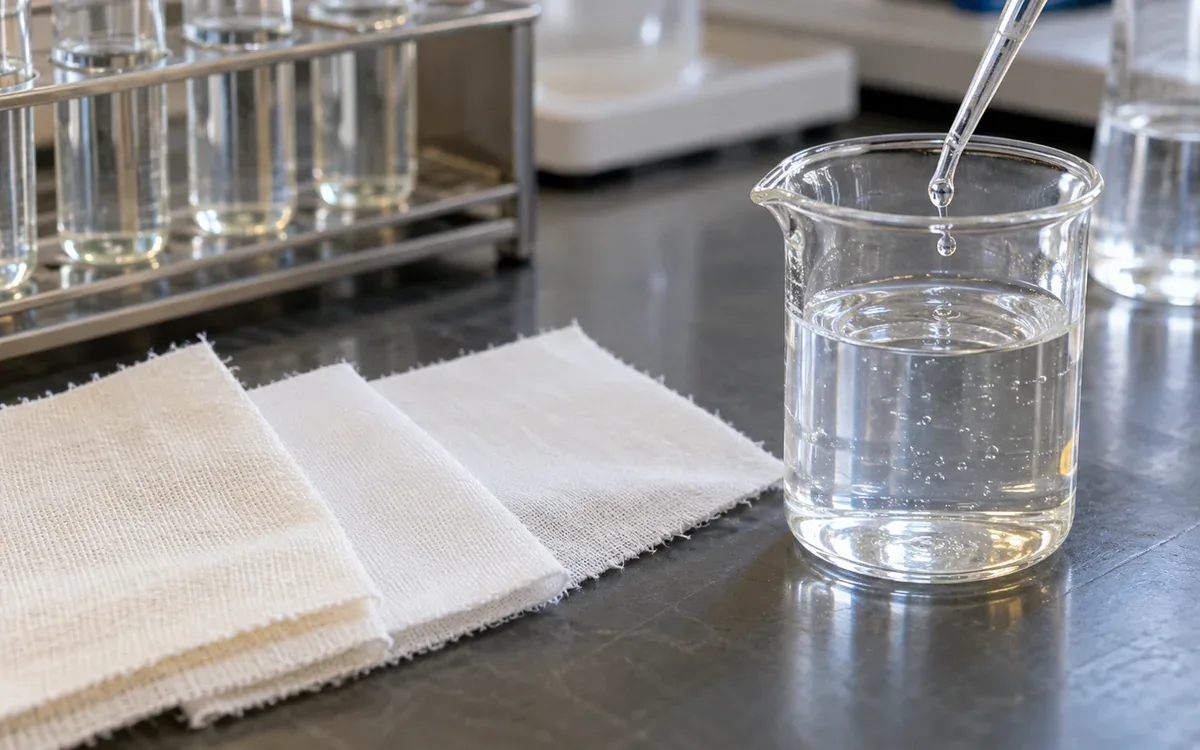
A whiteness report should name the index and instrument conditions. State how the specimens were prepared and backed. Record the number of layers and measurement positions. Note whether fluorescence is present.
Keep these conditions consistent with the method and buyer specification. Berger and CIE whiteness use different scales. Do not treat their values as the same measure.
Sample more than one location when uniformity matters. A roll average can hide a poor edge or section along the length. That area may behave differently in a pale shade.
Check the instrument with the required standards and controls. Keep a stable fabric reference. Use it to check unexpected shifts before changing the process.
For visual approval, use the agreed viewing setup and a physical reference. Instrumental and visual checks should support a defined decision. Neither should be changed after a trial simply to make it pass.
Evaluate low-temperature systems as new processes
Lower-temperature bleaching is an active area of research. It may need an activator and a revised chemical system. Turning down the temperature on an existing bath may not be enough.
Küster and colleagues compared peroxide activators and then examined dyed results in a 2025 experimental study. They found differences between light and darker dyeings. This shows why trials should include the intended downstream shade. A promising lab result does not define a recipe for every mill.
For a proposed commercial system, obtain its technical and safety information. Agree on the full operating range with the supplier. Test it on the intended fabrics.
Include residues, strength, shade, and wash requirements in the comparison. Count the full accepted route when estimating savings. An extra corrective wash or repeated treatment can change the expected benefit.
Use a simple cost boundary
Suppose an approved route costs 180 currency units per 500 kg batch before rework. A trial route costs 165 on the same basis. The apparent saving is 15.
If one in five trial batches needs an additional treatment costing 100, the average added cost is:
100 ÷ 5 = 20 currency units per batch
The trial's average becomes 185 before any delivery or quality cost. It is now 5 higher than the reference.
This hypothetical example does not predict a real failure rate. It shows why trials should measure accepted output. Track how often treatment must be repeated. The first bath's chemical bill gives only part of the cost.
Remove residual peroxide before sensitive downstream work
Bleaching and bleach cleanup have different endpoints. The fabric may reach its bleaching target. The next process still needs a controlled starting state.
Catalase is one option for peroxide cleanup. Novonesis describes the action of its Terminox catalase products: they break hydrogen peroxide into water and oxygen. Choose a product that suits the process. Set suitable operating conditions too.
The reaction can be written:
2 H₂O₂ → 2 H₂O + O₂
Do not assume that adding a cleanup product proves the endpoint. Test according to the agreed release method. Sample the bath and fabric in their handover state. The next operation will receive that state.
ApparelDiary's reactive dyeing control guide explains this handover. It forms part of the wider preparation and dyeing plan.
Report the limit of the test honestly
Suppose the cleanup method can report results down to 0.5 mg/L. Follow the method's reporting rules for a lower result. Record it as “below 0.5 mg/L”. Do not call it absolute zero.
The next process may require proof below 0.2 mg/L. This method cannot detect low enough levels to prove that. Choose and validate a more suitable method.
Keep the concentration basis and sampling location clear. A final rinse and a defined fabric extract are different samples. Do not assume their results mean the same thing.
Investigate faults from evidence
Use the observed pattern to choose the next check. Avoid changing peroxide, alkali, temperature, and time together without a trial plan.
Fault | Evidence to collect | Decision the evidence supports |
|---|---|---|
Low whiteness with acceptable strength | Check input colour and the chemical assay. Review actual exposure and the peroxide profile. | Did the route deliver the intended treatment? |
High whiteness with poor strength | Test matched input samples. Review process severity and map local defects. | Is extra whitening reducing useful fabric performance? |
Uneven white appearance | Map the locations. Review contact and speed records. | Does variation follow fabric handling or input sections? |
Unexpected rapid peroxide loss | Check the assay controls and volume changes. Review contamination and process history. | Does the trend show reaction, dilution, or test error? |
Dyeing changes after acceptable white results | Check the cleanup endpoint and handover records. | Did the next process receive a stable starting state? |
Isolated holes or weak spots | Compare the untreated reference. Record defect positions and equipment history. | Which chemical or mechanical cause needs a check? |
Keep failed trial samples. A supplier or laboratory may help find the cause. Failed samples can then reveal more than a summary number.
Keep handling controls part of the process
Hydrogen peroxide requires compatible, clean storage and transfer systems. Evonik's storage guidance explains the risks from contamination. Peroxide can break down fast and release heat and gas. The guidance also warns against holding peroxide in unsuitable closed equipment.
Use the grade's current safety data and the site's approved operating procedures. Dosing, sampling, maintenance, and emergency response require trained staff and appropriate equipment.
Do not improvise mixing tests on the production floor to investigate quality. Plan a laboratory study. Use the required chemical and equipment safeguards.
Keep this responsibility separate from the arithmetic in a formulation sheet. A mass calculation can be correct while the proposed change is unsafe. Check product changes, storage, and addition methods through the safety system.
Build a release record that connects the whole route
Link the fabric lot to the chemical lots in the final record. Include the measured process history, fabric tests, and cleanup result. It should state the approved route and any deviation.
Use actual results with units and methods. “Bleach okay” is too vague. State whether checks covered whiteness, strength, absorbency, evenness, and residual peroxide.
Preserve a retained sample when the quality plan calls for one. Label it with the process stage. A later dyeing or finishing fault can then be traced to the right material.
Before broad release, test the new route through the intended next operation. A white reading from the lab covers only part of product readiness.
Match the test to the claim
One test may ask whether a dyed textile resists peroxide bleaching. A mill may instead need to control the bleaching of undyed cotton. These are different tasks. A method named in an old article may answer the first question only.
Check method status as well as title. AATCC's 2026 manual change notice records the withdrawal of TM101, Colorfastness to Bleaching with Hydrogen Peroxide, in 2025. Do not list it as a current method on a new control sheet without review.
Specify the actual whiteness, fabric performance, and residue methods needed for the product. A buyer may name an older method. Agree on the edition and acceptance basis with that buyer before testing.
Frequently asked questions
Does all peroxide need to disappear during bleaching?
Not as a universal rule. The bleaching stage must reach its validated fabric endpoint. A separate cleanup stage may then remove the remaining peroxide. Fast disappearance alone does not prove effective bleaching.
Is the whitest trial always the best?
No. The selected route must meet strength and other product requirements as well as appearance. Excess treatment can raise the white reading. It can also reduce useful fabric performance.
Can the same recipe serve every cotton blend?
A blend changes the material constraints. Review the non-cotton fibre and any elastane. Check the fabric structure and previous treatments too. Validate the route for the actual product.
Can a peroxide test strip assay purchased peroxide?
Only if a validated method specifically supports that use, range, and sample preparation. Incoming chemical assay and low-level residue testing are different tasks. Select the method for the measurement.
Does an improved laboratory result prove energy savings?
No. It supports a candidate process. Measure the full production route before claiming a saving. Include washing, cleanup, repeat treatment, and accepted output.
Make the target a usable cotton fabric
Good peroxide bleaching creates the required white base. It should preserve useful fabric strength and use resources well. Control the chemical input and monitor real exposure. Judge the fabric with more than one result.
A clear link from incoming peroxide to final cleanup makes faults easier to investigate. A higher white reading, faster reaction, or lower bath cost may look better on its own. Check each gain against the finished fabric. Use the whole result to improve the process.
References
Cotton Incorporated: Dyeing preparation.
Datacolor: UV calibration and whiteness FAQs.
Evonik: Active oxygens for textile and laundry.
Cefic Peroxygens: Analytical methods and safety publications.
Novonesis: Terminox catalase for bleach cleanup.
Evonik: Hydrogen peroxide storage guidance.
AATCC: Changes in the 2026 Manual, including withdrawal of TM101.
Discussion0
Loading the discussion…