

A late trims order does not automatically justify premium freight. The extra payment is useful only if it changes the chance or consequence of missing the factory's real material deadline. Expediting cost benefit analysis compares incremental recovery cost with the delay exposure that the action can actually reduce. This guide gives a compact expected-cost calculation, a switching threshold and an approval record for deciding whether to expedite, seek another recovery option or retain the original route.
Set the deadline the production plan actually needs
Start with the material-ready date for the operation that consumes the trim. Work back from the approved shipment plan through receiving, incoming inspection, any testing, issue and the relevant production sequence. Arrival at the airport is not material readiness at the sewing line. A promise to deliver tomorrow is incomplete unless the receiving and release activities can also happen in time.
Identify the order, trim specification, required quantity and the first quantity that would unlock meaningful production. All units arriving late and a small balance arriving late can have different consequences. An approved partial delivery may be an alternative to expediting the entire order. A substitute is an alternative only after technical, buyer and commercial approvals have been confirmed; a superficially similar zipper is not interchangeable by decision-sheet arithmetic.
The site's supply-chain KPI dashboard guide explains the value of spotting material delays before shipment week. Use that visibility as the trigger for a specific recovery decision. A red material-status flag identifies a problem; it does not prove that the offered recovery route solves it.
Build an incremental cost comparison
For each feasible action, write the extra cost paid regardless of the outcome, the probability of an economically relevant delay after taking that action and the additional loss if that delay occurs. Multiply probability by the corresponding loss and add the action's fixed incremental cost. Expected cost is a weighted average across possible outcomes, not a guarantee about this order.
MIT's decision-making notes describe probability-weighted consequences under risk. The same arithmetic can compare recovery options, provided the probabilities refer to the action being evaluated. Do not use the original route's delay probability for both standard and expedited shipping: that would remove the very benefit you are trying to measure.
Estimate delay loss from costs that differ between the options. Possible components include unrecoverable contribution, an incremental rebooking fee, additional subcontracting or an evidenced contractual charge. Do not count an entire invoice as lost profit. Do not count the same capacity loss once as idle labour, again as lost output and a third time as lost revenue without checking which costs are incremental and mutually consistent.
The finance partner should separate recoverable delay from irrecoverable loss. If an approved resequence absorbs two days without affecting shipment or paid hours, those two days do not create the same financial loss as a missed dispatch. If the buyer can accept a later delivery with an agreed consequence, include that alternative rather than assuming the worst commercial outcome is certain.
Calculate the decision on a trims order
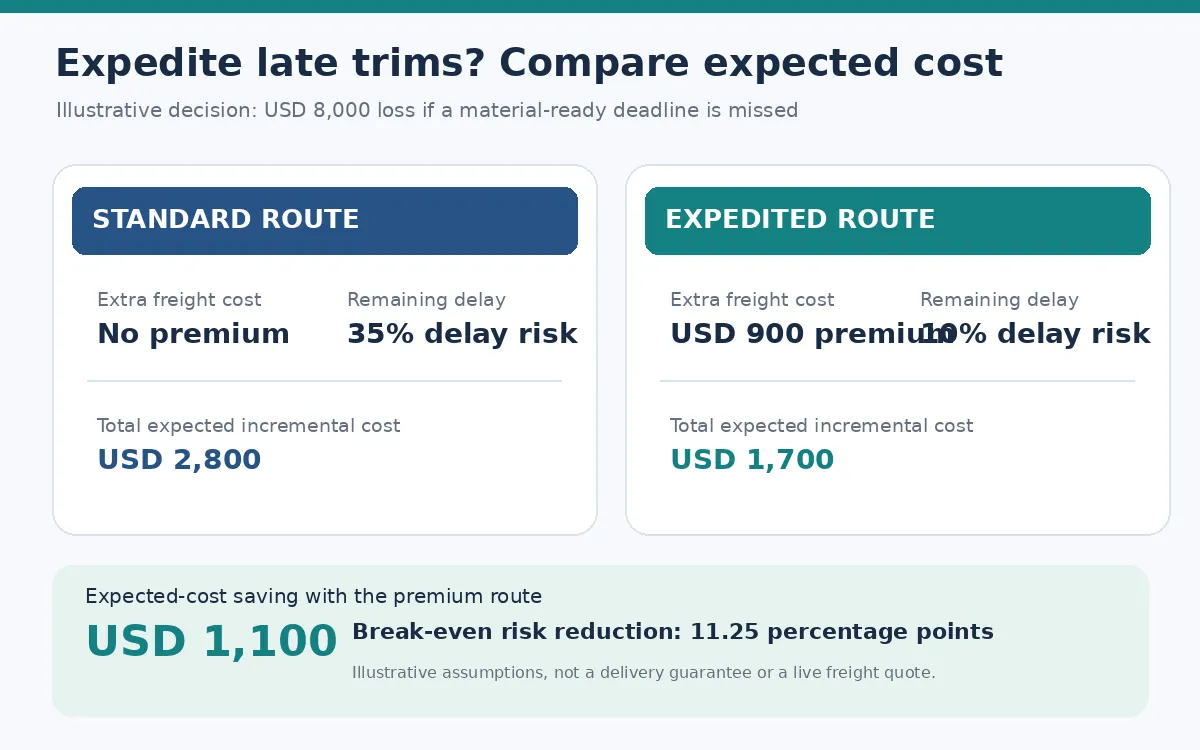
The following numbers are illustrative teaching assumptions, not shipping quotes or factory results. An order's normal route has a 35 percent probability of missing the internal material-ready deadline. A verified premium route is assumed to reduce that probability to 10 percent. The premium is USD 900, and the incremental loss from a relevant delay is USD 8,000 under either route. Base purchase and normal freight costs are common to both options and excluded.
Option | Extra premium USD | Delay probability | Delay loss USD | Expected extra cost USD |
|---|---|---|---|---|
Retain normal route | 0 | 0.35 | 8000 | 2800 |
Take premium route | 900 | 0.10 | 8000 | 1700 |
Normal-route expected cost is 0.35 × 8,000 = USD 2,800. Premium-route expected cost is 900 + 0.10 × 8,000 = USD 1,700. The premium route reduces expected incremental cost by USD 1,100 under the stated assumptions. It still leaves a 10 percent delay probability. The approval should therefore include a fallback, not a statement that premium freight guarantees readiness.
This simple model treats delay as one economically defined outcome. If a one-day delay, a four-day delay and a cancelled order have materially different losses, use separate outcomes with probabilities summing to one for each action. The site's capacity decision-tree guide provides the broader decision-tree context. Keep the short recovery model proportionate to the evidence available.
Find the probability reduction the premium must buy
When both actions have the same delay loss, expediting is favourable on expected cost if its premium is less than the reduction in delay probability multiplied by that loss. The break-even probability reduction is premium divided by delay loss. Use a probability fraction in the calculation, then convert the result to percentage points for the approval note.
Here, 900 ÷ 8,000 = 0.1125, or 11.25 percentage points. The assumed reduction from 35 percent to 10 percent is 25 percentage points, which exceeds the threshold. Given a 35 percent normal-route probability, the expedited route must reduce the probability below 23.75 percent to improve expected cost under these same loss and premium assumptions. Equality is the cost crossover, not a clear reason to pay.
This threshold gives the supplier and logistics team a useful question: what evidence supports a reduction greater than 11.25 percentage points? It is more informative than asking whether they can try their best. It also shows why a lower-loss order may not justify the same premium. If the loss is only USD 3,000, the required reduction rises to 30 percentage points.
Stress-test the uncertain inputs
Do not protect a preferred option by presenting one precise-looking probability. Build a few coherent scenarios reflecting the uncertainty in departure, transit, clearance, receiving and approval. HM Treasury's Green Book discusses sensitivity and switching values as appraisal tools. Those tools are useful here; the public-sector guidance is not a private garment factory's legal or accounting rule.
Scenario | Normal delay probability | Premium delay probability | Delay loss USD | Saving from premium USD |
|---|---|---|---|---|
Base assumptions | 0.35 | 0.10 | 8000 | 1100 |
Normal route more reliable | 0.20 | 0.10 | 8000 | -100 |
Premium route less reliable | 0.35 | 0.25 | 8000 | -100 |
Lower economic consequence | 0.35 | 0.10 | 3000 | -150 |
Each row uses the same USD 900 premium. A negative saving means the premium increases expected cost. The choice reverses in several plausible teaching scenarios, so the apparent USD 1,100 benefit cannot be stronger than the evidence for the probability and loss estimates. If a decision remains close to the crossover, record that uncertainty and escalate within the factory's approved spending authority.
Ask for evidence that can still change the choice
Useful evidence includes confirmed material completion, packing readiness, available transport capacity, the carrier's actual cutoff, required documents and a realistic receiving-and-release plan. Compare the proposed route with similar completed movements where reliable records exist. Keep sample size, route differences and the judgement involved visible. A percentage based on a few unlike consignments is a scenario assumption, not a measured universal probability.
Set a deadline for evidence collection before the transport decision closes. MIT's value-of-test resource frames information value in terms of a better decision. A supplier progress check is useful if its answer could change the action while that action remains feasible. Confirmation received after the flight cutoff may explain the delay but cannot create the original recovery opportunity.
Do not pay an information fee simply because it is smaller than the potential delay loss. Its value depends on what it can reveal, how often that information changes the decision and whether the changed action improves the outcome. When probabilities cannot be supported, compare bounded scenarios and state the judgement required instead of inventing precision.
Keep a short approval and fallback record
The merchandiser or planner prepares the material-ready deadline and feasible options. Logistics verifies route facts and cutoffs. Finance reviews incremental costs and consequences. The authorised decision owner signs the selected action, spending limit and fallback trigger. Purchasing records any supplier commitment without rewriting it as a guarantee.
Record the order trim quantity and operation being protected.
Attach the current standard-route and recovery-route evidence.
State action-specific probabilities and their basis or scenario status.
List common costs excluded and incremental losses included.
Show the crossover and at least one adverse scenario.
Name the fallback owner if the recovery milestone is missed.
After receipt, compare the actual milestones with the assumptions. Keep the original decision sheet so the review does not benefit from hindsight. The next action is to apply the threshold to one live delayed item, replace every assumed input that can be verified before the cutoff and approve only the recovery that addresses the actual readiness risk.



Discussion0
Loading the discussion…