
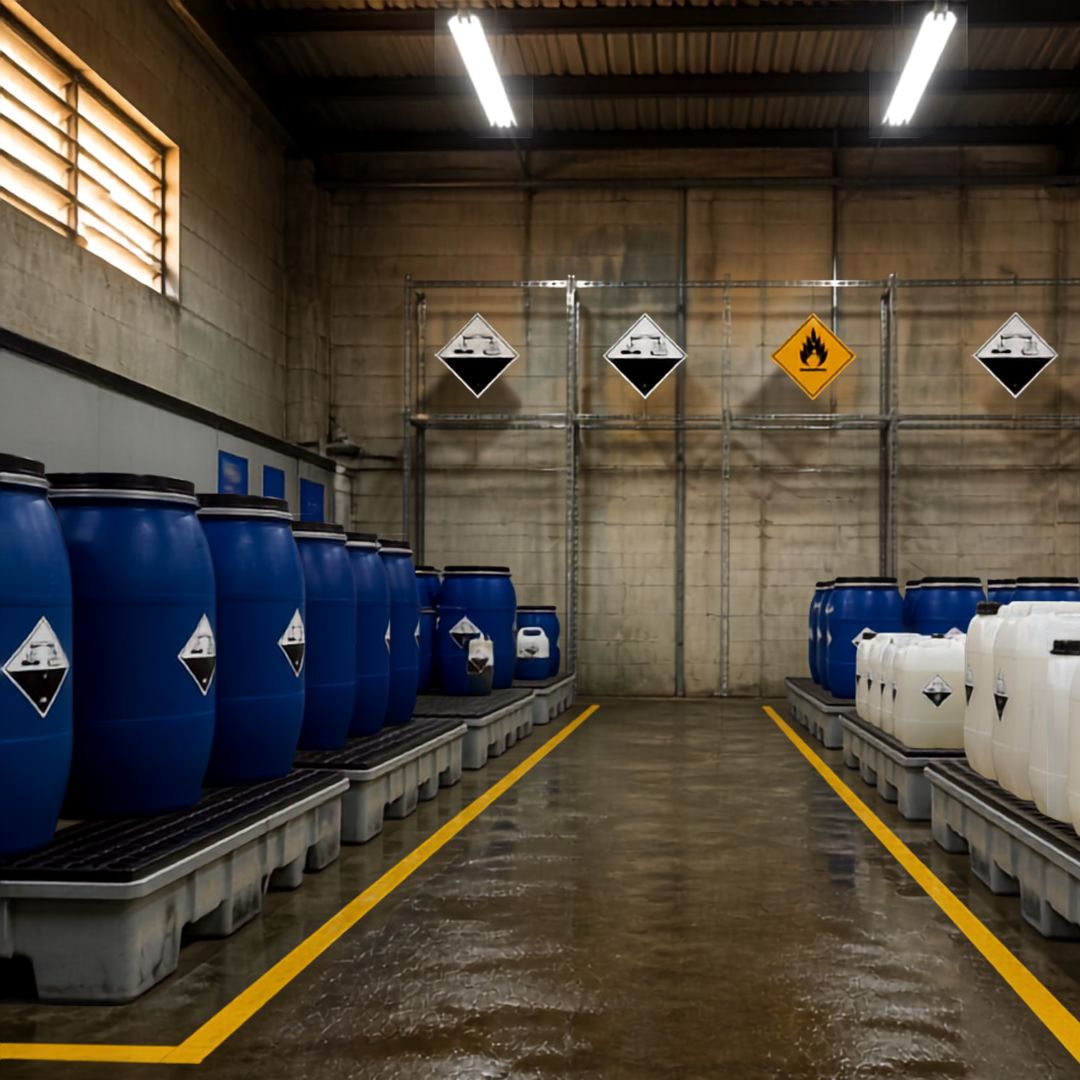
A shift supervisor in the dye store moves a leaking carboy of sodium hypochlorite onto the nearest empty pallet to stop it dripping on the floor. The nearest pallet happens to hold acetic acid drums, staged for the next batch's pH adjustment. Nobody planned this. It is 11pm, the store is short-staffed, and the two chemicals are now eighteen inches apart on the same bund.
This is how most chemical storage incidents actually happen: not from ignorance of the rules, but from a store that was never laid out to make the rules easy to follow under pressure. Chemical storage segregation fails at the point where a tired worker has to make a judgment call the layout should have made for them.
A chlorine gas release from hypochlorite-acid contact can evacuate a floor for hours, trigger a buyer audit non-conformance, and in the worse cases send workers to hospital. Most guides stop at a one-page compatibility chart borrowed from a lab safety manual (acids, bases, oxidisers, done) without naming the actual chemicals sitting in a textile wet-processing store. This article builds the matrix for those chemicals using the same systematic groundwork as a plant-wide hazard identification and risk assessment exercise, gives real segregation distances instead of "keep apart," sizes secondary containment properly, and walks through a hypochlorite-acid leak.
What Generic Charts Leave Out
A dyehouse store does not hold "an acid": it holds sulphuric acid for neutralisation, acetic acid for pH buffering, and sometimes formic acid for auxiliaries, each at different volumes and handling frequency. The chemicals that actually cause incidents in a textile wet-processing unit are a short, specific list: sulphuric acid, acetic acid, caustic soda, sodium hypochlorite, hydrogen peroxide, reactive dyes and auxiliaries used to keep reactive dyeing right the first time, and printing solvents (white spirit and toluene-based binder thinners).
The single most common segregation failure on plant visits is hydrogen peroxide and sodium hypochlorite stored together because both are labelled "bleaching agent" on the drum. They are chemically incompatible with each other and must never share a bund.
The Compatibility Matrix for a Wet-Processing Chemical Store
Use this table to lay out your store, not just to train on. Every "X" below has caused a real documented incident somewhere in the industry.
Chemical | Used For | Do Not Store With | Reason |
|---|---|---|---|
Sulphuric acid | Neutralisation, pH adjustment | Caustic soda, sodium hypochlorite, cyanide-bearing waste | Violent exothermic neutralisation with caustic; releases chlorine gas with hypochlorite |
Acetic acid | pH buffering, dye fixation | Caustic soda, sodium hypochlorite | Same failure modes as sulphuric acid, at lower reaction speed but still toxic fume release |
Caustic soda (NaOH) | Scouring, mercerising | Sulphuric/acetic acid, aluminium or zinc drums | Exothermic acid-base reaction; reacts with amphoteric metals to release hydrogen gas |
Sodium hypochlorite | Bleaching, stripping | Any acid, hydrogen peroxide, reactive dyes | Chlorine gas release with acids; violent oxygen release with peroxide; degrades dye stock nearby |
Hydrogen peroxide | Bleaching | Sodium hypochlorite, reducing agents, solvents, metal drums/fittings | Catalytic decomposition releases oxygen fast, creating fire and pressure-burst risk |
Reactive dyes & auxiliaries | Dyeing, fixation | Strong oxidisers (hypochlorite, peroxide) | Oxidiser contact degrades dye and can trigger exothermic decomposition of dye powder |
Printing solvents | Pigment print paste, binder thinning | Oxidisers, any ignition source | Flammable vapour ignites readily near an oxidiser spill or a spark source |
Read this table by row, not by column: for every chemical you store, ask "what is two shelves away right now" before you ask "what does the SDS say."
Distance or a Barrier, Not a Suggestion
"Store away from incompatibles" on a label is not a spec. A workable segregation rule needs one of four concrete forms: a fire-rated physical barrier between the two chemical zones, sized against the same fire load and compartmentation logic used elsewhere in the factory, not a stud partition; a separate bunded compartment sharing no drainage channel; a separate room entirely, with independent ventilation; or a minimum distance of 3 to 5 metres, with no shared drainage path.
A spill that reaches a shared floor drain or open channel defeats a 5-metre gap in seconds: the two chemicals meet in the drain, not on the floor between them. This is the detail most factory layouts miss: the acid and hypochlorite pallets are 4 metres apart, but both drain into the same effluent channel. Where 3–5 metres of floor space is not available, a rated barrier is the only honest option. A stack of empty drums is not a barrier; a steel bulkhead rated for the fire load of both zones, with its own bunded floor on each side, is.
Field note: At one composite unit I audited, the caustic soda IBC totes sat exactly 4.2 metres from the hypochlorite carboys, technically compliant on distance. But the floor sloped a few degrees toward a single central trench drain serving both zones. A 40-litre spill from either side would have reached the other's footprint before reaching the drain outlet. We re-graded the floor and added a containment lip around each zone; the fix cost less than a day's production downtime, and it should have been caught at commissioning.
Sizing Secondary Containment: The 110% Rule
Every bund must hold at least the greater of two figures: 110% of the volume of the largest single container stored in that bund, or 25% of the total volume of all containers in that bund. Whichever number is larger governs. The 110% figure covers displacement, splash and residual liquid; the 25% rule covers a cluster failure (a forklift clipping a rack, or a rain event flooding an outdoor pad) where no single container is "the largest." Outdoor bunds need additional freeboard on top of both figures, for rainfall accumulation and firewater.
Storage Configuration | Governing Rule | Practical Sizing Note |
|---|---|---|
Single 1,000 L IBC of sulphuric acid | 110% of 1,000 L = 1,100 L | Bund must hold 1,100 L minimum, plus rain allowance if outdoor |
Ten 200 L drums of caustic soda (2,000 L total) | 25% of 2,000 L = 500 L (exceeds 110% of one drum, 220 L) | Use the 500 L figure, since the larger of the two governs |
Mixed IBC + drums on one bund | Calculate both rules per chemical type, combine only compatible chemicals | Never combine acid and hypochlorite bunds regardless of size math |
The Scenario: When Hypochlorite and Acid Share a Bund
A 25-litre sodium hypochlorite carboy sits on a bund shared with acetic acid drums, the exact configuration in the opening scene of this article. The carboy's cap seal fails from age and UV exposure after eight months under a skylight. Hypochlorite drips onto the bund floor, where residual acetic acid already sits from a drum topped up carelessly the previous shift.
Sodium hypochlorite plus acid produces chlorine gas, a yellow-green gas denser than air that pools at floor level before it reaches a person's breathing height. Workers report a sharp, pool-chemical smell and burning eyes within minutes. If ventilation is ceiling-mounted only, the gas has nowhere to go: it accumulates instead of clearing. The realistic cost: a shift halted for hours, a mandatory incident report to the buyer's compliance team, and, if exposure was significant, hospital observation. None of that required an explosion. It required one leaking carboy, one shared bund, and one missed rule.
Segregation Checklist for a Wet-Processing Chemical Store
Check | Target | Why It Matters |
|---|---|---|
Compatibility matrix posted at store entrance | Chemical-specific, not generic acid/base chart | Matches what the responder actually needs to know in seconds |
Segregation method for every incompatible pair | Barrier, separate room, separate bund, or 3-5 m with no shared drain | Distance alone fails if drainage is shared |
Bund sizing | Greater of 110% largest container or 25% total volume, plus freeboard | Undersized bunds are the single most common containment finding on audit |
Ventilation zoning | Floor-level extraction for heavy gases, ceiling for light vapours | Ceiling-only extraction leaves chlorine pooling at breathing height |
GHS labelling | Every container including decanted day-use quantities | Unlabelled decanted containers are the most common labelling failure |
Inventory list currency | Updated weekly, posted at entrance | Emergency responders need current volumes, not last year's count |
Spill kit match | Kit contents matched to the specific chemicals stored, sized for largest container | A generic absorbent kit does not neutralise an acid-hypochlorite reaction |
Final Word
Chemical storage segregation only works if the matrix is built for the chemicals actually on your floor, not copied from a generic lab safety poster. Sulphuric acid, caustic soda, hypochlorite, peroxide, reactive dyes, and printing solvents each have one or two genuinely dangerous neighbours: know those pairs by name, not by category. Get the segregation distance, the bund sizing, and the drainage path right once, at layout stage, and you remove the judgment call from the tired worker at 11pm. The same discipline should extend to the store's front door: see our guide to access control and visitor management for export factories for keeping untrained visitors from wandering into a segregated bund in the first place.


Discussion0
Loading the discussion…