
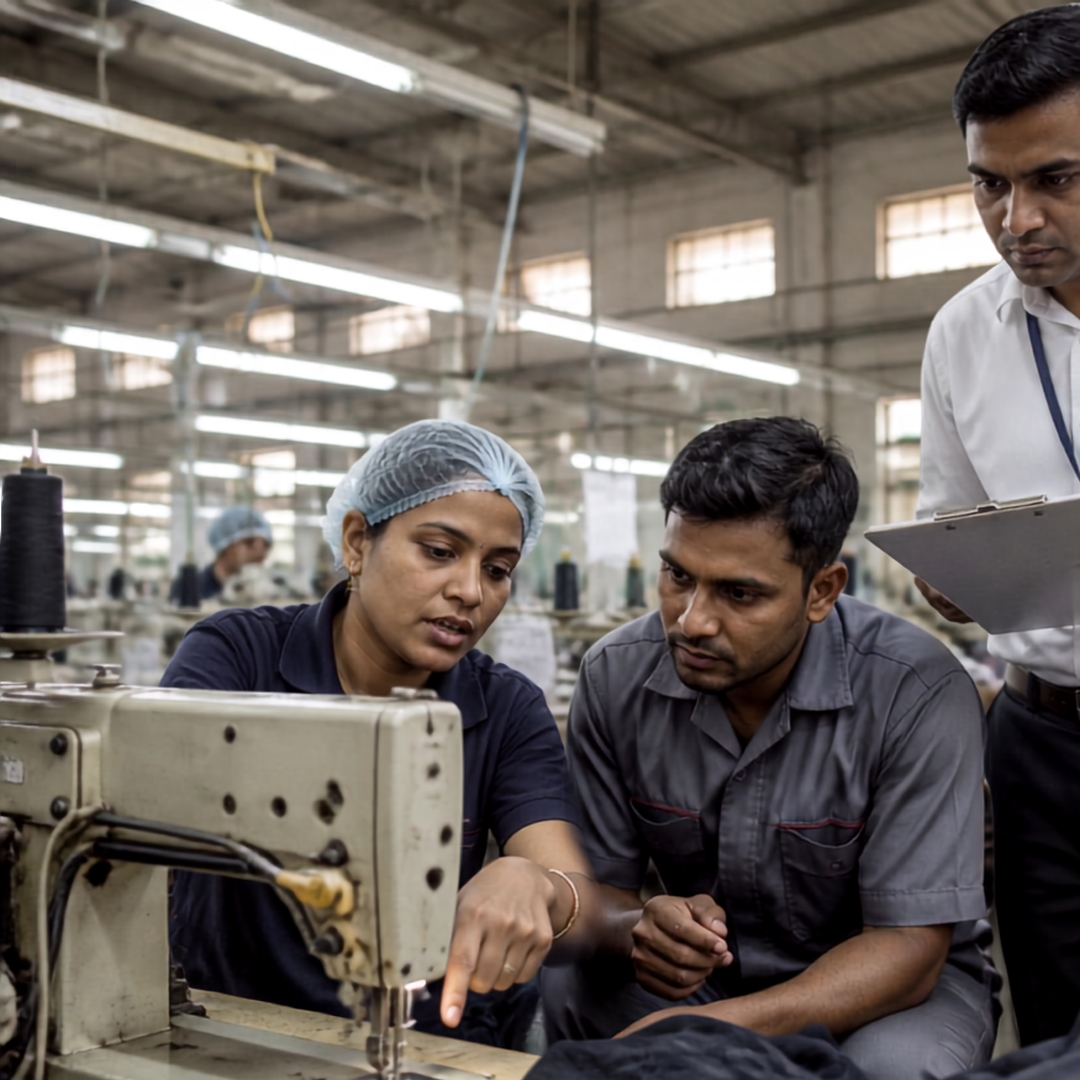
The auditor asks for the hazard identification and risk assessment on the straight knife cutting machine. Someone returns from the compliance office with a lever-arch file written eighteen months ago by a consultant who spent one afternoon on site.
It lists "cutting section" as the activity and "injury from machine" as the hazard. Control: "training and PPE provided". Rating: medium. Signed by a manager who has since left. The auditor stops asking about the file and starts asking about the blade change: who does it, what happens when the machine jams. Nobody answers in the language the document uses, because the document was never used.
That gap costs money. A failed audit delays a shipment and the corrective action plan pulls three managers off the floor for a fortnight. Meanwhile the injuries keep happening where the file never looked: during maintenance, during changeover, in the two minutes spent clearing a jam with the machine live.
This article gives you the whole method: scoring anchors, risk bands with mandated timescales, a filled-in worksheet of real apparel hazards, and the control logic auditors read. Put your own tasks into the tables and you have a working assessment by the end of the week, the same underlying method behind specialised assessments such as fire load calculation and compartmentation for factories.
Why most factory HIRA documents fail their first real test
Three failure modes account for nearly every weak assessment. Scope written at the wrong altitude: "sewing floor" is not an activity, it is a postcode. Undefined scoring, where one assessor writes 3 and another 5 because no definition sits behind the numbers, so priority goes to whoever shouts. Third, the control column: count how many rows in your register end in "PPE and training". More than half means the plant has not done risk assessment; it has done risk documentation.
Field note: At a 2,400-machine unit outside Gazipur we re-ran the HIRA on finishing with two operators in the room. Within forty minutes they described a habit nobody technical knew about: spot-cleaning gun operators holding the fabric with a bare left hand, six to eight inches from a solvent spray at 4 bar, in a store where the drums themselves sat next to an incompatible oxidiser because nobody had run a proper chemical storage segregation and compatibility check. The original assessment scored spot cleaning as low risk with "gloves issued" as the control. Glove usage that shift was two out of eleven, because gloves made the work slower.
Rule 1: Put the operator in the room before you write anything
The team must include an operator who does the task daily, not only the supervisor and the safety officer. In every HIRA workshop I have run, the operator names at least one hazard the technical people had not considered, usually what happens when the machine jams, or what the job looks like when the line is behind target.
A workable team is five: the operator, the line supervisor, a maintenance technician, the safety officer who owns the register, and one manager with budget authority. Without that last person you produce a wish list, not an action plan.
Rule 2: Scope by task, not by section
Assessing "the cutting section" produces vague hazards. Assessing "changing the blade on a straight knife cutting machine" produces specific, controllable ones. Break the site into tasks and sort each as routine, non-routine, or emergency. Non-routine work (maintenance, cleaning, changeover, breakdown recovery) generates a disproportionate share of serious injuries and is most often left out, as does contractor and visitor movement through those same areas, which is why access control and visitor management for export factories deserves its own line in the assessment too.
Rule 3: Identify hazards from a checklist, not from memory
Category | What to look for |
|---|---|
Mechanical | Entanglement, crushing, shearing, cutting, ejection of parts or needles |
Electrical | Shock, arc flash, static discharge, damaged flex under machine tables |
Chemical | Inhalation, skin contact, ingestion, incompatible reaction |
Physical | Noise, vibration, heat stress, poor lighting, radiation |
Ergonomic | Repetitive motion, manual handling, posture, workstation height |
Fire and explosion | Fuel load, ignition source, oxygen, suspended fibre dust |
Psychosocial | Excessive hours, harassment, unclear responsibility, target pressure |
Rule 4: Score with a matrix that has written anchors
A five by five matrix is standard. What makes it defensible is a written definition for every level, so two assessors reach similar numbers.
Score | Severity | Likelihood |
|---|---|---|
1 | Negligible: first aid only, no lost time | Rare: not known to have occurred in the industry |
2 | Minor: off-site treatment, back within the shift | Unlikely: occurred elsewhere in the industry |
3 | Moderate: lost time injury, full recovery | Possible: occurred at this site or a sister site |
4 | Major: permanent impairment or amputation | Likely: several times a year at this site |
5 | Catastrophic: fatality, or multiple serious injuries | Almost certain: monthly or more often |
Risk score = severity x likelihood, and the band is a contract about response time, not a label.
Score | Band | Mandated action | Timescale |
|---|---|---|---|
1–4 | Low | Monitor, no new control required | Review at next cycle |
5–9 | Medium | Control plan with a named owner | Within 90 days |
10–15 | High | Interim measure immediately, permanent control after | 30 days |
16–25 | Extreme | Stop the activity until controlled | Immediate |
A matrix with an extreme band that has never once stopped a job is decorative, and auditors notice.
Rule 5: Work down the hierarchy of controls in order
This is where most assessments quietly collapse. Take the five levels in sequence and document why each higher one was rejected before dropping to the next.
Elimination: remove the hazard; redesign so the task is unnecessary. A dosing pump means nobody decants caustic by hand.
Substitution: water-based adhesive instead of solvent-based.
Engineering: guard, interlock, enclose, ventilate, isolate. Works without depending on behaviour.
Administrative: procedure, permit, training, signage, rotation. Depends entirely on behaviour, so it ranks low.
PPE: last line, protects one person, fails silently when worn wrong.
A control plan made mainly of training and PPE is a plan that has not tried. Both ISO 45001:2018 clause 6.1.2 and the ILO guidelines require the hierarchy in order, not sampled from. Count your rows: engineering controls in fewer than a third is your finding before the auditor makes it.
Rule 6: Re-score for residual risk and set review triggers
Re-score after controls. Two numbers on every row: initial and residual. If residual risk is still medium or above, the control is insufficient and needs escalation, not acceptance. Engineering controls cut likelihood, not severity: a forklift still kills a pedestrian at 4 km/h, the barrier only makes contact less likely. Only elimination and substitution reduce severity.
Set review triggers explicitly: any incident or near miss on that task, any change of machine, guard or material, any change of process, layout or shift pattern, and a scheduled annual review as a backstop only. The annual backstop is the weakest trigger and the one most registers rely on exclusively, instead of drawing on the equipment-condition signals a proper preventive vs predictive maintenance programme is already generating.
What a filled-in HIRA worksheet looks like
Task | Hazard | Initial | Controls applied (hierarchy level) | Residual |
|---|---|---|---|---|
High-speed lockstitch sewing | Needle penetration to finger | 12 High | Finger guard (Eng); jam clearing after motor stop (Admin); no gloves at needle zone (Admin) | 4 Low |
Decanting caustic soda at washing | Chemical splash to eyes/skin | 12 High | Metered dosing pump (Elim); closed transfer line (Eng); eyewash within 10 seconds (Eng); face shield (PPE) | 4 Low |
Forklift movement in fabric store | Pedestrian struck by truck | 15 High | Barriered walkway, one-way routing, 4 km/h limiter (all Eng) | 5 Medium |
Retrieving trims from 4.5 m rack | Fall from height, falling stock | 16 Extreme | Order-picker truck above 2 m (Eng); ladder use above 2 m prohibited (Admin) | 4 Low |
Row 3 is the honest one. Severity stays at 5 because a struck pedestrian is still a fatality risk, so the residual sits at medium and stays on the escalation list until the aisle is re-laid, the method applied rather than the score managed downward.
Before you sign it: the HIRA quality checklist
Every row is a task, not a section or a machine name
Non-routine and emergency tasks are at least 30% of rows
An operator who does the task signed the assessment
Severity and likelihood definitions are printed on the document
Engineering controls appear in a third of rows or more
Where PPE is the top control, the rejection of higher levels is written down
Every row has both an initial and a residual score
No residual medium-or-above row is left without a dated next action
Every action has a named person, not a department
The extreme band has stopped at least one job in the last 12 months
Final Word
The value of a hazard identification and risk assessment is not the file. It is the argument the team has while filling it in: the moment a technician says the interlock has been bypassed since March and the operator says everyone knew.
A HIRA makes that conversation compulsory. Define the anchors, put the operator in the room, work down the hierarchy in order, re-score honestly, and the document becomes the thing you consult on Monday rather than the thing you hand the auditor. If your register has never stopped a job, it has never been used.

Discussion0
Loading the discussion…