
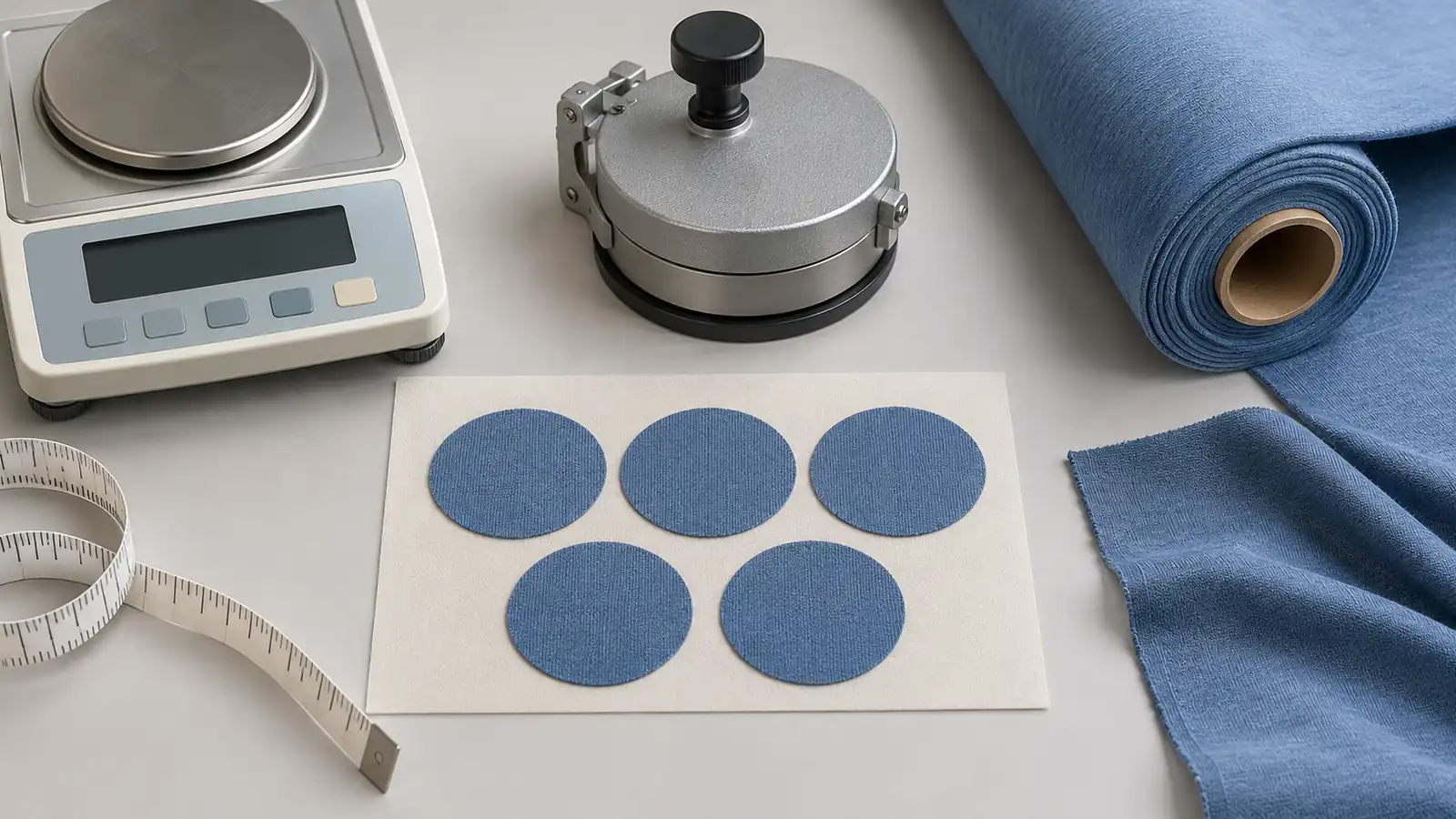
An incoming fabric roll can have a correct GSM result and still fail the weight check on the receiving sheet. Before opening a supplier claim, check whether the two records describe the same fabric area, moisture condition and net mass. Fabric GSM testing measures mass per unit area; it does not establish roll length, usable width or uniformity by itself. This guide shows how to calculate the result, build a traceable sampling record and investigate a roll reconciliation without confusing measurement error with a material problem.
Start with the measurement basis
GSM means grams per square metre. A 180 GSM fabric has a mass of 180 grams for one square metre under the stated test conditions. GSM is different from grams per running metre: the latter includes width. It is also different from a yarn count, which describes yarn fineness rather than the mass of a finished fabric area. Use the site's yarn count conversion guide when checking the yarn specification; do not use a converted yarn count as a substitute for weighing the fabric.
Record the construction, finish state, supplier lot, roll number and test method before taking a specimen. Greige, dyed, compacted and washed fabric can produce different mass-per-area results because their mass and dimensions have changed. A purchase specification should identify the state being accepted. A result from a relaxed sample cannot automatically resolve a dispute over fabric measured under spreading tension.
The public ASTM D3776/D3776M-20(2025) scope distinguishes full pieces, full-width samples, small swatches and narrow fabrics. The public ISO 3801 scope applies to woven fabrics. Use the agreed method for the material and buyer requirement. The workflow here is an internal measurement aid, not a replacement for the licensed procedure or an accredited laboratory report.
Convert the specimen area before multiplying
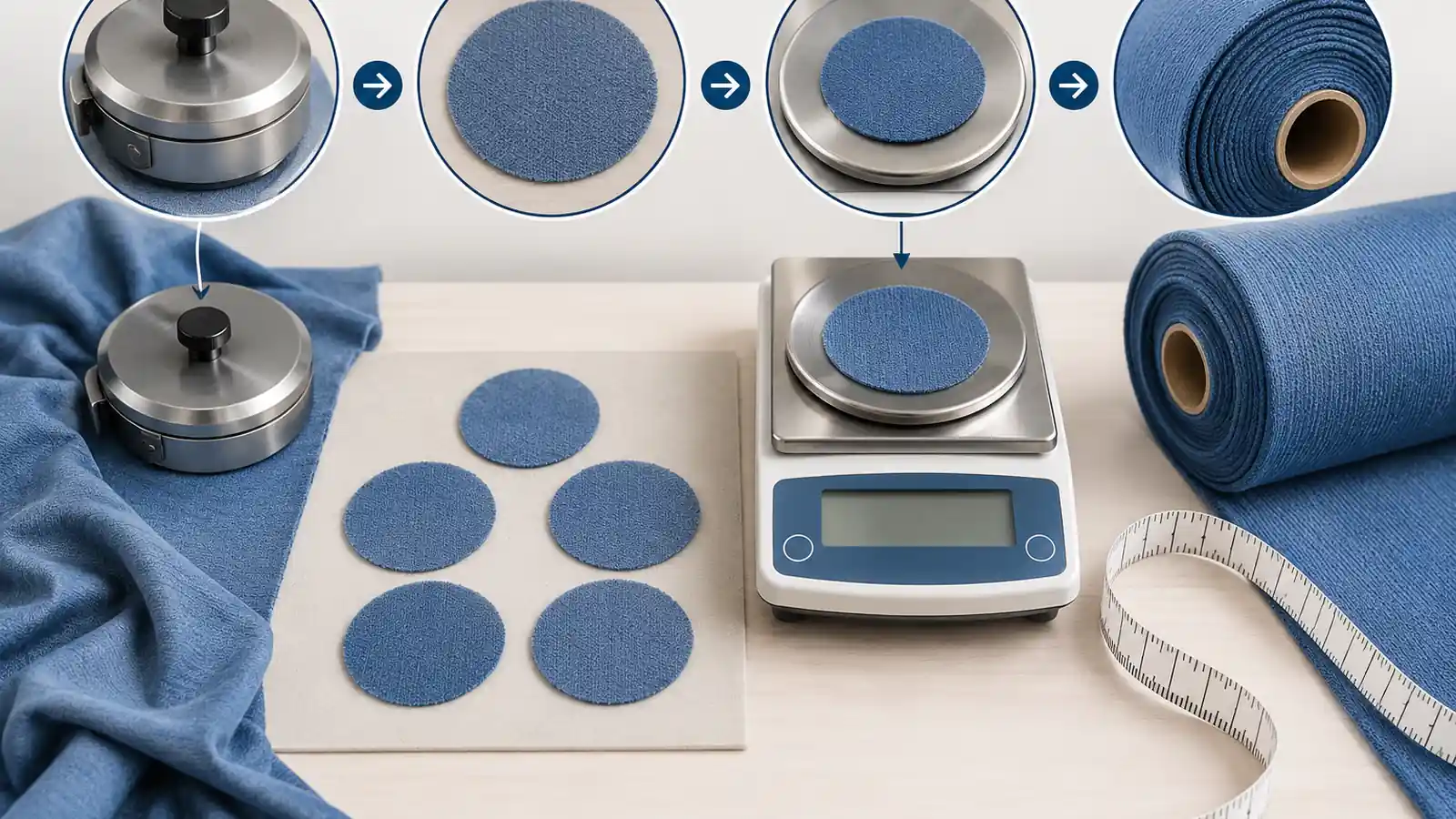
The arithmetic is simple once the units are written down. Divide specimen mass in grams by specimen area in square metres. If the area is recorded in square centimetres, multiply the mass by 10,000 and divide by the area. One square metre contains 10,000 square centimetres; this conversion is an area conversion, not a length conversion.
For a cutter that actually produces 100 square centimetres, a 1.80 gram specimen gives 180 GSM. Multiplying by 100 works because the area is 0.01 square metre. A different cutter area needs a different multiplier. Confirm the area from the equipment specification and verification record rather than assuming every circular cutter is the same size. Use the fabric GSM calculator only after checking its selected sample area against your own equipment.
The following five specimens are an illustrative teaching dataset, all cut to 100 square centimetres. They show the calculation and a compact record; they do not prescribe the number or location of specimens required by a standard or buyer.
Specimen | Mass g | Area cm2 | Calculated GSM |
|---|---|---|---|
A | 1.78 | 100 | 178 |
B | 1.82 | 100 | 182 |
C | 1.80 | 100 | 180 |
D | 1.79 | 100 | 179 |
E | 1.81 | 100 | 181 |
Mean | 1.80 | 100 each | 180 |
The individual range is 178 to 182 GSM. Retain those values beside the mean. An average of 180 can also come from two extremes that would matter to cutting, hand feel or a buyer's tolerance. Report the agreed precision, and keep unrounded measurements in the laboratory record. Rounding each reading early can conceal a small but systematic difference between instruments.
Make the sample representative of the question
A single cut from an easily reached roll end answers a narrow question: what was the mass per area at that location? It does not demonstrate that the whole delivery has that GSM. Decide whether you are investigating variation across width, along one roll, between rolls or between finishing lots. The sampling locations must be able to reveal the variation that concerns the receiving team.
For an internal investigation, an engineer might choose locations across the width and at agreed positions along selected rolls, keeping each location separately identified. That is a proposed investigation plan, not a universal acceptance plan. Do not silently omit a visibly unusual area: record why it was included or excluded under the agreed method. Similarly, do not include a selvedge in one specimen and exclude it from another without naming the difference.
Keep the balance on a suitable stable surface, check its status and zero, and use the laboratory's approved handling procedure. A displayed resolution of 0.01 gram is not proof of measurement accuracy. On a 100 square centimetre specimen, a 0.01 gram difference changes the calculation by 1 GSM. Damaged cutting edges, incomplete cuts, stretched fabric and loose lint can therefore matter even when the conversion formula is correct.
Moisture and conditioning belong in the record. ISO 139 addresses atmospheres for textile conditioning and testing. Follow the applicable agreed procedure and amendments; record what was actually done rather than writing a conditioning statement from memory. If goods were tested immediately after transport and later after conditioning, treat those as two identified states rather than two interchangeable laboratory results.
Reconcile roll length width and net weight
For a reasonably uniform roll, expected fabric mass in kilograms equals length in metres multiplied by width in metres multiplied by GSM, divided by 1,000. This is an area-to-mass reconciliation. It assumes the length, width and GSM describe the same fabric state and area basis. It is not a reliable estimator when substantial local variation, attached packaging or an uncertain length record dominates the comparison.
Consider an illustrative roll recorded as 100 metres long, 1.50 metres gross width and 180 GSM. Expected gross fabric mass is 100 × 1.50 × 180 ÷ 1,000 = 27.00 kilograms. If usable cutting width is only 1.46 metres, the usable-area equivalent is 26.28 kilograms. The 0.72 kilogram difference represents excluded width in this simplified example; it is not automatically missing fabric.
Now suppose the scale shows 28.10 kilograms including a 1.10 kilogram tube and wrapping. Net fabric mass is 27.00 kilograms, which agrees with the gross-area calculation. Comparing the gross scale reading with usable-area mass would have produced a false discrepancy of 1.82 kilograms. The store controller should record tare separately and keep the usable-width value available for the cutting plan, where it belongs.
Use the site's fabric length to weight converter as a second arithmetic check once you have confirmed the width convention. Check the tool's displayed formula and units. A converter can expose a centimetre-versus-metre entry mistake; it cannot prove the roll's measured length or tell whether the packaging tare was correct.
Investigate a discrepancy in a useful order
Start with identity and units, then examine the physical measurements. Recheck the roll number, length unit, width unit and finish state. Confirm that the net weight excludes the tube and wrapping actually present. A calculation using a width of 150 instead of 1.50 is not a supplier quality issue. Neither is a receiving sheet that uses yards while its formula expects metres.
Next test whether the specimen describes the roll. If repeat readings from the same specimen disagree, address the weighing system or handling before collecting more material. If the instrument repeats but locations differ, investigate fabric variation and sampling. If GSM is consistent but weight still disagrees, verify width and length using the approved equipment and procedure. Keep the original receiving entries; a corrected value needs an explanation and traceable replacement.
Record field | What the owner should enter | Decision it supports |
|---|---|---|
Material identity | Lot roll construction finish | Confirms the correct delivery |
Specimen basis | Area location method condition | Makes readings comparable |
Individual results | Mass GSM and unrounded values | Shows spread behind the mean |
Roll reconciliation | Length gross width net mass tare | Tests the measured area basis |
Acceptance reference | Buyer tolerance and method revision | Separates inspection from judgement |
Disposition | Hold release retest or supplier query | Gives the store a controlled next step |
Do not invent a tolerance from what usually arrives. If the contract says 180 GSM with an illustrative tolerance of plus or minus 5 percent, the corresponding limits are 171 and 189 GSM. That example does not establish a general industry allowance, and a few specimens inside those limits do not prove that every part of the shipment conforms. The acceptance decision still depends on the agreed sampling and test procedure.
Close the measurement loop
Give receiving, laboratory and cutting teams one shared record with two clearly named width values where needed: gross fabric width for the roll reconciliation and usable width for consumption planning. Keep measured GSM attached to the test state, not copied as a permanent property of the style. When a discrepancy remains, send the supplier the specimen locations, individual measurements and reconciliation basis so the next test answers the same question.
The next practical step is to choose one incoming roll and reconcile its recorded area, tare and conditioned specimen results before changing the acceptance sheet. A correct formula is useful; a record that explains what was measured is what makes the result defensible.


Discussion0
Loading the discussion…