
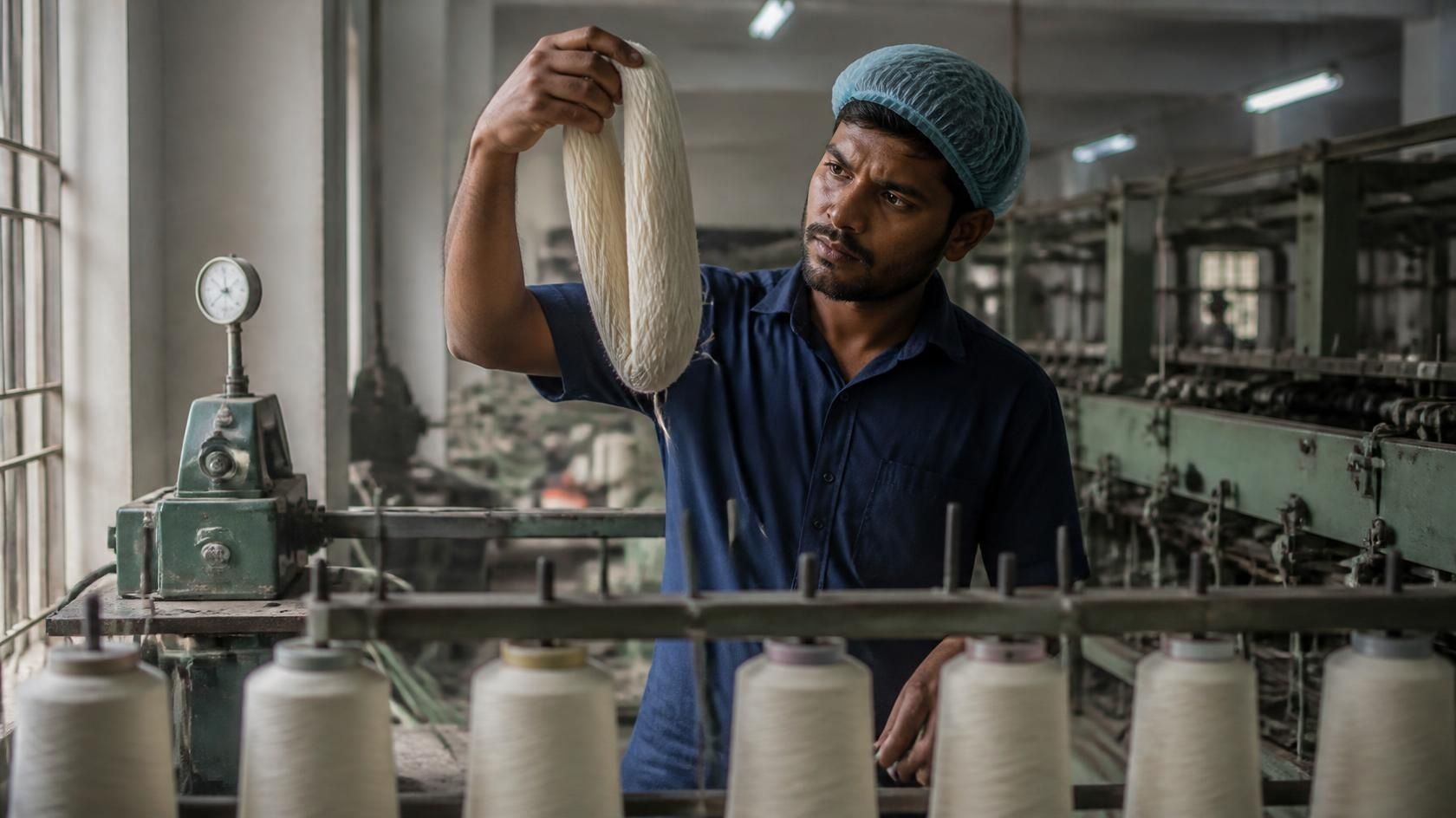
A buyer's tech pack lands asking for 150 denier warp. Your mill quotes in Ne. Your knitting merchandiser thinks in Nm because he trained on a European machine, and the polyester supplier works in dtex. Four people, one fabric, four numbers that describe the same thing and none of which match.
So somebody does a fast yarn count conversion in their head, gets the direction wrong, and orders yarn that is twice as coarse as the sample.
That mistake is not academic. A 20-tonne order at the wrong count is a six-figure problem: dyed yarn is non-returnable (the same reason getting reactive dyeing right the first time matters so much), the fabric fails GSM, and shipment slips three weeks while the mill re-spins. I have watched a shirting programme lose a season because a spec said "40/2" and the mill read it as 40 Ne resultant while the buyer meant two 40s plied.
The confusion is structural, not careless. Two of these systems count length per unit weight and three count weight per unit length, so the numbers run in opposite directions and there is no intuition that survives the switch.
Why does yarn count conversion go wrong so often?
Because half the systems are built backwards from the other half, and nothing in the notation warns you.
Indirect systems measure length per unit mass. You fix the weight and ask how much length you got. More length from the same weight means a finer yarn, so in an indirect system, a bigger number means a finer yarn. Ne and Nm are indirect.
Direct systems measure mass per unit length. You fix the length and ask what it weighs. More weight over the same length means a coarser yarn, so a bigger number means a coarser yarn. Tex, dtex and denier are direct.
The hook I teach every new merchandiser: indirect counts are hanks per pound, direct counts are grams per kilometre. Every yarn count conversion between the two families is a division, never a multiplication. If you find yourself multiplying to get from Ne to Tex, you have already made the error.
The five systems, defined precisely
System | Full name | Definition | Direction |
|---|---|---|---|
Ne | English cotton count | Number of 840-yard hanks per pound | Indirect (higher = finer) |
Nm | Metric count | Number of kilometres per kilogram | Indirect (higher = finer) |
Tex | Tex | Grams per 1,000 metres | Direct (higher = coarser) |
dtex | Decitex | Grams per 10,000 metres | Direct (higher = coarser) |
Den | Denier | Grams per 9,000 metres | Direct (higher = coarser) |
Tex is the internationally standardised system. In practice cotton spinning across Bangladesh, India and Pakistan runs on Ne and will keep doing so, so you convert rather than campaign.
What is the complete yarn count conversion formula table?
This is the table to bookmark. Read the row as "from", the column as "to".
From ↓ / To → | Ne | Nm | Tex |
|---|---|---|---|
Ne | N/A | Nm = Ne × 1.6934 | Tex = 590.5 ÷ Ne |
Nm | Ne = Nm ÷ 1.6934 | N/A | Tex = 1000 ÷ Nm |
Tex | Ne = 590.5 ÷ Tex | Nm = 1000 ÷ Tex | N/A |
dtex | Ne = 5905 ÷ dtex | Nm = 10000 ÷ dtex | Tex = dtex ÷ 10 |
Denier | Ne = 5314.9 ÷ Den | Nm = 9000 ÷ Den | Tex = Den ÷ 9 |
Four constants carry the whole table. 590.5 links Ne and Tex. 1.6934 links Ne and Nm. Multiply Tex by 9 for denier and by 10 for dtex. Everything else is a rearrangement of those.
Ready-reckoner for common cotton counts
Ne | Nm | Tex | dtex | Denier |
|---|---|---|---|---|
10 | 16.9 | 59.1 | 591 | 531 |
20 | 33.9 | 29.5 | 295 | 266 |
30 | 50.8 | 19.7 | 197 | 177 |
40 | 67.7 | 14.8 | 148 | 133 |
60 | 101.6 | 9.8 | 98 | 89 |
100 | 169.3 | 5.9 | 59 | 53 |
Three worked yarn count conversions you can check by hand
Example 1: 30 Ne combed cotton into every other system. This is the workhorse knit count, so learn this row.
Tex = 590.5 / 30  = 19.7 tex
Denier = 19.7 x 9 = 177 den
dtex   = 19.7 x 10 = 197 dtex
Nm     = 30 x 1.6934 = 50.8 Nm
Example 2: a buyer specifies 150 denier polyester filament and your weaver works in Ne. Ne = 5314.9 ÷ 150 = 35.4 Ne equivalent. It is an equivalent, not a cotton count, since filament has no hank, but it tells him the yarn sits between a 30s and a 40s cotton in fineness.
Example 3: a European wool supplier quotes Nm 48 and your costing sheet is in tex. Tex = 1000 ÷ 48 = 20.8 tex, almost identical in fineness to the 30 Ne cotton above.
Field note: a knitting unit in Gazipur ran a 180 gsm single jersey on 30 Ne for four seasons. A new merchandiser accepted a yarn offer written as "Nm 30" from a Turkish trader, assuming it was the same 30. Nm 30 is 33.3 tex, roughly a 17.7 Ne, nearly twice as coarse. The 4.2 tonnes that arrived knitted at 246 gsm on the same stitch length. The fabric was sold as heavyweight to a second buyer at a 22% loss against the original costing, and the machine gauge was wrong for it anyway. One missing letter, four hundred thousand taka.
What does 30/1, 30/2 and 2/30 actually mean?
This is where most commercial disputes start, and almost nobody writes it down clearly.
In the English system the ply count is written before the slash when the numbers describe singles. So 2/30s means two 30 Ne singles twisted together: two strands of the same weight over the same length, so the resultant count is 30 ÷ 2 = 15 Ne. The folded yarn is coarser than the singles, not finer.
30/2 in South Asian mill shorthand usually means the same thing (two ends of 30s), but read in the opposite order. Other spec writers use 30/2 to mean "resultant 30, made of two 60s." Both readings exist in live tech packs. 30/1 or 30s means a single yarn of 30 Ne, unplied: the only safe shorthand.
Notation | Most common reading | Resultant count |
|---|---|---|
30/1, 30s | Single yarn, 30 Ne | 30 Ne |
2/30s | Two singles of 30 Ne | ≈ 15 Ne |
30/2 (resultant convention) | Resultant 30 Ne from two 60s | 30 Ne |
40/2 | Ambiguous without confirmation | 20 Ne or 40 Ne |
Direct systems avoid the ambiguity entirely, which is their best argument. Two 20 tex singles plied together give roughly 40 tex, because mass per unit length simply adds: you write it as "20 tex × 2" and nobody can misread it. Add 2–5% for twist contraction, since plying shortens the yarn slightly.
The working rule: never accept a folded count without confirming whether the number quoted is the singles count or the resultant count, in writing, in the same email as the price. If a supplier will not answer that question in one line, they are not sure either.
What yarn count should this fabric be?
End use | Typical count (Ne) | Notes |
|---|---|---|
Denim warp (14–14.5 oz) | 6–10 Ne | Rope-dyed ring or OE, slub variants |
Basic single jersey tee | 24–34 Ne | 30 Ne combed is the global default |
Fine jersey, premium tee | 40–50 Ne | Combed compact, low neps essential |
Poplin shirting | 40–60 Ne | Often 2/60s or 2/80s in the warp |
Sewing thread (corespun) | 30–120 den | Quoted in tex or ticket, never Ne |
A 30 Ne combed cotton is the single most useful anchor in the industry. If you can convert it in every direction without a calculator, you can sanity-check almost any yarn offer you will ever receive.
Where does the count decision actually cost money?
Count is not only a fineness number. It sets yarn price, fabric hand, weaving efficiency and the GSM you have to hit, which in turn feeds straight into cutting room efficiency and marker planning once the fabric reaches the cutting floor.
Change | Fabric effect | Cost effect |
|---|---|---|
Finer count | Softer, better drape, lower tear strength | Higher yarn price, more ends to handle |
Coarser count | Bulkier, stronger, coarser hand | Cheaper yarn, higher GSM per garment |
Combed vs carded | Fewer neps, cleaner surface, better lustre | 15–25% yarn cost premium, around 15% noil loss |
For wovens, count works through cover factor together with thread density. Plain woven shirtings target a cover factor of roughly 20–24 for a crisp hand; above 28 the fabric goes stiff and weaving efficiency falls away.
For knits, stitch length is the GSM control, and it is more sensitive than people expect: a 5% change in stitch length shifts GSM by roughly 10%. That is why a count substitution and a stitch length adjustment must be decided together, ideally with input from whoever manages the RMG cutting process stage by stage, since GSM swings change fabric consumption at the marker table.
The spec-sheet check before you commit
Run this before any yarn order, any counter-sample approval and any costing that leaves your building. It takes ninety seconds and it has saved more money than any other checklist I use.
System named explicitly: "Ne", "Nm", "tex", "den", never a bare number
Singles or resultant stated in words, not inferred from a slash
Ply confirmed: "two ends of 30 Ne" beats "30/2" every time
Tolerance stated: count CV%, tracked the way a statistical process control chart would track any other process variable, and the test method behind it
Test method named: wrap-reel skein method, conditioned sample, standard atmosphere
Combed or carded named, with the cost premium already in the costing
Yarn count conversion double-checked: converted both ways and back, confirming the round trip returns the original number
Filament equivalents flagged: Ne shown as "equivalent" for filament, not as a cotton count
The round-trip check is the whole discipline in one line. Convert forward, convert back, and confirm you land on the number you started with. Every yarn count conversion error I have seen would have been caught by that round trip.
Final Word
Yarn count conversion is arithmetic, and arithmetic is never what costs you the money. What costs you the money is a spec sheet that assumes everybody in the chain reads a number the same way.
Pick one system for your internal documents (tex if you have the freedom, Ne if your spinners force it) and convert at the boundary, deliberately, in writing, with the system named every single time. Ban bare numbers from your tech packs. "30s" is not a specification; "Ne 30 single, combed, ±1.5% CV" is.
The mills that get this right are not better at maths. They are just more stubborn about writing the units down.


Discussion0
Loading the discussion…