
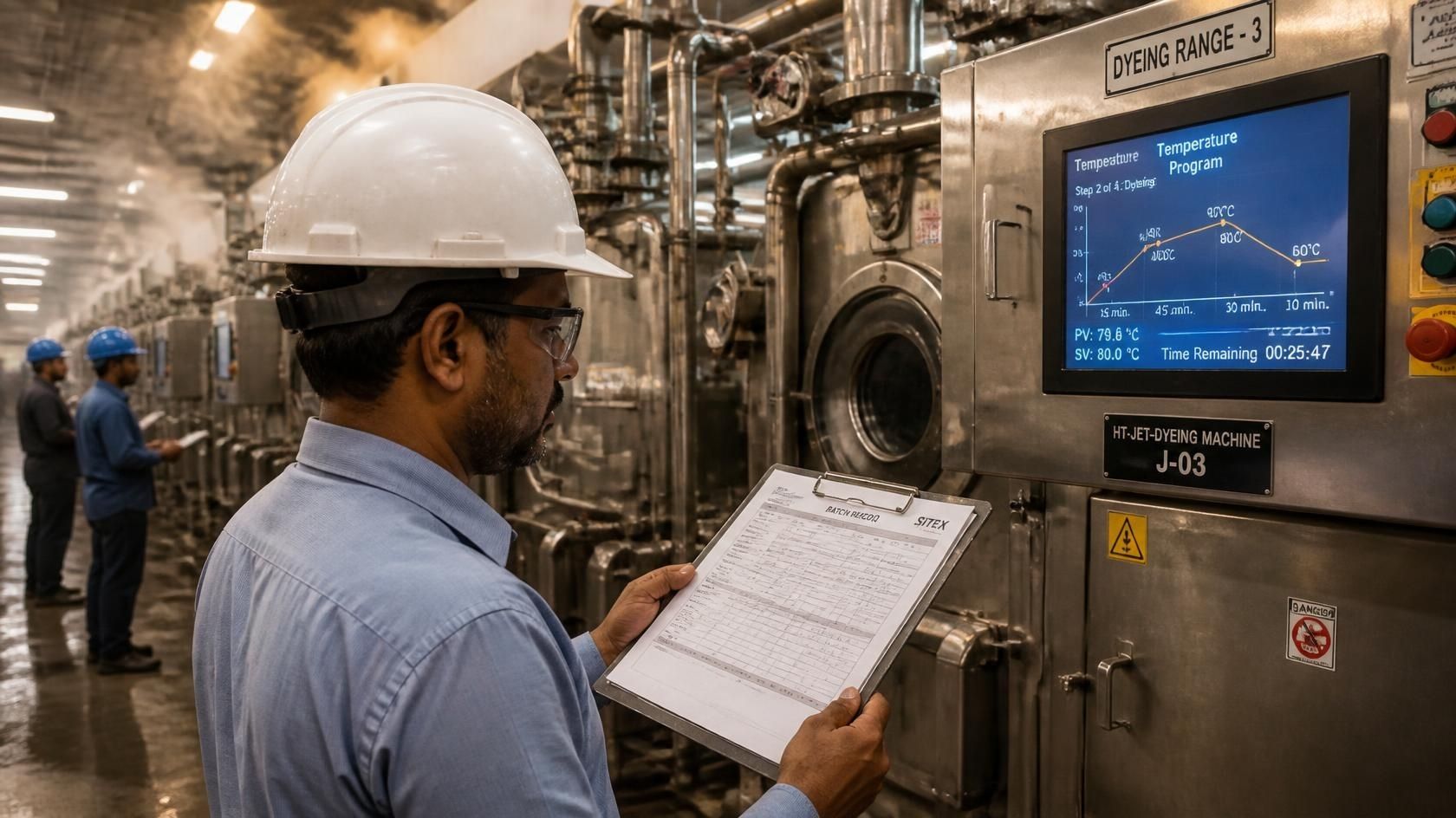
The meeting always goes the same way. Merchandising wants to know why the shipment slipped. QA has a swatch a shade darker than the approved lab dip. Production points at the dye supplier. The dye supplier points back at the machine. Nobody can say, with a number, what actually went wrong, because nobody wrote it down at the point it happened.
This is what low right-first-time reactive dyeing looks like from the inside. It isn't one dramatic failure. It's a dyehouse running at 68-74% RFT for months, treating every redye as a one-off, never adding up what that's actually costing.
RFT is the single most important number in a dyehouse, more important than machine utilisation, more important than average dyeing time. Every point below 90% is a specific, calculable tax on water, steam, chemicals, tank time and delivery dates. The uncomfortable finding, repeated across most floors: most shade failures trace back to pretreatment, not to the dyeing recipe itself. Fix absorbency and peroxide control before touching the recipe.
What Is RFT and Why Does One Point of It Matter So Much?
RFT is the percentage of dye lots in right-first-time reactive dyeing that pass shade and fastness approval without any addition, shading correction or full redye. It is measured against the approved lab dip or a physical standard, not against "close enough."
A batch that needed a shading addition to pass is not an RFT pass. Counting additions as RFT successes is the single most common way factories lie to themselves about their own performance. If you strip additions out and your RFT number drops from a comfortable 88% to an uncomfortable 71%, that drop is the real number: the 88% was never true.
Metric | Target |
|---|---|
True RFT (no additions, no reprocess) | above 90% |
Addition rate (shading correction, no full redye) | under 7% |
Full reprocess rate | under 2% |
Colour difference (ΔE) against standard, critical shades | under 0.8 |
Tracking that number lot by lot on a control chart, the way our practical guide to statistical process control describes, is what turns "RFT dipped this week" into a specific, traceable cause instead of a shrug. Each point below 90% represents a batch that consumed water, steam, chemicals and machine hours twice. On a dyehouse running 15-20 tonnes a day, the gap between 90% and 75% RFT is the difference between hitting shipment dates and explaining a delay to a buyer.
Why Does Most Shade Failure Trace Back to Pretreatment, Not Dyeing?
Reactive dye can only do what the substrate allows. If absorbency is uneven across a lot, the liquor penetrates unevenly, and no amount of correct salt or alkali dosing downstream fixes that: you're managing the symptom, not the cause.
Water droplet absorption time. A drop of water placed on prepared fabric should disappear into the fabric in 1-2 seconds. Anything slower signals incomplete scouring or residual wax, and that fabric will dye unevenly regardless of recipe discipline.
Residual peroxide. Peroxide left over from bleaching above roughly 5 ppm will oxidise reactive dye in the bath, producing shade shifts that look random from batch to batch, because they are random, tracking whatever peroxide happened to be left on that particular lot. A peroxide-killer step and a spot check (starch-iodide test or a peroxide test strip) before dyeing removes this variable entirely, and it only works reliably if the peroxide and the alkali used to kill it are stored and handled the way our guide to chemical storage segregation and compatibility lays out, since cross-contamination on the store shelf shows up later as an unexplained shade shift.
Bold takeaway: if you can only fund one instrumentation upgrade this quarter, fund peroxide testing at the pretreatment-to-dyeing handoff, not a new dyeing recipe database.
Field note: A mid-sized knit dyehouse I audited was running 74% RFT on a basic navy shade and blaming "dye batch variation" for months. Peroxide testing on the next 40 lots found residual peroxide ranging from 2 ppm to 22 ppm on fabric coming off the same bleaching range, on the same day. Once a peroxide-killer dosing step was added and verified with test strips before every dyeing lot, RFT on that shade moved to 89% within three weeks, with no change to the dyeing recipe at all.
What Control Points Actually Decide Reactive Dyeing Outcomes?
Five parameters decide most outcomes in reactive dyeing, and they interact: a drift in one changes the tolerance you have on the others.
Parameter | Target range | What happens if it drifts |
|---|---|---|
Pretreatment absorbency | Water drop absorbed in 1-2 seconds | Uneven dye strike, patchy or listing appearance |
Residual peroxide | Under 5 ppm | Oxidised dye, unpredictable shade shift |
Water hardness | Under 50 ppm as CaCO₃ | Dye precipitation, dull or off-shade results |
Salt dosing profile | Staged: ~20% at start, remaining 80% over 20 minutes | Sudden salt shock causes uneven exhaustion and tailing |
Alkali dosing / pH | 10.8-11.2 for bifunctional reactives, progressive over 20-30 minutes | Below range: incomplete fixation. Above 11.5: hydrolysis, dye wasted, dull shade |
Temperature ramp rate | 1.0-1.5°C per minute | Fast ramp causes uneven strike and listing on the fabric |
Liquor ratio | Match the recipe exactly (commonly 1:6 to 1:10) | Partial machine loads at full-load liquor ratio dilute or concentrate the recipe unintentionally |
Salt is a dosing profile, not a quantity you dump in at the start. Dumping the full charge immediately causes uneven, fast exhaustion near the fabric surface before the dye distributes through the liquor, showing up as tailing and unlevelness. Alkali behaves differently and more unforgivingly: once pH rises, the dye-fibre bond is not reversible. A shade that looks fine mid-addition can still fail if the remainder is dosed too fast.
What Does a Redye Actually Cost?
Numbers make this real in a way "reprocessing hurts efficiency" never does. Take a realistic 500 kg cotton batch (however that weight was spun up, whether the yarn was specified in Ne, Nm, Tex or Denier, our guide to converting between yarn count systems covers translating the count into the fabric weight the liquor ratio math actually needs), jet machine, liquor ratio 1:8 (4,000 litres), needing a full redye after a failed shade check.
Cost item | Quantity | Cost |
|---|---|---|
Reactive dye (2% shade, blended) | 10 kg | $120 |
Salt | 160 kg | $24 |
Soda ash / alkali | 60 kg | $15 |
Water (dye bath + two rinses, ~12,000 L) | 12,000 L | $24 |
Steam (extra heating cycle) | ~350 kg | $10.50 |
Extra machine time (opportunity cost) | 4 hours | $160 |
Extra labour (2 operators) | 8 operator-hours | $24 |
Total extra cost, one redye | ≈ $377.50 |
That's roughly $0.75 extra per kilogram, before the delivery consequence. Scale it: a factory processing 50,000 kg/day at 75% RFT instead of 90% is reprocessing an extra 7,500 kg every day, and the same batch-cost data behind this table is exactly what feeds a regression model that predicts dyeing recipe cost before the batch ever runs. At $0.75/kg, that's over $5,600 a day in avoidable cost, not counting the machine hours those redyes take from new orders, which is exactly how a quality problem becomes a shipment delay.
Checklist: Before You Blame the Dye
Water droplet absorption checked and under 2 seconds on this lot
Residual peroxide tested and under 5 ppm
Water hardness checked this shift, not assumed from last month
Actual liquor ratio calculated from real fabric weight and liquor volume, matched to recipe
Salt dosing profile followed and logged (staged, not dumped)
Alkali dosing pH checked at three points, within 10.8-11.2
Temperature ramp pulled from machine log and checked against 1.0-1.5°C/min
Dye lot strength certificate on file for this batch
Batch record completed in full before the shade result is discussed in any meeting
Final Word
RFT is not a quality department metric. It's a cost and delivery metric wearing a quality department's name tag. A dyehouse that treats 75% right-first-time reactive dyeing as an acceptable baseline is quietly paying for it in water, steam, chemicals and machine hours every day, and paying for it again in a missed ship date. Fix pretreatment first, fix the dosing profiles second, and write down enough at the point of failure that the next meeting has an answer instead of an argument.


Discussion0
Loading the discussion…