
A dyeing recipe can be copied perfectly and still be wrong for the machine load. If the fabric weight changes while bath volume stays fixed, a dose written as percent on weight of fabric behaves differently from a dose written in grams per litre. Dyeing liquor ratio calculation therefore starts with three signed inputs: the substrate mass basis, the actual liquor basis and the approved dosing basis. The purpose of this guide is to check those quantities before release, not to prescribe a dye, auxiliary, temperature or dosing sequence.
Define the ratio before using the number
The material-to-liquor notation 1:8 commonly means one unit of substrate mass to eight units of liquor mass. CottonWorks explains liquor-to-goods ratio as the weight of the dyebath compared with the weight of the textile substrate. In a water-based teaching calculation, a liquor density of approximately 1 kilogram per litre lets 1:8 be treated as about 8 litres per kilogram. Name that approximation; concentrated solutions or a different agreed measurement temperature may need a density correction.
The approved recipe must say whether substrate mass means conditioned goods, a specified dry-mass basis or another validated basis. Wet incoming weight is not interchangeable with that mass. Water already carried by the goods and retained liquor in the machine must be accounted for according to the machine and process procedure. If one shift records fresh fill and another records total effective bath, the two ratios cannot be compared directly.
Write the ratio as material:liquor alongside the numerical value. A bare entry of 8 is vulnerable to being read as liquor-to-material, litres per batch or an old machine setting. The supplier recipe, controller display and batch sheet need the same convention. If they disagree, resolve the definition before calculating a chemical quantity.
Separate three dosing conventions
Percent on weight of fabric, often shortened to percent owf, applies a percentage to the agreed substrate mass. A 2 percent owf quantity on 300 kilograms is 6 kilograms of the stated product basis. The bath volume does not enter that particular calculation. It still affects bath concentration and process behaviour, so identical owf quantities do not make two different liquor ratios equivalent processes.
A dose in grams per litre applies to the actual approved bath volume. At 1.5 grams per litre and 2,400 litres, the quantity is 3,600 grams, or 3.6 kilograms. Percent of a stock solution is a third basis: it describes how much active material or commercial product is present in a prepared solution. Keep that stock basis separate from the owf percentage on the substrate.
Basis on the approved record | Calculation | Quantity basis to confirm |
|---|---|---|
Percent owf | Fabric kg × percent ÷ 100 | Product or active material |
Grams per litre | Bath L × g per L ÷ 1000 | Product or active material |
Stock solution mass fraction | Required active kg ÷ active fraction | Solution mass not volume |
These are unit conversions. They do not establish chemical compatibility, solubility, exhaustion or fixation. CottonWorks' dyeing booklet identifies liquor ratio among the machine and process factors affecting exhaustion. The site's reactive dyeing right-first-time guide gives the wider control context; its example ranges should not replace a product-specific approved process.
Work through a full-load and partial-load check
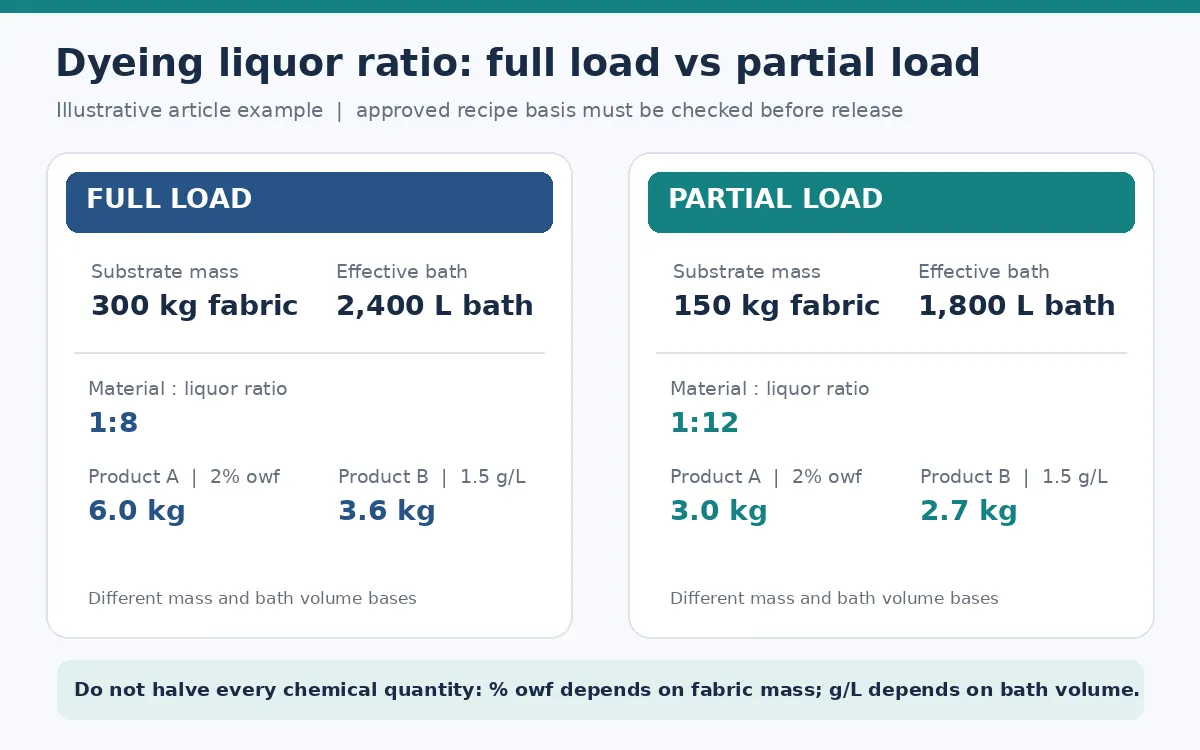
The following scenario is illustrative and uses unnamed materials so the arithmetic is not mistaken for a production recipe. An approved full-load sheet records 300 kilograms of substrate and 2,400 litres of effective aqueous bath. With density approximated as 1 kilogram per litre, the material-to-liquor ratio is 1:8. Product A is specified at 2 percent owf, and Product B at 1.5 grams per litre, both explicitly on an as-supplied product basis.
The full-load amounts are 300 × 2 ÷ 100 = 6.0 kilograms of Product A and 2,400 × 1.5 ÷ 1,000 = 3.6 kilograms of Product B. The calculated bath concentration of Product A before uptake is 6,000 ÷ 2,400 = 2.5 grams per litre. That concentration is a check on the starting arithmetic, not a prediction of shade or dye exhaustion.
Now suppose the machine's validated partial-load procedure allows 150 kilograms of substrate but still needs 1,800 litres of effective bath for circulation. The actual approximate ratio becomes 1:12. Maintaining the stated owf basis gives 3.0 kilograms of Product A. Maintaining the stated g/L basis gives 2.7 kilograms of Product B. The initial Product A concentration becomes approximately 1.67 grams per litre. A technologist must decide whether the altered process is acceptable.
Check | Full load | Partial load |
|---|---|---|
Substrate mass kg | 300 | 150 |
Effective bath L | 2400 | 1800 |
Approximate ratio | 1:8 | 1:12 |
Product A at 2 percent owf kg | 6.0 | 3.0 |
Product B at 1.5 g per L kg | 3.6 | 2.7 |
Initial Product A g per L | 2.50 | 1.67 |
Copying the full-load amounts into the partial load would produce 4 percent owf for Product A and 2 grams per litre for Product B. Halving both full-load amounts would preserve A's owf but reduce B to 1 gram per litre. Neither shortcut preserves both written bases. A correct recalculation still does not authorize the partial load: the process and machine constraints need their own approval.
Check stock solutions without mixing mass and volume
If an approved requirement is 3.0 kilograms of active material and a stock solution is documented as 20 percent active material by mass, the solution mass is 3.0 ÷ 0.20 = 15.0 kilograms. That is not automatically 15 litres. If the verified solution density is 1.10 kilograms per litre at the relevant condition, its volume is approximately 13.64 litres. The example assumes the concentration and density are both valid; neither may be guessed from a trade name.
Avoid applying an active-content correction to a dose already written on an as-supplied commercial-product basis. Doing so changes the recipe. Conversely, failing to correct a dose genuinely specified on an active basis can underdose. The recipe approver should state the basis for every ingredient, including whether a blend percentage refers to the total product or a particular component.
Solution additions can also change total liquor volume. If the approved procedure includes their contribution in the effective bath, the release sheet must reconcile the fill, retained liquor and additions consistently. Do not keep adding the same solution volume twice, once through the controller's measured total and again through a manual allowance. A small annotated volume balance is more useful than a ratio rounded to one decimal place with no explanation.
Treat machine limits as approval conditions
A low liquor ratio quoted for one configuration is not a universal setting for every load. The Thies iMaster H2O product page lists different chamber and load configurations. The page does not validate your machine's minimum circulation volume, fabric transport behaviour or permitted partial load. Those values must come from the relevant equipment documentation and approved operating procedure.
If the proposed fill is below a documented limit, stop the release calculation and escalate to the technologist and equipment owner. Changing a pump setting, level interlock or circulation safeguard to make the arithmetic fit is not an acceptable correction. If the goods cannot run within the approved load range, consider a suitable machine allocation or a validated process change instead.
Chemical handling needs a separate task assessment. The HSE guidance on safety data sheets makes clear that a supplier sheet informs rather than replaces a risk assessment. Confirm the actual product, transfer arrangement, exposure controls and emergency provisions through the competent site team. This calculation guide does not authorize manual mixing or trial quantities without those controls.
Use a release check that catches the actual error
Before a batch is issued, the operator or recipe preparer should enter the weighed substrate mass and the measured or validated liquor basis. The recipe approver checks the product basis and recomputes one owf and one g/L quantity independently. The supervisor confirms the machine allocation and that the proposed load is inside the approved envelope. Record names or controlled user identities so a later query can reach the right person.
Match the substrate identity and finish state to the recipe revision.
State mass-to-mass ratio and any density approximation explicitly.
Distinguish measured bath volume from fresh water addition.
Confirm commercial-product versus active-material dosing for each line.
Reconcile stock concentration density and solution contribution.
Hold the batch when an input or equipment limit remains unresolved.
When results fail, retain those inputs alongside the process log and shade decision. They can distinguish a weighing mistake from a changed load basis and keep the next investigation focused. The site's dyeing recipe cost regression guide is useful later, but a model trained on inconsistent dose bases will reproduce the inconsistency rather than explain it.
Start with one frequently used recipe and add a visible basis beside every quantity. Then reconcile a planned partial load before it reaches the controller. That small control gives the technologist a clear decision: the arithmetic is correct, the process has changed, and approval must address both facts.

Discussion0
Loading the discussion…