
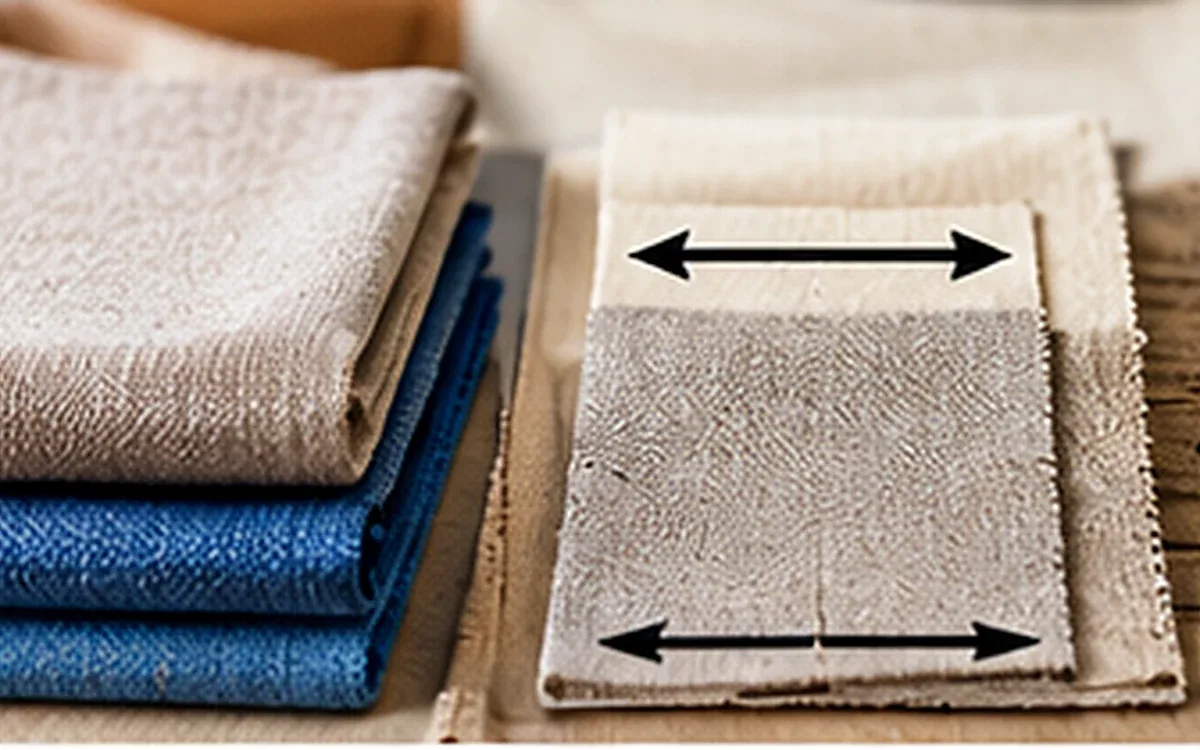
An approved fabric can meet its weight specification and still produce a garment that becomes too short after washing. Fabric shrinkage testing answers a different question from GSM testing: how far apart are the same marked points before and after an agreed treatment? The useful result records direction, treatment and measurement basis, then gives the pattern and production teams evidence they can apply without guessing an allowance.
This guide explains the calculation, a practical test record and the difference between a dimensional change percentage and a pattern compensation factor. The worked measurements are illustrative. They are not a substitute for the buyer's full test method or an instruction to use one wash programme for every fabric.
Agree the treatment before preparing the sample
A shrinkage result without its treatment is incomplete. A specimen washed and line dried cannot automatically stand in for one washed and tumble dried. Nor does a domestic laundering result establish what will happen during a particular industrial garment wash, steaming operation or finishing route.
The public scope of ISO 5077 concerns dimensional change after specified washing and drying procedures. ISO 6330 addresses domestic laundering procedures, while ISO 3759 addresses specimen preparation, marking and measurement. These documents have related roles; their numbers are not interchangeable instructions. Use the applicable complete documents and buyer agreement for the actual test.
Before work starts, the laboratory and quality owner should confirm the material identity, test method and edition, treatment sequence, number of cycles, drying route, conditioning procedure and acceptance limits. Record any deviation. Do not invent a standard temperature or tolerance from a previous order simply because the fabric description looks similar.

Keep the directions and marked points traceable
Identify the roll, color, finishing lot and specimen location. Mark the relevant fabric directions and retain that identification throughout treatment. For woven fabric this will normally distinguish warp and weft; for a knit, use the agreed lengthwise and widthwise directions. State the convention in the record instead of relying on the operator to remember how the sample lay on the bench.
Measure between defined reference marks, without stretching the material to make it lie conveniently. Follow the agreed preparation and conditioning method. A curled or distorted sample may need an approved handling approach; flattening it with arbitrary tension changes what is being measured. Keep the original readings, instrument identification and operator record.
Choose sampling locations that answer the commercial question. An investigation of one suspect roll end is different from an acceptance decision about a whole finishing lot. The site's GSM testing and roll weight guide explains the same distinction between a correct calculation and a representative sample. A precise measurement cannot repair an unsuitable sampling plan.
Calculate signed dimensional change consistently
Use the original marked distance as the denominator. If L0 is the distance before treatment and L1 is the distance after treatment, the signed change is:
Dimensional change percent = (L1 − L0) ÷ L0 × 100
A negative result denotes contraction under this convention; a positive result denotes growth. If the report instead presents shrinkage as a positive magnitude, name that convention and retain the underlying before and after readings. Do not alternate conventions between the length and width columns.
Consider three illustrative specimens. Every initial marked distance is 350.0 mm in both directions. These dimensions illustrate arithmetic only; they do not prescribe the specimen geometry required by a standard.
Specimen | Length after mm | Length change percent | Width after mm | Width change percent |
|---|---|---|---|---|
A | 339.0 | −3.14 | 343.0 | −2.00 |
B | 340.0 | −2.86 | 343.5 | −1.86 |
C | 339.5 | −3.00 | 342.5 | −2.14 |
Mean | 339.5 | −3.00 | 343.0 | −2.00 |
For specimen A, length change is (339.0 − 350.0) ÷ 350.0 × 100, or approximately −3.14 percent. Calculate from unrounded measurements, then round for reporting. The mean results describe this small illustrative set; they do not prove that every roll will contract by exactly the mean.
Separate an acceptance result from a compensation decision
First compare the results with the applicable acceptance rule. A material that fails the agreed limit does not become acceptable simply because a pattern could be enlarged. The quality owner must resolve the material disposition and obtain any necessary buyer approval before production proceeds.
Next consider whether the test state represents the garment route. Fabric may change during spreading, fusing, sewing, pressing or garment washing. Different components can also respond differently. A fabric test is evidence for a pattern trial, rather than permission to add one percentage to every pattern edge.
For a simplified rectangular dimension, let s be the positive fractional contraction expected along that direction. If the required dimension after treatment is T, the necessary dimension before treatment is T divided by (1 − s). Seam allowances, sewing take-up and construction effects must be handled separately by the competent pattern team.
Use division rather than a simple percentage addition
Suppose the illustrative length contraction of 3 percent is relevant to a trial component that must measure 70.0 cm after treatment. With s = 0.03:
Required dimension before treatment = 70.0 ÷ 0.97 = 72.1649 cm
The compensation above the final target is therefore about 3.093 percent, not exactly 3 percent. Adding 3 percent gives 72.10 cm; after 3 percent contraction that becomes 69.937 cm. The difference is small in this example, but the denominator distinction becomes more consequential with larger changes or tight dimensional requirements.
The calculation assumes proportional, repeatable change in a simple dimension. It does not account for a shaped seam, differential shrinkage between layers, a rib trim or distortion introduced during assembly. Test an approved trial garment through the actual relevant process and check its points of measure before releasing a bulk pattern change.
Length and width percentages also do not simply add to give area loss. A rectangle retaining 97 percent of its length and 98 percent of its width retains 0.97 × 0.98 = 95.06 percent of its original area. Area reduction is 4.94 percent. That arithmetic does not establish a cutting-consumption allowance because marker geometry and usable width remain separate constraints.
Build a record that the next team can use
The test sheet should make it possible to reproduce the decision, rather than just display a pass stamp. Retain the following fields with the actual readings and the authorized disposition.
Record group | Minimum useful information | Decision owner |
|---|---|---|
Material identity | Supplier, roll, lot, colour and sample location | Fabric QA |
Method | Agreed document, edition, cycles and treatment route | Laboratory lead |
Measurement | Direction, marked distances, units and instrument | Laboratory operator |
Condition | Preparation and conditioning actually performed | Laboratory lead |
Result | Individual signed changes and reporting convention | Quality reviewer |
Application | Trial pattern revision and garment measurement outcome | Pattern and production teams |
Keep the material result and the later garment-trial result linked but separately identified. If a buyer approves a concession, retain its scope. Approval for one colour or finishing lot should not silently become approval for a later delivery.
The site's cutting process control guide provides the broader handoff context. Carry the approved material and pattern revision into that release record so the cutting room does not work from an obsolete allowance.
Control which lot the allowance belongs to
Attach any trial compensation to the material and pattern revisions that were actually evaluated. A later finishing lot may have a different dimensional response even when its article number is unchanged. Give receiving and production a defined trigger for checking whether the approved evidence still applies before the next lay is released.
Keep directional results separate when reviewing related components. A facing, body panel and trim can have different material directions or treatment histories. A single garment-wide percentage can conceal those differences and create mismatched assembly dimensions. The pattern team should identify the relevant trial points of measure and confirm the combined construction, rather than asking the laboratory to infer the finished fit from a fabric average alone.
If an allowance changes after cutting has begun, identify the affected work explicitly. Record the old revision, the new decision and the disposition of already-cut components. An updated spreadsheet should not make the earlier release evidence disappear.
Investigate inconsistent results before changing the pattern
If replicate results disagree, first check identity, direction labels, reference marks, treatment and handling. Then examine whether the specimens represent different roll positions or finishing lots. Retesting a conveniently chosen area until it passes conceals the problem instead of explaining it.
Where dimensional change differs materially across a lot, consider whether segregation, additional investigation or supplier action is required under the agreed quality process. Do not hide that spread behind a single average. Likewise, growth is not a negative quantity to delete: it can create fit problems and needs the same traceable review.
Start the next trial with one complete record: original distances, final distances, treatment, signed results, acceptance decision and the proposed application. Release the compensation only after the relevant garment trial confirms it. This gives the laboratory, pattern room and cutting team one evidence trail to follow when the first finished pieces are measured.

Discussion0
Loading the discussion…