

A spare-parts store can hold expensive stock and still lack the one component needed to restore a critical machine. Critical spare parts inventory starts with the consequence of losing the function and the feasible recovery time, then asks whether holding a correct, serviceable part is the best protection. This guide gives a stock-or-source decision matrix, a bounded annual cost screen and the technical records needed to prevent a stocked component from becoming an unusable or unapproved substitute.
Define criticality at the function level
Start with the asset function, failure mode and consequence. A drive module that stops the only finishing machine capable of an approved process can be more important than a higher-value motor fitted to several interchangeable machines. Price and annual issue frequency are useful store measures, but neither establishes whether production, quality, environmental protection or worker safety depends on that specific part.
Put safety and mandatory protective functions through the competent engineering and compliance review first. Do not use a low expected monetary loss to justify running without a necessary safeguard or bypassing a protective device. The result may be a stocked replacement, an approved redundant system, a controlled shutdown plan or another engineered arrangement. A stores worksheet cannot choose that arrangement by itself.
For ordinary production consequences, write the actual recovery alternatives. Can the order move to another approved machine? Is a complete interchangeable assembly available? Can a qualified repairer restore the unit within the needed window? Each alternative needs verified capacity, compatibility and access. A nearby supplier's address does not prove that the correct part is available outside normal hours.
The site's maintenance strategy guide helps place failure modes in a broader maintenance programme. A spares decision supports the selected strategy; it does not replace inspections, preventive tasks or root-cause correction. Holding another bearing is not a solution to a recurring fit or lubrication problem.
Compare recovery time with the time the business can tolerate
Measure the chain from a recognised failure to an approved return to service: diagnosis, part identification, authorisation, supplier confirmation, transport, receipt, inspection, configuration, installation and functional checks. The supplier's nominal delivery time is only one part of that chain. If a drive requires firmware, parameter restoration or a specialist commissioning visit, include that work in the recovery plan.
Decide how much of the wait affects productive hours. A 12-hour calendar lead time crossing a planned shutdown is different from 12 productive hours lost during a capacity-constrained period. Identify available buffers and approved alternatives rather than multiplying every clock hour by an optimistic production value. Use a common time basis when comparing stock, vendor availability and redundant equipment.
NASA's facilities-maintenance material-management guidance considers historical use, spares for critical systems, projected work and delivery times when deciding inventory depth. Those are useful planning inputs. The institutional guidance is not a garment-industry stock requirement, and it does not prescribe a universal quantity for the components in your plant.
Use a decision matrix before setting quantities
The following rows are illustrative decision patterns, not recommendations for named equipment. Engineering must confirm each component's specification, function and safety relevance before purchasing. The first question is which protection arrangement is feasible; the stocking quantity comes after that decision.
Part situation | Evidence to check | Possible arrangement |
|---|---|---|
Unique long-lead production module | Correct revision configuration and no approved substitute | Hold a verified insurance spare |
Common consumable across many assets | Stable issue history and reliable replenishment | Minimum and maximum store levels |
Expensive repairable assembly | Swap compatibility and repair turnaround | Shared serviceable spare with repair loop |
Readily sourced low-consequence part | Written availability and tolerable restoration wait | Buy on need under an agreed supplier route |
Part serving a protective function | Competent engineering and local requirement review | Approved resilience and replacement plan |
For shared spares, verify that simultaneous demand would not leave another critical function unprotected. For vendor-held stock, confirm ownership, reservation terms, response hours and transport responsibility. For an insurance spare, identify the exact failure it protects against. A vague item called motor spare can conceal differences in mounting, voltage, enclosure, speed or coupling that become obvious only during a breakdown.
Screen the annual economics without confusing cash and cost
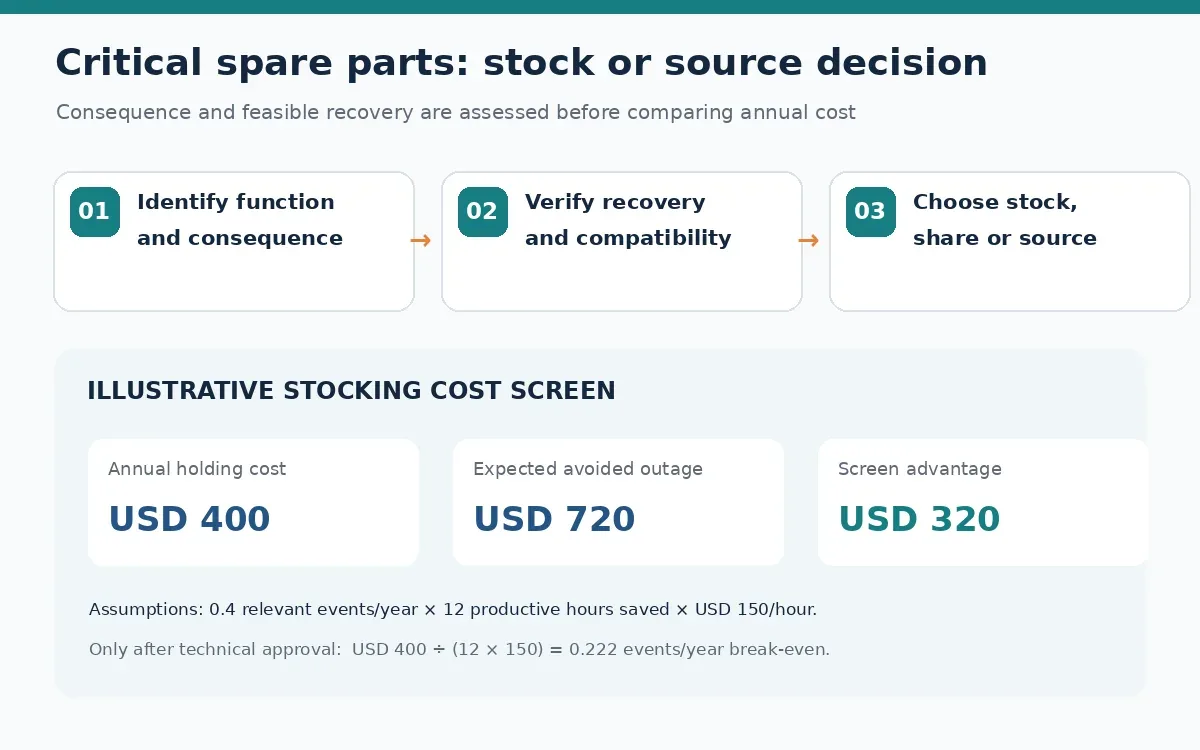
For a non-safety decision where the alternative is feasible, compare annual holding cost with the expected avoidable outage consequence. A simple screen multiplies assumed relevant events per year by productive hours saved per event and incremental contribution or cost per hour. Include other action-specific costs where justified. Keep the assumptions visible because rare failures often provide weak evidence for a precise event rate. In the formula, f is events per year, h is productive hours saved per event and v is incremental value per hour.
Consider an illustrative USD 2,000 component held as one serviceable spare. Assume an annual carrying rate of 20 percent, combining the components actually recognised by the business, for an annual holding cost of USD 400. Assume 0.4 relevant events per year, 12 productive hours saved per event and an approved incremental consequence of USD 150 per productive hour.
Expected avoidable consequence is 0.4 × 12 × 150 = USD 720 per year. The simplified annual screen therefore favours stock by USD 320 before any additional inspection, obsolescence, disposal or replenishment differences omitted from the assumed carrying rate. This is not an investment return guarantee or a cash payback calculation. Buying the spare still requires USD 2,000 of initial cash, and the part may never be used.
The screen assumes the spare is available and correct when needed, can be replenished appropriately after use and actually removes those 12 productive hours. The replacement purchase is assumed common to stocked and buy-on-need alternatives; action-specific price differences would need to be added. If production can recover the lost hours without incremental cost or lost contribution, the stated USD 150 consequence is overstated.
Find where the choice reverses
With those other assumptions fixed, the crossover event frequency is holding cost divided by productive hours saved and value per hour: 400 ÷ (12 × 150), or approximately 0.222 relevant events per year. This threshold is a sensitivity result, not a forecast that failure will occur at a particular interval.
Assumed events per year | Avoidable consequence USD per year | Holding cost USD per year | Screen difference USD |
|---|---|---|---|
0.10 | 180 | 400 | -220 |
0.20 | 360 | 400 | -40 |
0.40 | 720 | 400 | 320 |
0.80 | 1440 | 400 | 1040 |
One positive row does not settle the policy. Test shorter avoided downtime, lower incremental value and a realistic risk of obsolescence. If the result depends on a failure frequency inferred from one old event on a different asset, state that evidence limit. For a high-consequence but uncertain exposure, management may prefer resilience even when the simple screen is inconclusive, provided the decision and its cost are explicit.
The site's EOQ and periodic-review guide addresses replenishment policy for reusable inventory. Do not transfer a steady-demand assumption directly to a rarely used unique spare. Once you decide to hold a part, choose a review and replenishment arrangement suited to its actual demand pattern, lead time and serviceability constraints.
Prove that the stocked item will work
Keep a part-to-asset record containing manufacturer part number, drawing or technical specification, revision, approved alternatives, installation location and any required configuration. Record serial or batch identity where useful, supplier traceability, receipt inspection and the serviceable status. Separate new, repaired, quarantined and failed parts so a returned item cannot quietly re-enter available stock.
Counterfeit appearance cannot be resolved by a familiar box alone. SKF's brand-protection brochure recommends authorised sourcing to protect authenticity. Apply a proportionate supplier-verification process to the actual component, and use the manufacturer or qualified engineering channel when identity is uncertain. This is a provenance control, not endorsement of one brand for every application.
Storage conditions and shelf life are part of availability. Follow manufacturer requirements for protection, packaging, environmental conditions and periodic checks. A corroded bearing, aged seal or lost configuration record may occupy a bin without providing a usable recovery option. The site's bearing selection and failure guide gives useful mechanical context; it does not authorise a bearing substitution from dimensions alone.
Give the policy an owner and a review trigger
The maintenance planner proposes the function and recovery case, engineering approves compatibility, procurement verifies the supplier arrangement, stores owns quantity and condition records, and finance reviews the cost basis. A short decision record should state what is held or sourced, why, the approved alternative, the review date and the trigger for reconsideration.
The DOE spare-parts audit summary illustrates why central tracking and reliable records matter. Use that governance lesson without assuming its nuclear-facility findings describe apparel factories. Review your policy when an asset is modified, retired or added, when a supplier lead time changes, or after a failure exposes a missing assumption.
Begin with the parts tied to the few functions whose loss would be hardest to recover. Confirm one feasible restoration path for each before expanding the purchasing list. The useful outcome is a documented, technically approved recovery arrangement that the store can demonstrate when the machine stops.
Discussion0
Loading the discussion…