
A supplier offers a new finishing chemical and sends a safety data sheet. The trial should not begin simply because the document is present in the approval folder. The relevant question is whether the actual product, task and exposure controls have been assessed and the unresolved points closed. This guide explains how to read a safety data sheet, or SDS, as evidence for that decision and provides a review matrix that procurement, the technologist and EHS can use before a chemical trial is authorised.
Match the sheet to the container and intended use
Start with the product identifier on the container, purchase record and SDS. Check supplier identity, concentration or grade where specified, intended use and restrictions. A sheet for a similarly named product or a different concentration may describe different hazards and controls. An ingredient's Chemical Abstracts Service number can be useful, but one matching ingredient does not establish that two commercial mixtures are interchangeable.
Record the revision date and where the current sheet came from. Ask the supplier to confirm the version for the product being delivered if that is uncertain. An old date does not by itself prove the sheet is invalid, and a newly dated sheet does not prove it is correct. The review needs to identify relevant changes in product identity, hazards, controls and emergency information, with an owner who can obtain clarification.
The current US OSHA Appendix D specifies information under the SDS section headings for that jurisdiction. It is a useful navigation reference, not a statement of Bangladesh's legal duties. A factory must check the requirements that apply to its own location, chemical, supply chain and buyer programme through the competent compliance team.
Treat the SDS as an input to the task assessment
HSE guidance explicitly distinguishes a safety data sheet from a risk assessment. The sheet describes a product and provides hazard and handling information. Your assessment must also consider the work: quantity, concentration at use, transfer method, temperature, duration, frequency, ventilation, nearby activities and people who could be exposed.
A closed metered transfer and manual open decanting can create different exposures from the same product. A small trial is not automatically low risk if it introduces splashing, aerosol generation, heating or an incompatible material. The responsible EHS professional and technologist need to examine the actual proposed arrangement. The supplier's routine intended use should be checked against what the trial would do.
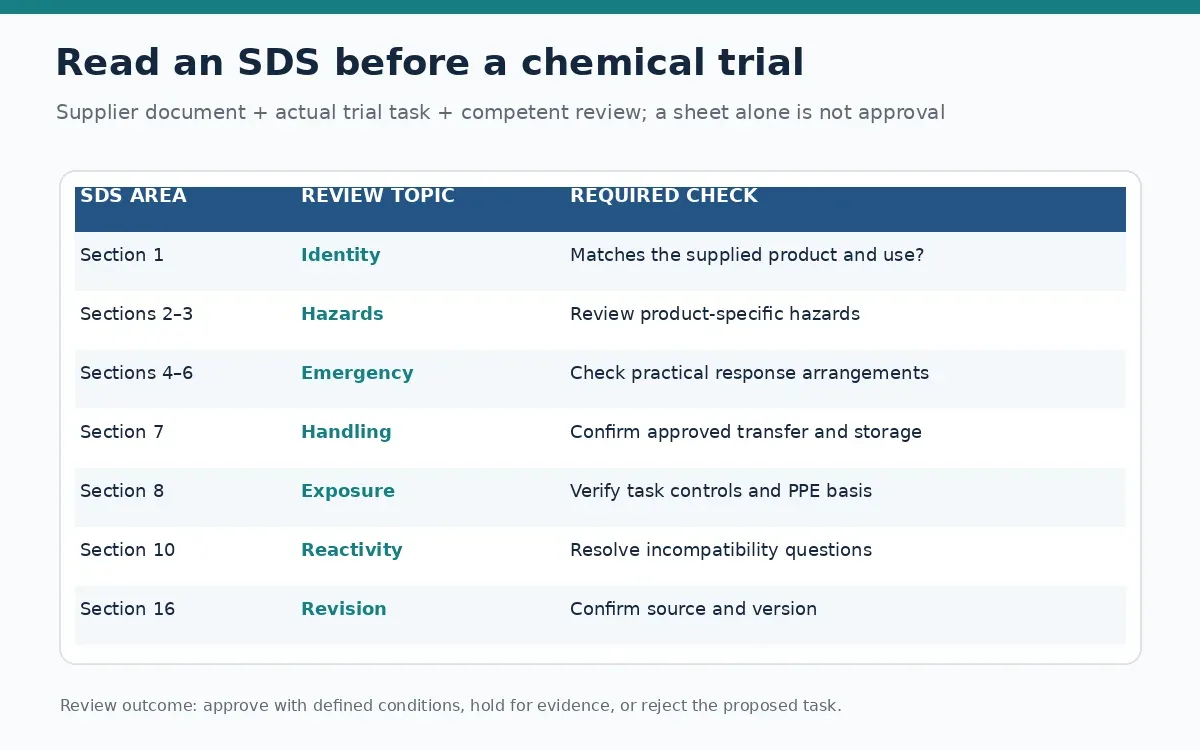
Use the site's HIRA guide for the broader task-based assessment structure. Its example scoring and timescales should not be adopted as universal legal thresholds. For this review, the practical output is a clear decision: approved under defined conditions, held pending identified evidence, or rejected for the proposed task.
Navigate the sections by the decision being made
The familiar SDS structure has sixteen numbered sections. OSHA's SDS guide is a useful explanation of that structure, but its older wording should be checked against current law. The currently retrieved US Appendix D states that sections 12 to 15 may be included and are not mandatory under that appendix. Other jurisdictions and supply requirements can differ; do not transfer either statement into a global compliance claim.
For a trial, read related sections together. Identity and hazards must refer to the same product. Handling guidance, physical properties and reactivity need to agree with the proposed process. Exposure-control information must be translated into a verified workplace arrangement. Emergency information needs to be accessible and usable by the people who would respond, rather than left in a remote purchasing folder.
The matrix below is an original review aid. It selects information relevant to a trial decision; it is not a replacement SDS format or a complete regulatory checklist. Add the product-specific questions that the competent reviewer identifies.
SDS area | Review question | Record before release |
|---|---|---|
Section 1 identity | Does it match the delivered product and use | Identifier supplier and use confirmation |
Sections 2 and 3 hazards and composition | Are the stated hazards understood for this mixture | Hazard review and any supplier query |
Sections 4 to 6 emergency information | Can trained responders use the specified arrangements | Response plan and access checks |
Section 7 handling and storage | Is the proposed transfer and storage compatible | Approved task and storage arrangement |
Section 8 exposure controls | Are engineering controls and protection suitable | Verified controls and PPE assessment |
Section 9 physical properties | Could the trial change vapour spray or thermal exposure | Process conditions reviewed |
Section 10 reactivity | Are contact materials and incompatibilities addressed | Chemical-specific compatibility decision |
Sections 12 to 15 where relevant | Are environmental disposal transport and local duties covered | Competent local review |
Section 16 revision information | Which version is being approved | Revision source and change record |
Resolve exposure-control gaps before choosing protection
A statement such as wear suitable gloves is not enough to select a glove for a specific chemical and task. The reviewer may need product-specific material guidance, permeation information, expected contact and the applicable working arrangement. A thin disposable glove that supports dexterity for one activity may be unsuitable for another. Do not choose from a photograph or a broad chemical family label alone.
The same caution applies to respiratory protection. A respirator mentioned on a supplier sheet does not create a complete workplace programme. Exposure assessment, suitable equipment, fit and training requirements and the applicable local controls need competent review. Prefer a process arrangement that prevents or controls exposure where feasible, rather than treating personal protective equipment as the only trial condition.
Exposure limits listed on a foreign SDS may belong to another jurisdiction or organisation. Record the source and units, then check which limits and assessment requirements apply locally. A liquid's concentration in a bottle cannot be compared directly with an airborne exposure limit. If the SDS has gaps or contradictory controls, obtain clarification and hold the relevant trial step instead of filling the gap with an assumed safe number.
Review compatibility beyond the storage shelf
Check what the product can contact during receipt, dispensing, process use, cleaning and waste handling. Consider equipment materials, residues from previous products, shared transfer lines and drainage or collection arrangements. A general acid-versus-base chart is not enough for every commercial mixture. The SDS reactivity information and supplier technical support should inform a chemical-specific assessment.
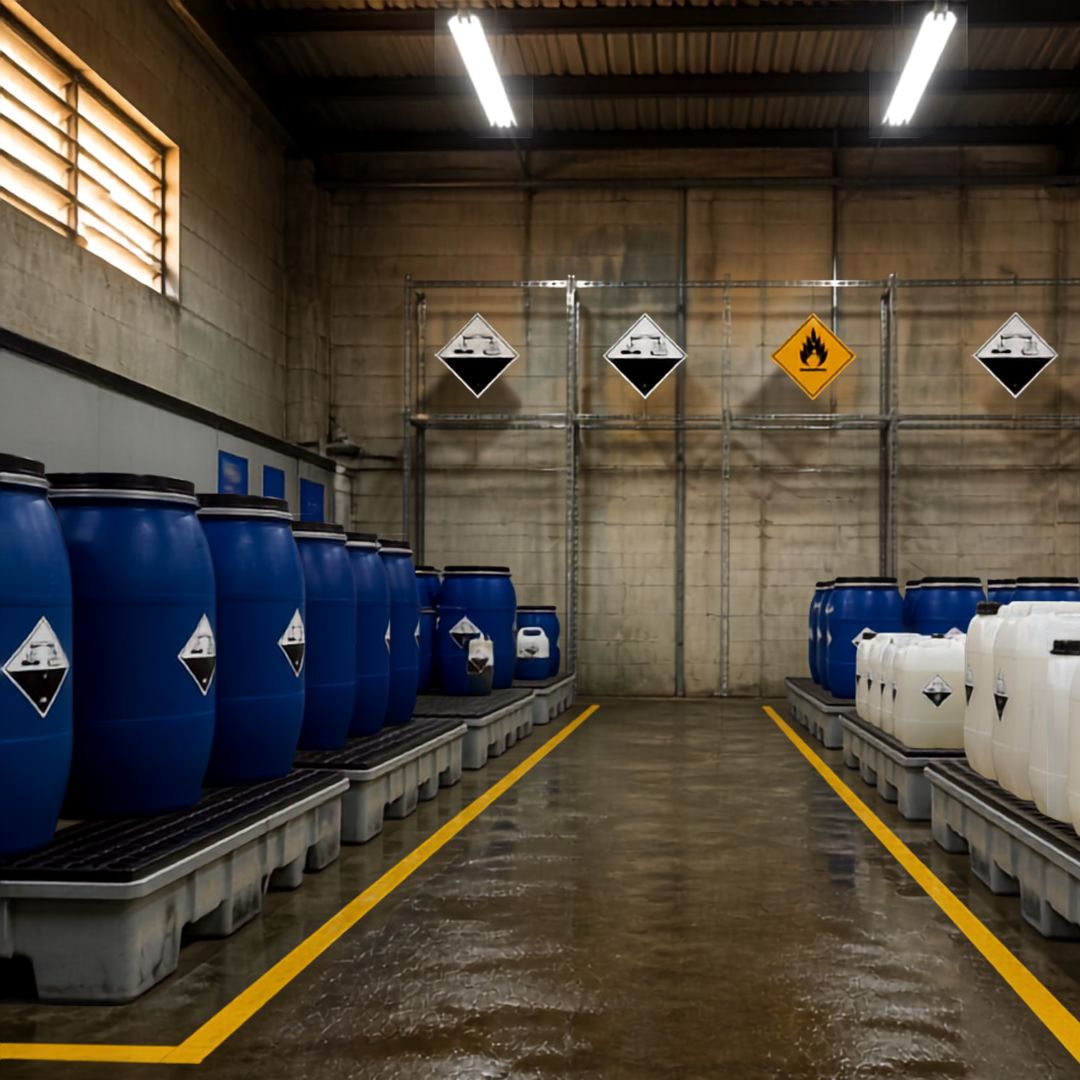
The site's chemical storage segregation guide provides useful context for incompatible products. Do not import a fixed separation distance or bund capacity from an article into a site design without checking the actual substances, local rules, drainage and competent engineering assessment. Store layout, process transfer and waste compatibility are related decisions with different evidence needs.
Unknown compatibility is a reason to obtain evidence, not a reason to experiment informally. No one should mix products merely to see whether a reaction occurs. The proposed trial must stay within an approved technical procedure and the authorised chemical-safety controls, with a clear stop and escalation route for a changed condition.
Test the review on an illustrative trial proposal
Suppose a finishing team proposes an unnamed auxiliary supplied as a concentrated liquid, while the draft trial record lists only a trade name and a dilution ratio. The SDS identifier matches the container, but the sheet's glove statement is generic and the trial's transfer method is not defined. These are illustrative documentation gaps, not a report of an actual factory audit.
The technologist first confirms the exact as-supplied product and proposed use with the supplier. EHS reviews exposure implications and requests suitable product-specific protection information where needed. The equipment owner confirms whether the approved transfer arrangement can be used. The supervisor checks that the assessed arrangement, trained people and required emergency access will actually be available when the trial is scheduled.
The appropriate release state remains held until those conditions are resolved. Writing a low risk score or adding gloves provided to the form does not establish that the control exists or is suitable. Once the gaps are closed, the approval records the actual quantity, process conditions, task controls, authorised people and observation plan. Any change beyond those conditions returns to the approval owner.
Keep emergency information available without inventing treatment
Make the product identifier, supplier emergency contact and approved response instructions accessible to the trained response team, including an appropriate offline arrangement where necessary. Check that the site's facilities and response capacity match the assessed hazards. A folder containing first-aid text does not prove an eyewash, spill arrangement or trained responder is available and suitable.
Do not convert this article into a generic treatment or spill-cleanup instruction. The actual substance, exposure and situation govern the response. Untrained personnel should follow the site's emergency and evacuation arrangements and contact the designated competent responders. Unknown reactions, uncontrolled releases and uncertain exposure conditions require escalation under that plan.
Close the approval loop and preserve the version
Procurement owns supplier identity and document retrieval. The technologist owns the proposed product use and process envelope. EHS owns the task-risk and exposure-control review within its competence, with engineering input where required. The supervisor confirms implementation before work begins. Assign actual names or controlled roles in the local record; approval should not depend on an unnamed department.
Retain the reviewed SDS revision with the trial record and capture the reason for every hold or condition. Review again when the product formulation, supplier, task, process condition or relevant requirement changes. Begin by taking one pending chemical proposal and completing the identity-to-control matrix. The useful result is a release decision supported by the real task and verified controls, with unanswered questions still visible.
Discussion0
Loading the discussion…