
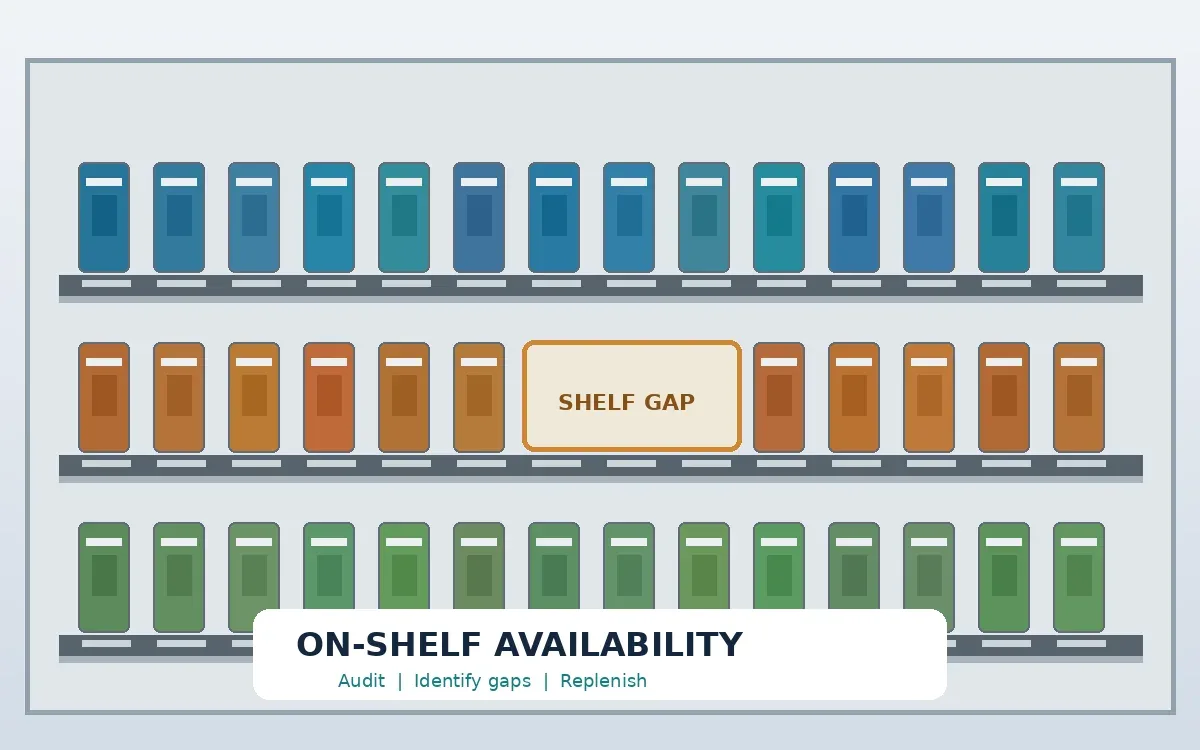
A store system shows eight units in stock, but the shopper sees an empty shelf position. The availability problem may be replenishment, a wrong location or an inaccurate inventory record rather than a supplier shortage. On shelf availability measures whether the required saleable item can actually be found at the intended selling location when checked. This guide gives a repeatable audit denominator, a worked availability calculation and a gap-to-owner record that helps retail and FMCG teams fix the right cause.
Define availability from the shopper's position
Specify the product identity, selling location and assortment being assessed. For a packaged FMCG product, another size or variant is not automatically the promised item. For an apparel application, the required size and colour may be part of the identity. A matching carton in the backroom is useful evidence for replenishment, but it does not make an empty selling position available to the shopper.
ECR Retail Loss distinguishes shelf and store stockouts. A store stockout concerns absence from the premises; a shelf stockout can occur while stock remains elsewhere in the store. Keep that distinction in the audit because the response owners differ. A supply planner cannot resolve a carton sitting in a misidentified backroom location simply by increasing the next order.
Define saleability as well as physical presence. Damaged, held, withdrawn or otherwise unsaleable stock should not count as an available item merely because it occupies the space. Follow the applicable product and store controls. The audit should not encourage putting restricted stock back on display to improve a percentage.
Freeze the eligible assortment before the round
Build a list of store-product pairs that are supposed to be ranged at the observation time. Specify how new listings, planned delistings, promotional displays and alternate selling locations are treated. A product can be correctly excluded when the approved assortment says it is not ranged. It should not be excluded after the round merely because the shelf was empty.
Use a product identifier that supports accurate matching, together with the shelf or display location. GS1's apparel inventory guidance connects visibility and traceability with inventory management. Identification technology supports the record, but a readable barcode or RFID count does not by itself prove that a saleable item is accessible at the intended shelf location.
Choose observation times before the pilot. Checking only immediately after the replenishment team finishes can produce an optimistic snapshot. Checking only at the busiest moment can answer a different service question. Keep times comparable across stores, record missed observations and explain the intended coverage. If you want peak-period availability, deliberately define that scope rather than implying an all-day measure.
Calculate the rate and the audit coverage separately
For a simple unweighted snapshot measure, observed availability is available eligible observations divided by completed eligible observations. Each store-product-time observation contributes one available or unavailable result. Report missing eligible observations separately so a team cannot improve the rate by skipping difficult positions.
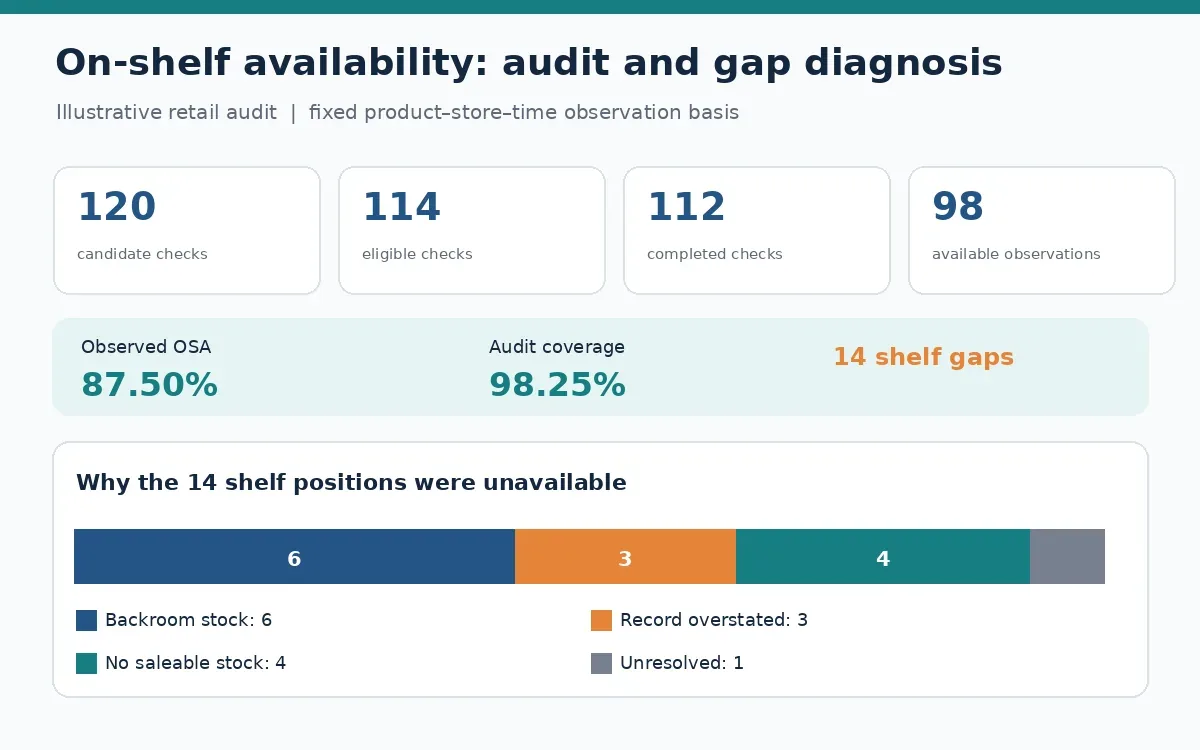
Consider an illustrative pilot: twenty catalogue products are listed for checks across three stores at two fixed rounds, giving 120 candidate observations. Six are confirmed not ranged under the approved assortment before the audit. That leaves 114 planned eligible observations. Two eligible checks are missed, leaving 112 completed checks: 98 available and 14 unavailable.
Audit item | Count or result | Basis |
|---|---|---|
Candidate observations | 120 | 20 products × 3 stores × 2 rounds |
Confirmed not ranged | 6 | Approved exclusions before checking |
Planned eligible | 114 | Candidate minus confirmed exclusions |
Missed eligible checks | 2 | Retained as missing |
Completed eligible | 112 | Planned eligible minus missed |
Available | 98 | Saleable item at approved location |
Shelf gaps | 14 | Completed unavailable observations |
Observed OSA | 87.50 percent | 98 ÷ 112 × 100 |
Audit coverage | 98.25 percent | 112 ÷ 114 × 100 |
The 87.5 percent result describes the completed checks in this defined panel. It does not describe every product in each store or prove that those shelves were available for 87.5 percent of all trading hours. The coverage measure makes the two missed observations visible. Retain their reason and arrange a controlled follow-up without silently replacing the original result.
If missing observations are concentrated in hard-to-reach or busy sections, investigate that coverage bias. A high overall completion percentage can still omit the positions most likely to be unavailable. Record both the achieved sample and what it was intended to represent before comparing stores or claiming improvement.
Diagnose each gap before ordering more stock
For an observed empty position, confirm the product and approved selling location first. Then check the recorded stock, accessible backroom locations, authorised alternate displays and any quality hold. Use a controlled physical count where appropriate. Preserve the initial system balance and timestamp so a later adjustment does not erase the evidence behind the gap.
ECR's inventory-record research explains how overstated records can delay replenishment and hide stockouts from the system. If the system shows eight units but a controlled count finds none, that mismatch needs investigation and an authorised correction. Do not assume theft from the mismatch alone; receiving, sale recording, returns, damage, movements and adjustment processes can also contribute.
In the illustrative pilot, classify the fourteen gaps using one primary verified status per observation. Six have saleable backroom stock, three have confirmed overstated system balances, four have no saleable store stock and one remains unresolved. These are teaching categories, not an empirical distribution of retail failures.
Gap status | Observations | First responsible action |
|---|---|---|
Saleable stock in backroom | 6 | Replenishment owner verifies and restores display |
Confirmed overstated record | 3 | Inventory owner investigates and corrects with authority |
No saleable store stock | 4 | Supply owner checks receipt and replenishment path |
Cause not yet verified | 1 | Named supervisor closes the evidence gap |
Total gaps | 14 | Each retains its original observation |
Restoring a display is the immediate service action where it is safe and authorised. The process action is different: why did the stock remain in the backroom, and what prevents recurrence? A count adjustment also has two tasks: correct the current balance and investigate the transaction path that created the mismatch. Keep both tasks visible rather than closing the issue when the shelf is filled once.
Record enough detail to connect the gap to an owner
A reusable gap log needs store, product, location, round time, physical availability, system balance at that time, checked alternate locations, confirmed status, owner, immediate action and closure evidence. Add a transaction or delivery reference only when relevant. Record unknowns explicitly; a default supplier delay code can shift responsibility away from a store execution problem.
Use status changes carefully. A later replenishment does not alter the original unavailable observation. It creates a closure time and an action record. Keeping both helps reveal repeated gaps and the duration between detection and correction. If several people inspect the same position, retain an observation identifier so repeated notes do not become several distinct stockouts.
The site's route-to-market guide explains the broader supply and distribution choices. Use the store's verified shortage record to inform that upstream discussion. Route restructuring is a different decision from correcting receiving, put-away or shelf replenishment, even when both affect availability.
Avoid turning a snapshot into an unsupported sales claim
An unavailable observation does not directly measure units or margin lost. Some shoppers substitute, delay a purchase or buy elsewhere, and the effect varies by product and context. If a business estimates lost sales, it needs an explicit model and defensible assumptions. Do not multiply shelf-gap count by average daily sales and describe the result as observed lost revenue.
Demand-weighted availability can be useful when products have different importance, but disclose the weight source and whether the weights were fixed before comparison. Observed sales during a stockout may understate unconstrained demand, so using them as weights can make an unavailable item look unimportant. Retain the unweighted count measure alongside a weighted measure when each supports a different decision.
Promotions complicate both demand and display location. Confirm promotional assortment, stock allocation and audit positions before the event. The site's trade-promotion effectiveness guide provides context for judging uplift; a campaign cannot be evaluated cleanly if the supposed promotion products were unavailable through much of the observed period.
Pilot the response before automating the signal
Agree the assortment and two observation rounds for a small store panel, train the auditors on the available-unavailable rule and assign an owner for every verified gap status. Track completion, observed availability, repeated positions and closure evidence. Choose a manageable scope that the store can inspect safely without blocking customers, obstructing exits or encouraging unsafe access to shelves.
After the pilot, review disagreements between physical findings and system signals. Use that evidence to decide whether better replenishment discipline, inventory accuracy, data integration or continuous sensing would answer the remaining problem. A technology alert is useful only if someone can verify and act on it. Begin with the fourteen-gap style of action record: one observation, one evidenced status and one accountable next step.

Discussion0
Loading the discussion…