
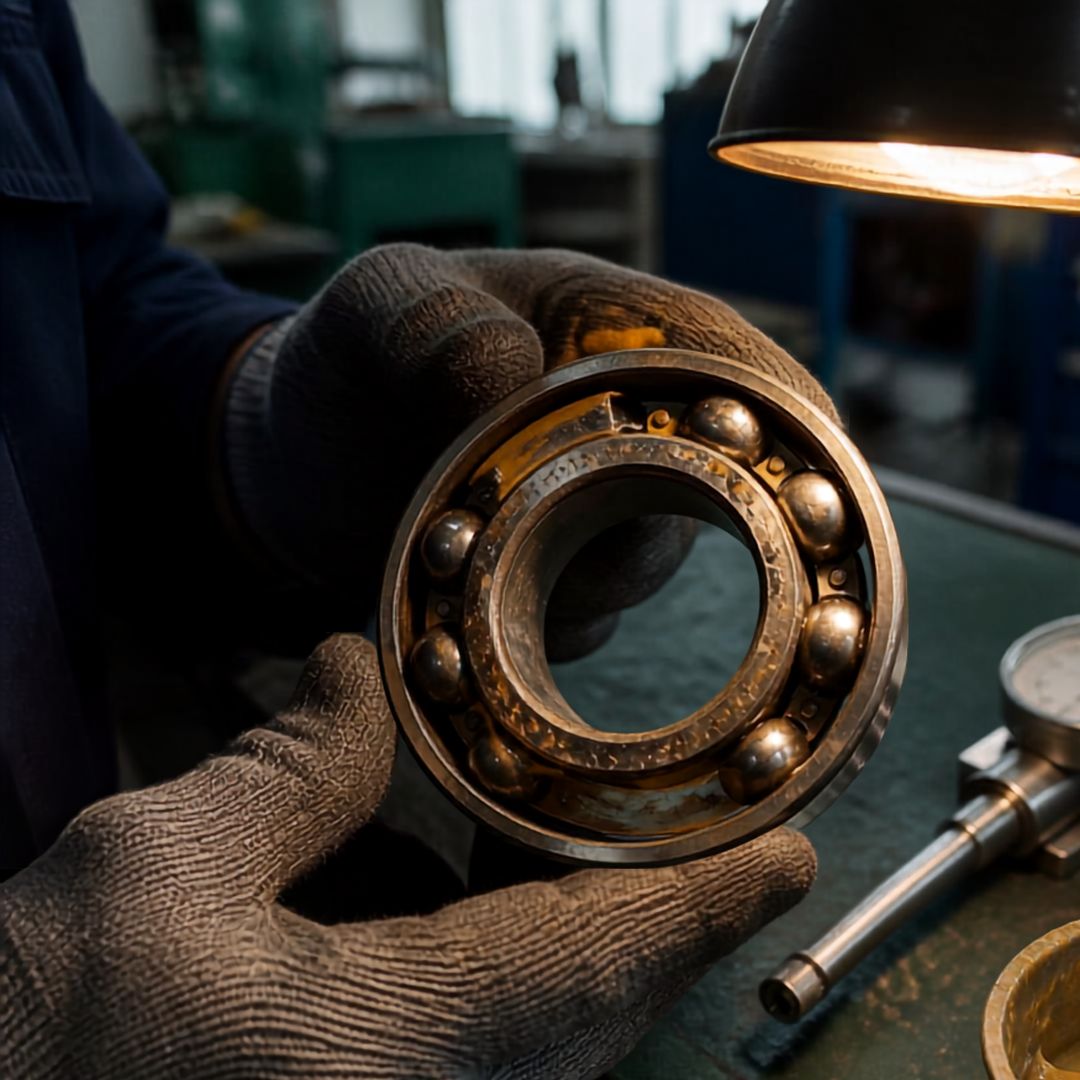
The bearing came off the sewing machine head three weeks after the last service. It is hot to the touch, it rattles when you spin it by hand, and the technician standing next to you wants to know two things: what killed it, and will the new one die the same way.
You cannot answer either question by looking at a catalogue number. A rolling element bearing that fails at three weeks instead of three years almost never failed because the bearing was bad: catalogue defect rates sit under 3 percent of all failures. The other 97 percent is fit, lubrication, mounting or contamination, and every one of those is something your plant controls.
Get the diagnosis wrong and you replace a bearing with an identical one, on the same shaft, with the same fit, and it fails again on the same schedule. This article gives you three things in order: how to select the right bearing for the load you actually have; how to get the shaft and housing fit right, because a wrong fit is the single most common cause of early failure; and a failure-mode identification table you can hold next to the failed part. Getting this diagnosis right the first time is exactly the kind of judgment call that separates a preventive maintenance program from a predictive one: one replaces on a schedule, the other replaces because the evidence says to.
How Do You Choose the Right Bearing for the Load You Actually Have?
Load direction and speed decide the bearing family before anything else does. Radial load runs perpendicular to the shaft. Axial (thrust) load runs along the shaft axis. Most real machines carry some of both, called combined load, and the ratio between them (Fa/Fr) decides which bearing family tolerates the mix.
Load type | Speed | Typical bearing type | Where you see it |
|---|---|---|---|
Pure radial, light-moderate | High | Deep groove ball bearing | Sewing machine heads, small motor drive ends |
Pure radial, heavy | Low-moderate | Cylindrical roller bearing | Boiler feed pumps, generator drive-end bearings |
Combined, moderate axial | High | Angular contact ball bearing | Spindles, high-speed motor non-drive ends |
Combined, heavy axial | Low-moderate | Tapered roller bearing | Dyeing machine drive shafts, gearbox input/output |
Misalignment expected | Any | Self-aligning ball / spherical roller | Long line-shafts, compressor auxiliary drives |
Life is not a guess once you have the bearing type:
L10 = (C / P)^p  million revolutions

  C = basic dynamic load rating (from the catalogue)
  P = equivalent dynamic bearing load
  p = 3 for ball bearings, 10/3 for roller bearings
L10 means 90 percent of a large population of identical bearings survives at least that long under the stated conditions. For combined loading, the equivalent load is P = X × Fr + Y × Fa, with X and Y pulled from the catalogue against the ratio Fa/Fr. Using P = Fr alone when there is meaningful axial load is a shortcut that can silently halve the calculated life, which is exactly the kind of arithmetic error that makes a bearing look like it failed early when it was undersized from day one.
Why Is the Fit Between Shaft, Housing and Bearing the Most Common Failure Cause?
The rule is short and violating it is the single most frequent mounting error: the ring that rotates relative to the load direction gets an interference fit. The stationary ring gets a transition or clearance fit.
Application | Rotating ring | Shaft fit | Housing fit |
|---|---|---|---|
Electric motor, normal load | Inner | k5 / k6 | H7 |
Heavy shock load, inner rotating | Inner | m6 / n6 | H7 / J7 |
Wheel hub / drive pulley, outer rotating | Outer | g6 | N7 / P7 |
Free (non-locating) bearing position | n/a | as above | G7 / H7 |
An interference fit consumes internal clearance, and that is the part that catches people out. A C3-clearance bearing pressed onto an m6 shaft can end up with near-zero operating clearance once thermal expansion is added on top of the mechanical interference. A bearing that ends up preloaded when it was never designed to be preloaded runs hot and fails within weeks, not years.
Field note: A dyeing unit was replacing the same drive-side bearing on a jet dyeing machine gearbox roughly every four months, always logged as "bearing quality issue." The shaft fit turned out to be n6 on a bearing spec'd for k6, a tolerance mix-up carried over from a spare-parts substitution two years earlier. Correcting the shaft fit alone took that bearing from a 4-month average life to just over 14 months on the next three changes.
How Do You Read a Failed Bearing to Find the Root Cause?
Every failure mode leaves a signature. Read it before the part goes in the scrap bin.
What you see | Likely cause | What to check next |
|---|---|---|
Uniform wear path, centred on the raceway | Normal fatigue | Log running hours against L10h for the next spec cycle |
Spalling: flaking, sub-surface pitting | Rolling contact fatigue, often overload or contamination | Verify actual load against calculated P; check seal condition |
Wear path offset to one side, both rings | Misalignment | Check shaft-to-housing alignment, coupling runout |
Wide wear on one ring, narrow on other | Preload from over-tight fit or thermal growth | Re-check shaft/housing fit class |
Evenly spaced dents at ball/roller pitch | Brinelling: impact mounting or shock load while stationary | Review mounting method; check shock loads in transport |
Fluting: fine axial marks, frosted look | Electrical current passage, common on VFD-driven motors | Fit insulated bearing or grounding ring; check VFD earthing |
Discolouration: straw, blue or brown | Overheating from lubrication failure or excess preload | Check grease condition, relubrication interval |
Reddish-brown staining or pitting | Corrosion: moisture ingress | Check seal integrity, storage conditions |
Photograph every failed bearing before it goes in the bin. A phone photo against the equipment record, repeated across a year, turns a string of "random" failures into an obvious pattern, usually one fit class, one lubricant, or one machine that keeps showing up.
With VFDs now standard on sewing line motors, dyeing machine drives and compressor motors, induced shaft voltage discharging through the bearing is one of the faster-growing causes of early motor bearing failure. If fluting shows up on a VFD-driven motor, the fix is at the drive and grounding system, not the bearing brand. Compressed-air-driven equipment carries a parallel lesson: a badly specified cylinder or valve in a pneumatic circuit quietly wastes money the same way a wrong bearing fit does, through a cost nobody traces back to the actual component.
What Does a Practical Lubrication Schedule Look Like?
Lubrication failure and over-lubrication together account for a larger share of premature bearing failures than any mechanical cause, and both are entirely preventable with a written schedule instead of a habit.
G = 0.005 x D x B

  G = grease quantity in grams
  D = bearing outside diameter, mm
  B = bearing width, mm
Over-greasing is as damaging as under-greasing. Excess grease churns inside the bearing, raises operating temperature, and degrades the base oil faster than the interval assumes, the exact overheating signature you would otherwise blame on a bad batch of bearings. Mixing incompatible grease thickener systems on top-up can soften both and cause the mixed grease to bleed oil far faster than either alone, the same kind of storage-compatibility problem a proper hazard identification and risk assessment of the lubrication store would catch before it reaches the bearing.
As a working rule, every 15°C above 70°C halves grease life. A bearing running at 100°C needs relubrication roughly four times as often as the catalogue base interval implies.
Running temperature | Relative relubrication frequency vs. 70°C baseline |
|---|---|
70°C | 1x (catalogue baseline) |
85°C | 2x |
100°C | 4x |
115°C | 8x |
Checklist: Before You Order the Replacement Bearing
Load type identified: radial, axial or combined, with the Fa/Fr ratio calculated, not guessed
Bearing type cross-checked against the selection table, not just "same as last time"
L10h calculated with correct P, axial component included if present
Shaft and housing fit matches the rotating-ring rule, not copied from an unrelated machine
Failed bearing photographed and logged, failure mode identified against the ID table
Root cause addressed: fit, lubrication, alignment or contamination source corrected
Grease type and quantity confirmed, compatible with existing grease
Relubrication interval set from actual running temperature, not the catalogue default
Final Word
A rolling element bearing is one of the few plant components where the failure itself hands you the diagnosis, if you look at it before it goes in the scrap bin. Most of what gets logged as "bearing quality" is a fit, lubrication or mounting decision made months earlier. Fix the root cause once and the replacement outlives the one it replaced: that is the entire difference between a maintenance program and a spare-parts subscription. The same root-cause habit pays off well beyond the mechanical room: the panel-cutting equivalent is tight cutting room efficiency and marker planning, where fixing the actual source of fabric waste beats re-cutting the same lay every time.


Discussion0
Loading the discussion…