
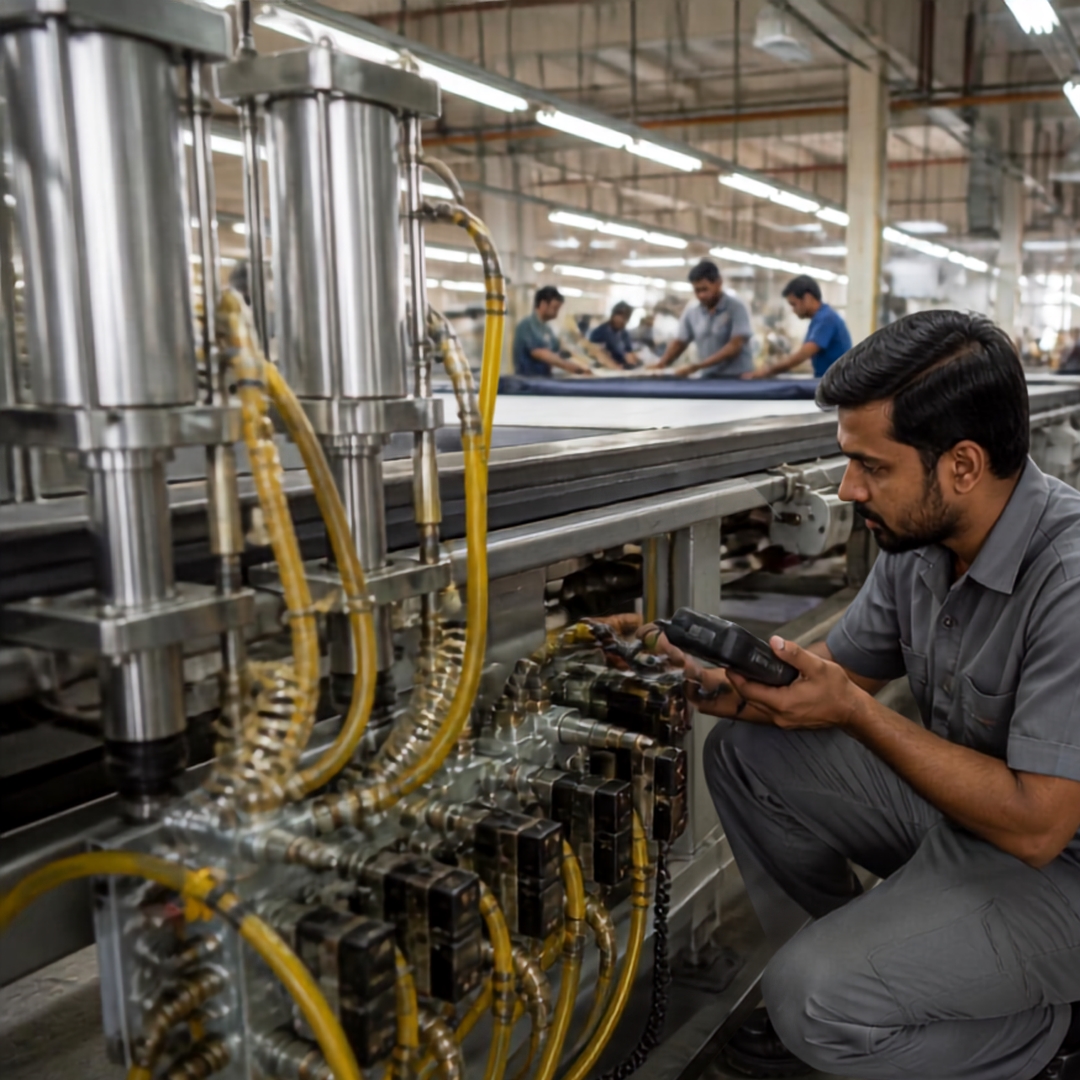
The compressor room runs all shift, every shift, and nobody in the monthly cost meeting can tell you what a single cutting table cylinder actually costs to fire. Electricity gets billed as one lump number to the whole plant. The cost of compressed air gets treated like it's free because nobody meters it at the point of use.
It isn't free. It is, by a wide margin, the most expensive utility per unit of useful work in the building. A typical plant converts only 10–15% of the electrical energy it feeds into a compressor into usable work at the cylinder rod. The other 85–90% leaves as heat, and a chunk of what does reach the point of use leaks out of fittings before it ever pushes a piston.
This matters more in a garment factory than most industries realise, because pneumatics show up everywhere: cutting table clamps and knife lifts, folding and pressing station actuators, spreader carriage stops, tacking and pattern machines. Every one of those circuits was designed by someone who picked a cylinder bore, a valve, and a pressure setting. Those three choices, made once and never revisited, are what set your cost of compressed air for the next ten years.
What Does Each Pneumatic Circuit Element Actually Do?
Single-acting cylinders extend on air pressure and return on a spring. They suit clamp-and-release jobs where the return stroke does no real work. Double-acting cylinders take air on both strokes (most cutting table lift cylinders and press station actuators are double-acting) and consume roughly twice the air of a single-acting cylinder of the same bore for a full cycle.
Directional control valves (DCVs) route air to one side of the piston or the other, and their sizing decides how fast a cylinder moves. An undersized valve is the single most common reason a cylinder runs slower than its datasheet promises, so the operator compensates by running higher line pressure, which quietly inflates the cost of compressed air for that whole line.
Flow control valves meter the exhaust air leaving a cylinder to set its speed. Fitted correctly (on the exhaust port, "meter-out"), they give smooth, load-independent speed control. Fitted on the supply side, or skipped in favour of throttling the main line pressure, they force every other actuator on that circuit to run underpowered. Quick exhaust valves dump cylinder exhaust air directly to atmosphere to cut cycle time, but that dumped air is fully paid-for compressed air doing zero work on its way out.
Field note: A mid-sized knit factory in Chattogram had a folding station run noticeably faster after a mechanic fitted a quick exhaust valve to fix a slow return stroke: cycle time down 1.2 seconds, problem solved. Eight months later an energy audit flagged that station at 340 Nm³ of air per shift, nearly triple its neighbours, because nobody ever fitted a silencer or rechecked the exhaust flow after the fix went in.
What Does a Litre of Compressed Air Actually Cost?
Ask a maintenance head about the cost of compressed air per cubic metre and most will guess low, because they are pricing the compressor's rated output, not what survives to the point of use. The build-up: generation (0.11–0.15 kWh per Nm³ at the outlet for an efficient rotary screw compressor at 7 bar, a figure that assumes healthy bearings and rotors, since a compressor running on worn bearings draws measurably more power for the same output; see our guide to bearing selection, fits and failure diagnosis), drying and filtration (3–8% parasitic loss), distribution losses (5–10% in most factories that haven't re-piped in a decade), and leaks (commonly 20–30% of total generated volume in a plant that has never run a leak survey). A conservative "landed" loss factor of 25% on top of generation energy is realistic for an average plant.
Worked example, using an industrial electricity rate of $0.09/kWh:
Compressor specific power: 0.13 kWh per Nm³ at the outlet
System loss factor: 25% (drying + distribution + leaks)
Effective landed energy: 0.13 ÷ (1 − 0.25) = 0.173 kWh per Nm³ delivered
Landed cost: 0.173 × $0.09 = $0.0156 per Nm³, or about $15.60 per 1,000 Nm³
Apply that to a single cutting table cylinder, one of dozens of pneumatic actuators whose uptime feeds directly into cutting room efficiency and marker planning: a 50mm bore, 20mm rod, 300mm stroke double-acting cylinder at 6 bar consumes about 7.5 litres FAD per cycle. At 10 cycles a minute across two shifts, that's roughly 7.2 Nm³ per hour, or around 115 Nm³ across a 16-hour two-shift day.
Daily air cost for that one cylinder: 115 × $0.0156 ≈ $1.80/day. Annual cost at 300 working days: ≈ $540/year, for one cylinder. A mid-sized cutting and pressing floor with 15 comparable pneumatic stations is carrying roughly $8,100 a year in compressed air cost that never appears on any line item except the whole-plant electricity bill.
Where Is the Air Actually Being Wasted?
Leaks. A 3mm leak at 6 bar releases about 11 litres per second and draws roughly 4 kW continuously, around the clock, whether or not the line is producing. Leak flow scales with the square of orifice diameter, so a leak twice as wide leaks four times as much air.
Orifice diameter | Approx. leak rate at 6 bar | Continuous power draw | Estimated annual cost |
|---|---|---|---|
1 mm | 1.2 l/s | 0.4 kW | ~$280 |
2 mm | 4.9 l/s | 1.8 kW | ~$1,260 |
3 mm | 11.0 l/s | 4.0 kW | ~$2,800 |
5 mm | 30.6 l/s | 11.1 kW | ~$7,780 |
8 mm | 78.2 l/s | 28.4 kW | ~$19,900 |
Oversized cylinders consume air proportional to their swept volume for the life of the machine: doubling bore diameter roughly quadruples air consumption per stroke for the same stroke length. Running high pressure when low pressure would do is another quiet loss: every 1 bar of pressure reduction across the whole plant cuts compressor energy by roughly 7%, yet factories accumulate pressure creep for years because one line once needed 7 bar. Unregulated exhaust dumping from quick exhaust valves and unsilenced blow-off nozzles wastes air with no work extracted: engineered nozzles and properly fitted silencers cut both noise and air use by 50–70% versus an open tube.
How Do You Run a Leak Survey Without Stopping Production?
Run the compressor with production stopped and all known equipment off.
Record load/unload cycle time: every unload-to-load transition while nothing should be drawing air is leak flow.
Convert cycle time to a volume using the compressor's rated capacity and duty cycle.
Walk the line with an ultrasonic leak detector to tag each source while it's audible, since floor noise hides leaks during production hours.
Rank tagged leaks by orifice size, not count: five pinhole leaks matter less than one 5mm fitting.
Most plants that have never run this audit find 20–30% of total air generation unaccounted for, almost always leaks. It is consistently the cheapest energy project available. Deciding whether to run that survey on a fixed calendar or trigger it off a rise in compressor load is the same preventive versus predictive maintenance tradeoff that applies to any other rotating equipment on the floor.
Circuit-Efficiency Checklist
Check | Target | Common failure |
|---|---|---|
Cylinder bore vs. actual load | ≤70% theoretical force for static hold, ≤50% for accelerating loads | Bore chosen "for safety margin," running at 15–20% of capacity |
Line pressure | Lowest pressure that meets the slowest circuit on the header | Whole plant run at the one high-pressure exception |
Flow control valve position | Meter-out (on the exhaust port) | Meter-in, or main-line throttling instead |
Quick exhaust valve exhaust | Fitted with a silencer/nozzle | Open dump, full noise and full air loss |
Leak survey cadence | Quarterly, off-shift | Never run, or only after a capacity complaint |
Valve Cv vs. required cycle time | Checked against swept volume and tubing run | Assumed adequate because "it's the size we always use" |
The single most important line on that table is line pressure. Everything else is worth doing; dropping header pressure by even 1 bar saves money on every circuit on that header at once, starting the same day.
Final Word
Nobody budgets for compressed air the way they budget for thread or fabric, and that is exactly why it leaks money for years without anyone noticing. The fix isn't a bigger compressor: that call, on the rare occasion it's genuinely warranted, belongs to decision tree analysis for capacity investment decisions, not to reflex purchasing. It's treating every cylinder, valve and fitting on the floor as a cost decision made once, at design time, that keeps billing you every shift until someone goes back and checks it.


Discussion0
Loading the discussion…