
Start with the result the garment must achieve
Ozone denim finishing uses an oxidising gas to change the colour of a garment. The product team may want a lighter overall shade, a cleaner cast or a planned local effect. Those are separate targets. They require separate standards and may require different equipment.
Begin with an approved garment and a written brief for the effect. “Ozone wash” names a treatment family. It does not define the finished look.
Jeanologia describes its G2 systems as garment treatments that use ozone to act on dyestuffs. This shows one possible route. It does not prove that every dye or fabric blend will respond in the same way. The assembled style also matters.
Define which areas may change and which must remain stable. Include the pocket facing, waistband, seam ridges, labels and exposed thread. A cleaner pocket bag may be part of the target. A pale leather patch may be a defect.
Keep an untreated garment from the same fabric lot. Also keep the approved reference for the complete finishing route. These serve different purposes. The untreated control helps show what the treatment changed. The approved reference shows the target the customer expects.
Name the equipment mode before comparing recipes
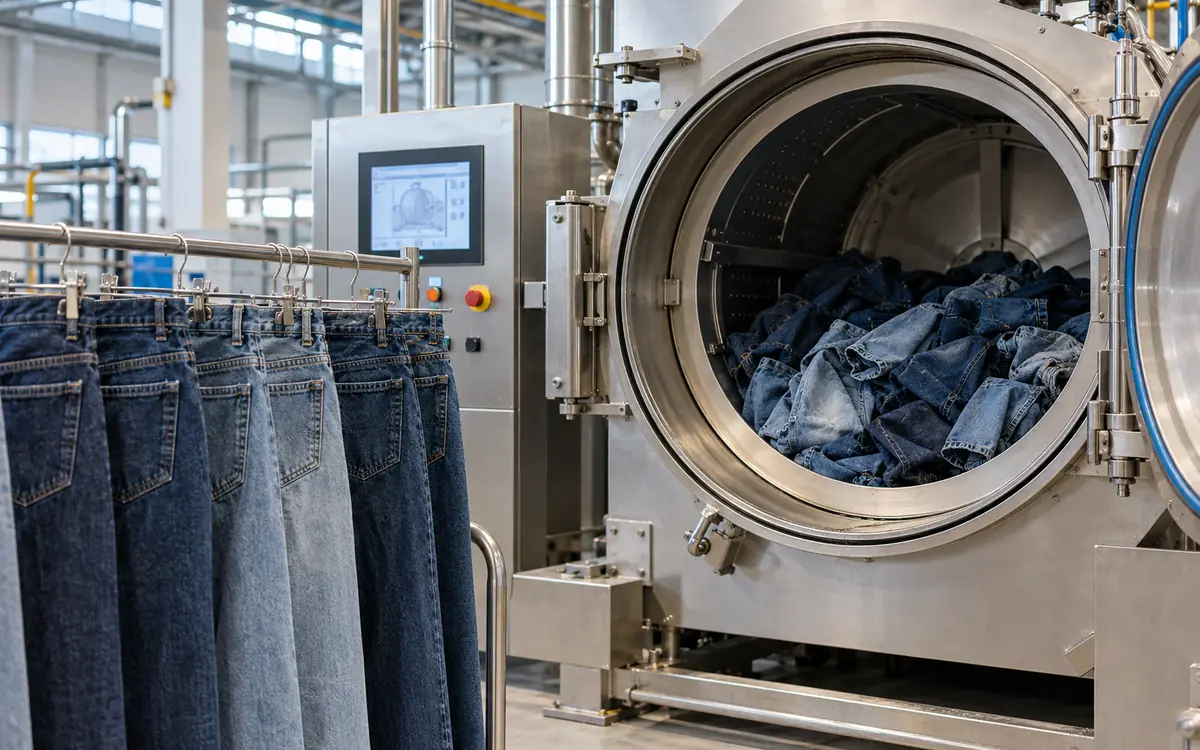
Ozone equipment varies. Its processes are not all the same. A load may move in a treatment drum. A garment may instead be held in a cabinet. These methods expose different surfaces to the gas. Water conditions and the way garments are supported also matter.
Tonello lists several ozone finishing technologies, including systems intended for different effects. Its O-Zone cabinet is a static system for local lightening and related aesthetic results. A cabinet sample may look uniform. That does not prove a bulk rotating load will give the same result.
Describe the actual mode in the trial record.
Item to record | Why it matters to the comparison |
|---|---|
Equipment model and process mode | Defines how the garment meets the treatment |
Dry, damp or liquid-contact condition | Makes the moisture state explicit |
Moving or fixed garment position | Helps explain exposure and contact differences |
Garments per load and dry mass | Records two useful measures of loading |
Prior finishing stages | Identifies the starting surface and shade |
Required stages after ozone | Defines when final approval takes place |
Do not move a recipe to another machine type based on time alone. The same number of minutes can involve very different conditions.
Confirm the starting garment, not just its fibre label
“Cotton denim” is too broad a description for process release. Record the fabric code, construction and mass. Add the stretch content, fabric lot and dye route when known. Then record what has happened since sewing.
A desized, washed garment has a different starting condition from an untreated one. A sample with a previous tint or surface finish is another case. Two garments can look close before treatment but respond differently after it.
Ask the fabric supplier which changes could affect the trial. These include a dye change, a finish change or a revised stretch component. Keep the question specific enough for the supplier to answer.
Assess the assembled product. A shell swatch cannot show a label colour shift, elastic damage or a fastening problem. Use swatches to narrow the trial range, then use garments to check the result.
Record the starting shade and any visible variation before processing. A panel may be dark before the trial starts. Without that record, the team could blame the new stage.
If the cotton preparation history is unclear, use ApparelDiary’s reactive dyeing preparation and control guide to help frame questions about that history. Its dyeing instructions do not form an ozone recipe.
Use published research as evidence, not a machine setting
A 2024 study by Atav and colleagues tested ozone fading on a specified, all-cotton denim. They varied moisture, treatment time and the pH of the applied water. They then assessed colour and fabric strength. The work shows why these factors deserve attention together. It does not set one recipe for every garment. Read the primary study.
A useful trial plan states which evidence applies to the new case. The need to define moisture can transfer. A setting tested on one fabric and machine may not apply elsewhere.
Before using a published condition, compare the material, dye and load. Check the moisture method, equipment and full sequence too. If several differ, treat the paper as a guide to variables worth studying.
Also check what the research measured. A study may measure colour and tensile strength. That does not answer all questions about elastic recovery, trim damage or repeated home care.
Record this distinction in the technical file. The reviewer can then see which choices have published evidence. The record also shows which still need factory trials.
Define the moisture percentage with an equation
Moisture is a common source of recipe errors. The same percentage can use a different denominator, or mass basis. Write the basis beside the value.
For a dry-mass basis:
Moisture pickup (%) = added water mass ÷ reference dry textile mass × 100
For a wet-mass basis:
Water fraction (%) = water mass ÷ total wet mass × 100
Take a hypothetical load with a reference dry mass of 100 kg. Add 30 kg of water. Its pickup on the dry basis is:
30 ÷ 100 × 100 = 30%
Its water fraction on the wet basis is:
30 ÷ 130 × 100 = 23.08%
Both describe the same load. Confusing them would change the intended water addition.
State how to obtain the reference dry mass. A factory may weigh goods after agreed conditioning. That weight is not always the same as an oven-dry mass. Use the basis required by the equipment supplier and trial method.
Weigh the load soon after adjusting moisture. Record elapsed time if garments wait before treatment. A weight recorded at the extractor may change before the load reaches the chamber.
These figures illustrate measurement only. They are not recommended ozone settings.
Check where the water is, not only how much there is
The total water mass can be correct even when the load is uneven. A thick waistband may hold more water than a single fabric panel. A pocket assembly may hold a different amount too.
For a uniform effect, inspect how garments drain, separate and wait. A folded bundle may stay damp in places that would dry in an open garment. A delay in a warm work area can further change the starting state.
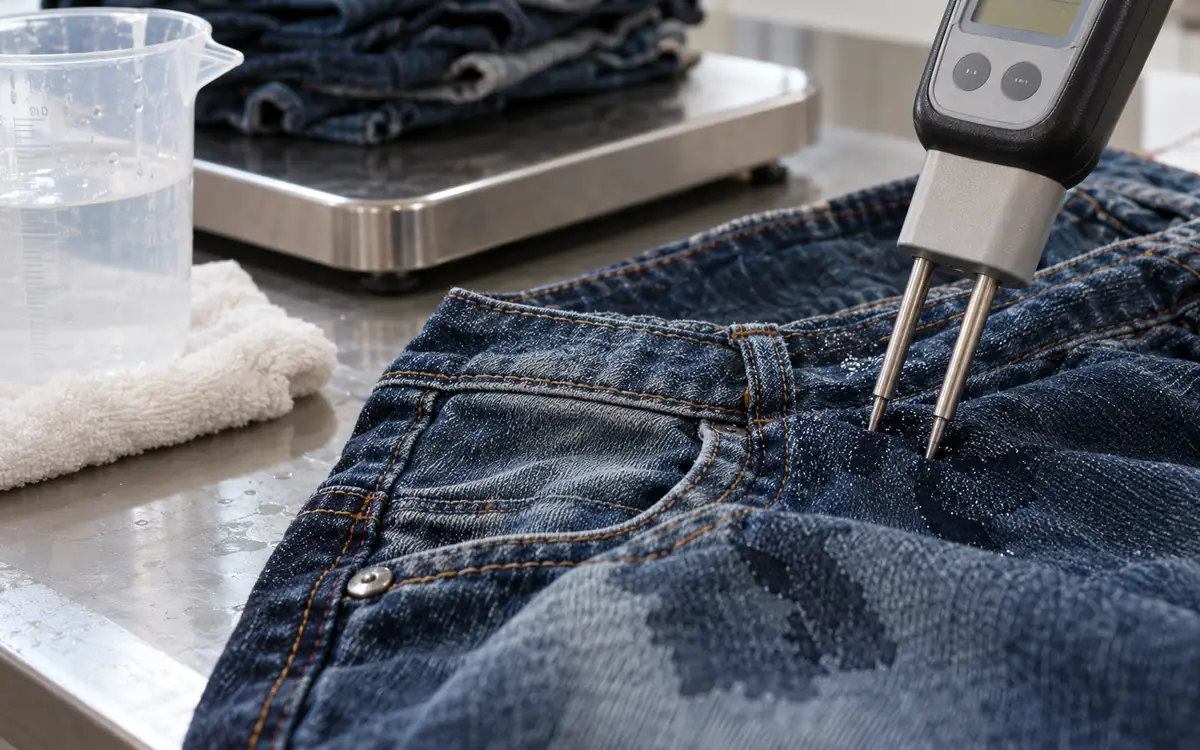
Build a practical moisture check around the product. Choose garment zones that can be checked in the same way each time. Or choose test pieces that represent the load. State the sampling method and what its evidence can show. A few surface readings do not form a complete map of the load.
If using an instrument, check that it suits the fabric and finish. A meter number with no stated basis is not a water percentage measured by mass.
Two trials may differ in both the amount of moisture and where it lies. Do not blame the result on amount alone. Improve the preparation method first.
A sound work instruction states how to prepare the load and where it may wait. It also lists the checks needed before loading. “Load while damp” leaves too much room for variation.
Keep generator output separate from garment exposure
A generator rating states its output under given conditions. It does not measure how much ozone reacts with a garment.
Keep four quantities separate:
Quantity | Example unit | What it describes |
|---|---|---|
Generator production rate | g/h | Mass produced per unit time |
Gas concentration | mg/m³ or ppm | Ozone present in a gas volume |
Gas flow | m³/h on a stated basis | Volume moving through the system |
Exposure duration | minutes | Time within a defined process stage |
Multiply the recorded concentration by time to give an exposure index. It can help compare runs made under the same defined conditions. It does not directly measure the dose absorbed or the reaction in the fibre.
Gas movement and load demand affect how to read the result. So does the measurement location. A sensor near an inlet may answer a different question from one in a return line. Identify the sensor location in the equipment file.
Do not divide the generator rating by kilograms of jeans and call it a garment dose. That calculation ignores what happens between gas production and the textile surface.
Ask the supplier which recorded values show normal operation. Ask which values signal a fault. Use those definitions when comparing pilot and bulk runs.
Check containment and safe release as well as shade
A good colour result does not prove that the equipment can run safely. Keep separate approval records for product trials and engineering checks.
Ozone is a strong oxidiser. It can harm the eyes and respiratory system. The NIOSH Pocket Guide lists a US recommended ceiling limit of 0.1 ppm. It also lists an OSHA time-weighted limit of 0.1 ppm. Their time bases differ. Neither figure is a setting that applies to opening every machine.
The site’s competent safety and engineering staff must set the required controls. These must suit the equipment and local rules. They include containment, gas destruction and ventilation. Monitoring, alarms and the conditions for access also need review.
Ask for evidence that the installed system works as intended. Commissioning should cover the installed system. A check of the generator alone does not cover the full setup.
Record the calibration and maintenance needs of sensors. Confirm how checks detect a failed sensor or gas destruction stage. They must also detect unsafe release conditions. Qualified staff must test these functions using the manufacturer’s procedure.
Do not use smell as a clearance test. Do not shorten a release stage to recover lost production time.
For chemicals used elsewhere in the route, ApparelDiary’s safety data sheet guide supports the chemical review. The equipment still needs its own safety assessment.
Design a trial that can explain the result
A trial should answer one clear production question. One question might be whether the prepared load has stable moisture. Another might be whether a revised effect still meets strength requirements.
Keep an unchanged control route. Use garments from the same defined fabric group. If the lot has known variation, share it across trial groups. Do not give one group all the light panels.
Record each variable that changes. A trial may change moisture, loading, time and the prior wash at once. It could produce an attractive sample without showing which change caused the result.
Use repeat runs to test repeatability. Several garments in one run show variation within that run. They do not show how the process behaves across separate starts.
Plan enough material for appearance review and destructive tests. Do not approve a treatment from the best-looking piece alone. Strength tests on a different, lightly treated piece would give a poor basis for that approval.
Mark every specimen so its test result connects to its actual route. The final record should make that link clear. It must not depend on someone’s memory.
Judge shade at a defined point in the route
Choose when the garment becomes ready for colour assessment. It may need specified rinsing, drying and conditioning first. Other finishing steps may also come before the colour check. Use the same endpoint for control and trial garments.
Review the garment under agreed lighting. Compare overall shade, cast, local contrast and unwanted marks. A single lightness value cannot describe all four.
Instrument readings can support a visual review. The method must suit the surface being measured. State the area measured and how the garment faces the instrument. Explain how to handle seam ridges or mixed light and dark areas.
Consider a hypothetical lightness target of 47 with a permitted range from 45 to 49. Four zone readings are 44, 47, 48 and 49.
Their mean is:
(44 + 47 + 48 + 49) ÷ 4 = 47
The mean meets the target. The first zone still lies outside the stated range. Approving from the mean alone would hide a local failure.
These values illustrate lightness. They do not propose a denim tolerance. Do not present a lightness difference as a complete colour difference. The buyer and laboratory must agree how to measure and judge colour.
Pair the shade target with garment performance
Approval needs more than a lighter shade. Choose performance checks to suit the product’s intended use and construction.
For a rigid jean, breaking or tearing behaviour may be central. For a stretch style, the team also needs relevant stretch and recovery evidence. For an assembled garment, inspect closures, labels and seams. Check other parts that the treatment may affect.
Use a suitable laboratory method and state the fabric direction. Compare like specimens from matching zones. A heavily lightened knee is not the same sampling location as a protected seam allowance.
Here is a hypothetical strength comparison:
Route | Mean result in the selected test | Retention from control |
|---|---|---|
Untreated route control | 800 N | 100% |
Trial A | 720 N | 90% |
Trial B | 640 N | 80% |
Retention for Trial A is 720 ÷ 800 × 100 = 90%.
Suppose the product needs a result of at least 680 N. Trial A meets that requirement and Trial B does not. A statement that Trial B “retains most strength” would not resolve the failure.
The numbers are examples, not industry limits. Review each result as well as the mean. Apply the required sampling rule. Averages should not conceal weak specimens.
Keep atmospheric ozone fastness separate from finishing approval
There are two different questions. One asks whether ozone can produce the required factory effect. The other asks how a colour resists ozone in the surrounding atmosphere.
ISO 105-G03:1993, confirmed in 2025, concerns colour fastness to atmospheric ozone. Its scope includes specified humidity conditions. It is not a production recipe for denim fading.
A passing atmospheric fastness test does not set an industrial finishing recipe. A successful industrial finish does not prove that the colour will resist ozone in the air later.
Use the atmospheric test when it addresses a relevant product requirement. Keep its report separate from the process validation record. Both document titles may use the word “ozone.” That does not mean one test covers the other. Separate records help prevent this paperwork error.
Confirm the bulk operating window
A pilot shows a result within the conditions tested. Bulk approval needs more evidence. It must show that normal production variation stays within the agreed limits.
Define the allowed material family and load range. State the moisture method and preparation route. Include the machine and software recipe version. A code without its version may point to a changed process.
Check loads that represent production. Do not test only the most convenient size mix. Thick styles and garment count can change how the load fills the equipment. A higher share of large sizes can also matter.
Track the full cycle. Preparation and loading take time, as do treatment and gas removal. Count verified release and unloading too. A short active treatment stage does not equal a short production cycle.
Take a hypothetical run. Loading and preparation at the machine use 8 minutes. Active treatment uses 12 minutes, controlled release 10 minutes, and unloading 5 minutes. Total occupied time is 35 minutes. Quoting only 12 minutes would overstate usable output.
This example shows how to calculate occupied time. It does not recommend an operating sequence or clearance duration.
Check variation in both the process and the assessment
Before rejecting a bulk run, check that the assessment itself is stable. Denim has texture and planned contrast. A pale ridge and the dark ground beside it are different surfaces. Their readings cannot be compared on equal terms.
Create a simple garment map showing the approved assessment zones. Mark the position from a stable construction feature, such as a seam intersection. State whether the instrument aperture fits entirely within that zone.
Ask two assessors to review a small set of coded garments on their own. They should use the same lighting and reference set. Compare where they agree and where their decisions differ. This check shows whether the approval wording is clear enough to use.
For instrument work, repeat readings on the same marked area before comparing different garments. If repeated readings vary widely, investigate placement and measurement conditions. Do not blame the spread on the ozone process before these checks.
Protect retained specimens under agreed storage conditions. A reference that has changed during storage can cause the factory to chase a moving target.
This step also helps with customer discussions. An “uneven shade” dispute is easier to resolve with clear records. Both parties need to identify the same zone, viewing condition and reference. A photograph can record the location. Screen colour should not replace an agreed physical or measured standard.
Once the assessment method is stable, use it for both pilot and bulk review. Changing the method after a disputed result weakens the comparison.
Investigate failures from the starting state forward
Use the location and timing of a defect to narrow the investigation.
Observation | Checks that help distinguish causes |
|---|---|
One garment zone stays dark | Starting shade, folds, moisture distribution and presentation |
Results drift between runs | Material lot, waiting time, load records and sensor history |
Whole load is too light | Recipe version, actual exposure record and preparation changes |
Label or thread changes colour | Component identity, location and prior compatibility evidence |
Shade passes but strength fails | Sampling zone, treatment severity and full route history |
Repeat run differs after maintenance | Sensor checks, gas path and restored operating settings |
Use these prompts to guide checks. They do not prove a cause. Confirm a suspected cause through a controlled comparison.
A longer treatment may correct a dark area. First check what it does to areas that already pass. The correction can create a new strength or shade problem.
Hold affected material while the cause is reviewed. Record approved rework as a separate route. Include all earlier treatments in its history.
Keep claims and change control tied to evidence
If ozone replaces a chemical stage, name the stage removed. Record which stages remain. A claim about one operation should not be presented as a claim about the entire jean.
Measure the complete route when comparing water, energy or accepted output. Count extra preparation, gas generation and drying within the stated boundary. Include rework and rejects within it too.
The word “ozone” alone does not prove a fixed environmental saving. Different machines, materials and target effects can require different routes. Supplier case studies can guide questions, but the factory still needs its own records.
Define changes that require review. A new dye lot may need a shade check. A new blend or trim may require a wider trial. A change to gas handling or protective controls needs engineering review. Product review alone is not enough.
Keep one approved record of the material, route and limits. Link the test results and release decision to it. That record makes later changes visible.
Frequently asked questions
Can ozone replace every denim bleach process?
No single route is certain to match every shade and local effect. Run trials on the actual garment. Compare both appearance and product performance with the requirements. Include the whole sequence needed to reach the approved result.
Is a longer treatment always a better correction?
Longer exposure may change more than the unwanted dark area. Check how the material responds and how even the effect is. Check garment performance before approving a correction. A local defect may come from preparation or how the garment is held. Too little overall treatment is only one possible cause.
Can a process be copied from a research paper?
A paper can point out useful factors and provide evidence for the material tested. Copying its settings does not prove an equal result on another fabric, machine or load. Record those differences. Test the proposed conditions before approving them.
Does a clear chamber display prove safe access?
Read the display in line with the installed equipment’s validated control system. Competent engineers must approve access conditions and sensor reliability. They must approve the release logic too. Operators should follow that approved procedure.
Make approval specific enough to repeat
Release an ozone finish only after the complete garment meets its appearance and performance requirements. The process must remain controlled. State the moisture basis, load conditions and final assessment point clearly.
The approval package needs a preparation method that the team can repeat. Add traceable machine records and product results that represent the load. Keep separate evidence for safe equipment use. Together, these records turn an attractive sample into a process the factory can manage.
References
Jeanologia: G2 ozone garment technology.
Tonello: Ozone washing technologies for denim.
Tonello: O-Zone static cabinet.
CDC NIOSH Pocket Guide: Ozone.
ISO 105-G03:1993: Colour fastness to ozone in the atmosphere.
Discussion0
Loading the discussion…