
An air-covered yarn can knit well and still produce fabric that grows during wear. It may have many interlacing points overall. Even so, long sections can remain where the parts are poorly held together. Neither the word “covered” nor a single yarn average tells the whole story.
The useful questions start with the product. How far must the fabric stretch? How much force should that take? How much length may remain after release and after care? The yarn construction and process settings must then support those needs.
This guide follows an air-covered yarn made with elastane and filament. It starts at the feeds and ends with a finished-fabric trial. The numerical cases are invented teaching examples. They show how to define measurements and check the maths. They are not production recipes or laboratory results.
What air covering does to the components
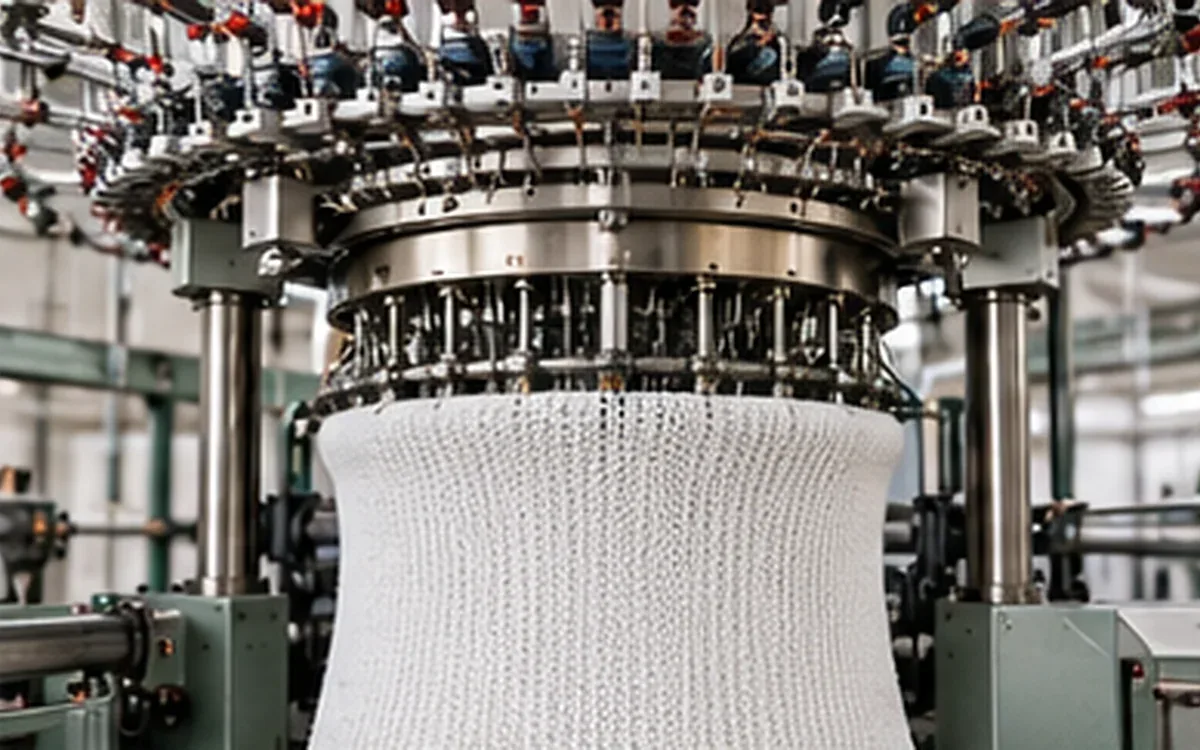
In a common air-covering route, a drafted elastane end and a filament yarn enter an air jet together. The filament may be textured and fed with some overfeed. Air brings the components into local tangles. The output has interlaced regions with more open lengths between them. The cover does not form a continuous helix. Rieter describes this distinction when comparing air covering with mechanical covering.
That structure matters when a loose length is stretched or passed through guides. Inspect the components together, including the lengths between interlacing points. A photograph of one tidy tangle cannot show the condition of an entire package.
The terms also need care. Mechanical covering winds a separate cover around a core. Air texturing changes filament structure through its own jet process. Air covering combines yarn components along the output. A splicer joins yarn ends at a break. Heberlein lists these as separate process functions. The air-covered label leaves some questions open. Was the incoming filament flat or textured? Did the composite receive another treatment later? Ask for those details.
Model research by Iemoto and colleagues helps explain how tangled and open parts form. Their experiment used a simplified filament arrangement and controlled air blows. It supports the physical explanation of interlacing. It does not establish an elastane recipe or prove a finished fabric's recovery.
Specify the feeds before choosing settings
Describe each component separately. For the filament, record its polymer, linear density and filament count. Include its flat or textured form, finish and lot. For elastane, identify the grade, linear density, finish and delivery condition. Keep the supplier's stated measuring basis with those values.
A count without its state can be misleading. The mass per unit length of an elastic yarn changes when that length changes under tension. Check the basis before combining a relaxed package count with a roller speed measured under strain.
Make the required downstream route part of the choice. The yarn may knit well in a brief greige trial. It must also suit the later dyeing, heat treatment and washing route. Obtain the relevant grade instructions before choosing a thermal or chemical treatment. The same nominal count does not make two elastane grades equal. Do not copy a temperature from another grade on that basis.
SSM's air-covering machine description links filament and elastane processing with adjustable machine settings. The published mechanical speed describes the machine. Each yarn combination still needs a suitable running speed. A usable setting must also give a sound package and acceptable downstream results.
For a first comparison, keep the component identities visible in the trial sheet. You might change the elastane grade, filament count and covering conditions together. The resulting product may work well, but that trial will not show which change helped.
Calculate draft and overfeed on a stated basis
Consider a steady process with these assumed speeds:
Stream | Speed | Linear density in its defined feed state |
|---|---|---|
Composite delivery | 640 m/min | To be calculated |
Elastane feed | 200 m/min | 44 dtex |
Filament feed | 652.8 m/min | 110 dtex |
Here, feed lengths and feed linear densities refer to the same measured states. Assume no roller slip, material loss or change in finish mass. These conditions let us use conservation of mass. They must be checked before applying the example to machine readings.
Elastane draft is the delivery speed divided by its feed speed:
Draft = 640 ÷ 200 = 3.2
This means one unit of input length becomes 3.2 units at delivery. The engineering extension relative to that input length is:
Extension = (3.2 − 1) × 100 = 220%
A draft of 3.2 does not mean 320% extension. One of the 3.2 units is the original length; the added length is 2.2 units. It also does not mean that the finished fabric will extend by 220%. Yarn draft and fabric extension describe different objects and reference lengths.
Define filament overfeed against delivery speed in this example:
Overfeed = (652.8 ÷ 640 − 1) × 100 = 2.00%
Some machine displays or suppliers may use another convention. State the equation beside the setting so that a value can be transferred correctly. The ratio alone does not reveal actual filament tension, slip or local yarn motion inside the jet.
Audit the feeds when the result looks wrong
Does the measured yarn differ from the calculation? Check the measurement states before changing the jet. Did the input-count test use the tension basis assumed in the speed calculation? Did the filament feed run continuously? Were the recorded speeds actual values or settings entered on the screen?
A mass check provides another view. Choose a steady interval. Check that the mass removed from the feeds equals wound output plus collected waste. Keep startup and stopping periods outside this steady-flow calculation. If they must be included, account for them separately. Compare material in the same moisture and finish condition. Use a scale that can resolve the small package-mass changes. Subtracting two imprecise readings may hide the change you need to find.
Watch for an elastic end that stops feeding while the filament continues. The output may still look like a continuous yarn. Its composition has changed, however. Mark the affected length and keep it separate. Do not average it into a normal count result. A package-average mass test alone may miss a short abnormal section.
To gain safe access to a feed path or jet, follow the machine's approved stopping and isolation procedure. Do not try to confirm interlacing by reaching into a running yarn path. Check the incoming material, feeding behaviour and jet action as separate possible causes. Take care not to create another fault during the inspection.
Check composite count through the mass flow
Dtex expresses grams per 10,000 metres. ApparelDiary's yarn-count guide explains its relationship to other count systems. For each component, multiply feed linear density by feed speed. Divide by 10,000 to obtain its mass flow in this example.
Elastane mass flow = 44 × 200 ÷ 10,000 = 0.88 g/min
Filament mass flow = 110 × 652.8 ÷ 10,000 = 7.1808 g/min
Total mass flow = 0.88 + 7.1808 = 8.0608 g/min
Divide by delivery speed to find mass per delivery length:
Composite linear density = 8.0608 ÷ 640 × 10,000 = 125.95 dtex
The same result follows by finding each component's contribution per delivery length. Elastane contributes 44 ÷ 3.2 = 13.75 dtex. The overfed filament contributes 110 × 1.02 = 112.2 dtex. Their sum is 125.95 dtex.
The calculated elastane mass share is therefore:
Elastane share = 13.75 ÷ 125.95 × 100 = 10.92%
Using 44 ÷ (44 + 110) would ignore the different lengths fed into one metre of output. Adding the two feed counts is not a valid composite-count calculation in this case.
This is a mass share within the defined yarn boundary. It is not a certificate of the final garment's fibre composition. Added yarns, finishes, moisture and later material removal need their own treatment. A fibre-composition claim needs a suitable test method. Agree that method and the reporting basis before making the claim.
Changing draft changes more than extension
Now raise the assumed draft to 4.0 while keeping delivery and filament feed unchanged. Elastane feed becomes 160 m/min. Its contribution falls to 44 ÷ 4 = 11 dtex.
The calculated composite is now 11 + 112.2 = 123.2 dtex, with an elastane mass share of 11 ÷ 123.2 × 100 = 8.93%.
This calculation does not predict a better or worse fabric. It shows that a draft change also changes the quantity of elastane in a delivery length. Account for the changed structure and content in the comparison. Do not attribute the result to draft alone.
Relaxed count is another measurement
Suppose 1,000 metres of the first composite weighs 12.595 grams in the defined delivery state. After release, it relaxes to 850 metres without losing mass. On that new length basis:
Relaxed linear density = 12.595 ÷ 850 × 10,000 = 148.18 dtex
The calculated elastane mass share remains 10.92%, because neither component lost mass. The count changed because the length changed. A laboratory report should therefore state conditioning, pretension and length measurement conditions. Do not compare a relaxed count with a line calculation as though both used the same reference length.
Look beyond interlacing points per metre
Point density is useful, but it describes only part of the structure. A trial also needs a clear counting rule, a length state and a view of the spacing between points.
Imagine five consecutive windows, each 100 mm long. Sample A has 4, 4, 4, 4 and 4 counted points. Sample B has 0, 5, 5, 5 and 5. Each sample has 20 points over 0.5 metre, or 40 points per metre.
The average is identical. Yet the first window in B contains no counted point. Its distribution deserves attention even though the average looks acceptable. These counts do not tell us the exact longest gap; that needs the positions of individual points.
Use one boundary rule when counting. For example, assign each point by its centre so that a point on a window edge is not counted twice. Keep the same viewing method and yarn loading state for both samples. Otherwise, part of the apparent difference may come from the measurement.
Density and stability also differ. The jet options in Heberlein's SlideJet information have different priorities. Some favour point density; others favour stability. Its application values are guidance for particular uses, not universal acceptance limits.
To investigate stability, define the challenge applied to the yarn. Inspect it again on the same measurement basis. That challenge might represent an agreed handling step in the intended route. Record whether the same points remain and whether component separation appears. Simply counting another length after an undefined treatment cannot isolate point stability.
Do not increase air pressure solely to obtain a larger count. First find the fault. Check spacing, interlacing strength, filament damage and the feeds. Use the machine and jet supplier's instructions when changing settings. Check the other needed properties too. A higher point count is of little use if the yarn now fails elsewhere.
Choose tests that actually cover the material
Bare elastane and an air-covered composite are different test specimens. That difference is explicit in ASTM D2731-21. Its scope covers elastic properties of elastomeric yarns. It excludes covered, wrapped and core-spun yarns. Yarns made from elastomeric staple are also excluded.
The method can inform a specification for a suitable bare elastomeric component. Its name must not be attached automatically to a composite-yarn result. For the composite, agree a method that suits the intended comparison. Check its construction, grips and extension range. Report any departure from a recognised method clearly.
Keep the questions separate when planning measurements. A component test may ask whether the incoming elastane grade behaves as specified. A composite test may stretch the yarn through a cycle. Do the filament and elastane remain together? A fabric test asks how loops and yarns act as a sheet. Passing one question does not answer the other two.
Before interpreting a low force or sudden jump, inspect the specimen and grip area. The specimen may have slipped, a component may have broken, or the yarn structure may have changed. Similar-looking traces can hide these different events. Save the trace and notes on what happened. The final average alone loses that detail.
Build a fabric trial that separates the causes
Decide first whether the comparison is about yarn structure or the best finished product. These are both useful aims, but they need different trial designs.
To investigate a yarn change, aim to keep the same machine, knitting construction and controlled settings. The materials may limit what can be held constant. Record actual stitch length, input conditions, fabric dimensions and mass. If the trial needs another gauge, record that change. The comparison now includes a machine or construction difference.
To develop a product, allow each candidate to reach its own suitable settings. Then compare finished fabrics against the same product specification. This can identify the better route. It does not show that air covering alone caused the result.
Mark trial lengths before processing. Keep each length linked to its yarn lot and setting through finishing. Allow enough fabric for the chosen test geometry and repeat specimens. Include both principal directions where they matter. A narrow laboratory strip cannot support a test that requires a larger clamped area. Mark any missing result clearly. A result from another construction cannot fill that gap.
Keep the finishing route in the comparison. Record the applied treatment and the fabric dimensions at the defined stages. A change in width or length alters the structure presented to later tests. ApparelDiary's shrinkage-testing guide covers dimensional-change calculations. Keep these separate from elastic recovery after a stretch cycle.
Where possible, compare more than one package or trial length. Repeated readings from the same small swatch help assess that swatch. They do not show the variation across a delivery. Use the observed spread and the product risk to decide what further sampling is needed.
Separate extension, growth and recovery
ISO 20932-1:2018, with Amendment 1:2021, concerns fabric elasticity measured with strip or loop tests. Its stated scope excludes narrow fabrics. A small specimen cut from a wider fabric is not, for that reason alone, a narrow-fabric product. It still has to meet the chosen method's specimen requirements.
Select the applicable method before setting limits. Specify the test direction, specimen dimensions and gauge length. Define the initial loading and the extension or force endpoint. Also state the speed, cycles, hold and recovery periods. Follow the complete agreed method to claim compliance. The following arithmetic only illustrates how to use defined lengths.
Assume a specimen's initial marked length is 100 mm. Under the chosen loading condition it reaches 140 mm. After release, it measures 104 mm at one minute and 102 mm at 30 minutes. All readings use the agreed reference loading and measurement conditions.
Applied extension = (140 − 100) ÷ 100 × 100 = 40%
Growth after one minute = (104 − 100) ÷ 100 × 100 = 4%
Growth after 30 minutes = (102 − 100) ÷ 100 × 100 = 2%
Now find how much of the imposed extension was recovered. Use the imposed extension as the denominator:
Recovery after one minute = (140 − 104) ÷ (140 − 100) × 100 = 90%
Recovery after 30 minutes = (140 − 102) ÷ (140 − 100) × 100 = 95%
Reading time | Length after release | Growth on initial length | Recovery of imposed extension |
|---|---|---|---|
One minute | 104 mm | 4% | 90% |
30 minutes | 102 mm | 2% | 95% |
The 95% recovery does not mean 5% growth. The percentages use different denominators. Here the unrecovered 2 mm is 5% of the imposed 40 mm extension, but 2% of the initial 100 mm length.
Timing also changes the result. A bare figure of “95% recovery” leaves out the loading history. It also hides the wait before measurement. Retain those details when comparing suppliers or repeating a trial after care. Do not select whichever waiting time gives a preferred result.
Measure force retention as a separate requirement
A fabric can recover much of its length while still changing the force it exerts at a fixed extension. Ask whether the product needs easy movement, firm support or another defined response. Length recovery alone cannot set that response.
For an original example, suppose the force at a held extension falls from 8.0 N to 6.8 N during the agreed hold period. Retained force is 6.8 ÷ 8.0 × 100 = 85%. Force decay is 15%. These figures describe force at a fixed extension. They do not describe the length recovered after release.
Record the hold period and loading history with the force values. For cyclic work, also retain the loading and unloading curves. For a repeated-cycle result, identify the cycle being reported. Do not mix the first and later responses without saying so.
Keep specimen geometry visible too. A force in newtons from one strip width should not be compared casually with a result from another width. If the method calls for a normalised value, follow its calculation and specimen rules. Dividing by width cannot repair a change in direction, clamping or construction.
In a product trial, plot the required extension against the acceptable force range for the design. Then ask whether the recovery limit is also met after that same loading history. A fabric that returns close to its original length but is too hard to extend can fail the product need. So can a soft fabric that leaves too much permanent growth. The decision needs both parts of the response.
Repeat the relevant checks after the intended care treatment when durability matters. Use the same measuring basis. Check for a change in the initial specimen dimensions as well as a change during the stretch cycle. A fabric-strip force is not a measurement of pressure on a body. Medical or pressure-related product claims need suitable product-level evidence.
Do not use other fabric tests as recovery evidence
Air permeability and bursting tests answer other useful questions. Neither replaces a cyclic stretch test.
ASTM D737-18(2023) measures fabric air permeability. Its discussion recognises effects from structure, finishing and flow direction. A test result is not a universal rating of comfort. Compare results under the agreed conditions and against the product need. A single value cannot prove that an air-covered yarn is more breathable.
ISO 13938-2:2019 covers pneumatic determination of bursting strength and distension. It can address a fabric's response under that loading arrangement. It does not establish the length left after a defined stretch-and-release cycle.
Keep the result matrix honest. Some constructions may not fit the available burst apparatus. Mark these as untested. Air permeability may have been measured only on a non-elastic comparison. Do not assign that result to the elastane fabric. Each claim must stay with the specimen and method that produced its evidence.
Make the approval specific to the tested route
Approve the air-covered yarn on the combined evidence. Confirm the feeds, mass calculation and interlacing. Check that the finished fabric meets its needs too. None of these checks replaces the others.
Tie the decision to the component grades, machine conditions and finishing route you assessed. A later change may affect the elastic feed state, jet setup or fabric construction. Identify which measurements need review before extending the approval. The goal is a repeatable product with clear limits. Its results should answer the product's real questions.
References
Heberlein: Product overview, including air covering and air texturing.
Iemoto and colleagues: A Discussion of Generation of Interlaced Yarn by Model Experiment, 2016.
ISO 20932-1:2018: Determination of the elasticity of fabrics, strip tests, with Amendment 1:2021.
ISO 13938-2:2019: Bursting properties of fabrics, pneumatic method.

Discussion0
Loading the discussion…