
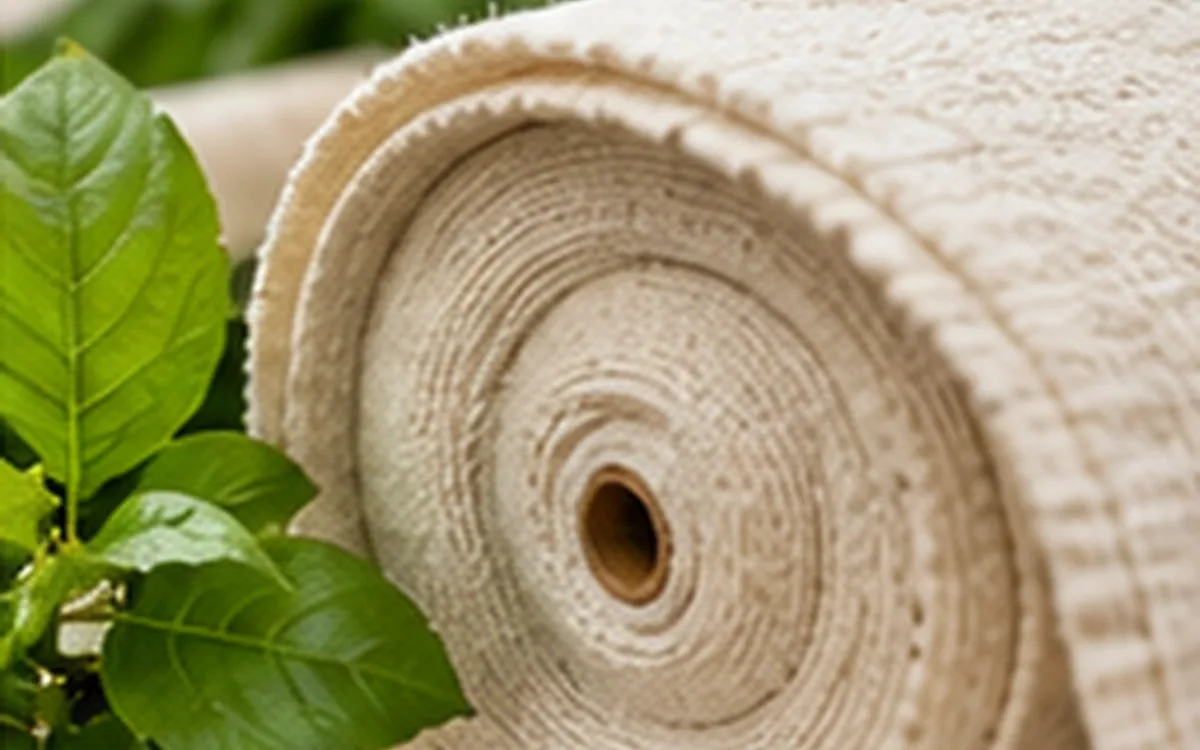
Choose the fibre form before choosing the process
A bale labelled “flax fibre” or “hemp fibre” does not tell a spinning mill enough. The material may contain long strands or short tow. It could also be partly opened bundles or cottonised fibre. Each form has a different processing history and may suit a different route.
The first decision is therefore the intended output. Is the aim a long-fibre yarn, a short-staple blend or a nonwoven web? How much variation in length, fineness and surface appearance can that product tolerate? Those answers shape the work required to turn stems into usable material.
Retting, scutching and cottonisation are connected steps, but they do different jobs. Retting helps release the fibre from surrounding tissues. Mechanical extraction removes much of the woody material. Later opening and cleaning prepare a fibre form suited to the next machine. More treatment is not always better. A sample may look cleaner yet contain more damaged or very short fibres.
The examples below use invented dry-mass data. They show how to compare routes and yields. One supplier's results do not set a rule for all bast fibres.
Understand what is being separated
Bast fibres occur in the outer part of plant stems. In trade, “fibre” can mean a strand made from several ultimate fibre cells. It need not mean one isolated cell. ISO's flax fineness guide explains why strands can remain after retting and scutching. Pectic material still binds some of their cells together.
This distinction explains a common buying problem. Two samples may have much the same measured strand length. Yet their strands may divide with very different ease. One may open into useful finer elements. Another may remain coarse or break into short pieces during preparation.
Ask what the supplier means by length and fineness. Was the sample measured as received? Or was it tested after a defined opening step or chemical treatment? A result without that context can be hard to apply to the mill's actual feed material.
Flax, hemp, jute and ramie also require their own process knowledge. Being bast fibres does not mean they can all use the same extraction recipe. This guide uses flax and hemp to explain the main choices. A trial on another species needs evidence for that material and route.
Retting changes how the fibre separates
Retting loosens the material that binds fibre-bearing tissues together. The Alliance for European Flax-Linen and Hemp describes this in European flax production. Field retting comes before mechanical extraction. Its flax processing account links the stages from harvested stems to prepared fibre.
Think of retting as preparation for separation. The aim is to extract and open the fibre with little damage. Check that result rather than rely on a fixed number of days. Raw material and field conditions can vary.
If the strands remain hard to separate, more force may break them. It may still leave unwanted material attached. At the other extreme, a process may weaken the useful fibre. Extraction then becomes easy, but the fibre loses value. The judgement should include both separation and retained properties.
An incoming inspection can compare how strands release under a defined handling check. That is useful screening, but it is not a universal retting standard. Record the procedure and compare it with material of known performance. If the result is important to a purchase, use a suitable laboratory or production trial to support it.
Field, water and enzyme routes need different evidence
Field retting depends on the crop and local conditions. A contained wet route gives other ways to control the process. It also raises questions about water, drying and effluent. An enzyme route adds another choice: the activity of the enzyme system and its effect on useful fibre.
USDA researchers studied enzyme mixtures used to ret flax. Their work showed two needs: remove the binding material and keep the useful fibre quality. A result from one tested mixture supports that experiment. A new plant or mill must still validate its own process.
That is especially important when comparing products sold under the broad name “retting enzyme.” In a separate pectinolytic-enzyme study, mixtures containing cellulase reduced fibre strength. Cellulase-free systems in that study retted flax with less strength loss. Specify the enzyme activity and measure the resulting fibre. Do not assume every enzyme treatment is gentle.
Use the approved process and supplier guidance to set conditions. Support those choices with trials on the actual material. A quicker treatment may have later costs. It could leave short fibre, weak yarn or rejected fabric.
Scutching and hackling have separate roles
Scutching mechanically separates fibre from woody stem material. Hackling further cleans and aligns long fibre while separating shorter material. The Alliance's flax-linen process map shows the streams separately. Long and short fibre go on through different preparation routes.
The distinction matters when comparing yield figures. A scutched-fibre yield is not a hackled long-fibre yield. A supplier can report a high recovery at one stage while the next stage removes a large share. Always ask where the weighing boundary sits.
Shorter material, often called tow, is not automatically useless waste. It may suit another spinning or nonwoven route if its properties meet the relevant needs. Classify each stream by its grade and use. Calling the main stream “good fibre” says too little about the rest.
Woody pieces, or shives, should also be identified separately from dust and fibre. If one trial removes more mass, examine that mass. Removing unwanted shive is different from losing usable fibre. A single waste percentage hides the distinction that the process engineer needs.
The Alliance also describes hemp fibre preparation. The desired fibre form helps determine the defibration, scutching and later steps. Ask which steps the supplier has already done. What work remains for the receiving mill?
A dry-mass balance from straw to prepared grades
Consider a hypothetical batch of 1,000 kg of dry flax straw. After the chosen extraction route, the processor records the following streams. These figures are teaching data, not typical industry yields.
Stream after extraction | Dry mass, kg | Share of starting straw |
|---|---|---|
Long-fibre stream for hackling | 250 | 25% |
Short tow stream | 100 | 10% |
Separated shives | 570 | 57% |
Collected dust and other separated matter | 60 | 6% |
Unreconciled difference | 20 | 2% |
Total | 1,000 | 100% |
The two fibre streams total 350 kg, or 35% of the starting dry mass. This is a stage yield of graded streams. It does not prove that every kilogram is pure fibre or ready for spinning.
The long-fibre stream then passes through hackling. Suppose it produces 180 kg of the intended long grade, 60 kg of tow and 10 kg of additional separated matter. The stage balance is 180 + 60 + 10 = 250 kg.
The long-grade yield can now be expressed on two bases:
Hackling-stage yield = 180 ÷ 250 × 100 = 72%
Overall long-grade yield = 180 ÷ 1,000 × 100 = 18%
Both numbers are correct, but they answer different questions. Reporting 72% without saying “of the hackling input” would badly overstate the recovery from straw.
The combined tow streams contain 100 + 60 = 160 kg. The processor can test them for another route. Their whole mass need not be treated as a loss to the long-grade product. Their usable value still depends on tests and a real outlet.
The 20 kg unreconciled difference must remain visible. It may reflect measurement error, uncollected material or an incomplete boundary. Do not call it “process loss” before finding the cause. That would make the balance look more certain than it is. Check scales, retained stock and collection points before assigning a cause.
Moisture can make one route look more efficient
The preceding example uses dry mass so that water does not disguise fibre recovery. In practice, material may be weighed at several moisture levels. The basis must stay clear when comparing incoming stems, washed fibre and dried output.
Suppose a batch weighs 500 kg as received and contains 10% water by wet mass. Its dry material is 500 × 0.90 = 450 kg. If the same dry material later contains 20% water by wet mass, the total wet mass is 450 ÷ 0.80 = 562.5 kg.
The scale now shows 62.5 kg more, although no dry fibre was added. That change cannot be credited as a better process yield. Conversely, drying can reduce gross mass without proving that useful fibre was lost.
State whether a moisture percentage is based on wet mass or dry mass. The formulas differ. The ApparelDiary moisture guide explains the two bases and how to use them in weight checks.
For trials, use a consistent method to establish the agreed dry or conditioned basis. One supplier may quote conditioned weight and another oven-dry weight. Bring them to a common basis with a justified conversion. The objective is a fair material comparison, not whichever denominator gives the higher yield.
Cottonisation prepares a form, not a new fibre species
Cottonisation adapts bast material for a short-staple processing route. It does not turn flax or hemp into cotton. Nor does the name prove that the material can run on every cotton spinning line at any blend share.
Rieter's bast-fibre processing guide stresses fibre separation, purity, strength, fineness and length. Its described flax-tow route uses progressive opening and cleaning without a cutting step. Cottonisation therefore means more than cutting a long strand to cotton length.
Cutting can control a nominal maximum length, but it does not by itself separate a coarse bundle. Opening can divide strands, but excessive treatment may create unwanted short material. A useful process must deliver the combination required by the next route.
Ask for the range of delivered lengths and the remaining shive. Also request the fineness basis and a suitable strength result. Also ask which spinning route was used to establish performance. A statement that material “spins well” is incomplete without the count, blend and conditions.
The Alliance's hemp application overview distinguishes long, semi-long and cottonised short fibre. Those are different industrial routes with different states of development. A successful result from one should not be presented as proof for all the others.
Compare two opening routes with both output and quality
Return to the example's 160 kg of tow. Divide it into two matched 80 kg trial inputs. In practice, the split must represent the source material fairly. The table shows invented outputs after routes P and Q.
Output category | Route P, kg | Route Q, kg |
|---|---|---|
Main cleaned product | 68 | 63 |
Separated short material | 6 | 10 |
Separated shive | 4 | 5 |
Collected dust | 2 | 2 |
Total | 80 | 80 |
The main-product yields are 68 ÷ 80 = 85% and 63 ÷ 80 = 78.75%. P gives five more kilograms of that grade. Q removes more shive, but it also sends more material into the short stream.
Now suppose a defined test finds 1.2% residual shive by dry mass in P's main product and 0.6% in Q's. The measured shive masses are 68 × 0.012 = 0.816 kg and 63 × 0.006 = 0.378 kg.
Those results do not show which route is better until the product needs are stated. If an agreed example limit is 0.8%, Q meets it and P does not. That limit is invented for this case. Another end use might accept P, or P might need a further cleaning trial.
The decision also needs fibre length and strength evidence. Q's cleaner appearance does not prove that its remaining fibre has avoided damage. P's higher output does not prove that the next machine can use all of it. Carry both materials into the relevant downstream test before choosing a route solely from yield.
Use visible faults to choose the next check
An opening trial often produces several changes at once. A sample may look cleaner and softer. Its range of lengths may still become less useful. To avoid choosing by appearance alone, record each observation and the question it raises.
Trial observation | Possible explanation to examine | Evidence that would help |
|---|---|---|
Coarse strands remain | Poor separation, unsuitable feed or too little opening | Compare incoming and opened strand form under a defined method |
Short material increases | Breakage, better release of existing short fibres, or both | Examine linked length distributions and the separated stream |
Shive falls but yield drops | Useful cleaning mixed with avoidable fibre loss | Sort and weigh the removed material by agreed categories |
Results vary across the batch | Uneven feed, raw-material variation or unstable treatment | Keep time-linked samples and compare the input portions |
These are hypotheses, not diagnoses. The same visible result can arise through different routes. A large short stream, for example, does not prove that all its fibres were broken in that stage. Some may already have been short but trapped in a larger strand or poorly opened mass.
A useful follow-up changes one chosen factor while preserving a fair comparison. If the question concerns opening intensity, use matched feed and the same later treatment. If retting quality is in doubt, first compare suitable raw-material groups. Harsher mechanical action may not solve the problem.
Keep the rejected stream for examination instead of sending it away as soon as it is weighed. Sort a small sample to see what was lost. Is it mainly unwanted matter or useful fibre? State how that sample was chosen; the cleanest handful from a waste bin will not represent the bin.
The trial record should finish with the unresolved question. For example: “Q removes more shive, but the extra short stream needs examination before we attribute it to damage.” This is a stronger basis for the next test than deciding that the cleaner route must be better.
Specify tests that fit the material form
Fineness testing needs particular care with bast strands. ISO 2370:2019 specifies permeametric methods for flax. The forms covered include long strands, broken strands and tow. Those forms are listed in its public scope. Other bast species or products need a method suited to them.
When ordering a test, identify the fibre species, form and preparation stage. State whether the question concerns the material as delivered or after a defined opening step. If the lab changes the preparation, include that change in the report.
Use a length test that makes sense for the distribution and strand form. A single average may hide a small but important long tail or a large short-fibre share. Ask which parts of the distribution could affect the planned equipment, then request the relevant result.
Strength results also need a stated specimen type and method. An ultimate fibre, a technical bundle and a yarn are not the same test piece. Comparing their numbers without that distinction can turn a true result into a false conclusion.
For residual shive, agree the separation and weighing procedure. A visual rating may be useful for screening, but it is not automatically a mass percentage. If two suppliers use different methods, run a common comparison before ranking them by a small difference.
Keep reference samples from each stage of a trial. An output sample alone may show that a problem exists. Linked input, intermediate and output samples give a better chance of finding where it arose.
Evaluate the yarn or web, not just the prepared bale
The purpose of fibre preparation is to support the next product. A cottonised bale that looks soft and clean may still give an unsuitable yarn. A coarser material may be quite useful in a different structure or nonwoven application.
For a short-staple blend, begin with a defined recipe and feed basis. Record the actual masses and whether either component is lost at a different rate. The input blend ratio need not equal the final yarn ratio when losses differ.
Observe stops, waste composition, yarn uniformity and strength under a stated route. Then assess the required fabric appearance and care response. Do not assume that a smooth-looking laboratory yarn represents a full production run.
For a nonwoven, choose tests that match its use. Web uniformity and bonding response may matter more than the same properties used to rank a fine spinning fibre. Let the receiving process define the evidence needed. A specification copied from an unrelated product may miss the real issue.
A sound process and a sound inspection serve different purposes. ApparelDiary's quality assurance and control guide explains how they work together. Bast processing needs both. The route must suit the fibre, and its output must meet the intended grade.
Compare environmental claims within a clear boundary
The word “natural” does not quantify the impact of a processing route. State the crop source and retting method. Identify the extraction, drying and later steps included in the comparison. It also states the output to which those inputs are assigned.
The Alliance publishes a European flax-linen process map. It separates fibre extraction from the later spinning and fabric stages. Use that kind of boundary to ask better questions. Data for scutched fibre does not describe a finished garment unless the remaining stages are included.
For two mill trials, record energy, water and chemical use against comparable saleable output. A lower input per kilogram of straw may not mean a lower input per kilogram of accepted fibre. If one route produces more co-products, state how their use is treated in the comparison.
Avoid assigning every separated stream a beneficial outlet without evidence. A possible use for shives is different from a documented use for the actual shives produced. The same applies to tow, dust and returned fibre.
A narrow claim can still be useful. One route may use less measured water for the tested output under the stated conditions. Extending that result to all impacts, all crops or all finished textiles would require more evidence.
Set the acceptance decision at the right stage
A processor should be able to describe the delivered form in practical terms. Identify the species and preparation route. State how length and fineness were measured, and what unwanted matter remains. Include evidence for the intended use. A trade name alone does not supply that detail.
For the worked case, the final choice might be Q for the stated shive limit, subject to acceptable downstream results. P might remain a candidate for another grade or a revised cleaning trial. The decision should preserve those reasons instead of labelling one route universally superior.
Bast processing is a sequence of selective separations. Each step should remove what the next stage cannot use while preserving the useful material. Define that purpose, reconcile the mass, test the delivered form and follow it into the product. The aim is the same for retting, scutching and cottonisation. Each should help deliver a consistent grade that the receiving process can use.
References
Alliance for European Flax-Linen and Hemp: Flax growing and processing.
Evans, Akin and Foulk: Enzyme mixtures for flax retting, USDA research record.
Foulk, Akin and Dodd: Pectinolytic enzymes and resulting fibre properties, USDA research record.
Rieter: Spinning bast fibres and cottonisation of flax and hemp.
ISO 2370:2019: Flax fibre fineness by permeametric methods, public scope.

Discussion0
Loading the discussion…