
Fabric moisture regain compares water mass with dry textile mass. Moisture content compares water mass with the total mass containing that water. The two percentages use different denominators, so substituting one for the other can distort a receiving reconciliation even when the scale readings are correct.
For textile laboratory staff and fabric receiving controllers, the task is to preserve the material's condition, select the agreed test method and compare quantities on a declared basis. This guide explains the arithmetic and record controls. It does not prescribe drying temperatures, instrument settings or a universal commercial moisture allowance.
Distinguish the two denominators
Let the initial sample mass be M and the dry mass determined by the applicable method be D. Water mass in the simplified calculation is M − D. Moisture regain percent equals (M − D) ÷ D × 100. Moisture content percent equals (M − D) ÷ M × 100.
The denominator determines the meaning. Regain expresses water relative to the dry material. Content expresses water as a fraction of the total measured material. Always write the quantity name beside its percentage. A field labelled moisture percent is incomplete without the basis and method.
ASTM D2654-22 covers moisture measurement in textiles and identifies method limitations. Its public discussion also notes that loss of volatile material other than water can affect oven-drying results. A mass reduction is therefore not automatically a pure water measurement for every finish or material.
Use a competent laboratory to select the procedure and assess applicability. Do not dry an unknown finished fabric using an improvised process or use a handheld meter's unverified percentage as an equivalent laboratory result. The receiving record should identify the instrument, calibration basis and material suitability where such screening equipment is used.
Work through the same sample on both bases
Take an illustrative sample initially weighing 108.0 grams and with a method-determined dry mass of 100.0 grams. The calculated water mass is 8.0 grams. Moisture regain is 8 ÷ 100 × 100 = 8.0 percent. Moisture content is 8 ÷ 108 × 100 = approximately 7.407 percent.
Quantity | Calculation | Result |
|---|---|---|
Water mass | 108.0 − 100.0 | 8.0 g |
Regain | 8.0 ÷ 100.0 × 100 | 8.000 percent |
Content | 8.0 ÷ 108.0 × 100 | 7.407 percent |
Dry share of initial mass | 100.0 ÷ 108.0 × 100 | 92.593 percent |
If regain R is expressed as a percentage number, content percent is 100R ÷ (100 + R). If content C is expressed as a percentage number, regain percent is 100C ÷ (100 − C). The second expression requires C below 100. Use consistent percentage notation; entering 0.08 where the formula expects 8 changes the result.
As a check, 7.407407 percent content converts back to 8 percent regain before rounding. Retain unrounded calculations in the laboratory worksheet and round only the reported result to the approved precision. Apparent disagreement at the last displayed digit may be a rounding effect rather than a second material condition.
Preserve the receiving condition
A sample can exchange moisture with its surroundings between receipt and testing. Record the sampling time, sample location, packaging condition and handling method under the approved laboratory procedure. The objective is to know which state a result describes, not to attach a generic humidity note after the sample has changed.
ISO 139:2005 and its listed 2011 amendment address conditioning and testing atmospheres. Conditioning a sample for a specified physical test answers a different question from measuring its moisture at the moment of receipt. Retain both results with their state descriptions when the investigation needs both.
For a roll that arrives with damaged or damp packaging, preserve the observation and apply the site's assessment procedure. Do not infer uniform moisture through the roll from one accessible edge sample. A sampling plan must be capable of investigating the suspected pattern, while accounting for safe handling and material integrity.
The GSM and roll weight guide provides the wider reconciliation context. Its mass-per-area result and the receipt scale reading should not be treated as directly interchangeable if they describe different moisture or dimensional states.
Separate commercial allowance from measured regain
ASTM D1909-13(2026) describes commercial regain and allowance values as agreed commercial quantities rather than experimentally measured properties of every delivered material. A commercial allowance cannot be assumed to equal the actual moisture of a roll, and it is not automatically a garment buyer's acceptance tolerance.
Where a purchase contract explicitly uses a regain basis, retain that reference and have the laboratory and commercial team approve the calculation. Do not import a fibre table value into a finished fabric transaction without confirming composition, finish, method and contractual applicability.
For a purely illustrative calculation, suppose a material has 500 kilograms of method-determined dry mass. At an agreed reference regain of 6 percent, its corresponding mass would be 500 × 1.06 = 530 kilograms. At an observed regain of 9 percent, its mass would be 500 × 1.09 = 545 kilograms. The 15-kilogram difference is a condition-basis difference in this model, not evidence of missing dry textile.
The 6 and 9 percent figures are teaching assumptions. They are not recommended values for cotton, blends or any purchase agreement. If the actual method cannot establish comparable dry mass, the calculation is insufficient to support an invoice adjustment.
Design a moisture investigation record
Start with roll identity and material description, then connect every sample to its location and time. Record initial mass, method-determined dry mass, calculation basis, conditioning or preservation details and the laboratory report reference. Keep the commercial rule in a separate field.
The reviewer should be able to reconstruct whether an apparent receiving-weight difference came from the denominator, a changed material condition, sampling or another measurement issue. Report uncertainty and limitations in the laboratory's required form. Extra decimal places cannot repair unrepresentative sampling.
If a receiving record mixes kilograms and metres, keep the quantity conversions separate from moisture arithmetic. The yarn count systems guide explains another unit-sensitive textile measurement. A correct count conversion is still not proof that two conditioned mass measurements describe the same material state.
Challenge the result before using it commercially
Ask the laboratory whether the initial and dry measurements belong to the same identified specimen and whether any fibres or finish were lost during handling. Ask which result represents the receipt state and which represents a later conditioned state. Confirm that repeat tests and control checks meet the selected procedure. These questions establish whether the arithmetic describes the intended material; they do not replace the laboratory's own quality controls. If the answers are incomplete, retain a qualified investigation result rather than issuing an apparently definitive commercial adjustment.
Avoid corrections that erase the evidence
Do not change the receiving weight to the reference weight in the original transaction. Store a separate calculated comparison with the approved method and contractual basis. This preserves the physical observation and allows finance to distinguish measured stock from a commercial settlement quantity.
Do not conclude that a small mass loss proves acceptable storage or that a large one proves deliberate water addition. Those interpretations need a broader investigation. Packaging, finish volatility, test applicability and sample history can all affect what the mass difference means.
For the next disputed delivery, ask the laboratory to name the question before choosing the test: moisture at receipt, conditioned physical performance or commercial mass reconciliation. Use the corresponding approved procedure and retain the result's basis. Once that distinction is visible, receiving and supplier teams can compare the same quantity.
References
ASTM D2654-22 Standard Test Methods for Moisture in Textiles
ASTM D1909-13(2026) Commercial Moisture Regains and Commercial Allowances for Textile Fibers
ISO 139:2005 Textiles Standard atmospheres for conditioning and testing
ARTICLE BODY END
Editorial appendix
Original calendar seed: fabric moisture regain during receiving
Adopted intent: fabric moisture regain during receiving
Intended action: NEW; Retain the seed as a distinct laboratory interpretation task.
Content gap: The GSM hub identifies moisture as a limitation but does not explain denominators and commercial-basis separation.
Distinct added value: Round-trip regain and content calculation; dry-mass commercial-basis teaching example and specimen-history review questions.
Nearest existing canonical: https://appareldiary.com/article/fabric-gsm-testing-and-roll-weight-calculation-guide
Overlap checks: Checked live homepage, topics, tools, search, both archive pages for the three nonsafety verticals, Safety navigation and known earlier draft topics. Public-page and title screening is incomplete for unpublished work because no complete CMS or prior-state export was supplied.
Keyword evidence: Source: supplied Day 1 calendar and current public search retrieval. Geography: international English queries; location not controlled. Date: 2026-10-18 Asia/Dhaka. Current volume, KD, ranking and property performance: Not independently verified. Historical SEMrush screenshot rows in the calendar were not promoted to current evidence.
SERP observations: Results included ASTM D2654 moisture methods and D1909 commercial regain references. This draft separates the laboratory question from the commercial settlement basis rather than recommending a universal correction. Observed 2026-10-18; returned search results are not a complete or location-controlled Google ranking capture.
Continuity: The available state is blank, so the prompt default selects Day 1. Today adds ten DRAFT rows; no publication is claimed.
Technical QA: 108 g initial and 100 g dry yield regain 8 percent and content 7.407407 percent. Conversion round trip checked. A 500 kg dry basis gives 530 kg at 6 percent and 545 kg at 9 percent; assumptions are invented and not fibre allowances.
Reviewer questions and caveats: Laboratory to approve method applicability, preservation, finish-volatility limitations and uncertainty. Commercial team must verify any settlement basis. No temperature or chemical handling prescription.
Implementation: Review and approve before CMS use. For REFRESH, compare and merge into the stated live canonical; retain verified assets and author attribution. For NEW, recheck overlap and canonical settings immediately before publication.
Source verification
ASTM D2654-22 Standard Test Methods for Moisture in Textiles — Public discussion identifies moisture methods and non-water volatile-loss limitations; no drying recipe is supplied. Accessed 2026-10-18 Asia/Dhaka.
ASTM D1909-13(2026) Commercial Moisture Regains and Commercial Allowances for Textile Fibers — Public scope distinguishes commercial defined allowances from measured material moisture. No copyrighted regain table reproduced. Accessed 2026-10-18 Asia/Dhaka.
ISO 139:2005 Textiles Standard atmospheres for conditioning and testing — Public abstract supports the conditioning-atmosphere reference only; exact laboratory conditions are not prescribed here. Accessed 2026-10-18 Asia/Dhaka.
ISO 139:2005 Amendment 1:2011 — Public catalogue confirms the listed amendment; full text not accessed. Accessed 2026-10-18 Asia/Dhaka.
Internal link map
GSM and roll weight guide | body section: Preserve the receiving condition. Live destination opened during research.
yarn count systems guide | body section: Design a moisture investigation record. Live destination opened during research.
Suggested reverse link: https://appareldiary.com/article/fabric-gsm-testing-and-roll-weight-calculation-guide → this approved article or refreshed section using its operational task as anchor. Add only after editorial approval.
Pending batch links: Article 01 receiving checklist after approval. These are editorial suggestions only; no proposed destination is linked as live in the body.
Featured image brief
Suggested filename: fabric-moisture-regain-receiving-weight-checks-featured.webp
Size and crop: 1200 x 750 pixels; 1.6:1 landscape. WebP for the eventual asset; aim near 50 KB when feasible and below 100 KB without severe degradation. Status: brief only.
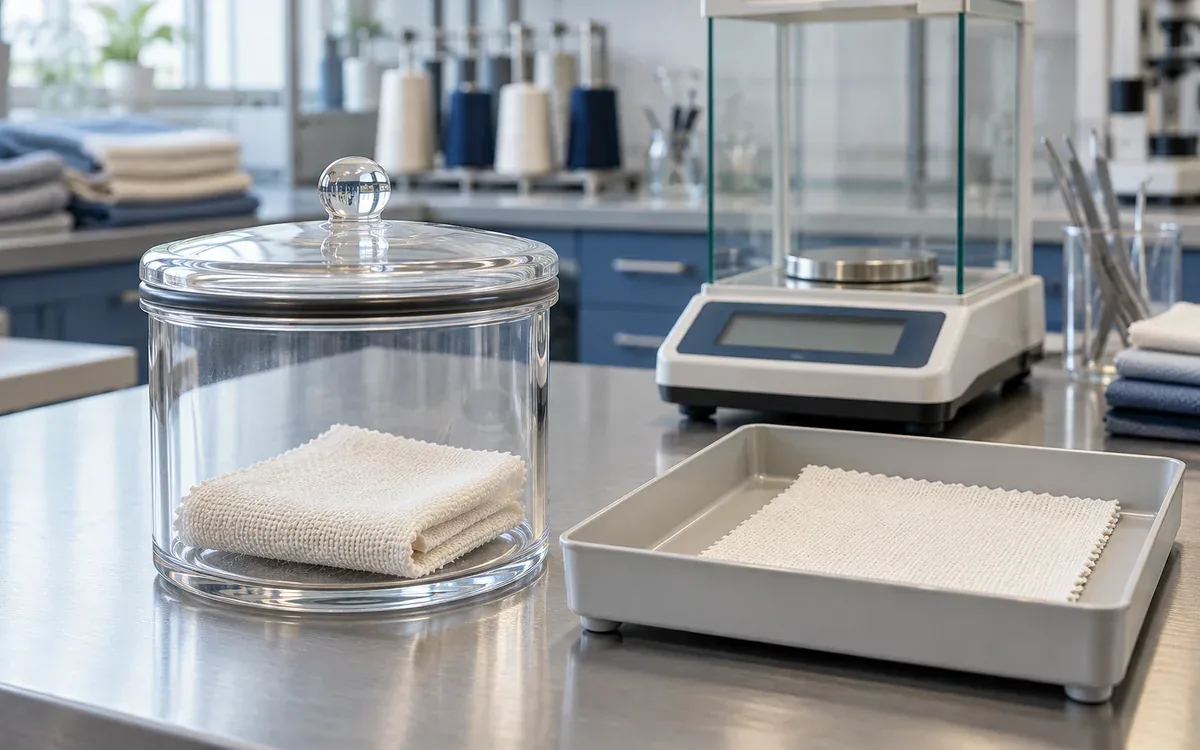
Generation prompt: Create a photorealistic professional industrial editorial photograph. A clean textile laboratory with a sealed transparent specimen container holding cotton fabric, a separate open conditioning tray with another matching sample and a precision balance with a blank display. Show calm controlled surroundings and real cloth texture, without claiming a particular humidity. Use believable textile materials and construction, natural proportions, restrained cream steel and blue tones, and soft balanced lighting. Keep the main subject in a central crop-safe area with crisp fabric texture. Compose at 1200 x 750 pixels for eventual WebP export. The scene is explanatory and is not attributed to any real factory.
Draft alt text: Fabric sample container and conditioning tray beside a laboratory balance
Optional caption: Review the material and records together before approving the next action.
Negative constraints: No female figures; no people needed. No readable numbers, text, fake labels, logos, watermark, unsafe practice, exposed blades, obstructed exits, fictional measurements or claimed real-factory attribution.
QA precautions: Inspect the eventual asset for plausible equipment and cloth, crop, stray text, compression damage and correspondence to this article. Any precise labels or data visual must be typeset and checked separately.
In-body image brief
Suggested filename: fabric-moisture-regain-receiving-weight-checks-body.webp
Size and crop: 1200 x 750 pixels; 1.6:1 landscape. WebP for the eventual asset; aim near 50 KB when feasible and below 100 KB without severe degradation. Status: brief only.
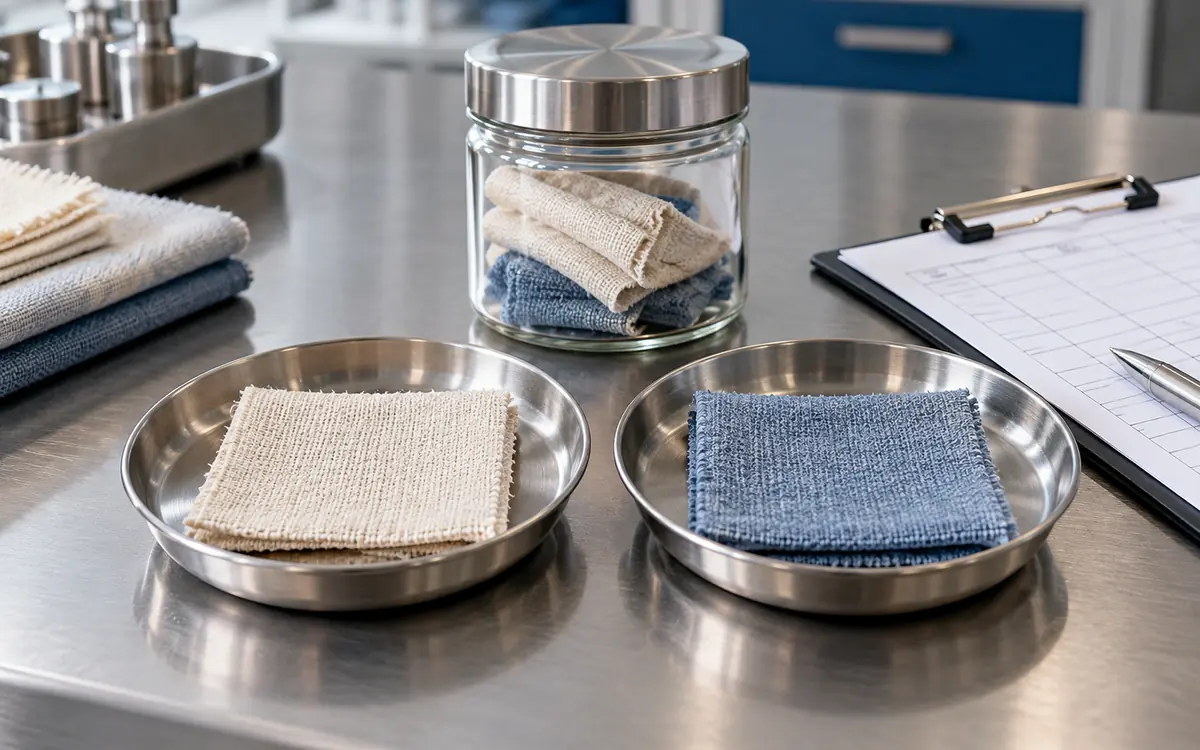
Generation prompt: Create a photorealistic professional industrial editorial photograph. A close editorial still life showing two equal-size fabric specimens in separate shallow weighing dishes beside a sealed sample jar and a blank laboratory record. Composition should distinguish receipt-preserved and laboratory-handled samples without picturing active drying or exposed hot equipment. Use believable textile materials and construction, natural proportions, restrained cream steel and blue tones, and soft balanced lighting. Keep the main subject in a central crop-safe area with crisp fabric texture. Compose at 1200 x 750 pixels for eventual WebP export. The scene is explanatory and is not attributed to any real factory.
Draft alt text: Separate fabric specimens and a sealed jar prepared for a moisture investigation
Optional caption: Round-trip regain and content calculation.
Negative constraints: No female figures; no people needed. No readable numbers, text, fake labels, logos, watermark, unsafe practice, exposed blades, obstructed exits, fictional measurements or claimed real-factory attribution.
QA precautions: Inspect the eventual asset for plausible equipment and cloth, crop, stray text, compression damage and correspondence to this article. Any precise labels or data visual must be typeset and checked separately.
Discussion0
Loading the discussion…