
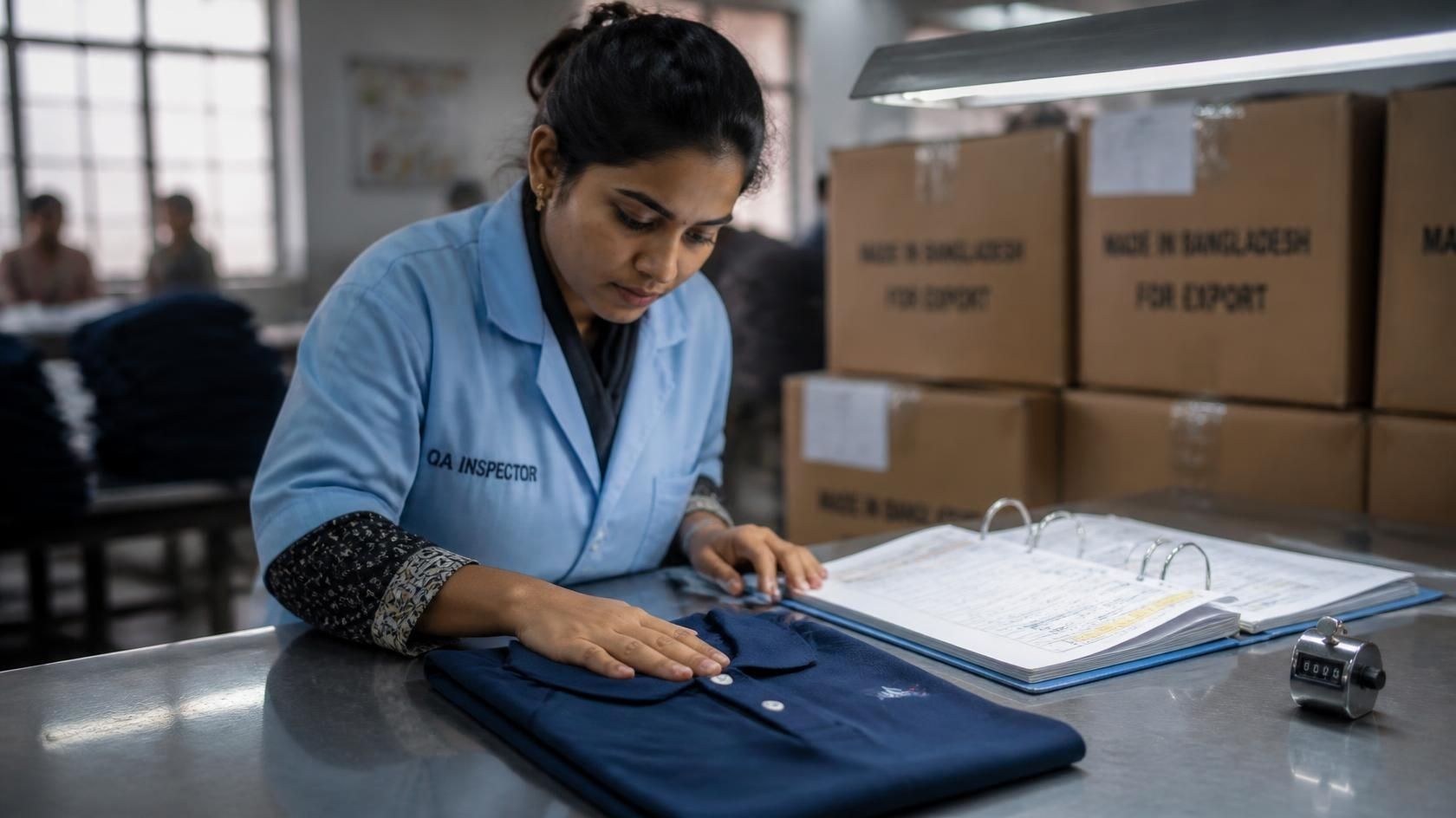
The final inspection is at 9 a.m. The buyer's QC opens eleven cartons off the top of the nearest pallet, pulls 125 pieces, finds nine majors, and fails the lot. Your QA manager says the pieces were not random. The QC says the plan was AQL 2.5, seven is the accept number, and nine is nine.
Nobody can settle it, because nobody can say which inspection level was used, which lot size row it came from, or whether the plan should already have moved to tightened after last month's two rejections.
That argument costs money that never reaches the costing sheet: 100% sorting at 0.6 to 1.2 minutes per piece, a re-inspection fee, and an air freight conversation that wipes out the margin on a 20,000-piece order. A factory that cannot read its own sampling plan out loud loses every disputed lot, in much the same way a factory that cannot show its stage-by-stage control over the cutting process loses the argument when a measurement defect turns up at final inspection.
AQL 2.5 is not a permitted defect rate, and treating it as one is the most common error in apparel quality management. It is a producer's risk quality level: the process average a plan will still accept most of the time.
What does AQL 2.5 actually guarantee?
The acceptable quality limit is the worst process average a plan would still routinely accept. Passing does not certify that the shipment contains 2.5% defects or fewer; it says the sample produced insufficient evidence to reject.
True defect rate in the lot | Probability the lot is accepted (n=125, Ac=7) |
|---|---|
2.5% (at the AQL) | 98.6% |
4.0% | 87.1% |
5.0% (twice the AQL) | 71.2% |
8.0% | 20.9% |
9.2% (the limiting quality) | 10.0% |
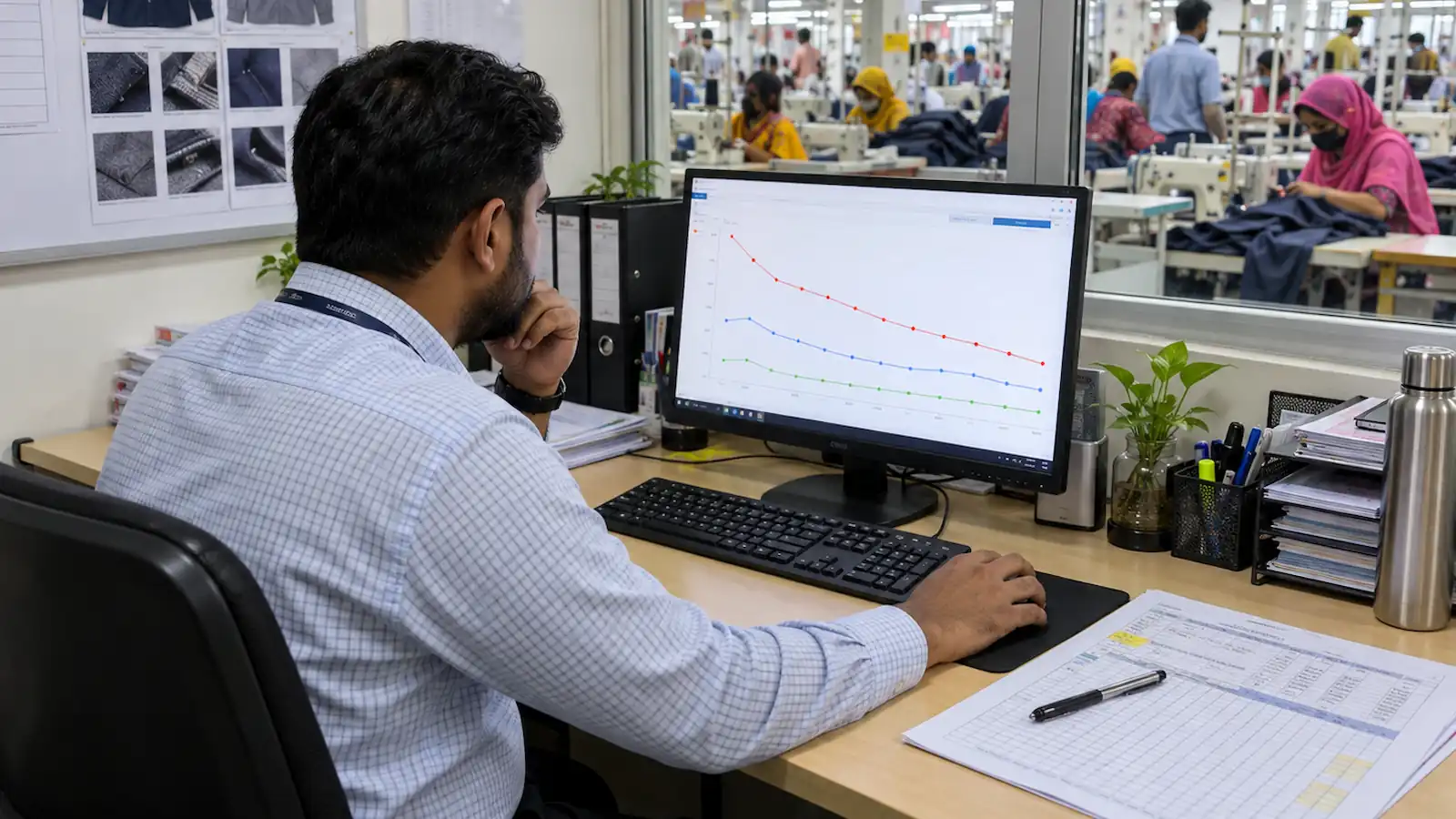
A lot running at double the AQL still passes roughly seven times in ten. The plan is not a filter. It is a cheap test with a low producer's risk at the AQL and a consumer's risk that only bites near 9% defective. So "we shipped at AQL 2.5" is a statement about procedure, not about quality, the same distinction a control chart tracking Cp/Cpk over time makes clear, since it shows whether the process itself is capable rather than whether one sample happened to slip through.
Step 1: Choose the inspection level before you open a table
The level is chosen first, and it is a commercial decision, not a statistical one. Level II is the default and the referee level. Level I gives about 40% of the Level II sample and suits cheap, stable, repeat goods. Level III gives about 1.6 times the Level II sample, for new suppliers, new styles, or a rejection history.
Write the level into the purchase order and the booking. Two-thirds of the disputes I have sat through were not about defects: one side assumed Level II, the other had booked Level I.
Step 2: Convert lot size into a sample size and an accept number
Three moves, always in this order: lot size to code letter at the chosen inspection level, code letter to sample size from the single sampling plan for normal inspection, then sample size plus AQL to accept (Ac) and reject (Re) numbers.
Lot size | Code | Sample | AQL 2.5 Ac/Re | AQL 4.0 Ac/Re |
|---|---|---|---|---|
151–280 | G | 32 | 2 / 3 | 3 / 4 |
281–500 | H | 50 | 3 / 4 | 5 / 6 |
501–1,200 | J | 80 | 5 / 6 | 7 / 8 |
1,201–3,200 | K | 125 | 7 / 8 | 10 / 11 |
3,201–10,000 | L | 200 | 10 / 11 | 14 / 15 |
10,001–35,000 | M | 315 | 14 / 15 | 21 / 22 |
Worked example. A 2,600-piece lot of men's polos, General Level II, 2.5 major and 4.0 minor. The lot falls in 1,201–3,200, so the code letter is K and the sample is 125. Accept on 7 majors, reject on 8. Accept on 10 minors, reject on 11. Critical: zero.
Both limits are judged against the same 125 pieces. You do not draw one sample for majors and another for minors, and a piece carrying one major and two minors counts once in each class.
Field note: a woven bottoms unit outside Gazipur ran double sampling on a repeat chino programme across 14 lots of 2,400–2,900 pieces. Eleven closed on the first draw of 80. Average pieces inspected per lot fell from 125 to 96 (about 23% less inspection labour), and back-checking against the single plan changed no lot's outcome.
Step 3: Run the switching rules: normal, tightened, reduced
This is where most published guidance stops, and it decides whether the programme has teeth. ISO 2859-1 is not a table, it is a scheme, and the switching rules are what make it one.
Switch | Trigger | Effect |
|---|---|---|
Normal → Tightened | 2 of 5 consecutive lots rejected on original inspection | Same sample, lower accept number |
Tightened → Normal | 5 consecutive lots accepted under tightened | Back to normal |
Tightened → Stop | 5 lots on tightened without returning to normal | Suspend acceptance sampling until the process is corrected |
Normal → Reduced | 10 consecutive lots accepted, production steady, buyer authorises | Smaller sample, split Ac/Re |
Reduced → Normal | A lot is rejected, or production turns irregular | Back to normal |
Tightened inspection cuts the acceptance probability of a 5% lot from 71% to 40%. That is the entire enforcement mechanism, and a supplier who failed two of the last five lots but is still on normal is running a weaker plan than the contract specifies.
If you keep one record from this article, keep the switching log: a dated, per-supplier register of lot number, severity in force, sample size, defects found and disposition. Without it the rules are unenforceable.
How should critical, major and minor defects be split?
AQL 2.5 is almost always the major limit in apparel. The convention across most buyers is 2.5 major, 4.0 minor, zero critical.
Class | Definition | Apparel examples | Limit |
|---|---|---|---|
Critical | Unsafe or unlawful for the user | Broken needle fragment, missing regulatory label, choking hazard trim | 0, any occurrence rejects |
Major | Likely to cause a return, claim or markdown | Stain on a front panel, open seam, measurement outside tolerance, shade variation | 2.5 |
Minor | Unlikely to affect usability or sale | Uneven topstitch in a concealed area, loose thread, packing irregularity | 4.0 |
Ninety per cent of inspection disputes are classification disputes, not counting disputes. The fix is physical, not written. Build a defect board of real boundary-case garments (the stain that is major beside the stain that is minor), signed by factory and buyer at the pre-production meeting and kept in the inspection room. The same structured, physical approach is worth applying upstream too: a proper hazard identification and risk assessment of the inspection room itself, covering needle detection and manual handling, tends to surface the process gaps that later show up as disputed defects.
The AQL 2.5 pre-inspection checklist
Standard named in the PO: ISO 2859-1 or Z1.4
Inspection level written down (General II unless stated)
Limits per class: critical 0, major 2.5, minor 4.0
Lot complete and homogeneous, one style, one PO
Lot size checked against packing list, code letter derived
Ac/Re read from the correct severity table
Severity in force checked against the switching log
Signed defect board in the inspection room
Cartons numbered, random draw list recorded
Resubmission declared if previously rejected
Final Word
AQL 2.5 has survived seventy years because it is cheap, auditable and legible to both sides. It was never a promise about quality, and everyone in the room knows it once the numbers are read honestly.
The factories that win disputes are not the ones with the lowest defect rates. They are the ones that can produce a switching log, a signed defect board and a recorded carton draw list within ninety seconds of being asked, and, further back in the process, the ones whose cutting room marker planning and efficiency was tight enough that panel-level defects never reached the sewing line in the first place.

Discussion0
Loading the discussion…