
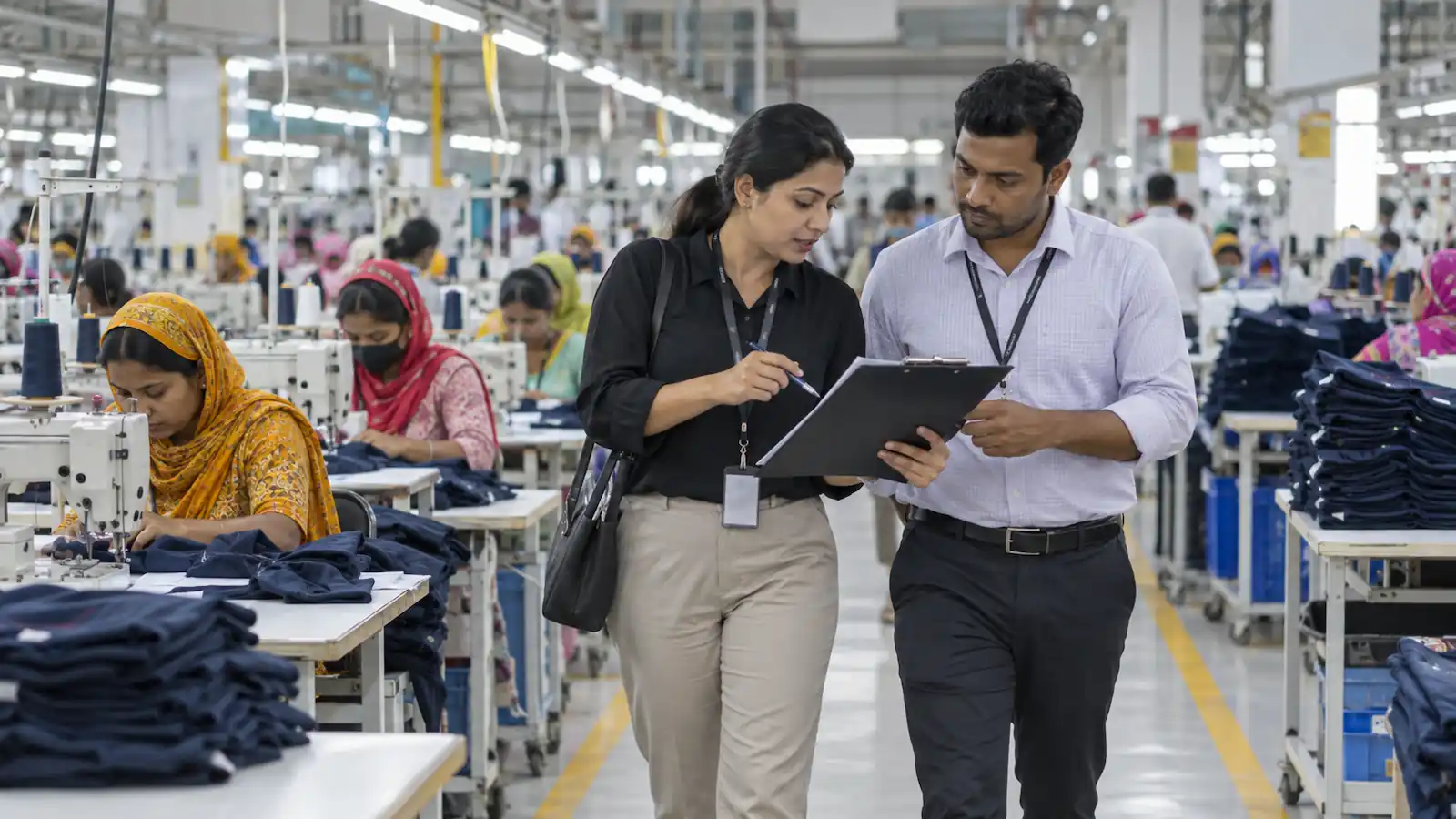
The morning of a buyer's audit has a particular kind of tension to it. The floor gets an extra sweep, the supervisors quietly double-check their folders, and everyone knows that today is not really about whether one shipment is good. It is about whether the person walking through the door with a clipboard decides this factory can be trusted with the next three years of orders, not just the next three weeks.
The Auditor Is Not Looking At Your Product. They Are Looking Through It.
A buyer's quality team does not walk onto a floor to admire good stitching. They walk in to find out whether that good stitching was an accident or a system. A single perfect garment proves almost nothing on its own; a documented, repeatable process that produced it, and can prove it again next season, proves everything. That is why the same audit looks different depending on the factory's history with that buyer.
Factory type | What the auditor is really testing |
|---|---|
New or first-time supplier | Basic discipline: is the floor organized, are machines maintained and calibrated, are workers trained on the specific process they are performing, does a documented system exist at all |
Standard or established supplier | Data-driven consistency: can the factory prove its quality metrics over time, not just describe them; does a defect trend go down after a corrective action, or does the same problem quietly resurface next month |
Rather than one pass-or-fail stamp, most serious buyer audits score a factory chapter by chapter, across categories like organization, sampling, fit and measurement, materials and trims, cutting, production, finishing, packing, and final inspection. A factory can be strong in cutting and weak in trims, and the audit is built to show that unevenness rather than hide it behind one overall grade.
Four Things Every Serious Audit Actually Checks
Strip away the paperwork and the walkthrough, and every serious buyer audit is really testing the same four things.
1. AQL: The Shared Language of Sampling
AQL, the acceptable quality limit, is the industry's common baseline for deciding how many pieces to check out of a shipment and how many defects are allowed before the whole lot is rejected. A factory that cannot speak AQL fluently, that cannot explain why a 1,200 piece lot gets a specific sample size, or what separates a critical defect from a minor one, immediately signals to an auditor that inspection is being done by feel rather than by standard. The full mechanics of picking an inspection level and reading the accept and reject numbers are covered in AQL 2.5 Sampling: How to Read the Inspection Table, and the site's own AQL sampling plan calculator will run the ISO 2859-1 numbers for any lot size directly.
2. Traceability: Can You Follow One Garment Backward?
A confident auditor does not just look at a finished garment. They pick one, almost at random, and ask the factory to trace it backward: which fabric roll it was cut from, which line and which shift sewed it, which accessories lot went into it, and which inspection reports signed off on it along the way. In a factory with real document control, that trail exists on paper, from the order sheet and pre-production meeting note, through the first bundle report and daily inline inspection, to the pre-final and final inspection reports and the shade and GSM record for that specific fabric batch. In a factory without it, that question causes a very long silence.
3. CAPA: Proof That Problems Get Closed, Not Just Found
No buyer expects a factory to be perfect. They expect a factory to have a real CAPA (corrective action plan) discipline: when a defect or a rejection happens, it gets a documented root cause, a specific fix, a named responsible person, and a date. Real factory quality reviews commonly run this as a simple recurring table, cause of rejection, root cause, CAPA, responsible person, reviewed by management on a set schedule. What an auditor is really checking is whether that table gets used honestly and whether the same root cause keeps reappearing month after month, which is the clearest sign of a corrective action that was written down but never actually implemented.
4. Two Separate Compliance Checks, Often Confused as One
"Compliance" gets used as a catch-all word, but a serious audit actually runs two distinct checks side by side. Product safety and restricted-substance testing covers the garment itself: dye and chemical residue limits (azo dyes, formaldehyde, pH), surface coatings, extractable heavy metals, plus physical safety checks like needle detection, metal detection and pull testing on trims. Social and ethical compliance covers the people making the garment: safe working conditions, fair wages, reasonable hours, and a firm line against child labor. A factory can pass one and fail the other, and treating them as a single checkbox is exactly the kind of gap that risk-based audits, similar in spirit to the structured risk assessment approach used on the safety side of a factory, are specifically designed to expose.
Field note: the factories that pass audits comfortably are rarely the ones scrambling to find paperwork the morning of the visit. They are the ones where that paperwork was already sitting in its usual place, because it gets used every single day, not just when someone is watching.
Why This Is the Real Continuation of the Buyer Relationship
The audit is not a one-time event disconnected from everything else in the relationship. It is the formal version of the trust question that starts building the day a buyer first walks into a factory, covered in The Buyer's Journey in Bangladesh, Part 2. A factory that has already built genuine documented discipline into its daily process is simply showing the auditor something that was already true, rather than performing it for one morning. That same discipline, extended into physical security and visitor handling on the day of a real audit visit, is exactly what a structured access control and visitor management system is built to support, and the same logic that keeps a compartmentalized fire risk plan current all year round is what keeps a compliance file current between audits instead of being rebuilt from scratch each time.
Buyer Audit Readiness Checklist
Inspection level and AQL basis for the current order can be explained and reproduced on demand, not just recited from memory
A finished garment can be traced backward through fabric roll, sewing line, accessories lot and inspection report without a long delay
A live CAPA log exists with root cause, action, responsible person and date, reviewed on a real schedule, not created for the audit
Product safety and restricted-substance test records are kept and filed separately from social and labor compliance records
Recent corrective actions can be shown to have actually reduced a repeat defect, not just documented it once
Final Word
An auditor walking onto a factory floor is not grading the garment in front of them. They are grading the system that will still be producing garments the same way six months from now, whether or not anyone is watching that day. AQL sampling, traceability, CAPA discipline, and two distinct compliance checks, one for the product and one for the people, are the four things that system gets measured against, and every one of them is something a factory can build and prove long before an auditor ever walks in.
In Part 3, we get into the single number that most decides how that audit conversation goes: DHU, and why it is treated less like a quality statistic and more like a factory's daily heartbeat.
Discussion0
Loading the discussion…