
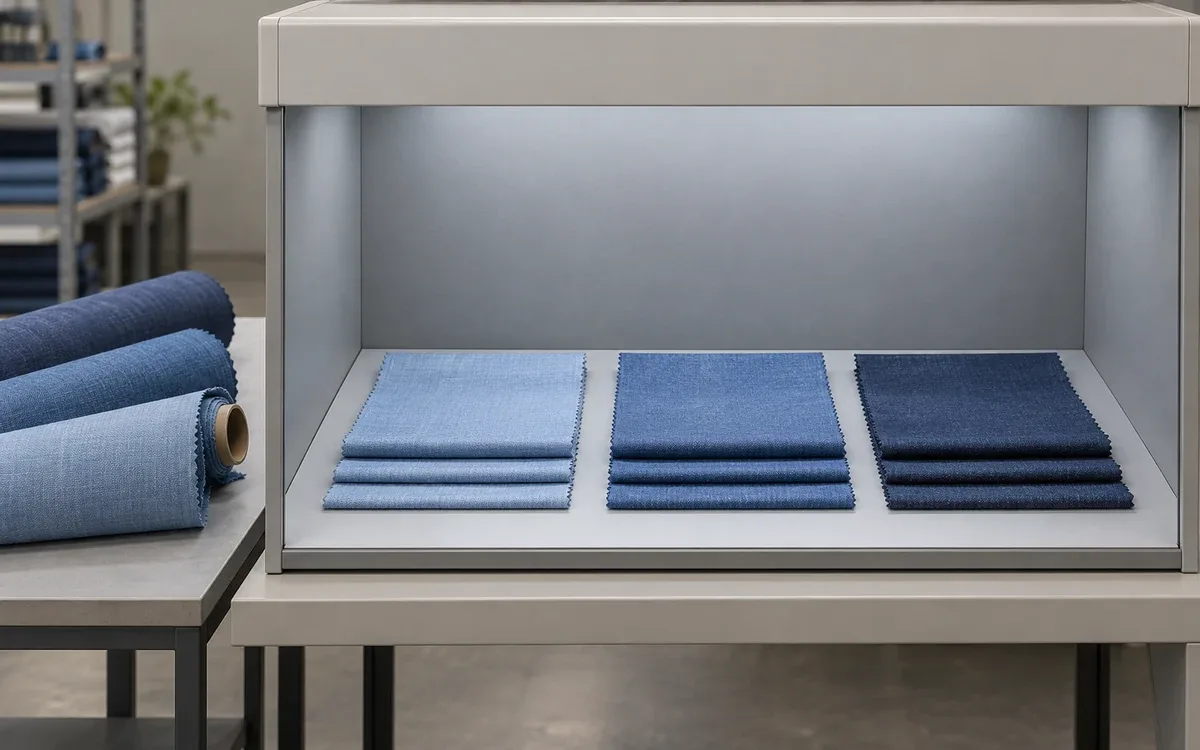
Fabric shade segregation keeps incompatible rolls or roll sections from being combined into the same garment. It begins with a repeatable colour assessment and ends only when the approved grouping survives spreading, cutting, bundling and recutting. A shade card on a laboratory wall does not control what reaches the sewing line.
This guide helps fabric QA and cutting planners build a roll-to-lay allocation record. It separates approval against the master standard from compatibility between panels. The grouping method and acceptance limits must be agreed with the buyer; there is no universal shade-band count or colour-difference threshold suitable for every fabric.
Separate master approval from panel matching
A roll can fall within an agreed tolerance to the approved colour standard while differing visibly from another approved roll. That distinction matters when the two become adjacent panels. Approval to the master and compatibility within a garment are related decisions, but they are not identical.
Datacolor's light-booth guidance explains how controlled illumination and viewing conditions support visual comparison. Its Tools documentation separately identifies roll-to-roll sorting and side-centre-side variation assessment. Those capabilities support a controlled evaluation; they do not establish a buyer's acceptance criterion or require the purchase of a particular system.
Use the approved master, defined light sources and consistent sample presentation. Identify fabric face and direction, especially where texture or nap changes appearance. The procedure should state how instrumental measurements and visual decisions interact, including who resolves a disagreement.
Record the colour-difference equation and measurement settings when numerical data are used. A value labelled only delta E is incomplete. Do not mix measurements from different settings or treat a photograph viewed on a screen as a substitute for the approved colour assessment.
Capture variation within a roll
Do not assign a group from one end swatch if the investigation concerns variation along the length or across the width. Define sampling locations capable of showing the suspected pattern. Keep every sample linked to its roll, location, direction and assessment record.
The approved procedure may distinguish a whole roll from separately identified usable sections. If a boundary occurs along the roll, mark and record the affected length so the spreading team can maintain the restriction. A laboratory group label that cannot be located physically is not an actionable cutting instruction.
Apply the buyer's method for multiple-light assessment where required. A pair that appears acceptable under one light source may behave differently under another. Escalate a boundary result through the agreed approval route rather than selecting whichever lamp gives the most convenient decision.
The cutting process control guide shows where roll restrictions must enter the production record. Shade approval should reach the lay plan before material issue, not become an explanation after mismatched panels are found.
Build a controlled shade-group record
Use a group identifier that is meaningful within the order, colour and approval revision. Group A on one order does not imply compatibility with Group A on another. Keep supplier dye lot and internal shade group as separate fields because one dye lot can contain relevant internal variation.
Record field | Purpose |
|---|---|
Order colour and master revision | Names the governing approval |
Roll and section identifiers | Locates the fabric physically |
Assessment locations and conditions | Makes comparison repeatable |
Approved internal group | Restricts compatible allocation |
Decision and approver | Records release or hold authority |
Lay bundle and recut references | Preserves grouping downstream |
For a borderline roll, record hold and the reason. Do not place it into the nearest group simply to consume stock. A larger comparison, a garment-panel mock-up or buyer escalation may resolve the issue, but the selected route must follow the approved procedure.
Keep superseded group assignments in the audit history. If a reassessment changes a roll from one group to another, identify any allocated lays or cut bundles that relied on the earlier decision. Updating the label without reviewing downstream allocations leaves the original risk in production.
Allocate a worked example without mixing groups
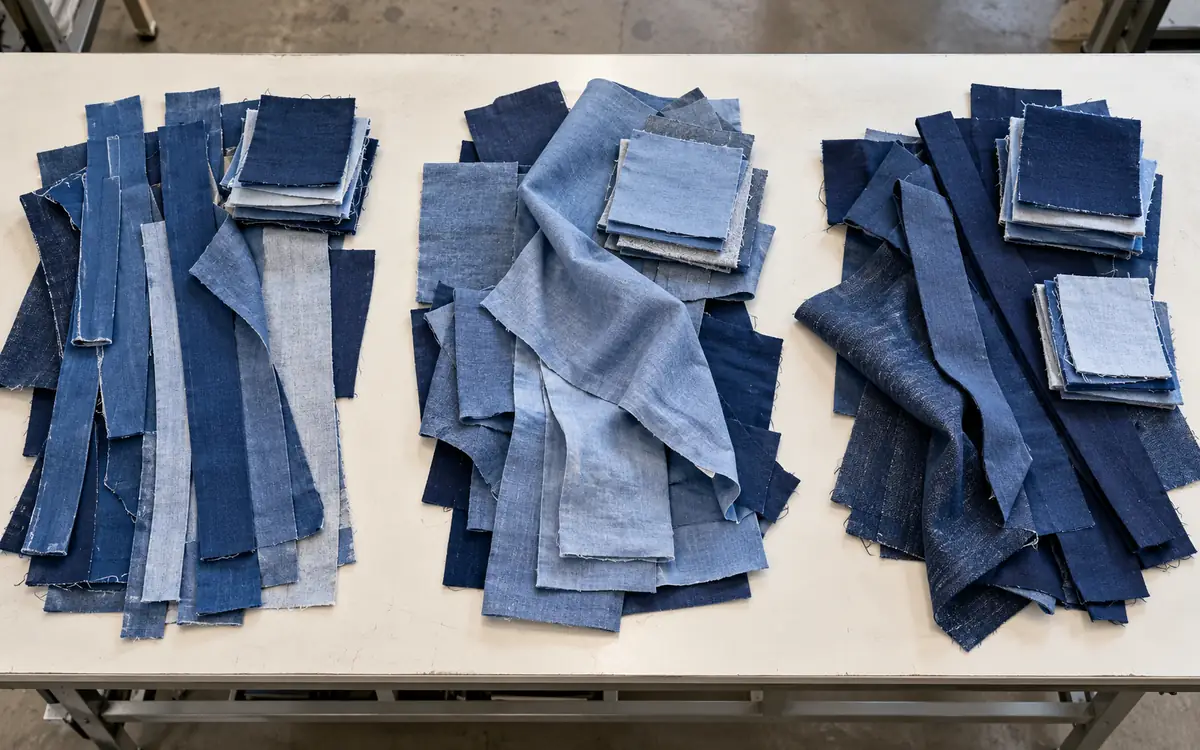
Consider six illustrative rolls approved into three groups. Group A contains 100 and 90 metres, Group B contains 80 and 70 metres, and Group C contains 60 and 50 metres. Total approved length is 450 metres. Assume each permitted lay uses 60 metres and the rolls are otherwise compatible with the proposed marker and spreading procedure.
A pooled calculation gives floor(450 ÷ 60) = seven lays. Keeping groups separate gives floor(190 ÷ 60) + floor(150 ÷ 60) + floor(110 ÷ 60) = 3 + 2 + 1 = six lays. The approved grouped plan consumes 360 metres and leaves 90 metres distributed as 10, 30 and 50 metres.
The pooled result would have suggested 420 metres of lay consumption and only 30 metres remaining. The additional 60 metres of apparent capacity depends on combining groups, which the example forbids. Grouping therefore changes feasible allocation even though the physical total is unchanged.
This is an arithmetic model, not a permission to join rolls anywhere in a lay. Roll joins, splice positions, defects and panel continuity must follow the actual spreading method. A planner should verify each proposed combination rather than assuming that group-level total length guarantees a feasible lay.
Review remnants and recuts explicitly
The 50-metre remnant in Group C may support a shorter approved marker. It should remain visible as an allocation option rather than being written off automatically. The planner can compare alternative marker lengths, sizes and required quantities while preserving the shade restrictions.
Recuts need particular care because a small replacement panel may be requested after the original roll has left the store. Retain the parent bundle's roll or compatible group reference and issue the replacement against it. A correct style and colour code alone do not establish panel compatibility.
The fabric shrinkage and pattern allowance guide addresses another material constraint. Two rolls that match visually may still need different dimensional treatment. Do not let a shared shade group overwrite independent width, shrinkage or quality restrictions.
Check the handover on the factory floor
Take one allocated lay and trace its rolls back to the approved shade assessment. Then trace one bundle and one recut request forward. The identifiers should survive every transfer. If a team must guess which label to trust, fix that break before expanding the system.
Keep physical identification readable and consistent with the electronic record. Colour-coded stickers can support the process, but they should not be the only identifier: a faded sticker, poor lighting or a reused group colour can cause ambiguity. Use an explicit roll and group reference in the controlled record.
Do not claim that segregation removes shade variation. It controls which assessed materials are combined under the approved decision. New evidence, changed lighting requirements or a buyer complaint may require reassessment and review of already allocated stock.
Release the smallest complete allocation instruction
For the next cutting order, issue an approved group-to-roll-to-lay map with the marker version and any section restrictions. Keep the unresolved group separate and give it an owner and escalation route. Ask the spreading supervisor to explain which rolls may be combined from the instruction alone.
That handover turns colour evaluation into production control. The useful output is a defensible allocation, including what remains available for shorter markers and what must wait for approval.
References
Datacolor How to Use a Light Booth for Accurate Color Evaluation
Datacolor Tools Color Quality Control Software
ISO 139:2005 Textiles Standard atmospheres for conditioning and testing

Discussion0
Loading the discussion…