
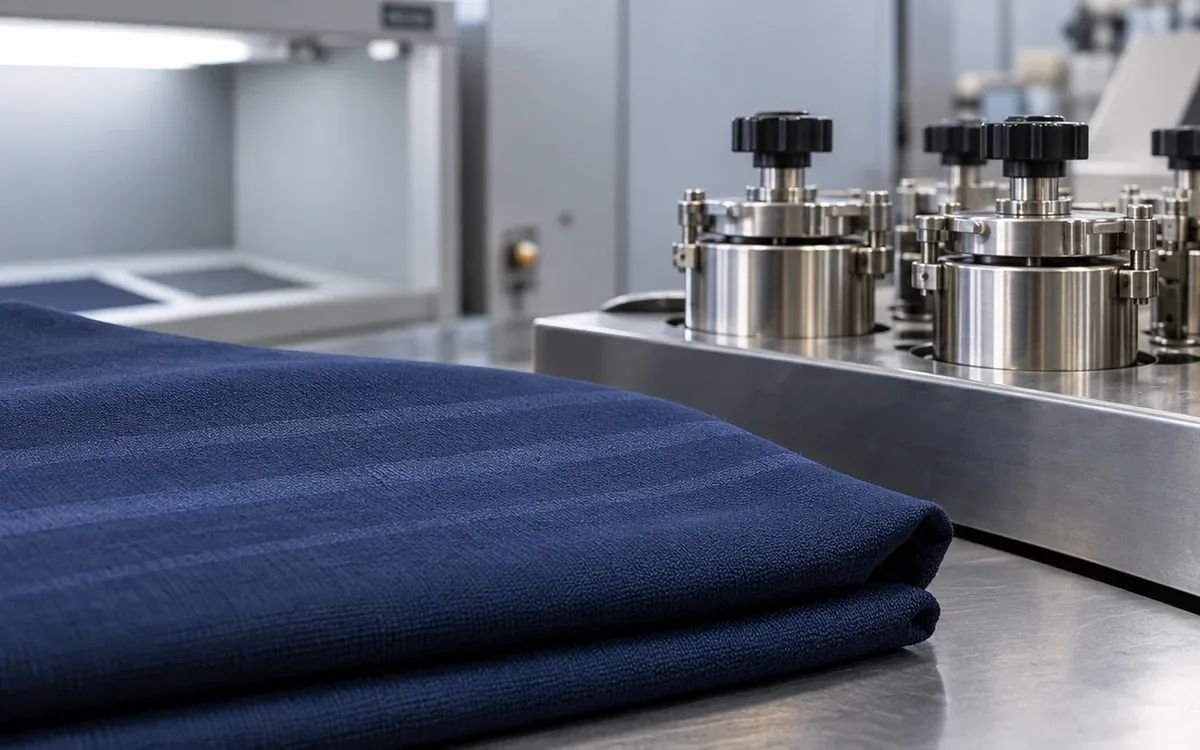
Diagnose the stripe before trying to dye it away
Nylon acid dyeing needs a suitable fibre, dye mixture, and process. All three must work together for an even shade across the lot. Stripes may reflect differences in yarn or fabric structure. Preparation and dye uptake can also vary. More acid or a longer hold may deepen the colour. It may leave the cause in place.
Barré is a pattern of visible bands or streaks. It reflects differences within the textile. In nylon, ask how fast each region takes up dye. Then compare their final dye response. These are separate questions. A physical difference can also affect appearance without a dye difference.
This guide follows that investigation from incoming yarn records to finished fabric tests. The figures are made up for teaching. They show how to make decisions. They do not provide mill recipes or limits for every product.
Understand the acid dye–nylon relationship
Acid dyes are anionic colourants. Under suitable acidic conditions, positively charged sites in nylon can attract them. Dye uptake also depends on the fibre's physical structure and the selected dye.
Bell's study of acid dyeing of nylon 6,6 examined two dyes. It found a link between amino-end-group content and dyeing rate. This supports checking the nylon itself when similar lots behave differently. It does not give a single way to convert end-group content into a production recipe.
The word “acid” on a dye label is not enough for selection. Check its migration, shade build-up, and fastness. Check whether it mixes well with the other dyes. These properties must suit the fabric and its use.
Keep nylon types and modifications distinct
Nylon 6 and nylon 6,6 should be identified in the material record. Also ask whether the yarn has a special dyeability modification. “Polyamide” alone may be too broad to reproduce a colour route.
Record fibre composition for blends. For nylon/elastane, consider both fibres. Set heat, chemistry, and aftertreatment limits for the whole blend.
Cationic-dyeable and regular acid-dyeable nylon need different procedures. Do not confuse them because both are called nylon. Confirm the substrate with its supplier. Then investigate a poor shade before assigning operator error.
Treat fibre history as dyeing information
Drawing, texturing, and heat exposure can change fibre structure. This affects how dye enters it. Two packages may share the same nominal yarn count. Check more than that before combining them in one solid-shade fabric.
Sweet and Bell's research on nylon 6 structure and dye diffusion showed that drawing conditions affected the measured diffusion behaviour. The response was not a simple straight-line change with draw ratio.
Keep the yarn supplier and production lot with the fabric record. Add each package identity and its relevant process history. If a band follows a package change, that connection is useful evidence.
A dyehouse cannot reconstruct every earlier thermal event from a final shade. Clear records narrow the investigation. They help avoid using another production cycle on an unproven correction.
Surface appearance can also change
A visible band may reflect yarn size, cross-section, or lustre. Fabric geometry can affect it too. The amount of dye is only one factor.
Tayebi and colleagues studied nylon 6 yarns with different cross-sections and titania contents. The dye adsorption rates differed under their test conditions. This reinforces the need to compare like substrates.
Inspect the fabric before dyeing. After dyeing, use the agreed viewing conditions. During diagnosis, also change the viewing direction on purpose. Keep the formal approval setup fixed.
If a band changes strongly with direction or lighting, investigate the physical structure. That observation does not by itself rule out a dye difference.
Read the pattern in the fabric
Map the defect before cutting small test pieces. Mark the fabric direction, face, and band boundaries.
Ask whether the pattern follows courses, wales, warp ends, or weft insertions. Compare the band spacing with package changes and machine feeds. Check recorded stops too. A repeating structural pattern gives different evidence from a single stain or crease.
The lab needs to see how the dark and light areas connect. Do not send unrelated scraps alone. A connected strip crossing several bands preserves much more information.
Pattern evidence | Useful next comparison |
|---|---|
Bands repeat with a yarn-feed sequence | Check package identities and matched yarn dyeability. |
One section begins at a known process stop | Compare before, during, and after the event. |
A crease-like line changes with fabric presentation | Examine the structure and check preparation records. |
Shade difference appears only after dyeing | Compare fibre affinity and process history. Run dye-mixture trials. |
Difference appears after finishing | Compare matched samples before and after that finish. |
Whole-lot colour shifts without internal bands | Check the recipe and input lot. Check whether the process repeats well. |
These comparisons guide the work. They do not prove a cause from the pattern alone.
Separate rate differences from endpoint differences
Some regions dye faster at first. They may reach a similar result under a suitable controlled route. Other regions keep different colour responses even with more time.
A useful trial follows the difference through defined stages. Do not assume that a longer hold will resolve every case.
Take an example trial with two yarn samples. Dye them together under controlled conditions. Their measured colour-strength values are:
Trial stage | Yarn A | Yarn B |
|---|---|---|
Early sample | 6.0 | 3.5 |
Later sample | 9.0 | 8.0 |
Defined final stage | 10.0 | 9.8 |
The narrowing difference suggests that uptake rate deserves attention. It does not prove that this process is acceptable or that the two yarns are identical.
In another trial, final values might remain 10.0 and 7.5. More time has not removed that difference under the tested conditions. Examine the substrate and dye system before ordering another full hold.
Colour-strength readings require a valid method, matched presentation, and repeat measurements. These illustrative numbers are not universal barré thresholds.
Select dyes for levelness and fastness together
A highly mobile dye can help even out some differences. The product still needs its required fastness. A dye with strong wet fastness may need a different process for even colour.
CHT's acid dye information compares several properties across its ranges. These include migration, wet fastness, shade build-up, and combinability. Some dyes do not combine well with others. CHT mainly recommends those for single-dye use.
This is a practical reason to obtain mixture guidance. Three dyes may each look suitable on their own. Together, they may not form a stable trichromatic mixture.
Choose the dye set against the actual end use. A pale fashion shade, a dark activewear shade, and a swimwear shade may have different priorities.
Test hue development, not just the final depth
Dyes can enter the fibre at different rates. The hue may then change through the cycle. The final lab sample may look correct. A small bulk-process change can still cause a hue error.
Run the complete mixture, not only its individual components. The development plan may require stage samples. Keep these to check whether the dyes develop in balance.
A light shade does not justify the same percentage change to every dye. First establish which part of the colour difference changed.
Use ApparelDiary's lab dip and buyer sign-off guide to identify the approved reference and recipe version. Then focus the acid-dye investigation on the nylon response and process conditions.
Control the pH path, not only the last reading
Acid addition changes the environment in which nylon and acid dyes interact. The timing of that change matters.
A batch may reach the intended final pH after an unsuitable earlier path. Record pH at defined stages. Link it to temperature and addition history.
Bhatt and Daruwalla's mechanistic study examined the influence of pH, temperature, and dye affinity. It used strongly acidic experimental conditions and also observed polymer changes. Those conditions are evidence from a study, not a recommendation for production.
Avoid a rule such as “lower pH always gives a better nylon shade.” The process must deliver even colour. It must also preserve the fabric properties the product needs.
A pH change is not a linear dose change
IUPAC defines pH in terms of hydrogen-ion activity. The scale is logarithmic.
A change from pH 6.0 to pH 4.5 corresponds to an activity ratio of:
10^(6.0 − 4.5) = 31.6
This does not mean that the bath needs 31.6 times as much acid. The dose needed for a given pH depends on the bath. Buffering, water alkalinity, fibre, and other components all affect it.
Nor does it predict a 31.6-fold dyeing rate. The calculation shows why a small pH change matters in chemistry. It does not replace a measured process response.
Name the meter and calibration checks in the controlled procedure. State the sampling conditions and sample temperature. Compare readings made on the same basis.
Distinguish an acid donor from a buffer
A sliding-pH process may use an acid donor. This releases acidity as the process develops. A buffer serves a different control purpose. Product names and supplied concentrations also differ.
Sarex describes this temperature-linked approach for ACIDON-PA. The product information describes one commercial route. Its dose and starting conditions do not apply to every nylon dyeing system.
A mill may replace direct acid dosing with an acid donor. Validate the resulting pH profile. The same final pH does not prove the same dye uptake history.
Do not swap products at equal mass without review. Check each product's job and technical information. The recipe must identify the actual product and dosing basis.
Compare the addition records with the cloth
Take an example addition of a prepared solution. The plan delivers 12 litres over 30 minutes. Its mean delivery rate is:
12 ÷ 30 = 0.40 L/min
If the same amount enters in 5 minutes, the mean rate is 2.40 L/min. That is six times higher. Equal total volume has not reproduced the addition history.
This is an arithmetic example, not an acid-dosing instruction. Actual rates, concentration, mixing, and safety controls must suit the validated process.
Keep an interruption visible in the record. A controller may finish its total after a pause. Local exposure and exposure over time can still differ from the plan.
Use levelling agents for a defined purpose
A levelling agent may act on the dye, fibre, or both. Its chemistry determines which. Select it for the dye system and required result.
Sarex describes NYLOLEVEL-606 XC as a dye-affinity product. It is intended to support migration in acid dyeing of polyamide. This describes one product. It does not mean all levelling agents work the same way.
A larger dose is not automatically better. Evaluate the approved range with the chosen dyes and fabric. Record shade, exhaustion where measured, evenness, and final fastness.
If a levelling change improves a banded sample, identify what it has proved. It may show that the process can reduce the visible difference for that shade. It does not prove that the yarn lots can replace each other in all colours.
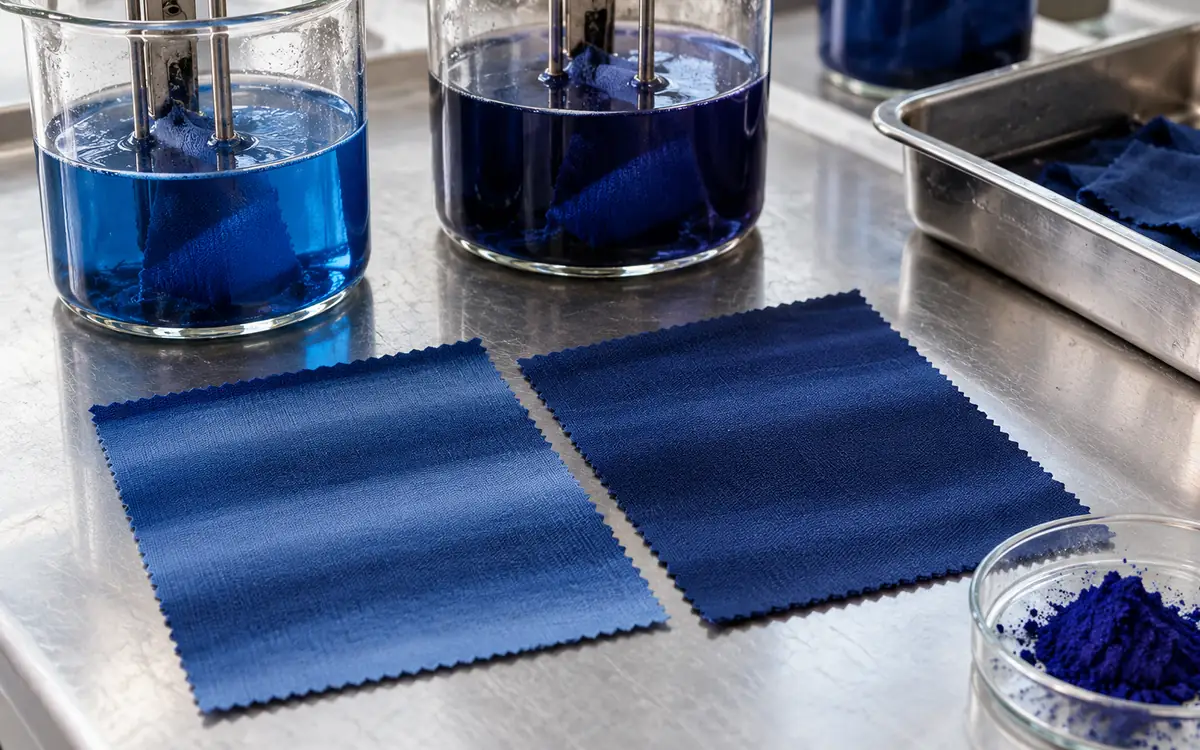
Use matched dyeability trials to isolate the input
Compare suspect and reference material in a practical trial. Use the same controlled dyeing conditions for both. Keep each specimen identifiable throughout the test.
Start with material that differs in the factor being examined. The suspect fabric may also differ in construction and finish history. Those differences prevent the trial from isolating the yarn lot.
For yarn investigations, ask a suitable laboratory or supplier to prepare comparable test specimens. Keep the dyeing and assessment conditions matched.
Repeat a promising comparison on separately prepared specimens. Several readings of one small swatch describe that swatch. They do not show variation across a whole package or roll.
Keep the comparison load consistent
A shared bath exposes reference and suspect material to a common process. It also changes the bath's total fibre load. Include both specimen masses when setting the trial's dye and liquor basis.
Keep their proportions constant between repeats. One trial might use a small reference and a large suspect sample. Another might use equal masses. These are different loads. The materials may compete for a limited amount of dye. That can make the comparison harder to interpret.
Where needed, run separate matched baths as well as the shared-bath comparison. State which arrangement produced each result. Test a clear hypothesis about the input. Do not choose an arrangement only because it hides the difference.
A two-route trial can separate questions
Consider a hypothetical investigation with two yarn lots and two approved laboratory routes:
Material | Current route | Controlled alternative route |
|---|---|---|
Reference yarn lot | Level result | Level result |
Suspect yarn lot | Visible band contrast | Reduced but still unacceptable contrast |
The alternative route has improved the symptom under those conditions. It has not met the product requirement.
Both materials might instead improve equally. That would point to a shared process factor to review. Keep the question clear before deciding what a successful trial means.
Before approving a production correction, check the whole result. Test the final shade, fastness, dimensions, and fabric performance.
Investigate preparation and heat history separately
A preparation problem can interfere with consistent contact between the bath and fabric. A heat-history difference can affect the substrate itself. They need different evidence.
Compare input samples, preparation records, and relevant yarn or fabric heat records. Inspect whether the suspected difference existed before the dye bath.
Where practical, clean matched samples through the same approved route. Then compare dyeability. Keep an untreated retained sample too.
Do not keep heating or stripping suspect fabric just to make it look even. Each extra treatment changes the specimen being investigated.
For blends, check the whole product after any proposed correction. An improvement in nylon colour cannot compensate for damaged stretch, handle, or structure.
Avoid confusing a darker repair with a level repair
Dyeing a faulty lot deeper may reduce the visible contrast under some conditions. It may also change the product beyond its approved colour.
Judge a repair against the buyer's required shade. Check the appearance within the fabric. Test the required fastness too. These are separate decisions.
Suppose a hypothetical light panel and dark panel both deepen by the same amount. Their difference may remain. A successful overall depth change has not necessarily corrected the band.
If a repair trial uses a new dye set, retain the full recipe and result. A new dye set may change the basis of product approval. If so, do not record it as a minor addition to the original route.
Repeated correction also adds heat, chemistry, time, and cost. Set the decision rules before the repair. What evidence would justify another attempt? When should the lot stay on hold?
Assess aftertreatment on the finished shade
Aftertreatments may improve wet fastness, but they need a clear test plan. They should not be used as a substitute for diagnosing uneven dyeing.
Sarex lists several fixing products for polyamide. Options for acid and metal-complex dyes appear in its polyamide auxiliaries information. Select the product for the actual dye system and end use.
Test matched material before and after the proposed aftertreatment. Include shade and handle as well as the required fastness measures.
Test the candidate through later finishing or care before release. A newly treated swatch may pass. That does not prove it will pass after all planned exposures.
Read fastness grades as grades
A wash-fastness report may contain both colour-change and adjacent-fabric staining results. Keep them separate.
A change from grade 3 to grade 4 is not a 33% gain in fastness. The grades are ordered assessment groups. They do not form a linear measure of dye mass.
Record the method, specimen state, and affected adjacent fibre. One part of a test may pass while another fails. Keep both visible in the report.
A dye system that covers barré but fails the product's required fastness remains unsuitable. Choose the complete result, not the most attractive single measure.
Build a useful barré trial report
A report should let another person connect the stripe to the input and process. Include a mapped fabric sample, not only a final pass or fail.
Record yarn and fabric identities. Add preparation, dye products, and recipe revision. Keep pH and temperature histories, addition events, and aftertreatment details. State the comparison method and lighting used for the result.
Photographs can show where a band lies. They should not replace the required physical or instrumental assessment.
State the scope of the conclusion. For example, write “The alternative route reduced contrast on this navy trial.” That is a clear, limited claim. “The yarn is now dyeable” says much more than the trial proves.
Trial conclusion | What it supports | What it does not yet support |
|---|---|---|
One dye set gives lower band contrast | Further testing of that colour system. | It does not prove the same result for every shade. |
A matched reference dyes evenly | The reference provides a comparison. | It does not prove the machine is fault-free under every load. |
A longer hold reduces the difference | Uptake timing needs investigation. | It does not prove unlimited holding is safe or economical. |
The defect follows yarn identity | An input investigation is justified. | It does not prove a specific chemical cause. |
Aftertreatment improves staining grade | That treatment merits further trials. | It does not prove barré has been removed. |
Calculate the decision cost without hiding rejected cloth
Trial cost includes the fabric and resources used. The production decision also depends on accepted output.
Take a teaching example with a 600 kg lot. Its correction costs 240 currency units. After assessment, 480 kg is released and 120 kg remains held.
The correction cost per released kilogram is:
240 ÷ 480 = 0.50 currency units/kg
Dividing by the full 600 kg would give 0.40. That describes the treated input, not the currently released output.
Keep held stock distinct from final rejection. If it is later released, update the outcome without double-counting the fabric or correction cost.
Also record machine time. A three-hour correction occupies a loaded machine. Its scheduling impact differs from a short lab trial. Keep any assumed capacity value separate from direct cash costs.
Contain the lot while the cause is resolved
Identify the affected fabric by roll and section. Preserve the yarn and process links. These help the team avoid repeating the same combination by mistake.
If some material is suitable for a different approved use, document that decision. A concession should state exactly which fabric and product it covers.
ApparelDiary's shade segregation guide explains how approved fabric groups remain traceable through cutting. That containment helps production. It does not remove barré or correct its cause.
Close the investigation with a practical input or process control. The control may restrict yarn lots or define an approved dye set. It may change the pH profile or preparation. Use the evidence to show why that control addresses the fault.
Frequently asked questions
Is every stripe in dyed nylon chemical barré?
No. Physical structure, optical effects, contamination, and processing marks can also create bands. Map and inspect the defect before assigning a mechanism.
Can extra acid remove barré?
It may change uptake and depth. That does not prove it removes the underlying difference. Check the pH path and final fabric performance before approving a correction.
Does a longer hold always improve levelness?
No. Some rate differences may narrow, while other differences persist. Extra exposure also has process and material limits.
Should nylon 6 and nylon 6,6 share one recipe?
Only if the complete system has been validated for both. Keep polymer identity and relevant yarn history explicit.
Does a levelling-agent trial prove the yarn is acceptable?
It proves only the tested result. Test the intended shades, fastness, and fabric performance. Check that production can repeat the result before expanding approval.
Make the stripe explainable
A useful investigation connects the band to the material and process records. Check dye compatibility and the pH–temperature path. Use matched trials to separate an input difference from a process difference.
Keep the finished product requirements active through every repair decision. The goal is an even fabric that meets its shade and fastness needs. Production must be able to repeat it. Keep enough evidence to prevent the same defect in the next lot.
References
Bell: Fibre and dyebath variables in acid dyeing of nylon 6,6.
Sweet and Bell: Dye diffusion and fibre structure in nylon 6.
CHT: Acid dye ranges and application properties.
Bhatt and Daruwalla: Mechanism of polyamide dyeing with acid dyes.
IUPAC Gold Book: Definition of pH.
Discussion0
Loading the discussion…