
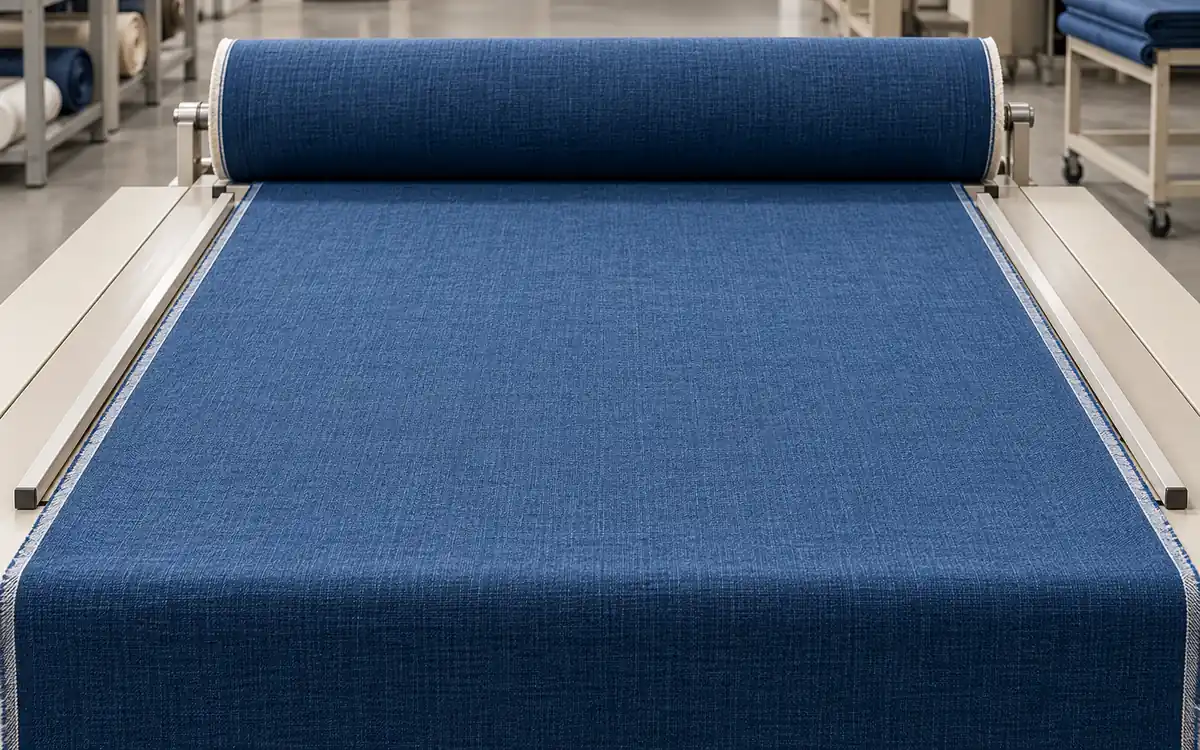
Usable fabric width is the width that can actually support the intended cutting layout. Nominal width is the stated or ordered width, whose meaning must be defined by the supplier and buyer. A roll described as 160 centimetres wide may therefore provide less than 160 centimetres for pattern placement. The cutting planner needs the approved usable width, while stores may need gross width for quantity reconciliation.
This guide helps fabric QA and cutting teams keep those measurements separate, compare a roll against a marker and record the consequence of a width shortfall. The decision depends on the fabric state, measurement procedure and purchase agreement; a label alone is insufficient.
Give every width value a clear meaning
Write the width basis into the material specification. Gross width normally describes the full measured span, including the edges when the selected method calls for them. Usable width excludes the portions that cannot serve the agreed application. Those exclusions may relate to selvedges, pin marks, an unfinished edge or an identified local problem.
ASTM D3774-18(2024) covers width measurement for woven and knitted fabrics, including usable width. Its public scope distinguishes full-roll and specimen options. Select the contractual method and record which width was reported. Do not present a supplier's nominal width as an independent receiving measurement.
The Association for Contract Textiles describes usable width in relation to the intended application and buyer-seller agreement. That guidance concerns contract textiles; its example product widths are not garment-factory acceptance limits. The useful transferable principle is to define what area can be used, then agree the requirement explicitly.
Measure the state that the cutting plan will use
A stretched fabric can show a different width from the same fabric after approved relaxation. Record whether the material was received, conditioned, relaxed or prepared for spreading when measured. Keep the procedure for relaxation separate from the measurement result, and follow the material-specific approved process rather than assigning an arbitrary waiting time.
Mark the selected measurement locations and record individual readings. A single average can hide a narrow section that prevents a marker fitting later in the roll. Sampling coverage must follow the agreed method and risk assessment; the examples here do not prescribe a minimum number of readings.
For tubular fabric, identify whether a value is lay-flat width, open width or a stated circumference. Do not double a number automatically without establishing its definition and the intended cutting arrangement. For open-width material, identify both usable edges and record any local exclusions that alter them.
The fabric GSM and roll weight guide explains why width basis also affects mass reconciliation. A usable-width figure belongs in marker planning, while a gross-area mass check must account for fabric that remains physically present at the edges.
Calculate the width available to the marker
Consider an illustrative roll with a measured gross width of 160 centimetres. The approved inspection identifies 2 centimetres excluded at the left edge and 3 centimetres at the right. Usable width is 160 − 2 − 3 = 155 centimetres. A marker requiring 156 centimetres cannot be released against this roll merely because the nominal width is 160.
The width excluded from cutting is 5 ÷ 160 × 100 = 3.125 percent of gross width. This percentage describes an area-width relationship for this simplified uniform example. It does not establish that garment consumption will increase by 3.125 percent, because pattern nesting changes in steps rather than in a smooth proportion.
Width field | Illustrative value | Appropriate use |
|---|---|---|
Supplier nominal width | 160 cm | Purchase description subject to its definition |
Measured gross width | 160 cm | Gross area and mass reconciliation |
Left and right exclusions | 2 cm and 3 cm | Evidence for the usable span |
Approved usable width | 155 cm | Input to marker suitability check |
Required marker width | 156 cm | Proposed layout that needs revision |
At 100 metres length and 180 GSM, gross-area mass would be 100 × 1.60 × 180 ÷ 1,000 = 28.80 kilograms. The usable-area equivalent is 100 × 1.55 × 180 ÷ 1,000 = 27.90 kilograms. The 0.90 kilogram difference is excluded area in the calculation, not proof of missing material.
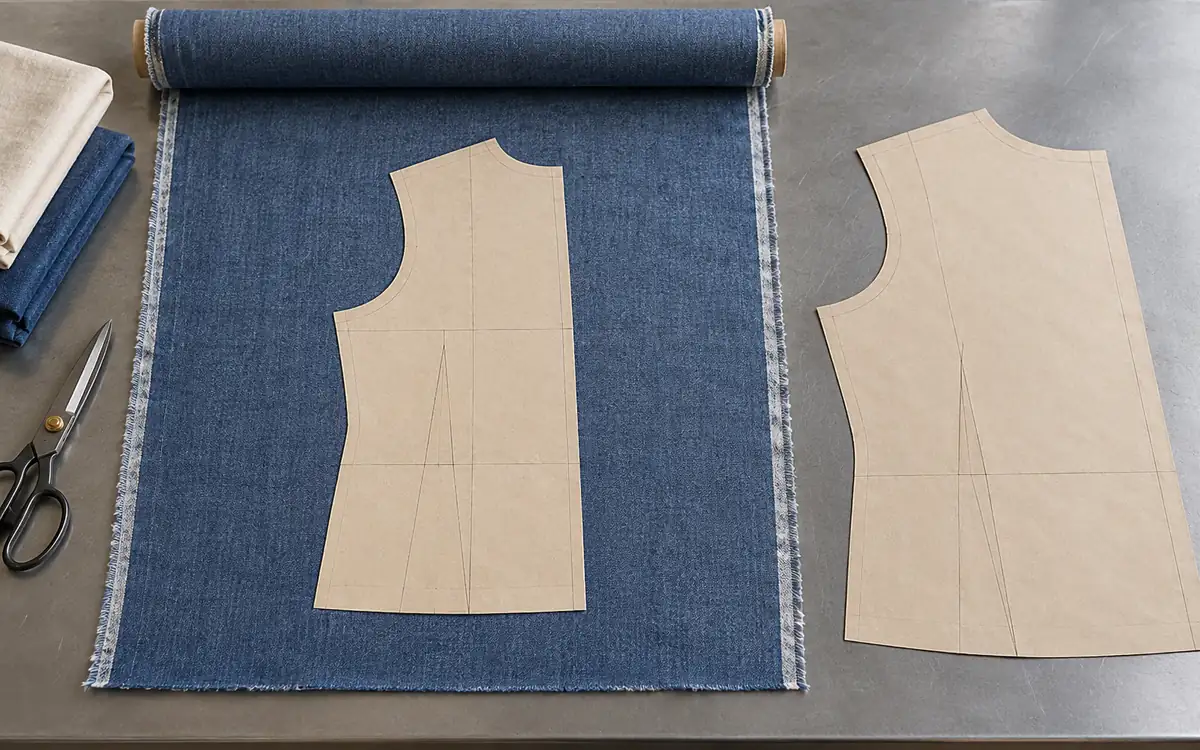
Replan consumption rather than scaling a percentage
Suppose the original 156-centimetre marker is 5.0 metres long and contains ten complete garments. Its marker consumption is 0.50 metre per garment. After an approved redraw at 155 centimetres, assume the verified layout becomes 5.2 metres for the same ten garments. Consumption is now 0.52 metre per garment, an increase of 0.02 metre or 4 percent.
For 2,000 garments, that particular change adds 40 metres before any separately approved allowances. The numbers are invented to demonstrate the decision, not measured nesting results. A CAD operator must establish the actual revised marker length and garment count; a width ratio cannot supply them reliably.
Check whether every size and component still fits, whether pattern direction rules remain satisfied and whether shade segregation limits the rolls available. A shorter remaining roll may be usable for a different marker without being suitable for the original one. Record that reassignment instead of declaring it generally acceptable.
Use the RMG cutting process guide to connect the approved width to the lay and bundle records. A corrected receiving measurement has no production benefit if the spreading instruction still references the superseded marker.
Handle variation along the roll
Consider four investigation readings of 155, 155, 153 and 154 centimetres usable width at identified locations. The mean is 154.25 centimetres, but a marker requiring 154 centimetres would not fit the observed 153-centimetre section. Averaging does not remove that constraint.
Depending on the approved process, the team may re-inspect the affected region, create separately identified sections, select a narrower marker or hold the roll. Each choice requires its own traceable authorisation. Do not infer that all unmeasured locations meet the narrowest observed result, and do not claim full-roll uniformity from a few readings.
Keep measurement uncertainty and process variation separate. If two inspectors disagree at the same marked location, investigate positioning, tension, equipment and procedure. If repeat measurements agree but different locations vary, the evidence points toward a material or process distribution question. The supplier investigation should receive both the readings and their locations.
Prevent width errors at handover
Give the planner one approved usable-width field with a unit, procedure reference, roll identity and approval date. Preserve supplier nominal width in a separate field. A spreadsheet column labelled only width invites accidental substitution, especially when centimetres, inches and metres appear in different records.
Make the marker version part of the release record. If an operator later reports that the approved marker does not fit, preserve the actual material condition and location before changing a value. Repeatedly stretching the fabric until the marker fits conceals the issue and can alter the cut parts.
Review purchase claims on the contracted basis. A roll can meet a gross-width requirement while failing an agreed usable-width requirement, or satisfy the purchase specification while requiring a different internal layout. The commercial conclusion should follow the agreement and measured evidence rather than a familiar nominal description.
Make the next cutting decision from two numbers
Choose one pending lay and compare the approved usable width with the actual width required by its current marker version. If the margin is insufficient, return the layout to the authorised planner before release. Record the resulting marker length, garment count and allocation change.
This small check prevents a receiving value from becoming an unexplained cutting loss. It also gives merchandising a defensible consumption change: the changed usable width, the revised layout and the measured quantity consequence belong together.
References
ASTM D3774-18(2024) Standard Test Method for Width of Textile Fabric
Association for Contract Textiles Voluntary Quality Guidelines April 2020 section 1.7
ISO 139:2005 Textiles Standard atmospheres for conditioning and testing
Discussion0
Loading the discussion…