
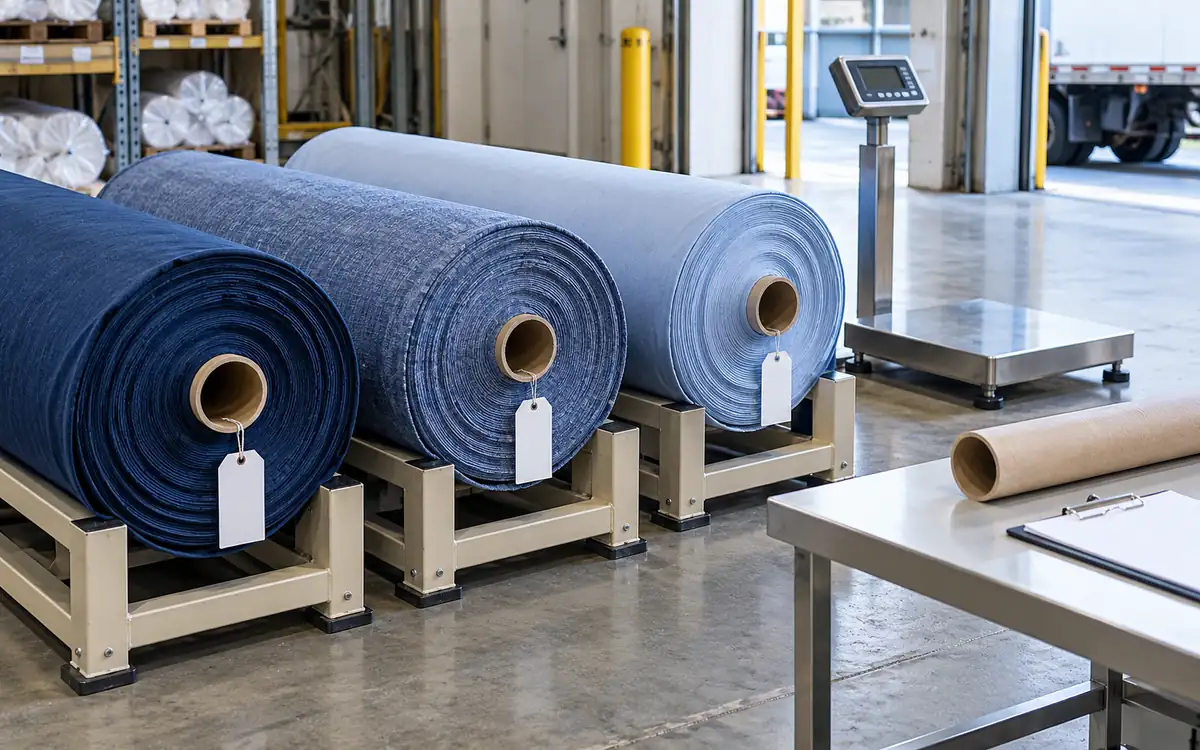
An incoming fabric roll should enter production only when its identity, quantity and required quality evidence agree with the purchase specification. A delivery note alone cannot establish that agreement. A fabric roll acceptance checklist gives receiving, laboratory and cutting teams a shared decision record: what arrived, what was checked, what remains unresolved and who can release it.
For a store controller or fabric quality inspector, the useful result is a controlled stock status. This workflow separates physical receipt from quality approval and production allocation. It is an internal record design, to be adapted to the buyer contract and approved inspection procedures, rather than a universal sampling plan.
Define the acceptance unit before unloading
Identify the purchase order, material code, construction, composition, finish state, supplier lot, colour and roll number. Keep supplier identity alongside any internal roll identifier. If a roll is split or relabelled, preserve the relationship between the new pieces and the original roll. Otherwise a shade or width complaint can become impossible to trace after the first lay.
Decide which level receives the disposition. A shipment can contain several dye lots, and one lot can contain both released and held rolls. A single delivery-level approval may conceal those differences. Conversely, holding an entire shipment for one identified roll can create avoidable disruption if the approved procedure permits separate disposition.
Give each receipt a time and an accountable receiving person. Record damaged packaging, suspected water exposure and missing labels before repacking changes the evidence. Photographs support identity and condition; they do not replace a traceable measurement or demonstrate colour conformity on an uncalibrated screen.
Keep receipt checks separate from laboratory conclusions
At receipt, match the physical roll count against the packing list and record quantity in its original unit. Capture gross mass, packaging tare and net mass separately when weighing is required. Record length and width using the agreed method, including whether width means the entire fabric or the usable cutting portion.
Use the fabric GSM and roll weight guide for the separate area-to-mass calculation. Acceptance is broader: correct GSM does not establish acceptable shade, defect distribution, dimensional stability or order identity. The checklist should show which checks have results and which still await the laboratory.
ASTM D5430-26 covers visual examination and grading of fabric. Its public scope supports agreeing the inspection method between purchaser and seller; it does not supply a universal commercial pass limit for this checklist. Enter the actual contractual grading option, acceptance criteria and sampling instructions rather than copying a familiar points threshold.
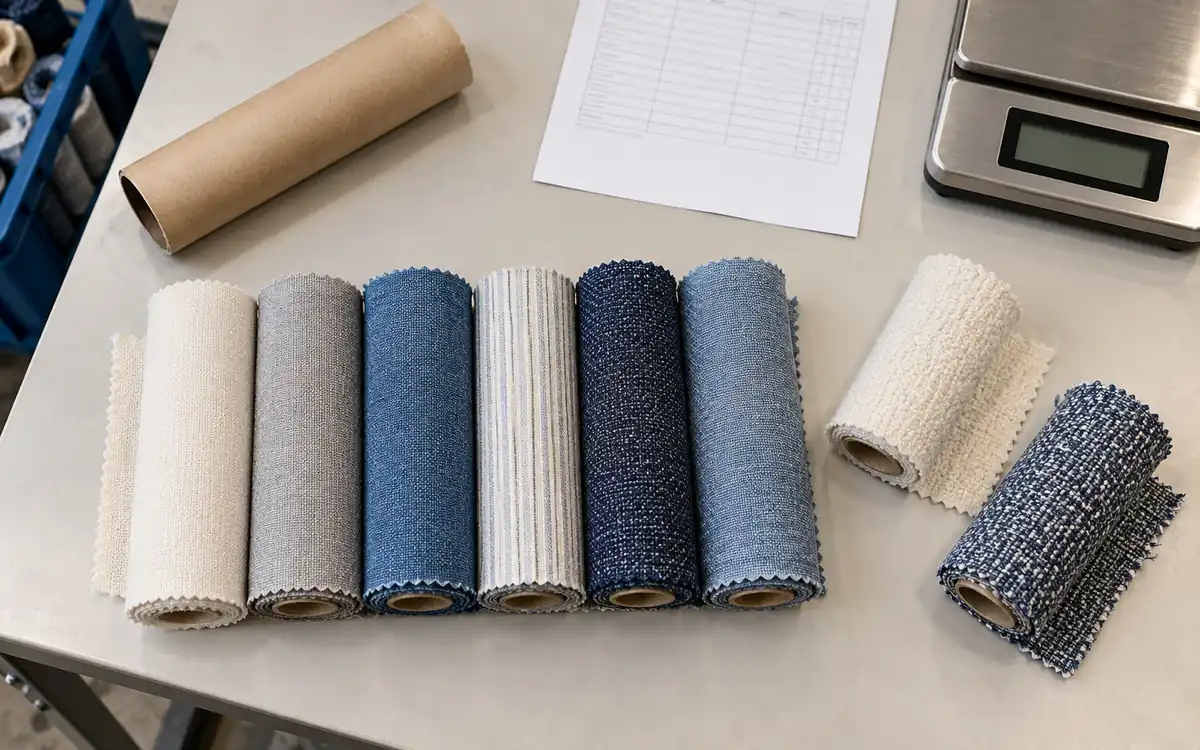
Build a record that can support a decision
The following fields form a practical minimum for an internal pilot. Add fields only when they support an acceptance decision or preserve evidence that another team needs. A record with a hundred empty columns is less useful than a short one with clear ownership.
Record group | Required evidence | Decision owner |
|---|---|---|
Identity | PO line, supplier lot, internal roll ID, material and colour | Receiving controller |
Quantity | Original units, measured length, gross mass, tare and net mass | Store controller |
Physical quality | Inspection report, defect locations, agreed criteria | Fabric QA |
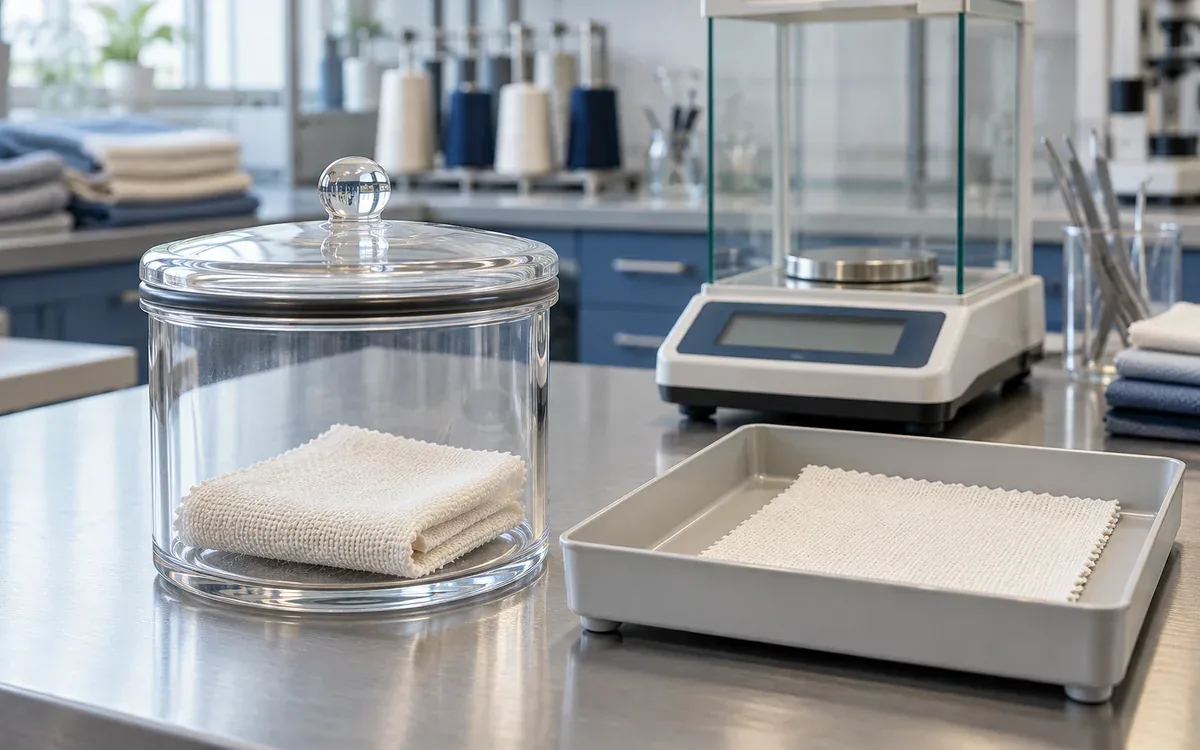
Laboratory status | Required tests, method revisions, result references | Laboratory approver |
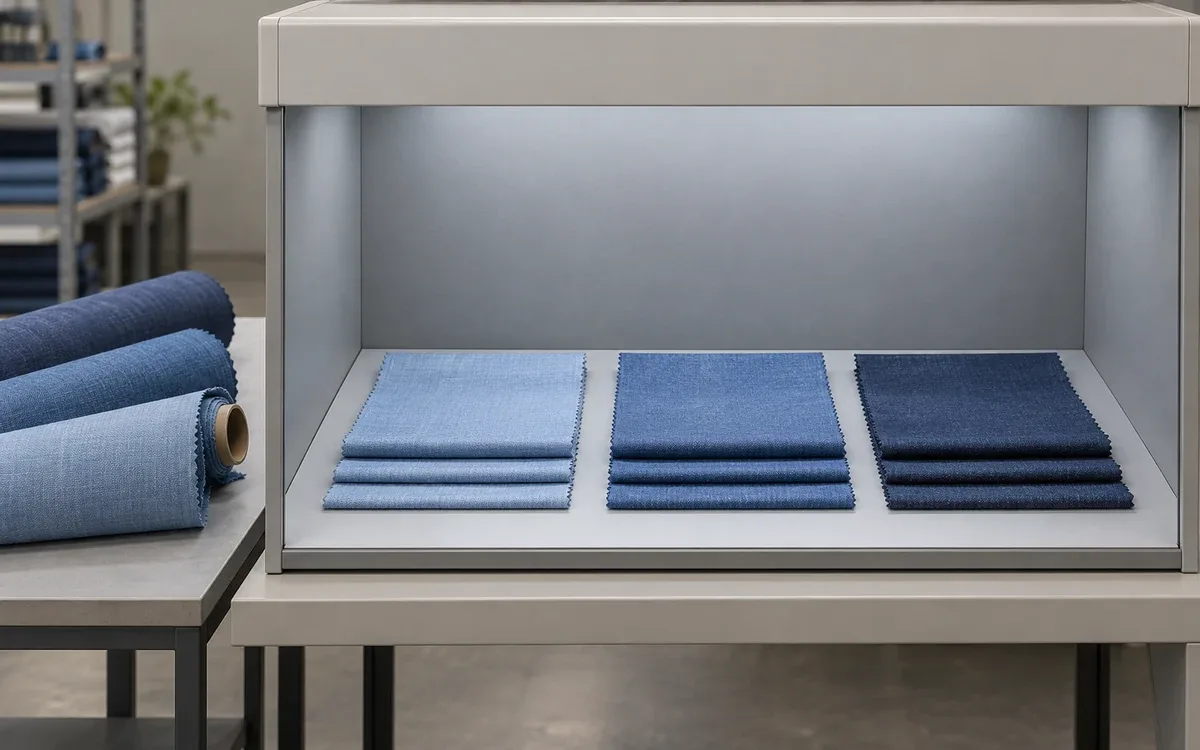
Production suitability | Approved shade group and usable width | QA and cutting planner |
Disposition | Hold, release, reject or conditional approval reference | Authorised approver |
ASTM D3774-18(2024) includes fabric width and usable-width measurement within its scope. The contract must still specify the width being purchased. Record the measurement basis next to the value so the cutting planner does not inherit an unexplained supplier number.
Separate an observed result from its judgement. A width entry of 148 centimetres is a measurement; whether it passes depends on the applicable specification and procedure. Do not allow the inspector to replace a measured value with the target simply because the final disposition is approved.
Reconcile the roll quantities with a worked example
Consider an illustrative delivery of eight rolls. The packing list states 100 metres per roll, so the declared length is 800 metres. The approved receiving check records six rolls at 100 metres, one at 98 metres and one at 102 metres. The measured total is also 800 metres, but the two roll-level differences must remain visible.
The delivery-level difference is zero: 800 minus 800 equals 0 metres. At roll level the differences are minus 2 and plus 2 metres. If the short roll has already been allocated to a marker plan requiring its full declared length, the extra fabric on another roll may not solve the problem, especially when the shade groups differ.
Suppose the combined scale reading is 242.4 kilograms and the documented total tare is 10.4 kilograms. Net fabric mass is 232.0 kilograms. At a declared gross fabric width of 1.60 metres, the implied average mass per area is 232.0 × 1,000 ÷ (800 × 1.60) = 181.25 GSM. This is a reconciliation value, not a substitute for specimen testing.
The calculation assumes the length, width and net mass describe the same physical fabric state. If width varies materially, use the approved measurement approach and retain that variation. A plausible calculated GSM cannot validate incorrect roll identities or offset an unacceptable local defect.
Control holds without losing the production picture
Use explicit statuses with different meanings. Received means the material is physically present. Hold means its use is restricted pending a decision. Released means the required approval has been recorded. Allocated identifies a planned production use. A stock system that treats these as one field will eventually show held material as available to a planner.
For a conditional release, record the approving person, permitted rolls or lengths, affected order and restrictions. The permission should have a defined scope. An email approving one disputed roll for one style should not become standing approval for future deliveries from the supplier.
Keep the laboratory report identifier in the stock record and the roll identifiers in the report. If retesting changes the result, retain the original entry and add the approved correction with its reason. Silent edits prevent the supplier and factory from reconstructing what happened.
The RMG cutting process control guide provides the downstream context. The receiving record should carry the restrictions that must survive spreading, cutting, bundle creation and recut decisions, rather than ending at the store door.
Test the checklist with exceptions
Walk through a delivery with a missing lot label, a roll with correct weight but insufficient usable width, and a passing laboratory result attached to the wrong colour. Each exception needs a named owner and a stock restriction. If the checklist can record a concern but cannot prevent unintended issue, the workflow is incomplete.
Do not confuse the percentage of rolls inspected with the percentage accepted. If four of eight rolls are inspected under an agreed plan, that is 50 percent inspection coverage by roll count. The lot disposition follows the selected plan; it is not automatically four accepted rolls and four unknown rolls, nor proof that every metre was examined.
Review recurring holds separately from one-off receipt errors. A repeated mismatch in tare recording needs a different correction from a repeated shade problem. Track the evidence category and resolution so the next supplier discussion concerns an identified process failure.
Release one clear instruction to the next team
Before issue, the store controller should be able to answer five questions from one record: which roll, which approved specification, which completed checks, which remaining restrictions and which authorisation. Trial the checklist on one delivery and ask the cutting planner to reconstruct the approved allocation without a phone call.
Keep the pilot outcome practical. Resolve missing identity or measurement fields, remove duplicate entry and agree who updates the status when laboratory approval arrives. The best checklist is the one that makes an incorrect material issue difficult and a justified release easy to verify.
References
ASTM D5430-26 Standard Test Methods for Visually Inspecting and Grading Fabrics
ASTM D3774-18(2024) Standard Test Method for Width of Textile Fabric
ISO 139:2005 Textiles Standard atmospheres for conditioning and testing
Discussion0
Loading the discussion…