
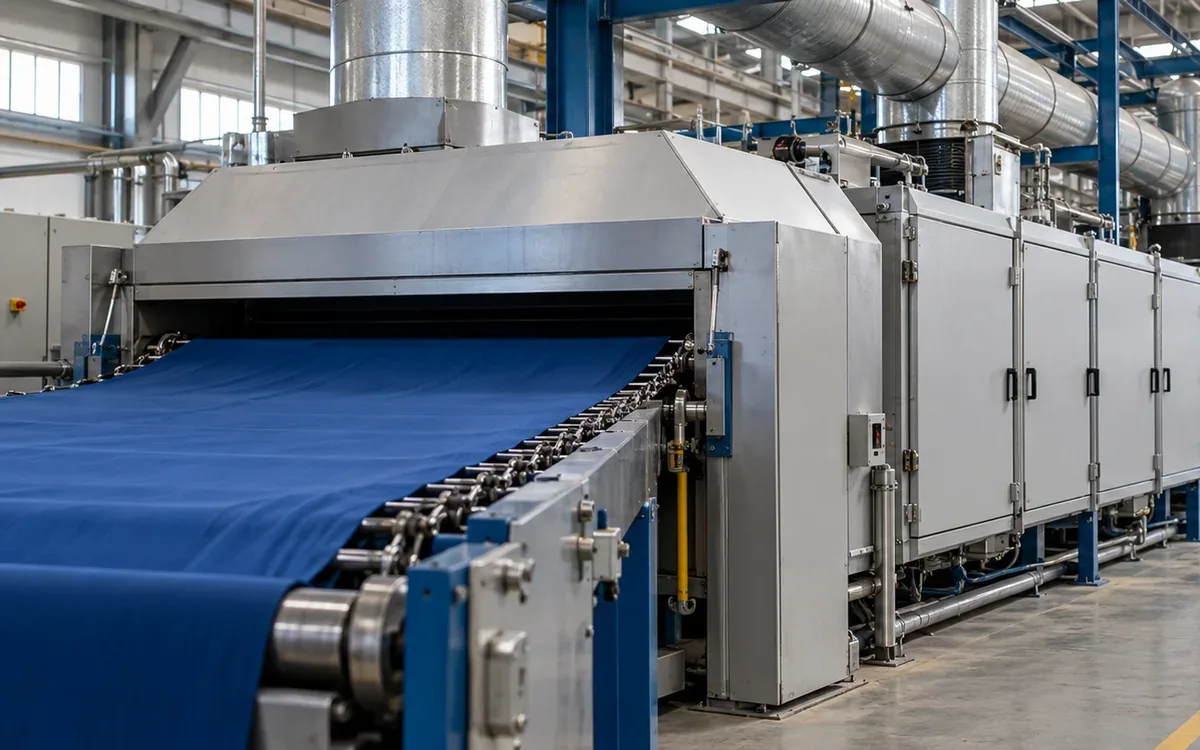
Drying starts with the water entering the stenter
Extra incoming water can make a stenter use more heat for less accepted fabric. Overdrying can also waste energy. Dry the fabric to the moisture level the next operation needs. The right starting point is a water balance linked to a defined fabric endpoint.
Link three measurements to control stenter drying. Measure water entering on the cloth and moisture leaving in it. Measure moisture carried out in the exhaust too. Fabric temperature and energy use help explain the result.
Modern stenters can perform several jobs. Monforts describes drying, fixing, and other heat treatments in its stenter range. This article focuses on drying duty and moisture control. A heat-setting or curing requirement must still be validated on its own basis.
Name the output condition before changing speed
“Dry enough” is not a complete specification. The target depends on fibre content, the next operation, handling, and the product requirements.
Define the final moisture measure and its basis. State the sampling stage and allowed range. Does the limit apply to the average or each measured location? Record any other agreed rule.
A fabric that feels dry at the surface may still vary across its width. A reading taken after long storage may describe a different state from the material leaving the dryer.
Keep the endpoint tied to the production decision. A finish may also need a particular cure. A moisture pass does not prove that cure. The route may aim for stable dimensions too. Check that result separately.
ApparelDiary's elastane heat-exposure guide explains how heat treatment affects stretch-fabric performance. That is a separate process question.
Keep dry-basis and wet-basis moisture separate
Two moisture percentages can describe the same sample and have different values.
Let dry material mass be M_d and water mass be M_w.
Dry-basis moisture (%) = M_w ÷ M_d × 100
Wet-basis moisture (%) = M_w ÷ (M_d + M_w) × 100
Consider a hypothetical specimen with 100 g of dry material and 60 g of water. Its dry-basis moisture is 60%. Its wet-basis moisture is 60 ÷ 160 × 100 = 37.5%.
These values are both correct. Substituting one for the other in a drying calculation is not.
Description | Value for the example |
|---|---|
Dry material | 100 g |
Water | 60 g |
Total wet mass | 160 g |
Water on dry basis | 60% |
Water on wet basis | 37.5% |
Put the basis beside every recorded moisture value. Check the instrument's definition rather than assuming that all devices use the same convention.
Convert before comparing
If wet-basis moisture is expressed as a fraction w, the dry-basis fraction x is:
x = w ÷ (1 − w)
A wet-basis value of 0.06, or 6%, becomes 0.06 ÷ 0.94 = 0.06383, or 6.383% on a dry basis.
The reverse conversion is:
w = x ÷ (1 + x)
These conversions require a consistent definition of dry material and water. Other volatile material may be present. If so, mass loss may measure more than water.
ASTM's D2654 moisture test methods distinguish several measurement procedures and uses. Select the full procedure suitable for the textile and decision. Do not assume that every oven mass-loss test is equivalent.
Calculate the water that must leave the cloth
For a simple drying balance with no dry-material loss or addition:
Water removed = dry material mass × (incoming dry-basis moisture fraction − outgoing fraction)
Suppose a lot contains 500 kg of dry material. It enters at 70% moisture on a dry basis and leaves at 6%.
Incoming water is 500 × 0.70 = 350 kg. Outgoing water is 500 × 0.06 = 30 kg. The dryer removes 320 kg.
The initial wet mass is 850 kg, and the final mass is 530 kg. The difference is also 320 kg, which checks the balance.
In a real route, define dry mass carefully. Does it include retained finish solids? Check chemical additions, loss of other volatile substances, and material losses. Without these checks, every mass change may wrongly be assigned to water.
Compare water load at the same dry output
Now let mechanical extraction reduce incoming moisture from 70% to 60%. Keep the final target at 6%.
Water removal becomes:
500 × (0.60 − 0.06) = 270 kg
The thermal dryer has 50 kg less water to remove. That is 50 ÷ 320 × 100 = 15.625% less evaporation duty for this example.
It does not prove a 15.625% fuel saving. The line also heats air, fabric, and equipment, and it loses heat. The extraction stage may use more electrical energy.
The calculation identifies a measurable opportunity. Use a production trial to measure the net effect. Check accepted fabric, energy, and the applied finish.
Check whether the measurement can resolve the change
Take the 500 kg example again. Assume incoming dry-basis moisture has an uncertainty bound of two percentage points. That alone corresponds to 500 × 0.02 = 10 kg of water. Assume a separate outgoing-moisture bound of half a percentage point. It adds 2.5 kg.
Assume dry mass is exact. Adding the bounds gives a conservative range of 12.5 kg around the calculated load. This is not a statistical confidence interval. Uncertainty in dry mass would add another factor.
Those measurements would struggle to prove a gain of only 5 kg. Improve the method or collect a stronger comparison. Then decide whether a precise small saving can be reported. Keep measurement limits beside the calculated result.
Convert fabric speed into dry mass and evaporation rate
Metres per minute do not reveal drying load without width and dry mass per area.
For a consistent fabric measurement basis:
Dry mass rate = speed × width × dry mass per area × 60
Use metres per minute, metres, and kilograms per square metre to obtain kilograms per hour.
Take an example fabric running at 30 m/min. Its width is 1.8 m, and its dry mass is 180 g/m²:
30 × 1.8 × 0.180 × 60 = 583.2 kg/h
If moisture falls from 75% to 5% on a dry basis:
Evaporation rate = 583.2 × (0.75 − 0.05) = 408.24 kg/h
That is the water load associated with the stated steady condition.
Use measurements from a compatible fabric state
Width and mass per area can change during finishing. Multiplying the inlet speed by an unrelated final width and mass may mix incompatible states.
Use dimensions and dry mass from the same material flow. Another option is a direct, verified dry-mass throughput. Explain any conversion.
If a coating or finish adds dry solids, include that change at the correct point. Otherwise, the apparent water balance may be wrong even when each instrument works.
For variable production, calculate the balance over defined intervals or complete lots. One steady reading cannot represent a varied shift. Account for different fabrics and long stops.
Remove avoidable water before paying to evaporate it
Review mechanical water removal before raising dryer temperature. Lawrence Berkeley National Laboratory's textile energy guide discusses extraction before the stenter. It also covers avoiding overdrying and controlling exhaust losses.
The useful extraction limit depends on the fabric and process. More pressure is not automatically better. It may affect marks, dimensions, or the amount and distribution of an applied finish.
A padder may apply finishing liquor. A pickup change then affects both water load and chemical add-on. Check each effect separately.
An add-on check for a pickup trial
Suppose a hypothetical liquor contains 40 g/L of a supplied product. For this simplified example, its density is taken as 1 kg/L and its concentration is uniform.
At 70% wet pickup, each kilogram of dry fabric carries about 0.70 L. Supplied-product add-on is:
0.70 × 40 = 28 g/kg of dry fabric
At 60% pickup, it becomes 24 g/kg.
The lower pickup reduces water but also reduces the applied product by about 14.3%. The finish may need the original add-on. If so, approve changes to the formulation and application process. Test them in a trial.
This arithmetic is not a finishing recipe. Use actual liquor density, product basis, retention, and application measurements for production.
Use a water-heating estimate as a reference, not a fuel bill
A simple energy calculation helps show the scale of evaporation. It is not a complete dryer model.
Use the following reference path as an example. Heat liquid water from 25°C to about 100°C. Then evaporate it near atmospheric pressure. Take liquid-water heat capacity as about 4.18 kJ/kg·°C.
TLV's steam-table guide gives an evaporation enthalpy of about 2,257 kJ/kg near that condition.
The reference energy per kilogram is:
4.18 × (100 − 25) + 2,257 = 2,570.5 kJ/kg
2,570.5 ÷ 3,600 = 0.714 kWh/kg
For 320 kg of water, the reference amount is about 228.5 kWh.
This does not mean the cloth boils at 100°C in a stenter. Evaporation into hot air occurs under different local conditions. The calculation follows a stated path for water alone. It is not a universal minimum. It does not predict the actual burner requirement.
Explain the gap from measured energy
A real line also transfers heat to fabric, retained moisture, air, and machine parts. Exhaust and surface losses matter. Heating-system performance and heat recovery affect the purchased energy.
Suppose the meter records 480 kWh for the example lot. The difference from 228.5 kWh is not automatically “waste”. A full energy balance is needed to explain it. This comparison guides the investigation but cannot assign every loss.
Keep thermal and electrical energy visible. Gas use may fall while fan or extraction electricity rises. Measure both to judge the net energy and cost effects.
Control exhaust moisture without confusing it with relative humidity
Drying air must carry away the evaporated water. Excessive exhaust can remove more hot air than the process needs. Insufficient exhaust can create other process or safety problems. The correct control range is specific to the machine and materials.
Mahlo's exhaust humidity guidance links water load to fabric mass, width, and speed. Incoming and outgoing moisture matter too. It describes control through exhaust flow. One fixed setting cannot suit every product.
Record the humidity quantity used by the sensor. One measure is kilograms of water vapour per kilogram of dry air. Water-vapour percentage and relative humidity are different measures.
A relative-humidity value also depends on temperature. Do not transfer a room-air humidity target to a hot stenter exhaust.
A simplified dry-air balance
Consider an indirect-heated system in a simplified steady state. Assume only the fabric adds evaporated water. Let exhaust humidity ratio be x_out. Let inlet humidity ratio be x_in.
Dry-air flow = evaporation rate ÷ (x_out − x_in)
If evaporation is 320 kg/h, inlet humidity ratio is 0.010 kg/kg, and exhaust ratio is 0.090 kg/kg:
320 ÷ (0.090 − 0.010) = 4,000 kg dry air/h
If the exhaust ratio is only 0.050 under the same assumptions:
320 ÷ (0.050 − 0.010) = 8,000 kg dry air/h
The second case carries the same water with twice the dry-air flow. This illustrates why exhaust moisture matters to air-heating demand.
It is not a damper-setting instruction. A real balance must account for leaks and recirculation boundaries. Include other water sources and operating limits. Direct-fired systems add combustion water too. This simple fabric-only balance is incomplete for them.
Keep circulation and exhaust as separate controls
Circulating air transfers heat and moisture around the fabric. Exhaust removes part of the moisture-laden air from the system. The two functions are connected but not identical.
Monforts describes controlled airflow and temperature distribution in its stenter design. Check the role of each fan before changing it. A change is more specific than a general “air reduction.”
An overall exhaust reading may seem reasonable. The cloth can still dry unevenly across its width. Inspect the relevant airflow paths. Follow the maker's procedure to check their condition and operation.
Do not keep overdrying the whole width to cover one uneven zone. Look for the cause. Check pickup, contact, airflow, and the measurement itself.
Verify the residual-moisture sensor against the fabric
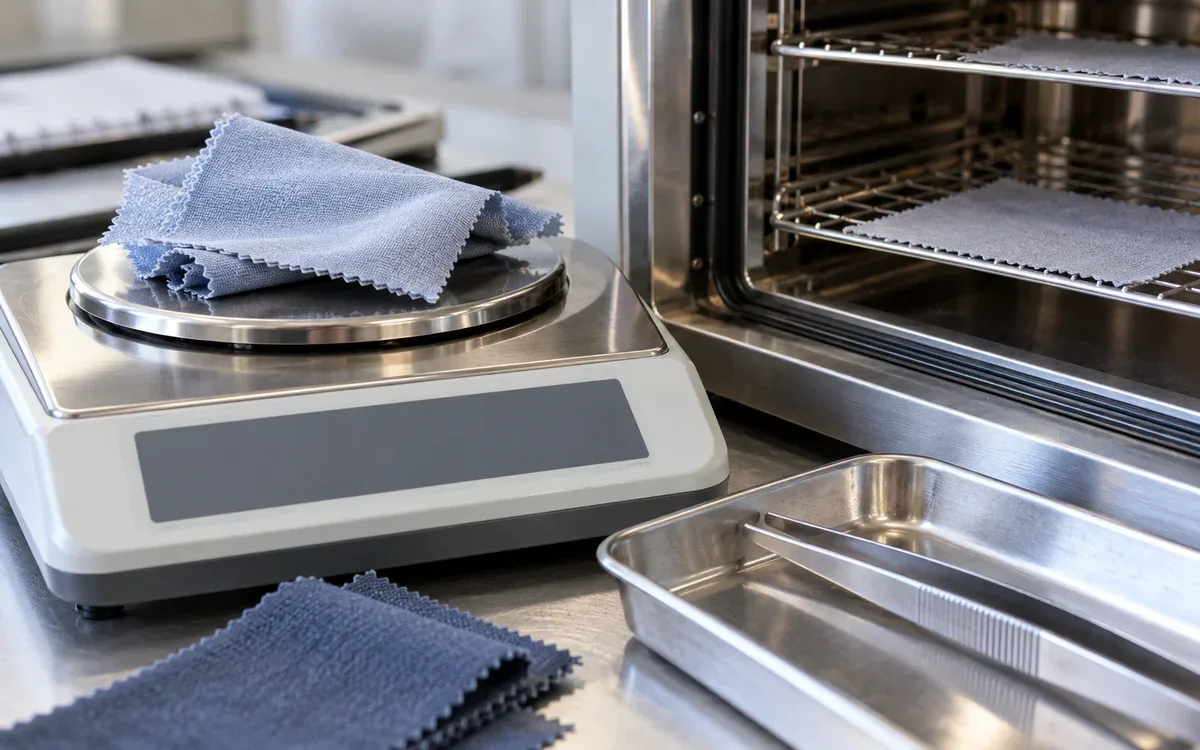
Choose a sensor that suits the material. Install and maintain it correctly. Check how its output relates to the agreed reference measurement.
PLEVA's RR residual-moisture brochure describes electrical-resistance measurement and different sensor arrangements. It also identifies different ranges and limitations for specific designs and materials.
A calibration for one fibre or construction may not fit another blend. Ask the instrument supplier to review changes in finish, contact, or material.
Take paired samples at the defined measurement location and time. Compare the sensor with the selected reference method across the range that matters to control.
Check the width profile
A centre reading may miss a wetter edge. A full-width aggregate may conceal a local region. Choose the measurement arrangement for the quality decision.
Suppose a hypothetical outlet has dry-basis readings of 4%, 5%, and 9% at left, centre, and right. Their simple mean is 6%.
Suppose every monitored location must remain between 4% and 7%. This run fails that rule despite its average. The right side needs attention.
Check incoming pickup at corresponding positions before changing the dryer. A wetter inlet strip can resemble an uneven drying zone at the outlet. Their remedies differ.
Use the temperature record to understand the drying zone
Fabric temperature and air temperature answer different questions. The chamber setpoint is a control target. The cloth's temperature history helps describe its actual treatment.
PLEVA lists fabric temperature, air temperature, residual moisture, and exhaust humidity as separate measurements in its stenter control approach. Keeping them separate helps avoid using one display as proof of all process conditions.
Find where moisture approaches its target. Then examine the later temperature exposure. The cloth may reach its moisture target well before exit. Check whether the rest of the treatment serves another required purpose.
Do not remove that exposure without checking any cure or heat-setting requirement. The same machine can serve more than one process goal.
Run a controlled trial on accepted output
Select one fabric and a stable reference condition. Record the whole trial boundary. Include entry preparation, startup, steady running, and repeated drying.
A first trial might improve extraction while holding the drying endpoint constant. Another might adjust an approved exhaust-control strategy. Keep the changes distinct enough to interpret.
A field study of stenter energy performance by Patel and colleagues used measured plant data. It assessed operating variables. Its results belong to the studied machine and conditions. They support measurement-based trials, not a universal saving percentage.
Use repeated runs and explain material differences. A lighter fabric or drier inlet can reduce energy intensity. So can a longer continuous run. None of these proves that the machine improved.
Keep two energy indicators
For each defined trial, calculate:
Energy per accepted dry kilogram = measured energy ÷ accepted dry fabric mass
Energy per kilogram of water removed = measured energy ÷ measured water removed
Suppose a reference trial uses 600 kWh. It delivers 500 kg of accepted dry fabric and removes 320 kg of water. Its indicators are 1.20 kWh/kg fabric and 1.875 kWh/kg water.
A second trial uses 540 kWh for the same accepted dry mass. It removes only 270 kg of water. Its indicators are 1.08 kWh/kg fabric and 2.00 kWh/kg water.
The second trial uses less energy per fabric kilogram. Yet its energy per evaporated kilogram is higher. Both results can be correct. Fixed loads and the reduced water duty affect the two ratios differently.
Judge the change against the actual objective and full process cost. Do not choose the indicator after seeing which one makes the trial look better.
Make idle time and cleaning part of the comparison
Short lots and frequent stops can change energy per accepted kilogram. Record these events. A long reference run is not a fair match for several interrupted trial runs.
Use the manufacturer's approved idle and restart modes. Minimum ventilation, combustion, emissions, and fire controls remain part of the operating envelope. Energy savings do not justify improvised closure of exhausts.
Inspect seals, panels, filters, and accessible air paths through the maintenance programme. The Berkeley guide identifies damaged panels and poor sealing among issues that can affect a stenter's air balance.
After maintenance, compare the relevant signals and fabric results. Link meter changes to the actual repair. Check them under comparable production conditions.
Troubleshoot the water path first
When output is wet or energy rises, work through the path from entry water to exit fabric and exhaust. This prevents a temperature increase from becoming the default response to every fault.
Symptom | Evidence to compare | Likely decision area |
|---|---|---|
More energy at unchanged output | Check incoming pickup, fabric mass, and idle time. | Did drying duty or fixed load increase? |
One wet edge | Compare inlet and outlet width profiles. | Check extraction, application, airflow, or sensor contact. |
Low moisture with excessive thermal exposure | Track cloth temperature and moisture through the route. | Does drying or another required treatment set the speed? |
High exhaust flow with low moisture loading | Check the flow basis, humidity quantity, and approved limits. | Review exhaust control and air-heating demand. |
Sensor and lab disagree | Check paired specimens, method, and material calibration. | Validate measurement before changing the process. |
Reduced pickup gives poor finish performance | Check chemical add-on and its distribution. | Review the formula or mechanical settings. |
The table identifies where to investigate. It does not establish a diagnosis from one symptom.
Hand over a clear drying-control record
State the dry-mass basis and incoming and final moisture. Add accepted output, energy boundary, and operating conditions. Name the sensor or test method. Record the fabric location.
Keep raw values and conversions visible. A result labelled “5% moisture” without a basis can invalidate an otherwise careful water balance.
For a capacity change, link the observed load to ApparelDiary's factory utility load register. Higher fabric speed may raise evaporation rate and utility demand. This can happen even when energy per kilogram improves.
Release a new route only after it meets the fabric and next-process requirements. Continue to monitor the variables that the trial showed were important.
Frequently asked questions
Is lower final moisture always better?
No. The process should meet the required moisture state. Further drying can consume energy and change fabric behaviour without adding useful value.
Does a ten-point reduction in pickup give ten percent fuel savings?
No. It changes the water duty by a calculable amount, but fuel also serves other loads. Applied finish and extraction electricity may change as well.
Can exhaust relative humidity be used directly in the water balance?
Not in the humidity-ratio equation without a correct conversion using the relevant temperature and pressure. Confirm which quantity the instrument reports.
Does a dry fabric prove that a finish is cured?
No. Drying removes moisture. Cure and heat-setting requirements need their own validated conditions and product checks.
Which energy indicator should the mill report?
Use accepted dry fabric mass for production comparison and water removed to understand evaporation duty. Keep both alongside the actual endpoint and operating conditions.
Control the water balance and preserve the fabric result
The mill needs three facts to improve stenter drying. How much water enters? How much must leave? What fabric condition is needed at exit? Those measurements give speed, airflow, and energy readings a useful context.
Start with avoidable water, check the moisture measurement, and then assess the approved drying controls. Measure the energy change at the same accepted product condition. A documented reduction then shows a useful gain. A lower temperature setting or hourly fuel reading alone cannot prove it.
References
Monforts: Stenter functions and airflow control.
ASTM D2654-22: Moisture in textiles.
TLV: How to read a steam table.
Mahlo: Exhaust-air humidity measurement and control.
PLEVA: RR residual-moisture measurement.
PLEVA: Stenter heat-treatment measurements.
Patel and colleagues: Field-trial assessment of stenter energy performance.
Discussion0
Loading the discussion…