
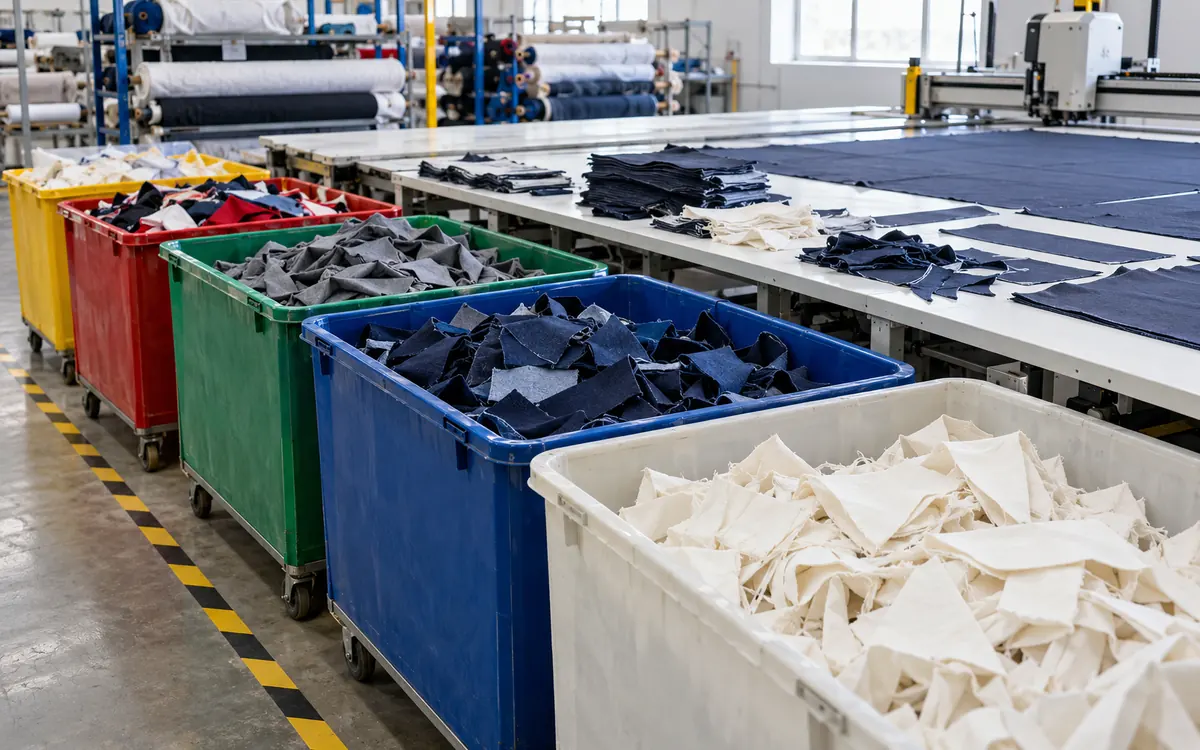
Start where the offcut is made
A clean cotton offcut has a known source while it sits beside the cutting table. Its value becomes less clear when someone tips it into a bag of mixed scraps. Add backing paper, stretch fabric, oil, and wet floor waste, and the next user has a much harder job.
Textile cutting waste segregation starts before that first bag fills. The factory needs to know which materials it will keep apart, who will take them, and how each transfer will be weighed. It also needs a record that follows the scrap after it leaves the gate.
The aim is a useful material stream with evidence behind it. A tidy scrap room alone does not prove recycling. Nor does a truck receipt prove that all the load became new fibre. This guide builds a practical system from the cutting table to the receiver's acceptance record. All quantities and prices in its worked examples are hypothetical.
Define the boundary and the terms
Choose a clear starting point for the scrap account. It might cover offcuts released from cutting, rejected cut panels, and loose fabric ends. Keep reusable stock outside that boundary until someone has made and recorded a decision to release it as scrap.
A usable fabric end can return to stores with its original material identity. Calling it waste first, then counting its return as recycling, would distort the report. ApparelDiary's material issue and return controls explain that earlier handover.
Use these working terms in the site procedure:
Term | Meaning in this procedure | Evidence to keep |
|---|---|---|
Generated scrap | Material first released into the scrap account | Source, date, material code, net mass |
Reusable remnant | Fabric retained for an approved use | Stock return or reuse record |
Sorted scrap | Scrap held to a stated material specification | Sorting code and inspection result |
Dispatched scrap | Material that has left the site | Load list and gate weighing |
Accepted scrap | Material accepted by the next receiver | Receipt and any rejection record |
Recycled output | Material made through a recycling process | Relevant downstream process evidence |
These are operational terms, not a substitute for a scheme's definitions. Textile Exchange's pre-consumer material definition excludes certain scrap that can be reclaimed within the same process that made it. The mere fact that a piece came from a factory does not settle its status for a recycled-content claim.
Agree the outlet before choosing the bins
Ask the intended recycler for an input specification. It should state the fibre types, blend ranges, colours, and forms it can accept. It should also cover coatings, stretch fibres, hard parts, dirt, moisture, and packaging. Have it name the tests or documents used when a load is in doubt.
Avoid using a broad label such as “cotton waste” for several different blends. A buyer might accept one blend and reject another. There is no single contamination limit that suits every textile recycling process.
The European Commission's assessment of textile waste options describes several recovery routes and barriers to recycling. That range matters at factory level. A route that works for one scrap stream may not work for the next.
Use a short trial to test the proposed outlet. Send a small, well-described batch through the normal process. Ask for the received mass, accepted grade, rejected mass, and reason for each deduction. Compare the result with the specification before buying a baler or changing every cutting table.
Agree what happens to a rejected load. A low price can become costly if the factory must pay for return freight and resort the whole shipment. Put responsibility for transport, weighing disputes, and rejected material into the order terms.
Build a sorting matrix workers can use
Start with the few divisions that protect the chosen recycling routes. Add finer grades only when someone can use and pay for them. Too many bins can lead to mistakes, especially during a style change.
An illustrative sorting matrix might look like this:
Stream | Material basis | Keep separate from | Release condition |
|---|---|---|---|
C01 | Verified cotton, white or undyed | Blends, coloured cloth, paper | Material code and colour checked |
C02 | Verified cotton, coloured | Stretch blends and unknown fibre | Colour group matches buyer terms |
P01 | Verified polyester | Coated cloth and mixed blends | Finish and fibre record checked |
B01 | Known blend | Other blend ratios | Exact blend identity retained |
H01 | Unknown or suspect material | Every released grade | Hold until a decision is recorded |
These codes are examples, not a universal sorting standard. Adapt them to the actual fabric range and outlet. A site with laminated goods may need separate routes for each laminate. A simple knitwear site may need fewer streams.
Use written labels with clear symbols as well as colour. Do not rely on bin colour alone. Show a real sample of acceptable scrap beside the label where it is safe to do so. Train workers to put unknown material on hold rather than guess.
Preserve the fabric identity through cutting
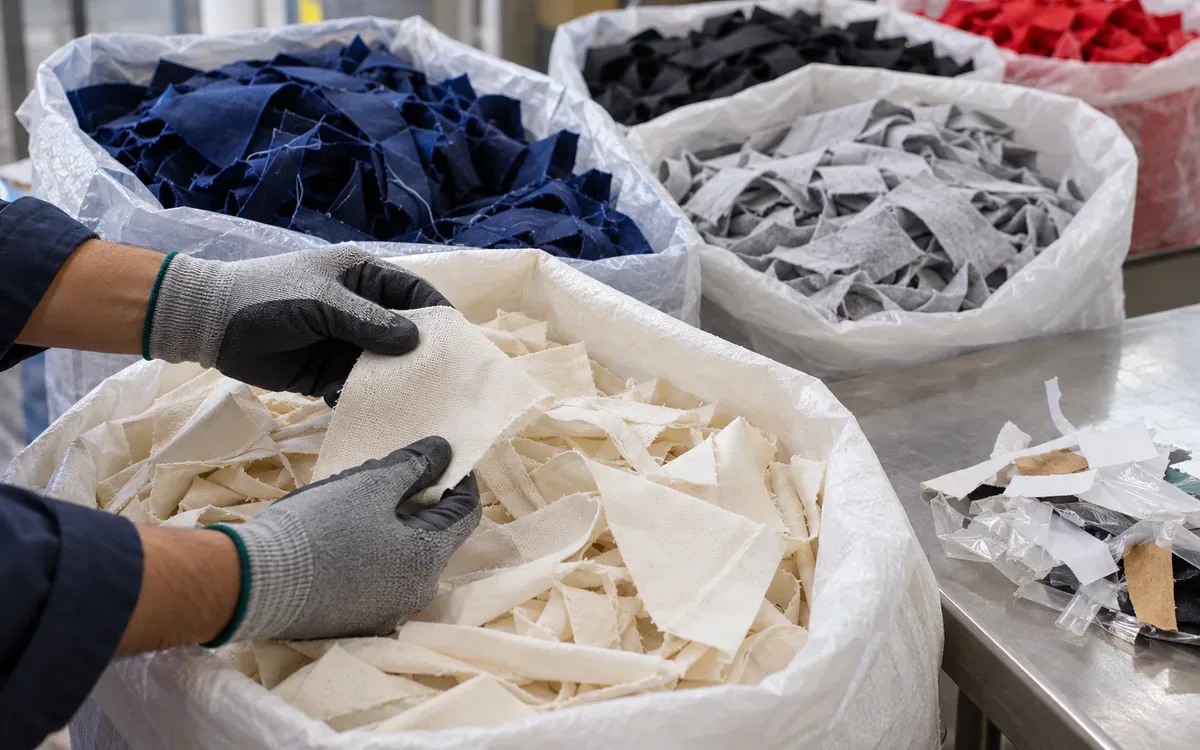
The fabric record should follow the lay to the table and then to the scrap container. Record the roll or batch code, fibre declaration, finish, and any known special treatment. The source may be a supplier specification backed by test results where needed.
A hand feel test cannot prove a blend ratio. A piece that looks like pure cotton may contain a stretch fibre. If the records disagree, hold that lot and resolve the conflict. Do not fill the gap with a more valuable grade simply because the fabric looks similar.
At a change of material, empty the old stream and check the table area. Clear loose scraps beneath the table and around the transfer trolley. Then attach the new batch card before cutting resumes. This small changeover step prevents errors that are hard to undo once scraps are baled.
If two lays run at once, give each a separate collection point. Do not merge their bags unless their accepted specifications match. Record the merge when it happens. The resulting bale must retain links to both source lots.
Keep foreign matter out of the stream
Separate paper, plastic film, food waste, and sweepings at the point of use. Put each bin within easy reach of the task that creates that waste. A rule is unlikely to work if the right container is across the room.
Do not mix oil-soaked rags or chemical-contaminated textiles with clean offcuts. Their handling route needs a competent review under the site's applicable rules. A recycler's willingness to buy a material does not by itself establish that the route is lawful or safe.
Use a check before each bag or bale closes. Look for visible foreign matter, the wrong fabric grade, loose labels, and wet areas. Record who checked the lot. For high-risk streams, agree a sampling and testing method with the receiver.
Avoid setting a percentage limit from a handful of clean pieces taken from the top. Such a sample may miss what lies inside the bale. A practical check needs access to several parts of the load, a stated selection method, and a clear basis for accepting or holding it.
Weigh net material on a stated basis
Record gross mass, tare, and net mass separately. Tare is the mass of the bag, pallet, or container. Use a scale suited to the load and the required accuracy. Keep its identification, checks, and maintenance records with the procedure.
For example, a filled cage weighs 127.4 kg. Its empty mass is 12.4 kg:
Net scrap mass = 127.4 − 12.4 = 115.0 kg.
Using a default tare of 10 kg would report 117.4 kg. That is an overstatement of 2.4 kg for one cage. Repeating the error across 40 cages would add 96 kg to the scrap account.
Protect scrap from rain and wet floors. If the buyer uses a moisture adjustment, agree the measurement method and basis before shipment. Wet-basis moisture and dry-basis moisture are different ratios. They cannot be substituted without conversion.
For a hypothetical 1,000 kg load with 8% moisture on a wet basis:
Dry material mass = 1,000 × (1 − 0.08) = 920 kg.
That calculation does not set a permitted moisture level. It only shows the arithmetic for a defined basis. Do not apply it to a guessed moisture value or use it to alter an invoice without the agreed test.
Give each lot an unbroken record
Assign a unique code to each bag, cage, or bale at the level the site can manage. A batch code may cover several bags, but the record must still show their counts and masses. Reusing an old identifier makes it hard to trace a later complaint.
A useful lot record contains:
The source area, date, and source fabric lot.
The fibre and finish information used for sorting.
The assigned scrap grade and its specification version.
Gross, tare, and net mass with the scale identifier.
Inspection result, holds, and release decision.
Any split, merge, or reclassification.
The dispatch reference and intended receiver.
Textile Exchange's Reclaimed Material Declaration Form guidance explains the role of structured origin, composition, and classification data in certified supply chains. The site's internal log should be able to support the relevant declaration rather than recreate the evidence at month-end.
Keep original records after an error is corrected. Show the old value, the new value, the reason, and who approved the change. A clean final total is less useful than a traceable total whose changes can be explained.
Reconcile the material balance each month
Use one boundary, one unit, and one weighing basis. Treat internal movements as transfers, not new scrap generation. If a bag moves from the cutting floor to the scrap room, it must not enter the total twice.
For a simple account:
Opening stock + generated scrap = dispatches + other recorded exits + closing stock + unexplained difference.
Consider a hypothetical month:
Movement | Net mass, kg | Treatment |
|---|---|---|
Opening scrap stock | 1,200 | Available at the start |
Scrap generated | 8,400 | First entry during the month |
Dispatches | 8,100 | Left the site |
Other recorded exits | 200 | Separate approved route |
Closing stock | 1,250 | Physically verified |
Available material is 1,200 + 8,400 = 9,600 kg. Recorded exits and closing stock total 8,100 + 200 + 1,250 = 9,550 kg. The unexplained difference is 50 kg, or about 0.52% of available material.
That 50 kg is a signal to investigate. It is not automatically theft, drying loss, or a scale fault. Check the cut-off time, missing dispatch notes, tare entries, stock counts, and transfers. If a supported moisture change explains part of the gap, record it separately.
Use the approach in cycle counting fabric and trims for sound count discipline. The scrap account still needs its own grades, weights, and downstream evidence.
Separate site dispatch from downstream acceptance
Continue the example. The factory dispatches 8,100 kg. The receiver records 7,900 kg as accepted and rejects 200 kg. The receipt therefore reconciles with the dispatch total.
If the rejected 200 kg returns next month, record a return linked to the original dispatch. Do not count it as fresh cutting waste. If it moves to another route, retain evidence for that movement instead.
The receiver's acceptance rate is:
7,900 ÷ 8,100 × 100 = 97.53%.
This measures acceptance of that shipment. It does not measure the yield of recycled fibre. That later yield depends on the receiver's process and output records.
The UNEP textile roadmap links better collection and sorting with input data and suitable processing capacity. A factory can support that link by retaining the receiver's identity and process route, then asking for evidence that fits the claim it plans to make.
Use separate measures for separate questions
A single “recycling rate” can hide several different results. Keep the numerator and denominator visible. State whether the measure covers generated scrap, material dispatched, accepted input, or verified recycled output.
For daily control, consider four measures:
Measure | Calculation | Question answered |
|---|---|---|
Hold rate | Held mass ÷ sorted mass | How much needs a decision? |
Receiver rejection rate | Rejected mass ÷ dispatched mass | Does the stream meet the agreed grade? |
Unexplained balance gap | Unexplained mass ÷ available mass | Can the site account for its scrap? |
Evidence completion | Dispatches with complete receipts ÷ dispatches due | Can the claimed route be supported? |
Choose a time period and apply it consistently. A receipt due next month is different from a missing receipt that is overdue. Make that distinction visible so teams do not invent a receipt just to clear a dashboard.
Track scrap prevention separately from scrap routing. The EPA waste hierarchy gives priority to prevention and reuse. More scrap sold is not always better if the factory generated more avoidable waste to begin with.
Test the business case without inflating the benefit
Use accepted net mass and the actual grade price. Deduct sorting, handling, bags, transport, tests, and any rejection cost. Include the effect of storage if it delays cash or uses scarce floor space.
Suppose mixed scrap earns 0.10 currency units per kg. A verified sorted grade earns 0.22. For 6,000 kg accepted at the higher grade, the gross gain is:
6,000 × (0.22 − 0.10) = 720 currency units.
Assume added labour costs 220, bags cost 60, and extra transport costs 90. The net gain is 720 − 220 − 60 − 90 = 350. These figures are illustrative and do not represent market prices.
Check what happens if only 4,000 kg qualifies for the higher grade. Gross gain falls to 480. If the added costs remain 370, the net gain is just 110. This sensitivity helps decide whether a finer grade is worth keeping separate.
Do not count the full scrap sale value as new profit if the old process already sold that material. Use the difference between the two feasible routes. Also keep environmental claims separate from the cash calculation.
Keep certification and claims current
Sorting records help a claim, but they do not create certification. Textile Exchange's RCS and GRS overview describes third-party certification and chain-of-custody requirements. Check the applicable scope, transaction evidence, and claims rules with the relevant certification body.
The system is also changing. As checked in October 2026, Textile Exchange's transition timeline makes Materials Matter effective on 31 December 2026. It becomes mandatory for the stated Tier 4 audit transition from 31 December 2027. The timeline gives 30 June 2029 for all claims and labels to move to the new system.
Use the policy for the organization's role and audit date. Do not treat those dates as one deadline that applies to every factory activity. The official declaration form page also carries a version code. Record the version used when supplying data.
Run a controlled four-week trial
In week one, map the scrap streams and review outlet specifications. Observe a full style change. Check how fibre identity reaches the table, where bags stand, and who can release a held lot.
In week two, trial the labels and weighing record on a limited area. Ask workers to explain what they would do with an unknown blend or a wet bag. Their answers will show whether the procedure is usable.
In week three, send a traceable shipment. Compare the factory weight with the receiver's weight and acceptance result. Investigate differences before treating the route as stable.
In week four, close the material balance and review the cost. Expand only the controls that worked. Assign one owner for the unresolved cases and a date for the next review.
Handle splits and merges without losing the trail
Sorting often changes the shape of a lot. A large cage may become three bales. Several small bags may form one dispatch lot. Those changes need a link between the old and new codes; a fresh label alone is not enough.
Suppose lot L17 contains 240 kg. Further sorting produces 180 kg of the accepted grade, 50 kg of a known blend, and 10 kg of paper and other removed matter. Close L17 with three child records that total 240 kg. Record each destination. Do not leave the parent lot open while also adding the children to stock.
If a new bale joins 180 kg from L17 with 120 kg from L18, its net textile mass is 300 kg. Its record must point to both parents. Check that both meet the same grade before merging them. A good weight total cannot repair a wrong blend identity.
Use a simple movement table with an event code, source lot, destination lot, mass, and date. This can work on paper or in a spreadsheet. The key control is that a reviewer can follow any bale backwards and account for every part of a closed source lot.
Resolve a weight dispute while evidence is fresh
If the factory records 1,500 kg and the receiver records 1,470 kg, keep both readings. Ask whether the records use the same tare, packaging, scale units, and moisture basis. Check that the same number of bales arrived and that all were weighed.
The 30 kg difference is 2% of the factory's reading. That percentage describes the gap; it does not prove which scale is wrong. Review scale checks and the load's condition before settling the adjustment. A documented joint reweigh may help when the material is still available.
Agree a dispute window and a person to contact before the first shipment. A receipt raised weeks after the scrap has been processed may leave few ways to test the cause.
Protect the stock while it waits
Mark storage spaces by grade and status. Keep held stock apart from released stock, and show the oldest lot date. Plan collections to prevent bags from spilling into walkways or being mixed during a space shortage.
The scrap layout must fit the site's fire and handling controls. Keep access routes clear and use the approved stacking and baling methods. Ask the responsible safety team to review changes in stored quantity or packing density. A higher sale price should not be gained by creating an unmanaged storage hazard.
Common problems and practical responses
Problem | Likely control gap | First response |
|---|---|---|
Unknown fabric in a clean grade | Weak changeover identity | Hold the lot and trace source cards |
Heavy bags after rain | Poor storage protection | Isolate wet stock and review weighing basis |
Repeated buyer deductions | Input specification not understood | Compare rejected samples with agreed limits |
Dispatch exceeds available stock | Duplicate or missing entries | Reconcile lot movements and month cut-off |
Complete gate notes, missing receipts | Follow-up ownership unclear | Assign due dates and chase the named receiver |
Good totals, weak origin evidence | Records created too late | Capture source identity at the cutting table |
Frequently asked questions
Can known blends go into one mixed bin?
Only when the receiving process accepts that mix and the specification allows it. Keep the composition records. A buyer's informal “all fabric accepted” statement is too vague for a controlled grade or a precise claim.
Does selling scrap count as recycling?
It proves a sale if the transaction record is sound. It does not by itself prove the next process or its output. Describe the route at the level the available evidence supports.
Must every bag be tested for fibre content?
No universal rule applies to every stream. Set checks from source reliability, material risk, scheme rules, and buyer terms. Use testing where the records cannot support the required decision.
Should a factory report zero unexplained loss?
It should aim to explain its balance with sound records. It should not force the result to zero through unsupported adjustments. Show a remaining gap and its investigation status honestly.
Make each transfer worth trusting
Good segregation protects identity at the point where scrap is made. Reliable weighing then protects quantity, and downstream records protect the claim. Start with a few usable grades, keep unknown material on hold, and reconcile every exit. The result is a scrap stream that the factory can sell, explain, and improve with evidence.
References
Textile Exchange. Pre-consumer material definition.
European Commission Joint Research Centre. Techno-scientific assessment of management options for used and waste textiles, 2023.
Textile Exchange. Reclaimed Materials Declaration Form guidance.
United Nations Environment Programme. Sustainability and Circularity in the Textile Value Chain: A Global Roadmap, 2023.
US Environmental Protection Agency. Non-hazardous materials and waste management hierarchy.
Textile Exchange. Recycled Claim Standard and Global Recycled Standard.
Textile Exchange. Materials Matter standards transition, checked October 2026.
Textile Exchange. Reclaimed Material Declaration Form, TE-MM-TEM-105-V2026.2.
Discussion0
Loading the discussion…