
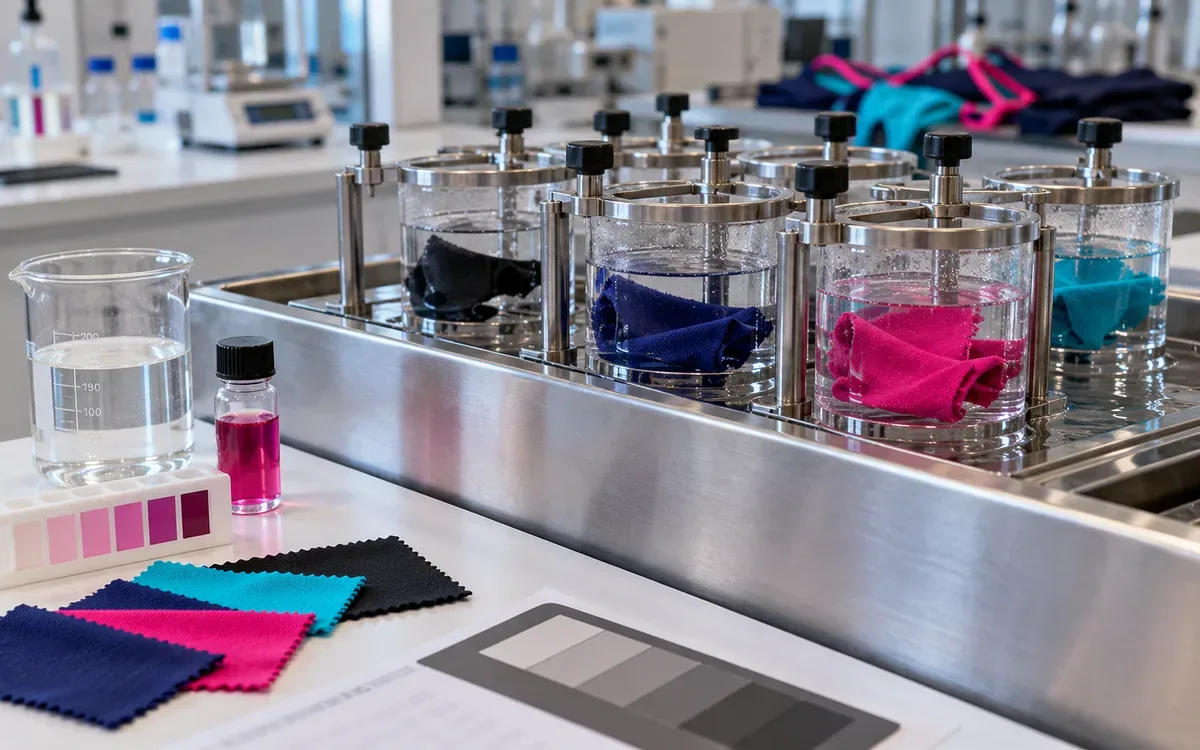
Define the colour claim before choosing the test
A swim fabric may keep its shape while its print fades. Another may retain a strong colour yet lose the support that made it suitable for training. Colourfastness to chlorinated water addresses the first problem. How does the colour change after a defined chlorine exposure? The test does not measure every part of swimwear life.
The useful buying question is specific. Will this colour, on this finished fabric, meet the agreed limit under the chosen test? A report headed chlorine resistant may leave that question open. It needs a method, condition, and result. The fibre name and elastane percentage cannot fill that gap.
Build the programme around the actual product. Include the shell, lining, contrasting panels, and important printed areas. Keep colour performance separate from strength, stretch, and fit requirements. The team can then improve a failed shade while still checking other garment problems.
ISO and AATCC requests need their own conditions
ISO 105-E03:2010 specifies three alternative conditions. Its scope lists active chlorine levels of 50 mg/L and 100 mg/L for swimwear. It lists 20 mg/L for items such as towels and beach robes. ISO confirmed this edition in 2026. A request that names only E03 still needs the intended condition.
These figures describe laboratory test conditions. They are not instructions for operating a swimming pool. Do not use them as pool treatment advice. They also do not prove what conditions exist at a given leisure centre.
AATCC TM162-2011e2 is a related method for coloured yarns and fabrics. Its test principle controls agitation, temperature, time, pH, and hardness. The dried sample is then graded. Related methods are not always equal. Do not relabel a result from one as the other.
Obtain the full required method before running the test. The public pages give scope and status. They do not give every test step. Do not mix a solution recipe from one method with the load or heat from another. That makes a different exposure, even if the report keeps a familiar standard number.
Specification field | Why it belongs in the request |
|---|---|
Method and edition | Identifies the complete test route |
Test condition | States the required chlorine challenge and other method options |
Material and finish | Connects the result to the delivered fabric |
Colour or print area | Shows which part of the design was assessed |
Pretreatment | Defines any care or processing before exposure |
Assessment and limit | Makes the acceptance decision reproducible |
Treat chlorine terms as measured quantities
The words free, combined, total, and available can appear in chemical and laboratory records. Do not shorten all these names to chlorine if that hides what was measured.
Hach's explanation of free and total chlorine identifies hypochlorous acid and hypochlorite ion as free available chlorine. Combined forms include chloramines, and total chlorine includes free and combined forms. The document also explains the DPD colour reaction. Other oxidants may affect that response.
Take a made-up water result of 5.0 mg/L total chlorine and 2.0 mg/L free chlorine. On the same reporting basis, combined chlorine is 3.0 mg/L. That subtraction does not make free chlorine equal to 5.0 mg/L. Say which quantity was measured.
Use the analytical quantity specified by the textile method. Record the assay procedure and its reporting units. If a stock states available chlorine expressed as Cl₂, keep that basis through the sum. A percentage on a hypochlorite label may not be the same quantity as a current lab assay.
Two labs may report the same number but measure different chlorine forms. Settle that issue first. Then compare how the fabrics performed.
Verify the stock strength before dilution
Use the stock assay required by the controlled procedure. A purchase certificate or old mixing label may not show the strength at test time. Use a checked value on the correct chemical basis for dilution.
For a made-up trial bath, assume a stock assay of 1,200 mg/L. This is on the required available-chlorine basis. The target is 2.00 L at 50.0 mg/L. Assume no reaction or loss during mixing. The measured quantity is conserved, so:
Stock volume = target concentration × final volume ÷ stock concentration.
Stock volume = 50.0 × 2.00 ÷ 1,200 = 0.08333 L = 83.33 mL.
This is dilution arithmetic, not a complete test recipe. The actual method still sets the water, chemistry, pH, mixing order, tolerances, and handling.
Now suppose the operator uses an outdated stock value of 1,500 mg/L. The calculated addition would be only 66.67 mL. With the actual 1,200 mg/L stock, the final concentration would be about 40.0 mg/L. That is 20% below the intended 50.0 mg/L.
A good result in this weaker bath does not prove a pass at the target condition. The sum assumes a final total volume of 2.00 L. Do not add the stock to 2.00 L of water already in the vessel. That gives a larger volume and another concentration error.
Make the assay fit the concentration range
Choose an assay and dilution route suited to the sample. A meter may work well for low residual chlorine. A stronger textile test solution may need a proven dilution step first. Follow the assay method. A displayed number is not proof that the meter is valid at any concentration.
Hach's DPD method documentation calls for prompt analysis. It covers interferences and dilution above its range. It also warns that dilution may cause some chlorine loss. This guidance is for a specific instrument. It does not permit replacing a textile method's required assay with this one.
Consider a separate analytical example. A laboratory takes 5.00 mL of a solution and makes it to 100.0 mL. The dilution factor is 100.0 ÷ 5.00 = 20. If the diluted sample reads 2.40 mg/L, the original value calculates to 48.0 mg/L. This assumes that the assay method validates the dilution. It also assumes no relevant loss.
Keep both readings in the record. Entering 2.40 mg/L as the bath value misses the dilution factor. Entering 48.0 without noting the dilution makes an audit harder. Near a tolerance, keep enough detail to show uncertainty. Do not hide it through rounding.
Use suitable blanks and checks. A coloured or cloudy sample may need special assay steps. A weak DPD colour does not prove low chlorine by itself. Check the method's range and interference rules first.
Control pH, temperature, and hardness together
Chlorine concentration is only one test factor. Hach's chemistry guidance shows that pH and other conditions affect chlorine forms. AATCC TM162 also names temperature, pH, and hardness in its principle. Matching concentration alone does not make two tests the same.
Record actual pH and temperature at the stages required by the method. Identify the water and hardness preparation. A distilled-water label does not prove that later additions were correct. Local tap water may also create an uncontrolled difference between sites.
Use the specified preparation order and laboratory handling controls. Wrong additions can change hypochlorite chemistry. Do not improvise acid adjustment from a generic internet recipe. Follow the authorized method and reagent safety instructions.
For diagnosis, change one relevant factor at a time or design a trial that separates their effects. A supplier may change pH, chlorine level, temperature, and shade recipe at once. That compares two whole routes. It cannot show which change solved the failure.
Keep nominal settings apart from measured conditions. A controller target is useful. Still record the required checks on the working solution and loaded machine. If a measured value is out of range, decide what to do and record it. Do not quietly replace it with the target value.
Control the amount of fabric in the bath
Fabric mass and solution volume affect the amount of chlorine available relative to the load. Follow the rules for sample mass, makeweight, control cloth, and allowed groups. Extra samples in one vessel may change the test. Do not assume they are a harmless way to save time.
Consider a made-up inventory calculation. A 0.500 L bath at 100 mg/L holds 50.0 mg on the stated chlorine basis. With 5.00 g of textile, it starts with 10.0 mg per gram of textile. With 8.00 g, it starts with 6.25 mg per gram. That is 37.5% less per gram.
Those values are not absorbed doses or predictions of colour damage. They simply show why changing the load changes the exposure system. The cloth and chemicals it carries may change what stays in solution. Reactions over time matter too.
Do not group unrelated test fabrics unless the method permits it and the load rules are met. One piece may change the bath for another. A mixed-load result may then differ from an individual test.
Maintain a container map. Give every specimen, control, and vessel a clear identity before loading. Dark shades may look alike when wet. A location record helps prevent a label mix-up that would be hard to solve later.
Use control fabric to check the run
AATCC supplies a TM162 chlorine test control fabric to help verify correct test performance. Use the specified control and the relevant batch instructions. A random cloth that faded last month cannot replace the required control.
Record the control lot, expected response, observed response, and disposition. An out-of-range control raises a question about the run. It does not mean all bulk samples suddenly got better or worse.
Investigate the result through the laboratory's validity rules. Check preparation, strength of solution, time, temperature, machine, and grading. Do this before blaming the fabric. Keep the original data while deciding whether a valid repeat is needed.
A passing control has a limited role too. It supports the run under a defined rule. It cannot make a wrongly labelled bulk sample correct. Sample identity and test validity are separate checks. Both need to be sound before a report can support release.
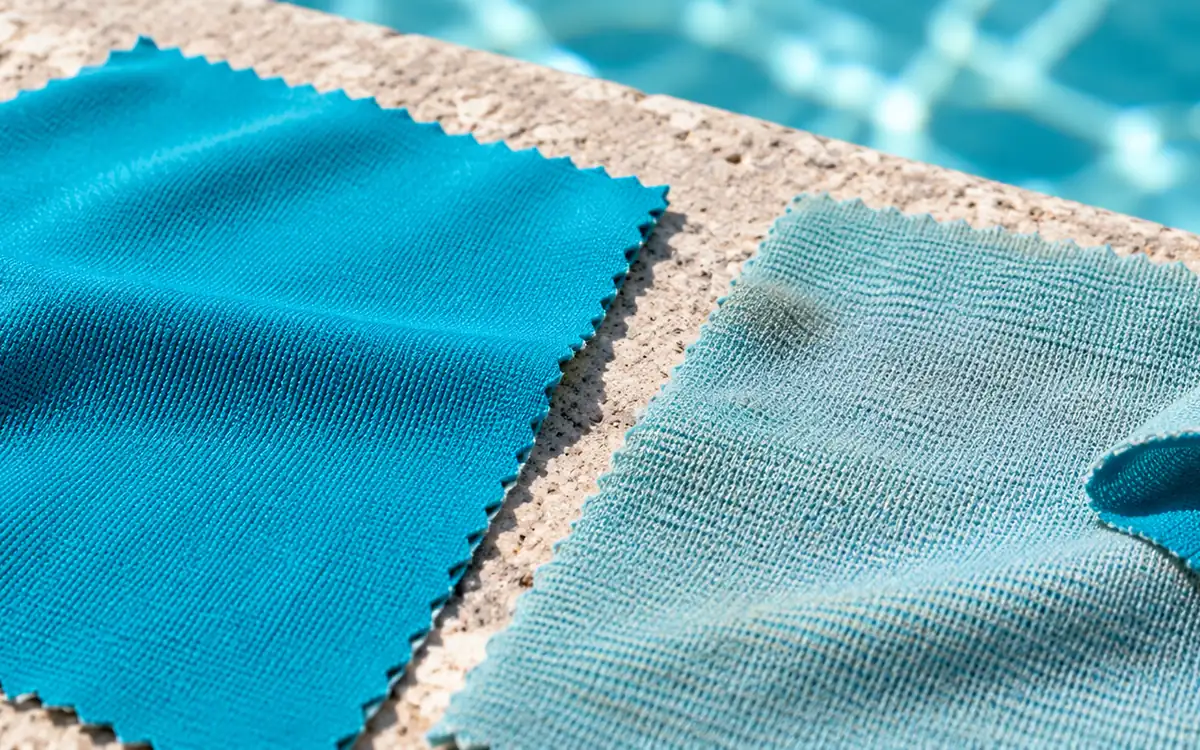
Diagnose chlorine loss with a separate study
When an unexplained difference persists, a development study can track solution concentration over time. Keep this study separate if sampling would change the required bath volume or exposure. Do not keep opening a compliance test to take liquid unless its method allows it.
Use matched vessels or another sound sampling plan. Label readings from a blank bath and a bath with textile. A blank shows background loss. Comparing it with a loaded bath helps reveal the effect of the cloth and chemicals it carries.
Suppose an invented one-hour study records 50, 35, 25, and 20 mg/L at 0, 20, 40, and 60 minutes. Estimate the concentration-time area by treating each interval as a straight line:
Area = [(50 + 35) ÷ 2 + (35 + 25) ÷ 2 + (25 + 20) ÷ 2] × one-third hour.
Area = 31.67 mg·h/L.
A constant 50 mg/L for one hour would give 50 mg·h/L. The estimated area is therefore 36.7% lower. This compares measured solution histories to help find a cause. It does not predict fading. It cannot replace the standard condition or convert exposure into hours of swimming.
The estimate also depends on the sampling interval. A rapid early drop can be missed by sparse readings. Plan the study around the process question. A precise-looking area must not imply more certainty than the readings support.
Assess the dried colour against the right reference
Compare the exposed piece with retained unexposed cloth in the same state. An approved lab dip helps identify the target shade. It may not be the correct unexposed reference for a new bulk fabric.
AATCC EP1-2025 describes visual assessment of overall colour change with a grey scale. Its scope allows notes on lightness, chroma, and hue change. The method does not quantify each one separately. Use the grading route required by the test and buyer.
For a print, decide how each relevant colour will be assessed. A large aperture may average a fading red motif with an unchanged white ground. A small motif may need a different setup from solid cloth. Agree the approach before testing. Keep the setup the same for repeat work.
For instrument results, record the metric, geometry, aperture, light source, and observer. Add the backing and sample presentation required by the method. Keep visual findings where needed too. A number without its conditions may not resolve a dispute.
ApparelDiary's fabric colour approval guide covers the initial shade decision. In a chlorine trial, retain both that starting appearance and the change caused by exposure. A shade that starts out of tolerance does not pass just because it fades little.
Compare colour routes on matched finished fabric
Do not claim that every dye in a class has the same chlorine performance. Test the actual colour system on the intended cloth. Use its true shade depth and finished state. Supplier guidance can narrow the trial. The fabric result decides whether the route meets the brief.
Consider three hypothetical navy routes. Each starts within the agreed shade tolerance. The example buyer wants at least grade 4 for colour change under two named exposures. These grades and limits are made up. They are not rules for all swimwear.
Colour route | Exposure A | Exposure B | Decision under the example rule |
|---|---|---|---|
N1 | 4–5 | 3 | Fails B |
N2 | 4 | 4 | Meets both colour limits |
N3 | 5 | 3–4 | Fails B |
Choosing the best result under A picks N3 and misses its failure under B. Averaging both conditions would hide that failure too. Show each condition separately. Keep half grades in the lab's original form.
A successful route still needs a bulk check of the planned dye and finish process. A new recipe may use a different component to match the shade. Check its other required fastness properties too. The same navy name does not prove an unchanged colour system.
Preserve colour-area identity in printed developments. Label the red flower, blue ground, and dark outline separately when the plan requires separate ratings. If one area fails, the printer can check that colour's recipe and application. One overall print grade may hide which part needs work. This is a particular risk when the failed area is small.
Separate colour retention from fabric durability
Research can help frame the wider qualification plan. In a 2024 study by Potočić Matković and colleagues, nine swimwear knits underwent outdoor chlorinated-water ageing, with and without sun exposure. The researchers measured physical properties, tensile response, and moisture management. They also laundered the cloth after immersion. This was not a standard colourfastness test.
The study shows why a trial needs named endpoints and clear exposure steps. Its findings do not predict service life for every swim fabric. They also do not isolate chlorine from the other parts of that process.
Keep the colour report alongside separate mechanical evidence. A fabric with grade 4–5 colour change can still fail a required fit or strength measure. A cloth may keep its strength and still fail because its print visibly changes.
ApparelDiary's elastane stretch and recovery guide explains those mechanical measurements. Use that framework for the distinct fit question. Do not use the chlorine colour test to claim that every garment property is proved.
Investigate an apparent improvement before scaling it
A finish change can appear to improve a chlorine result. Confirm whether the improvement remains after the required care and whether the starting shade still matches. Also check that the test solution and controls behaved as expected.
A finish may change how much chlorine the solution loses. A shared bath trial may then answer a different question from an individual test. Use the approved loading setup. Study solution behaviour separately if there is a clear reason to suspect it.
For a matched development, retain untreated control fabric, the existing finish route, and the proposed finish route. Keep the base dyeing the same where the aim is to study the finish. Add a process-only control if extra wet and dry handling may affect colour. This helps separate a chemical effect from a process effect.
Do not select a finish solely from its first chlorine grade. Check its durability, shade effect, handle, and other required properties. Record enough detail to repeat the accepted route in bulk. The result belongs to that whole system. A chemical product name alone does not define it.
Report a result without promising a lifetime
A useful report states the method, condition, specimen state, colour, measured result, and any deviation. It identifies the control outcome where applicable. The acceptance decision names the buyer's limit and the material it covers.
Avoid converting one laboratory exposure into a guaranteed number of swims. Real use varies in water chemistry, time, drying, sunlight, care, and garment strain. A concentration-time sum alone cannot prove equal effects across those conditions.
If a supplier makes a durability claim, ask for the supporting protocol and endpoint. Ask what failed, what counted as a pass, and which reference was used. Fibre breakage and visible colour change are different claims. Keep sales language within the supplied evidence.
Frequently asked questions
Does chlorine resistant elastane prove colourfastness?
No. It addresses a fibre performance claim under its supporting evidence. The dyed or printed finished fabric still needs the required colour test. The shell, lining, and trim may use different colour systems.
Can a towel result approve swimwear fabric?
Only if the report actually meets the swimwear specification. ISO 105-E03 lists different alternative chlorine concentrations for swimwear and accessories. Check the condition, cloth, and acceptance rule. A general test title is not enough.
Does grade 4 mean 80% of the dye remains?
No. A grey-scale grade is a colour-change assessment. It does not measure dye mass, percentage of colour left, or remaining useful life.
Should a failed shade be retested at a weaker condition?
That may be a useful development comparison if clearly identified. It does not replace the original required condition. Only the party responsible for the limit can decide to change it.
Make the exposure and the claim match
Reliable chlorine colour testing starts with a clear condition and a verified solution. It preserves the specimen load, controlled environment, and assessment route. The team can then compare colour systems on equal terms and investigate a failure with focused trials.
Release the fabric when the evidence meets the actual product brief. Keep colour, fit, and strength decisions visible as separate requirements. A clear report supports a sound colour decision. It does not turn a lab grade into a promise about every pool or the lifetime of every garment.
References
ISO 105-E03:2010: scope, alternative conditions, and status.
AATCC TM162-2011e2: official scope and principle.
Hach: free and total chlorine chemistry.
Hach: DPD method range, dilution, and sample handling.
AATCC: TM162 chlorine test control fabric.
AATCC EP1-2025: grey scale for colour change.
Potočić Matković, Salopek Čubrić, and Krstović, 2024: swimwear ageing study.

Discussion0
Loading the discussion…