
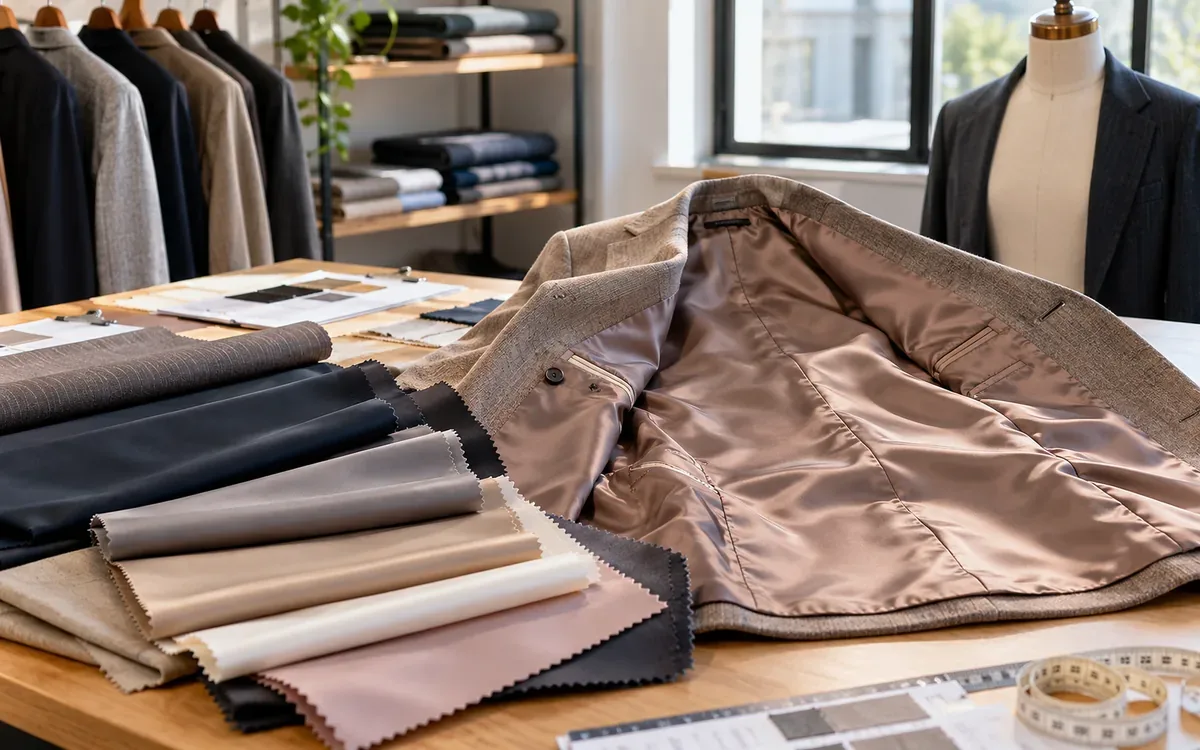
A lining should help a garment move and feel right from the inside. If it is too tight, a jacket hem may pull upward. The arm may feel restricted, too. If it is too loose, it can hang below the shell. It may also catch during dressing. A fabric may feel smooth on the table. It can still cling to the wearer’s base layer.
Garment lining selection therefore combines material choice with pattern and assembly decisions. The shell and lining work together. They may still remain separate layers.
Choose the fabric for the job it must do. Then prove that choice in the garment, through movement and the intended care.
Separate lining from structural support
A lining covers part or all of a garment’s inside. It can cover internal construction and help the garment slip on. It may also manage body contact or protect other layers from wear.
Interlining has a different main role. It adds support, shape or another function within the construction. A lining can add some body. That does not make it a replacement for a support material. Their shared position inside the garment does not give them the same job.
Also distinguish lining from insulation. A light smooth lining may add little warmth. A separate insulating layer can add much more. A quilted lining assembly combines several functions. Specify the complete assembly.
This distinction keeps the brief clear. The jacket may need more chest shape. A change to its loose lining may not solve that problem. A sleeve may catch on a shirt cuff. Adding a stiffer support is unlikely to fix the cause.
Define the lining’s role by garment area
One fabric does not have to serve every inside area. List the body lining, sleeve lining, pocket bag and local facing. Each can face different demands.
Area | Main questions for selection |
|---|---|
Sleeve | Does it slide over the intended base layer without restricting reach? |
Upper body | Does it follow shoulder and back movement without pulling the shell? |
Skirt or dress | Does it hang cleanly, provide the intended coverage and avoid cling? |
Trouser seat and thigh | Does it tolerate movement and local rubbing? |
Insulated outerwear | Does the complete inner assembly suit warmth, moisture and care needs? |
Partial lining edge | Is the transition smooth and secure against the wearer? |
Write the priority for each area. A summer jacket may need a light inside with easy movement. A formal coat may place greater emphasis on drape and a neat visible interior.
Record what the garment will be worn over. A lining that slides well over a fine shirt may grip a brushed knit. The intended clothing layers are part of the application.
Use fibre names as a starting point
Linings may use cupro, viscose, polyester, polyamide, silk, cotton, blends or other fibres. The name helps describe the material. It does not establish how the finished fabric performs.
Check yarn form, weave or knit, mass, density and finishing. These also affect hand, slip and durability. Two fabrics with the same fibre percentage can behave differently.
Asahi Kasei describes Bemberg cupro as a fibre derived from cotton linters. Linings are one of its uses. The listed features include a smooth feel. The fibre also absorbs and releases moisture. These features help the team select candidates. They do not prove that every fabric made with that fibre meets the garment’s needs.
Lenzing’s product information likewise distinguishes its cellulosic fibre products and their applications. Confirm the actual fibre and fabric identity when a supplier uses a brand name.
Ask for a complete fabric specification. Include composition, construction, finished width, mass, colour, finish and intended care. Keep a swatch with that record. A familiar material name could otherwise hide a changed product.
Compare fabric structure and surface
A smooth surface can help one layer slide over another. A more open structure can change opacity, airflow and snag behaviour. A knitted lining may offer movement that a stable woven lining does not.
These are selection questions, not automatic rankings. Inspect the actual fabric against the shell and base layer.
Check both faces. Some linings have a clear face and reverse. Their friction or appearance may differ. Record which side faces the wearer.
A lustrous face may look attractive when the garment opens. Gloss alone does not measure smoothness. A textured surface may feel pleasant by hand. Yet it may drag against another fabric.
Use a simple, consistent comparison in development. Place each candidate against the same intended base-layer fabric. Compare the same movement. Formal friction measurements may be needed. If so, agree the method with a lab. An informal hand test should not become a numerical performance claim.
Separate comfort questions
“Breathable” can conceal several different properties. Air movement through a fabric is not the same as water-vapour transfer. Neither is identical to liquid sweat absorption.
ISO 9237 provides a method for fabric air permeability. ISO 11092:2026 addresses thermal and water-vapour resistance. Its steady test conditions can cover multilayer assemblies.
The ISO 11092 scope explains its limits. The conditions do not represent a specific comfort situation. They do not set a physiological-comfort performance limit. A test result therefore needs an application context.
For a lined garment, consider the complete layer arrangement. A highly permeable lining cannot remove a barrier imposed by the shell. A warm insulating layer changes the experience even when the lining itself is thin.
Choose measurements that answer the design question. The wearer may report clamminess during active use. Visual openness alone gives weak evidence about that problem.
Evaluate static and cling in the intended pairing
Cling can interfere with drape and dressing. The problem may instead be mechanical friction. Check for a tight lining or a rough base layer, too.
Compare candidates under relevant conditions and with the intended shell and clothing layers. Record the environment when static behaviour is part of the assessment. A result in one room does not establish performance across every climate.
Do not assume that a soft finish permanently solves the problem. Check whether the property remains after the agreed care.
Observe how the garment behaves after movement. Does the lining return to its intended position? Does it cling around the legs or remain caught at the sleeve? Record the location and the clothing combination.
Avoid promising that one fibre will eliminate static in all garments. The material pair, finishing and conditions all contribute. Use the supplier’s evidence to select candidates. Then confirm the finished product’s behaviour.
Give the lining room to move
Lining ease is extra freedom built into the inner construction. It lets the lining follow movement without pulling the shell. It is not simply a larger copy of every shell panel.
Check garment shape, material stretch, attachment points and movement. These determine how much freedom is needed. Dimensions, pleats and folds can provide this freedom. The way edges are joined can help, too.
A back pleat may allow reach across the shoulders. A hem fold may let the shell hang without being held up by the lining. A sleeve needs suitable length and shape through elbow movement.
Do not adopt one universal centimetre allowance for all styles. A value may work on a loose coat. The same value can add excess bulk to a close-fitting jacket.
Check the lining pattern at seam lines and finished attachment points. Sewing and folding take up space. Cut-edge measurements alone can conceal that loss.
Use movement paths to diagnose tightness
A garment may fit at rest and become tight when the wearer reaches forward. Find which path between attachment points becomes restricted.
Consider a hypothetical sleeve trial. A path between two marked locations measures 520 mm at rest. During the agreed reach, the required path is 565 mm. The lining provides 550 mm of usable path before it becomes taut.
Movement deficit = 565 − 550 = 15 mm.
This is a development observation, not a general sleeve-pattern formula. The path is three-dimensional. It depends on the wearer, posture and points of attachment.
The result tells the team where to investigate. The lining may need a pattern change or more freedom at an attachment. The material’s response may also need to change.
Do not simply add 15 mm everywhere. The lining could then hang at rest. The actual restriction might remain. Modify the relevant construction and repeat the same movement comparison.
Check attachment points as part of the pattern
A suitable lining can become restrictive if it is attached too tightly. The connection may consume the ease that the pattern intended.
Inspect the lining at the facing, armhole, cuff, hem, vent and any retaining points. Confirm which connections are fixed and which allow movement.
A short retaining thread or tight local seam can pull on the shell. An absent connection may let the lining twist or migrate. Both are assembly issues, even if the fabric is suitable.
Make the construction record show the intended relationship. “Attach lining neatly” leaves the amount of freedom to the operator’s judgement.
Use a trial garment to observe the inside while the outside moves. Where possible, use a development sample that gives access to the lining. This can reveal the point of tension. Keep that sample separate from an intact approval reference.
Measure differential change after care
Shell and lining can change by different amounts during cleaning and drying. That difference can consume an initially adequate movement allowance.
Suppose a hypothetical shell path begins at 600 mm. The matching lining path begins at 610 mm. The initial difference is 10 mm.
After the agreed care route, the shell reduces by 1%:
600 × 0.99 = 594 mm.
The lining reduces by 3%:
610 × 0.97 = 591.7 mm.
The lining began 10 mm longer. It is now 2.3 mm shorter than the shell path.
The calculation shows why initial ease is not enough. The two fabrics must also behave suitably after care. It does not predict the whole garment’s shape. Attachment and restraint also matter.
Measure relevant marked paths and inspect the garment after care. Find the cause and check whether the change repeats. Do this before enlarging the lining pattern to compensate.
Use fabric and garment care evidence together
Fabric tests help compare candidates. Garment tests reveal interactions between layers and construction.
AATCC’s method list lists separate dimensional-change tests for fabrics and garments. Choose the test that matches the sample being assessed. This helps the team choose evidence for a lining decision.
A loose fabric result may show that one candidate changes more than another. It cannot fully show whether a jacket hem will pull upward, a vent will twist or a sleeve lining will emerge at the cuff.
Use the care route intended for the complete garment. A lining may need a more restrictive process than the shell. That can change the product’s care options.
Inspect appearance and function after the agreed recovery period. Check hem position, sleeve length, closure access and local tension. Keep the care record tied to the tested shell-lining combination.
Check seam behaviour in the lining fabric
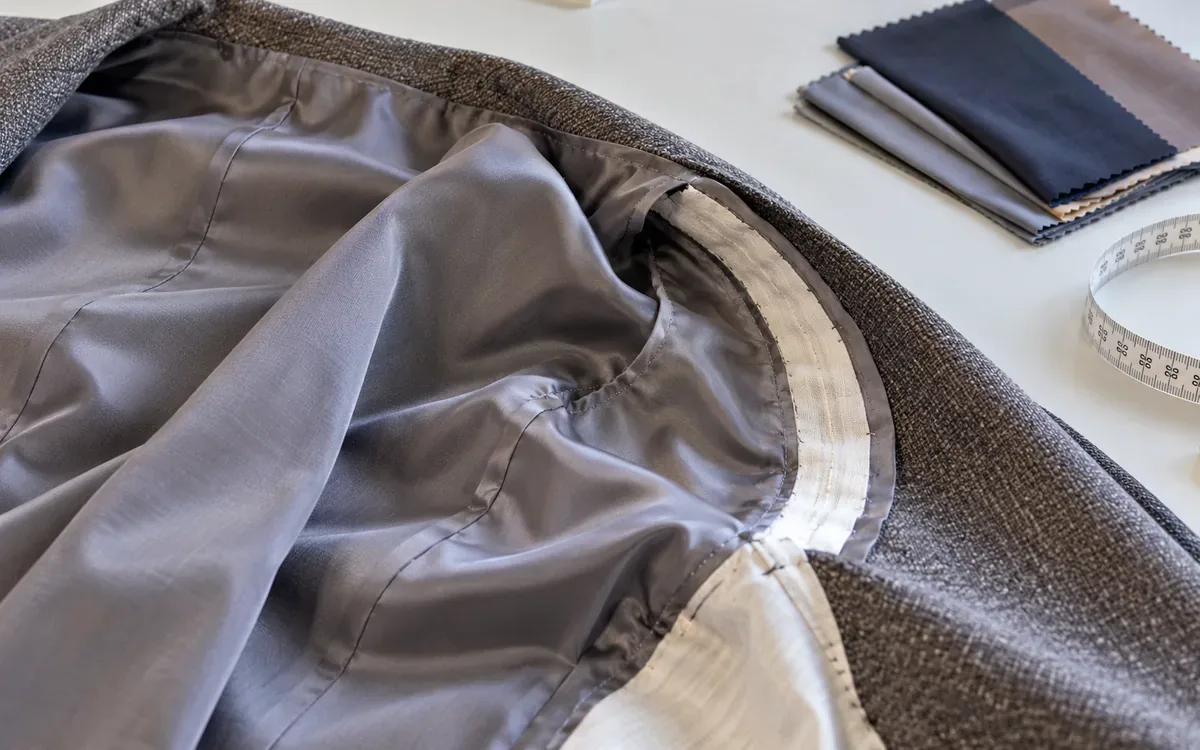
A lining seam can fail because thread breaks, fabric tears or yarns shift away from the stitch line. These are different mechanisms.
ISO 13936-2 addresses resistance to yarn slippage at a sewn seam in woven fabrics. Its scope is relevant when a woven lining opens beside an intact stitch line.
Do not assume a stronger sewing thread will stop yarn slippage. The lining construction, seam arrangement and load need review.
Use the intended sewing setup in application trials. Check areas that carry movement, such as the back, elbow or seat. A long straight sample with little stress may miss the relevant failure.
ApparelDiary’s guide to garment seam construction and selection explains the wider seam choices. For a lining, check the chosen fabric and local construction together. The lining needs to move with the garment. It should do so without added bulk or discomfort.
Assess local wear instead of one vague durability score
Linings wear differently by location. A sleeve can rub against a shirt. A trouser lining can experience movement at the thigh. A bag carried under the arm can change wear on a jacket’s inside.
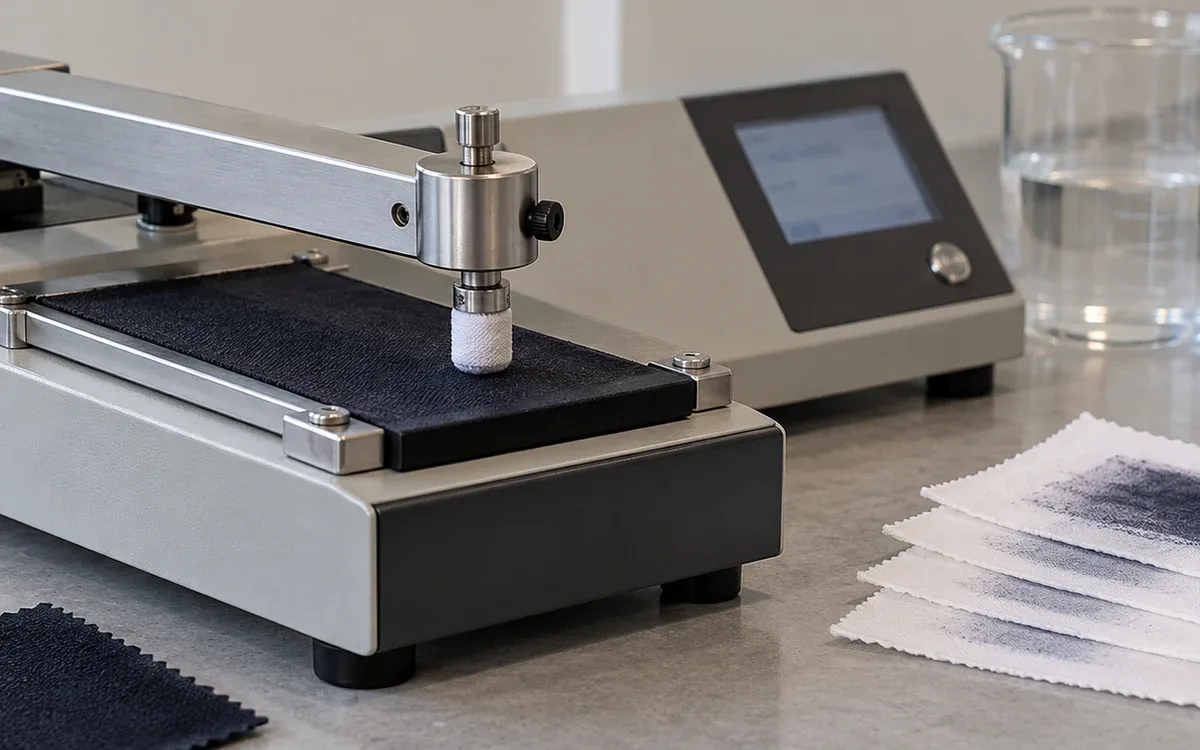
ISO 12947-2 addresses specimen breakdown in Martindale abrasion testing for applicable textile fabrics. Its scope excludes coated and laminated surfaces from that method.
Use a suitable test where abrasion resistance matters. A cycle count cannot be turned directly into months of garment life. Actual wear involves a different combination of contact, load, moisture and movement.
Inspect snagging, surface change and holes separately where relevant. A fabric may resist general rubbing. It could still catch on a watch or rough fastener.
The garment trial should include the contact points the lining will actually meet. Check pocket hardware, internal labels and rough seam ends. Each may cause local damage.
Compare opacity and colour in the complete assembly
A lining can alter the appearance of a light or sheer shell. It can also become visible at openings and edges.
View the shell alone and with each candidate lining under consistent lighting. Check the intended face colour, opacity and drape.
A dark lining may change a pale shell’s apparent shade. A pale lining may show at a vent or sleeve opening. The design may call for a darker interior there. Neither outcome is automatically wrong, but it should be an explicit choice.
The paired materials may create a risk of colour transfer. Assess it through a suitable lab test. A dark lining against a light shirt or shell needs specific review. A general colour approval does not answer this question.
Keep these checks distinct from matching the lining’s own shade to a swatch. A shade may match correctly. It may still affect adjacent materials during care or wear.
Compare added mass without confusing it with warmth
Lining mass affects garment weight. It does not, by itself, measure insulation or comfort.
Consider a hypothetical cut component area of 1.40 m². Candidate A weighs 65 g/m². Candidate B weighs 90 g/m².
Candidate A material mass = 1.40 × 65 = 91 g.
Candidate B material mass = 1.40 × 90 = 126 g.
The difference is 35 g before any separate trims or sewing thread are included.
This calculation describes the material area in the example. It does not include purchasing waste or establish a consumption allowance.
Use the result to discuss the weight brief. Then compare the complete garment’s drape and comfort. A lighter lining may cling or snag. It may also lack the required coverage. Low weight does not settle the choice.
Build a small garment trial matrix
Select candidates that represent plausible solutions, not a random collection of colours. Keep shell, pattern and sewing conditions consistent at first.
A hypothetical lightweight jacket trial might compare three identified linings.
Requirement | Candidate A | Candidate B | Candidate C |
|---|---|---|---|
Sleeve dressing over the target shirt | Smooth | Noticeable drag | Smooth |
Forward reach | Acceptable | Acceptable | Tight at upper back |
Hem after care | Stable | Stable | Pulls upward |
Lining seam appearance | Acceptable | Local yarn opening | Acceptable |
Development decision | Advance | Review fabric and seam | Review pattern and care compatibility |
The table separates material and construction questions. Candidate C may suit a revised lining pattern. Candidate B may need a different fabric construction.
Check essential requirements before adding scores. An average must not hide an essential failure. Required movement, care and durability conditions should act as gates.
Use a repeatable wear assessment
A useful wear trial has a defined garment size, wearer or fit form, base layer and movement sequence. Keep those conditions consistent when comparing candidates.
Choose movements that matter to the product. These may include dressing, reaching, bending, sitting or opening a closure. Avoid claiming that one sequence represents every user.
Record observations by location. “Pulls at the left upper sleeve during forward reach” is actionable. “Uncomfortable” needs further detail.
Use more than one relevant wearer where size and fit variation affect the decision. The lining may work on one body shape. Another may expose a grading or pattern issue.
Treat wearer feedback as evidence with a stated context. Use it alongside fabric tests and construction checks. It cannot replace them with a universal comfort rating.
Troubleshoot the relationship between shell and lining
Symptom | Questions to check first |
|---|---|
Shell hem lifts | Is the lining short after care, tightly attached or caught at a retaining point? |
Sleeve feels restricted | Is length or width inadequate along the movement path? |
Lining hangs below shell | Is there excess length, a loose attachment or unequal care change? |
Back seam opens | Is movement allowance insufficient, or are fabric yarns slipping? |
Skirt lining clings | Is the cause static, friction, fit or the base-layer pairing? |
Lining twists | Are grain, panel identity and attachment positions correct? |
Local holes develop | What nearby surface rubs or catches at that location? |
Inspect the garment before changing the fabric. A misassembled lining can make a good material look unsuitable.
If a fabric change is proposed, repeat the failed condition. A smoother fabric may help the garment slip on. A short lining path would still remain short.
Keep production handling consistent with the trial
Light lining fabrics can move during spreading, cutting and sewing. Distortion at these stages can consume the ease that the pattern provides.
Mark and preserve face, direction and panel identity. Check cut parts without stretching them into the template.
During sewing, compare the intended joining lines and balance marks. Avoid forcing one layer to match another by pulling it through the machine.
Press the lining under conditions suitable for the complete material combination. Sewing may be correct. A later finishing step can still change dimensions or leave a mark.
These controls do not require a separate complex system. The production instructions need to preserve the key conditions from the approved trial.
Write the final lining specification
Record the exact fabric identity, colour, finish and care evidence. Add the garment areas where it is approved.
Keep the lining pattern and assembly revision linked to the material. Include movement features, attachment points and any important hem or cuff relationships.
State which tests support the decision and what each one covers. A fabric abrasion result does not prove garment fit. A successful fit trial does not establish care stability.
On repeat orders, check for changes in shell, lining finish, supplier lot or care needs. Any of these may affect the established relationship. Use targeted rechecks based on the changed feature.
Retain an approved garment with its lining intact. A flat swatch cannot preserve the construction decisions that made the product work.
Frequently asked questions
Is the smoothest lining always the best?
No. Smoothness can help dressing. The lining also needs suitable movement, coverage, care and durability. Compare the complete set of requirements.
Must a stretch shell have a stretch lining?
Not in every construction, but the lining must allow the required movement. That freedom can come from material stretch, pattern ease or both. Prove the actual garment.
Can the lining use the shell pattern unchanged?
It may share some geometry. Its movement and attachment needs still require a separate check. Copying every shell dimension can create restriction or excess.
Why does the hem pull up only after cleaning?
Differential dimensional change can consume the lining’s initial freedom. Check both layers and their attachment before changing the hem length.
Does a high abrasion result guarantee long wear?
No. Laboratory abrasion is one defined exposure. Actual garment life also depends on local stress, snagging, care, fit and assembly.
Select the lining as part of the garment
The best lining is the one that performs its intended role inside the complete product. Fibre and fabric data help form a shortlist. Movement, attachment and care trials establish whether the choice works.
Keep the shell, lining and construction evidence together. This gives the product team a clear basis for selection. It also helps production preserve the comfort and shape achieved in development.
References
Asahi Kasei: Bemberg cupro applications and properties
Lenzing: Cellulosic fibre product information
ISO: 9237 fabric air permeability
ISO: 11092:2026 thermal and water-vapour resistance
ISO: 13936-2 yarn slippage at woven seams
Discussion0
Loading the discussion…