
Read bursting strength as a defined fabric response
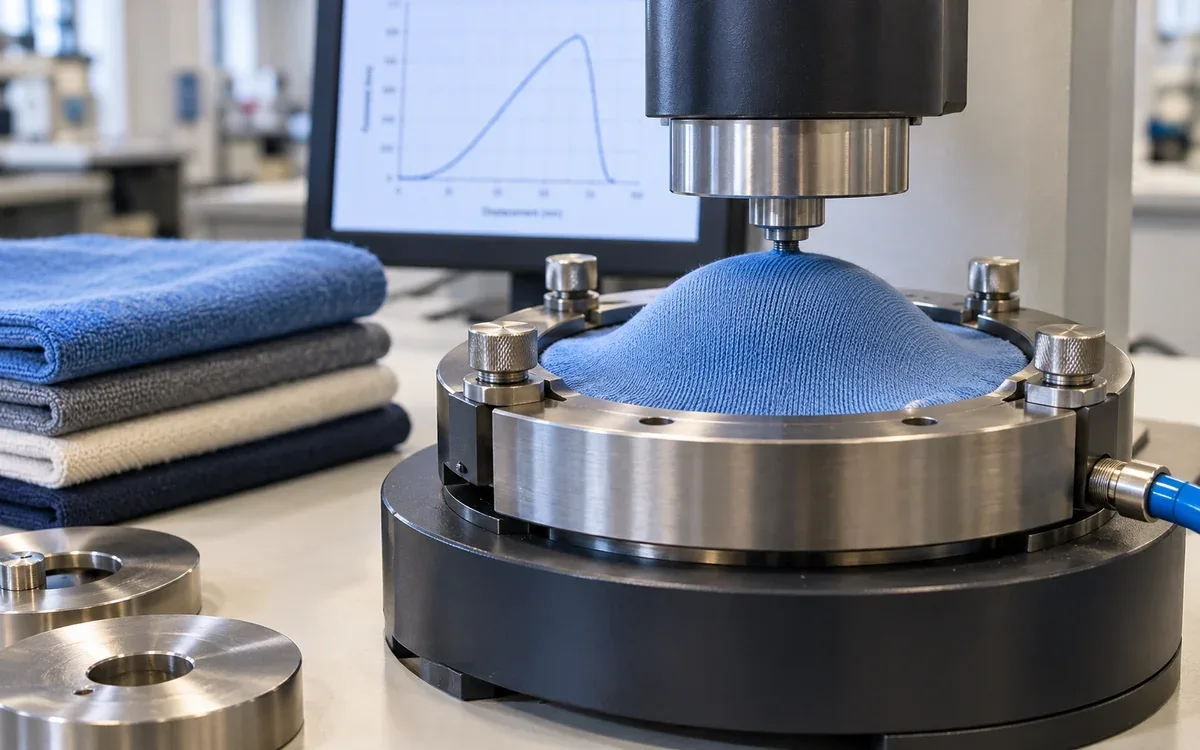
A knitted panel can stretch over a broad area before it breaks. Pulling a narrow strip in one direction does not create that load pattern. A burst test holds cloth around an opening. It pushes the cloth out of its flat plane until the defined failure occurs.
Fabric bursting strength is useful for this response to load in many directions. Method, area, sample state, and load rate all affect the result. So does the definition of failure. A pressure value alone is incomplete.
Two common diaphragm routes use hydraulic or pneumatic pressure. Ball-burst methods use a mechanical probe and report force. Know these differences to avoid false comparisons and choose the right test. This guide explains the methods and correction sums. It shows which checks support an apparel decision.
Separate diaphragm burst from ball burst
In a diaphragm test, the specimen is clamped over a flexible membrane. Pressure beneath the membrane expands it against the fabric. The recorded pressure includes the diaphragm's response. Apply the required diaphragm correction to obtain the fabric result.
Hydraulic equipment uses a liquid pressure system. Pneumatic equipment uses air pressure. Both are diaphragm methods when the expanding membrane loads the fabric. Pneumatic does not mean that a steel ball is pushed through the specimen.
In a ball-burst test, a rounded probe moves against fabric held by a clamp. The instrument measures the resisting force. Instron's ball-burst fixture information shows a fixture on a test frame. The probe connects to the load cell. The fixture's listed range includes woven and knitted textiles.
A universal test frame can run a suitable ball-burst test with the right fixture and method. Owning a tensile machine is not enough. The load cell, clamp, probe, travel, software, and safety setup must fit the test.
Route | How the load reaches the fabric | Typical reported quantity |
|---|---|---|
Hydraulic diaphragm | Liquid pressure expands a diaphragm | Corrected pressure and specified distension |
Pneumatic diaphragm | Air pressure expands a diaphragm | Corrected pressure and specified distension |
Ball burst | A mechanical ball displaces the clamped fabric | Force at the defined rupture event |
These quantities describe different setups. Converting units does not make the methods equal.
Select the applicable standard and version
ISO 13938-1:2019 covers the hydraulic determination of bursting strength and distension. ISO 13938-2:2019 covers the pneumatic route. ISO confirmed both editions in 2025. The pneumatic scope includes knits, wovens, nonwovens, and laminated fabrics. Samples may be conditioned or wet.
ASTM D3786/D3786M-18(2023) addresses hydraulic or pneumatic diaphragm testing. Its scope points to other methods for material that may exceed the instrument range. Check the actual cloth and machine. Not every burst tester can reach the needed pressure or distension.
For mechanical ball testing, distinguish machine principles. ASTM D6797-24 covers ball-burst tests for woven and knitted textiles. It uses a constant rate of extension, or CRE. It notes that CRE and constant-rate-of-traverse (CRT) equipment can give different results. It directs CRT users to D3787.
State the complete method, edition, and relevant option before testing. A report saying burst strength tested to ASTM leaves too much open. Public scope pages help select a method. Use the full method for preparation, loading, correction, validity, and reports.
Do not copy sample diameter or machine settings from an old training sheet. The geometry and steps must match the chosen method and actual machine. A familiar number does not prove a correct setup.
Understand the hydraulic and pneumatic comparison
ISO 13938-2 gives a comparison in its public scope. Available data show no significant difference between hydraulic and pneumatic results up to 800 kPa. For specialist textiles that need higher pressures, it identifies hydraulic equipment as more suitable.
Read that statement within its scope. This is not a promise that any two setups will agree. Machines, areas, diaphragms, and programs may differ. A supplier may use liquid pressure while a buyer uses air. Their tests still need compatible conditions for a valid comparison.
Check the expected pressure and distension against equipment capability. A fabric may stretch a long way before breaking. It can reach the travel limit while pressure capacity remains. A machine stop at a limit is not a valid fabric burst.
The James Heal TruBurst brochure shows separate pressure and distension ranges. It also shows automatic diaphragm correction and control of time to burst. These features show what to check in the machine specification. The listed limits belong to that model and setup. They do not apply to every pneumatic tester.
Keep the laboratory's validation and calibration evidence with the method. A maker's maximum range does not prove accuracy across that range. Check accuracy and control where the actual samples are measured.
Correct for the diaphragm on the right basis
SDL Atlas describes diaphragm correction in terms of two pressures. Start with the specimen's burst pressure. Subtract the pressure needed to inflate the bare diaphragm. The method defines how to find and apply the correction. Follow it. Do not reuse a convenient constant from an earlier fabric.
In a made-up record, total burst pressure is 520 kPa. The applicable diaphragm correction is 45 kPa:
Corrected bursting strength = total burst pressure − diaphragm correction.
Corrected bursting strength = 520 − 45 = 475 kPa.
Software may already report 475 kPa as corrected strength. Subtracting 45 again gives 430 kPa. This is 45 kPa, or about 9.5%, too low. Identify each exported field before doing sums outside the machine software.
The reverse mistake is reporting the gross 520 kPa as fabric strength. The diaphragm then contributes to the apparent result. Keep the gross reading, correction, and corrected result as required by the method and data system.
Check that the correction belongs to the relevant diaphragm, test area, and procedure. A new membrane or setup may need fresh checks. Do not quietly carry an old correction into a new setup.
A correction can change the ranking
Consider two invented trials with valid method-specific corrections:
Trial | Gross pressure | Diaphragm correction | Corrected strength |
|---|---|---|---|
A | 520 kPa | 45 kPa | 475 kPa |
B | 550 kPa | 80 kPa | 470 kPa |
B has the higher gross pressure but the slightly lower corrected fabric result. Ranking the fabrics from the gross column would reverse the order. Judge the small corrected difference against test variation and the decision rule. The sums alone do not prove a meaningful material difference.
Keep pressure, force, and stress distinct
A pascal is one newton per square metre. One kilopascal equals one kilonewton per square metre. Thus 475 kPa and 475 kN/m² express the same pressure. The same value is 4.75 bar because one bar equals 100 kPa.
Pressure is not the force reported by a ball-burst test. For a simple mechanics example, assume uniform pressure of 400 kPa. It acts over a projected area of 25 cm²:
Area = 25 ÷ 10,000 = 0.0025 m².
Resultant force = 400,000 Pa × 0.0025 m² = 1,000 N.
This is the pressure resultant over that projected area in the ideal model. It does not convert a diaphragm result to a ball-burst result. A ball makes a different contact. The cloth takes a different shape.
Nor is 400 kPa the tensile stress in every yarn. Membrane shape, yarn directions, changing curves, and cloth structure govern load sharing. The pressure is not a fibre stress measured by this test.
Use one unit system consistently during a method. Some standards treat SI and customary units as separate systems. Follow those rules. A rounded conversion on a report must not become a new operating tolerance.
Multidirectional loading does not make the fabric uniform
The cloth may carry the bulging load differently in each direction. A knit's courses and wales have different yarn paths. A weave may have different warp and weft systems. The burst reflects the whole structure in the chosen fixture.
Do not read it as the average of warp and weft tensile results. Those strip tests use different boundaries and loads. A burst result alone cannot show which direction became weaker. Inspect the failure and use suitable tests for that question.
Record the face presented to the diaphragm where the method requires it. Take care when choosing a method for coated, raised, or unequal faces. If a trial reverses the face, label this as a separate condition. Use the same rule for all fabrics in that comparison.
Test area is a condition, not a conversion factor
The clamp opening sets the area free to bulge. A new opening changes the shape and amount of cloth involved. Small and large areas may give different burst pressure or distension.
Do not multiply pressure by an area ratio to invent an equal result. Cloth deforms. Its contact and load sharing do not act like a fixed rigid piston. Use the area required by the method and specification.
Record the actual dome or clamp designation. If the machine detects parts automatically, check that it recognizes the installed part. A wrong selected area can affect the program and report. The piece may still look firmly clamped.
For a large pattern repeat, area affects which regions are tested. A small opening may sit within a dense motif or a loose zone. Plan samples to cover the relevant structure. Do not keep using one attractive spot.
Keep cut specimen size separate from exposed test area. The cut piece must fit and clamp well. Its full area may not be the area that bulges. Record the method's geometry. One diameter labelled sample size may be unclear.
Distension adds information that pressure misses
Bursting distension describes how far the cloth deforms out of its plane at the named event. The method and machine define the measure. It may be height, volume, or another permitted quantity. Keep that definition and unit with the result.
Two fabrics may burst at similar pressures yet deform very differently. Take a made-up comparison under one method and area. Fabric A reaches 480 kPa at 22 mm height. Fabric B reaches 485 kPa at 36 mm. Their pressures are close. Their deformation at rupture is not.
That does not automatically make B more suitable. A product needing support may differ from one needing easy movement. Burst distension does not prove recovery after release either. The piece has broken at the endpoint.
Do not divide dome height by clamp diameter to claim fabric elongation. Height is a geometric displacement. Tensile elongation needs a defined starting length and measured extension. Yarn paths change across the bulge. One height cannot give every yarn's strain.
Use the full pressure-and-distension record where available. A sudden shift in that response may be a clue to a layer or mounting issue. Read it alongside sample observations and the method's event definition.
Make clamping consistent without damaging the fabric
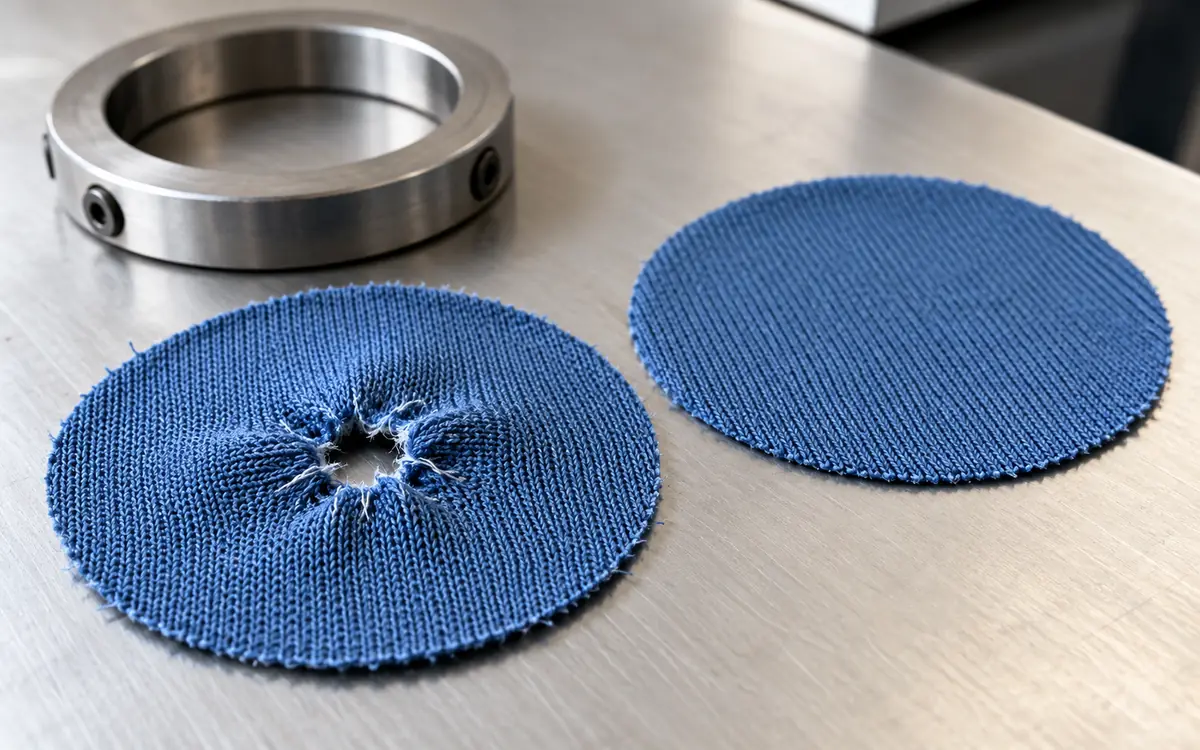
The clamp must prevent movement that the method does not permit. It must not create an artificial weak line. Too much grip can damage delicate cloth. Too little can let cloth draw into the test area.
Follow the specified clamp arrangement and pressure. Do not pull one piece tight while mounting another relaxed. That creates a difference before testing. For stretch cloth, follow the method's preparation and mounting state.
Observe the specimen during and after the test through the equipment's approved arrangement. Record slip, unusual edge damage, or rupture close to the clamp. Apply the method's validity rules. A low result alone is not grounds for rejection.
If many specimens fail in an abnormal way, stop and investigate the setup. Repeating a damaging clamp setup adds data without answering the fabric question. Keep the attempted tests and reasons for invalid results.
James Heal's burst test-material guidance lists plain, reinforced, and low-pressure diaphragms. It also lists materials used to check test performance. This range shows why you must name the required membrane. The wrong type may fit the machine but not suit the test.
Control the rate and time to burst
The rate of loading affects how the specimen reaches failure. Use the method's required control and time window. A speed copied from another machine may not give the same pressure or deformation history.
SDL Atlas explains the use of flow control. It brings burst time within the standard's required window. Keep the actual time to burst. Record program changes needed to meet the method.
For a made-up hydraulic example, assume constant flow of 90 mL per minute. In 20 seconds it delivers 30 mL, ignoring leaks and system effects. This does not tell us pressure at 20 seconds. Pressure depends on the diaphragm, cloth, geometry, and machine.
Similarly, a fixed ball travel speed does not give a constant increase in force. The fabric response changes as the probe moves. Keep the controlled variable distinct from the measured response.
When comparing treatments, use a consistent valid method route. If one material requires a different permitted adjustment, record it. Show the actual loading conditions as well as the program name. The reader can then assess the comparison.
Plan conditioning and wet tests separately
Conditioned and wet tests answer different product questions. The ISO pneumatic scope allows both states. Do not infer a wet result from a conditioned result. Follow all preparation steps for the required state.
Use the atmosphere and equilibration rules specified by the method. Cloth straight from a humid store may not be ready. A correct lab room display does not prove it is ready. Let the cloth reach the defined state before testing.
If care or finishing precedes testing, preserve that history. Washing may change size, density, surface, and material response. Higher pressure after care does not alone prove stronger fibres.
Burst testing destroys the specimen. A before-and-after-care comparison needs matched separate pieces. The same piece cannot be broken both before and after treatment. Use adjacent or otherwise comparable cloth under the agreed plan. Keep its source identity.
For a sample plan, take three fabrics, two care states, and five pieces per state. This needs 3 × 2 × 5 = 30 burst pieces. Add pieces for setup, retained references, and any separate wet tests.
Use a corrected dataset for acceptance
Consider five hypothetical valid corrected pressures: 480, 495, 460, 505, and 475 kPa. Their sum is 2,415 kPa and their mean is 483 kPa. The minimum is 460 kPa.
Suppose a made-up brief requires a mean of at least 480 kPa. Each piece must also reach 470 kPa. The mean passes, but the 460 kPa piece fails. This invented rule shows why the reporting basis matters.
If a real specification controls only the mean, apply that rule. Do not create an extra limit after seeing the data. Equally, do not ignore a required individual limit because the mean looks comfortable. Keep the buyer's decision rule separate from the lab readings.
Report valid count and sample coverage. Five pieces from a small swatch mainly describe that swatch. A claim for a broad lot needs more coverage. Plan samples across the relevant rolls and process variation.
Retain the individual corrections and burst events. For an odd result, review gross pressure and diaphragm response. Then check distension, time, and failure spot. These may explain what happened. An average alone loses much of that value.
Read layered and highly extensible fabrics carefully
A laminate can show more than one event as it bulges. A surface layer may crack or separate before the whole structure ruptures. The lab must use the event defined by the method. Record relevant observations too.
Do not call the first sound final burst without checking the method and detection system. The brief may need that surface layer to work. If so, a high final pressure must not hide its earlier failure.
Cloth with high stretch may reach a machine limit. Record that limit and the cloth state at stopping. Maximum pressure without rupture is not an exact burst strength. Use a suitable method and machine to complete the required measurement.
The product may also need to withstand repeated stretch or fatigue. Specify a separate test for that. Some burst machines offer trial modes. One rupture result does not prove durability through repeated cycles. Name the mode, endpoint, and meaning separately.
Investigate a disagreement in the right order
Compare sample identity and finished state first. Then compare method, area, diaphragm type, correction, conditioning, loading rate, and validity rules. A missing correction or different area may explain a supplier gap. Check those before material chemistry.
ASTM D3786 calls for randomly drawn pieces from the same material when labs disagree. It also notes a limit of the clamp setup. The clamp constrains load transfer and stretch that may occur in wear. Use the result for its defined purpose. It is not a full model of garment movement.
For a process check, keep cloth from before the suspect stage. Compare it with matched cloth after that stage. Keep structure and test conditions aligned. ApparelDiary's yarn tensile testing guide can support a separate yarn investigation if needed. Yarn force and fabric burst pressure remain different measures.
Confirm a proposed correction on representative finished fabric. A small hand-treated swatch may guide trials. Bulk production must still repeat the route and meet all other product needs.
Make a clear handoff to the buyer
Suppose two labs send a result for the same jersey lot. One file gives only 510 kPa. The other gives 475 kPa with its method and correction fields. Do not first ask which lab is right. Ask what each number means.
The first lab may have exported a gross value. It may also have used another area, sample state, or test piece. Obtain those records before doing more sums. If it reports a 35 kPa correction for that test, its corrected value is 475 kPa. This would explain the numeric gap in this made-up case. It would not by itself prove that the two tests were otherwise alike.
Keep both original files and the clarified field names. Add a note to the review that states why the first comparison was incomplete. When the buyer receives the final report, show the corrected value under its proper label. This makes later reviews faster and avoids repeating a dispute over two different kinds of number.
Frequently asked questions
Is pneumatic burst the same as ball burst?
No. Pneumatic diaphragm testing uses air to expand a membrane beneath the fabric. Ball testing uses a mechanical probe and measures force. Keep the method and quantity distinct.
Can ball burst be used for knitted fabric?
Yes, where the selected method and fixture cover it. ASTM D6797-24 includes woven and knitted textiles. Suitability still depends on the exact material, equipment, and product requirement.
Can pressure be converted into an equivalent ball force?
Pressure times projected area gives a pressure resultant under stated assumptions. It does not recreate ball contact or cloth shape. It cannot give an equivalent ball-burst result.
Does higher burst pressure prove better recovery?
No. Recovery is measured after a defined loading and unloading sequence. Rupture pressure and distension do not show how intact cloth returns after release.
Report enough detail to make the number useful
State the fabric, treatment, method, and test area. Add the diaphragm or probe setup, sample state, load basis, and valid results. For diaphragm work, identify the correction and whether the reported pressure is already corrected. Include distension and event details where the method requires them.
A useful bursting test connects the right apparatus to a clear product question. Correct units, valid mounting, and clear corrections make that link dependable. Explain what failed and under which conditions. Show how the result supports the fabric decision.
References
ISO 13938-1:2019: hydraulic bursting properties.
ISO 13938-2:2019: pneumatic bursting properties.
ASTM D3786/D3786M-18(2023): diaphragm bursting strength.
ASTM D6797-24: CRE ball-burst testing.
Instron: ball-burst compression fixture.
SDL Atlas: Autoburst correction and flow control.
James Heal: TruBurst pressure, distension, and control features.

Discussion0
Loading the discussion…