
Choose the tear method before comparing the numbers
A fabric tear strength result describes resistance to a tear under a defined test. It is not the same as the force needed to pull an intact strip apart. A tear test starts with a cut or another specified condition. This directs damage through the specimen. The result depends on how the apparatus makes that damage grow.
This distinction explains a common problem in fabric approval. One supplier reports an Elmendorf result. Another reports a tongue tear result. A buyer then puts both values in one table. Both may use newtons. They do not necessarily describe the same behavior. A higher number in that table may reflect the method as well as the material.
Start with the intended comparison. Are you screening a lightweight woven shell, checking a change in finish, or reviewing a coated fabric? Select a method within scope and set the specimen condition. Use the same procedure for every candidate. Record enough detail to repeat the work.
All calculations and fabric data in this guide are hypothetical. They illustrate test interpretation and common errors. Product limits must come from the relevant specification and an appropriate test method.
Understand what tearing adds to a material assessment
Tensile testing loads an intact specimen. Tear testing examines the growth of damage under its prescribed geometry. Bursting testing applies a different loading pattern again. A strong result in one test cannot establish a pass in another.
The place where the load acts matters. During tearing, forces concentrate near the advancing tear. Yarns may move, share load, or break in sequence. The test shape and grip arrangement affect that process. A measured tear result therefore belongs to a particular specimen and procedure.
The distinction also matters when investigating garment failure. A torn panel, a broken seam, and yarn slippage beside a seam are different observations. ApparelDiary's guide to garment seam strength and failure mode testing covers the seam investigation. Use a fabric tear test to study how damage grows through the fabric.
Do not describe a fabric as “strong” without saying which property supports that statement. A useful approval record may need several properties, each with its own limit. Tear testing supplies one part of that record. It cannot give one score for overall durability.
Map the main methods by their actual geometry
The ISO 13937 series separates several tear procedures. Its parts have different specimen shapes and loading arrangements. The official scopes identify Part 1 as the ballistic pendulum method, Part 2 as the trouser method, Part 3 as the wing method, and Part 4 as a tongue method involving a double tear.
The word “tongue” alone is not a complete method name. ASTM D2261-13(2024) concerns a single rip tongue procedure using a constant rate of extension machine. Treating it as identical to ISO 13937-4 would confuse two different arrangements.
Method | Broad test arrangement | Key detail to preserve |
|---|---|---|
ISO 13937-1 or ASTM D1424 | Ballistic pendulum, commonly called Elmendorf | Range, specimen arrangement, tear path |
ISO 13937-2 | Trouser specimen | Leg geometry and specified evaluation |
ISO 13937-3 | Wing specimen | Wing geometry and loading |
ISO 13937-4 | Tongue specimen, double tear | Both tear paths and method calculation |
ASTM D2261 | Tongue specimen, single rip | Force trace and selected peak evaluation |
ASTM D5587 | Trapezoid procedure | Marked geometry and evaluation option |
Use this table to choose the full method, not to construct a hybrid procedure. The controlled standard defines specimen dimensions and preparation. It also sets machine conditions, validity rules and reporting requirements.
Check material scope before cutting specimens
A method may work well for a stable woven fabric. It may not suit cloth that stretches or tears along an uncontrolled path. The selected standard's scope and limitations should guide that decision.
The current ASTM D1424-25 scope describes the falling pendulum method and limits its use for some knitted constructions. It includes certain warp knitted fabrics in the specified direction. Most other knitted fabrics are excluded. A specimen may fit the clamps. That alone does not bring every knit within scope.
If the tear does not follow the required path, a force reading can still appear on the display. That does not make the reading valid. Inspect the torn specimen as well as the number.
Coated and laminated materials need particular care. The base cloth, coating, and bond can affect the way damage travels. Select a method suitable for the material and application. A buyer may specify a method outside its normal scope. Resolve this before testing. State any agreed deviation clearly. A silent change leaves later readers unable to judge the result.
How an Elmendorf tester obtains a tear result
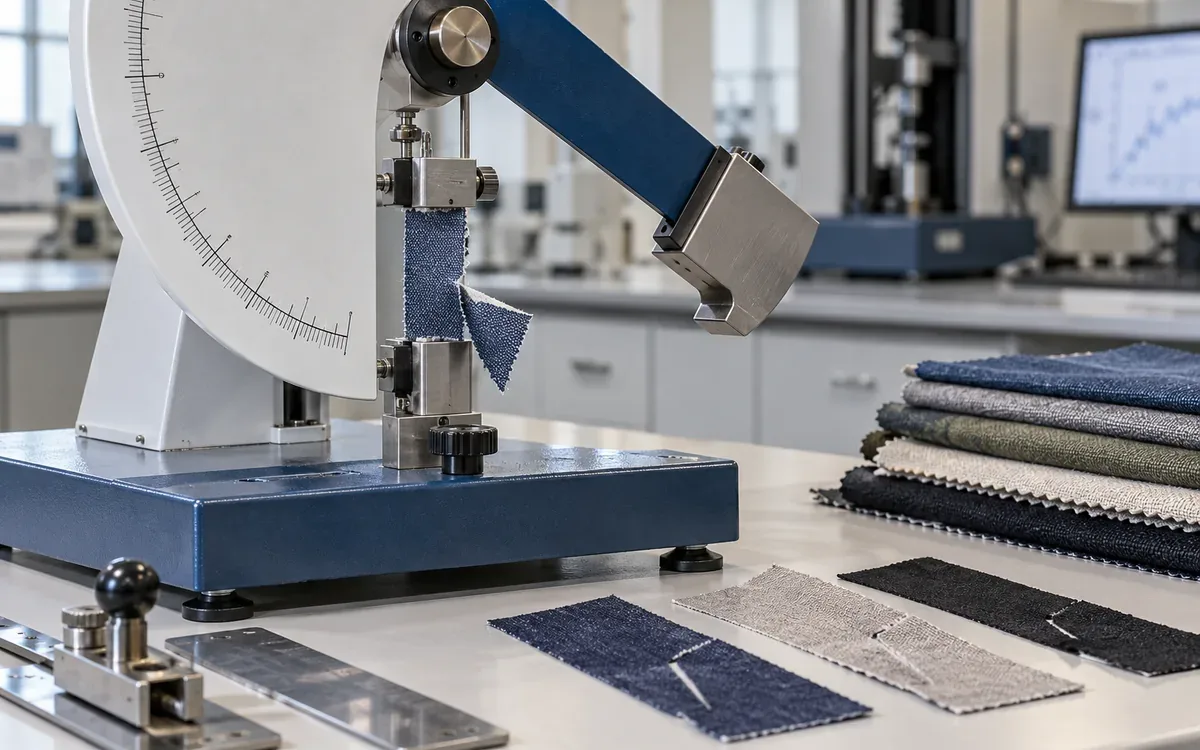
An Elmendorf tester uses a swinging pendulum. Part of the specimen is held in a fixed clamp and part in a moving clamp. First, make the specified starting slit. As the pendulum moves, it tears the remaining test length.
Thwing-Albert's explanation of the Elmendorf principle describes the instrument in terms of energy used during tearing. The calibrated instrument turns that response into its reported tear resistance. It does not measure an instantaneous force peak. A tensile machine produces a different kind of force trace.
A pendulum reading is therefore different from the highest peak in a tongue test. Reporting both in newtons does not make them equivalent. The test speed, geometry, and way the result is derived differ.
The operator still controls key parts of the test. These include range, specimen, initial slit, clamp condition and instrument checks. Automatic display and calculation reduce some manual work. They do not remove the need to inspect the setup and the tear path.
Select a pendulum range that suits the fabric
A weak specimen may be tested on a very large range. Its reading would then use little of the scale. A strong specimen may approach or exceed capacity. That can also make the result unsuitable. Use the range requirements in the method and the instrument instructions.
For example, Thwing-Albert's equipment guidance recommends a central part of its scale. It defines this as 20% to 80% of capacity. This is the cited manufacturer's guidance. Check each machine and method before applying it elsewhere.
On a hypothetical 32 N full scale range, 20% corresponds to 6.4 N and 80% to 25.6 N. A 3 N result uses only 9.4% of that capacity. On an 8 N range, the same force would use 37.5%.
At the other end, 28 N uses 87.5% of a 32 N range. A 64 N range would place it at 43.8%. These calculations show how to plan a suitable range. They help plan a retest. They do not authorize an arithmetic change to a completed result.
Prevent scale and unit errors
Some instruments show force directly. Others use a scale reading and the installed capacity. The exact conversion depends on the apparatus. Never use a remembered multiplier without checking the current setup.
Suppose a valid scale system expresses the reading as a percentage of full scale. A reading of 40 on a 32 N capacity gives:
Tear result = 40 ÷ 100 × 32 = 12.8 N
The same reading on a 64 N capacity gives 25.6 N. If the worksheet omits the range, it can produce a twofold error. The specimen record may still look correct.
Legacy reports may use gram-force. The force unit must remain distinct from grams of mass:
1 gram-force = 0.00980665 N
A result of 1,600 gram-force therefore equals about 15.69 N. It does not equal 1,600 g of specimen mass or 1,600 N. Keep the original value and unit when converting an old result. Report a sensible number of digits.
Keep specimen plies separate from replicate counts
Multiple plies may be used in some permitted test arrangements. Follow the selected procedure for the calculation. Use the actual number of plies. A replicate, however, is a separate test observation. It is not another ply in the same tear.
Consider five valid single specimen results of 12, 14, 13, 15, and 16 N. Their mean is:
Mean = (12 + 14 + 13 + 15 + 16) ÷ 5 = 14 N
Dividing that mean by five again gives 2.8 N. That second division has no basis merely because five tests were made.
Record the ply count for each test. Keep the number of valid repeat tests in a separate field. The method may permit a stacked arrangement. Check its rules for specimens, starting cuts and evaluation. Do not stack layers simply to move a weak specimen into range. The procedure must permit that approach.
This record prevents a common spreadsheet error. The instrument may have already corrected the quantity. Applying the correction again would be wrong.
Define direction using the test convention
A report headed “warp tear” can be unclear. The lab needs to state its direction convention. Describe the advancing tear path separately from the yarns that rupture across it. A direction label can otherwise conceal which yarn system the test has loaded.
For a simple woven construction, a tear that travels along the warp direction crosses and breaks weft yarns. That physical description is clearer than an unexplained label. The method may define its reported directions in a particular way. Follow that convention. Include enough detail to remove doubt.
Mark fabric direction before specimens are separated from the sample. If the construction is difficult to identify, resolve it before testing. Do not infer warp direction from whichever side happened to face the operator.
Keep directional results separate in the report. A mean combining two directions may hide the weaker response that matters in use. The buyer may require limits in each direction. If so, assess each against its own requirement. One direction may be strong while the other fails. A strong result cannot cancel that failure unless the specification allows it.
Prepare the slit and inspect the full tear path
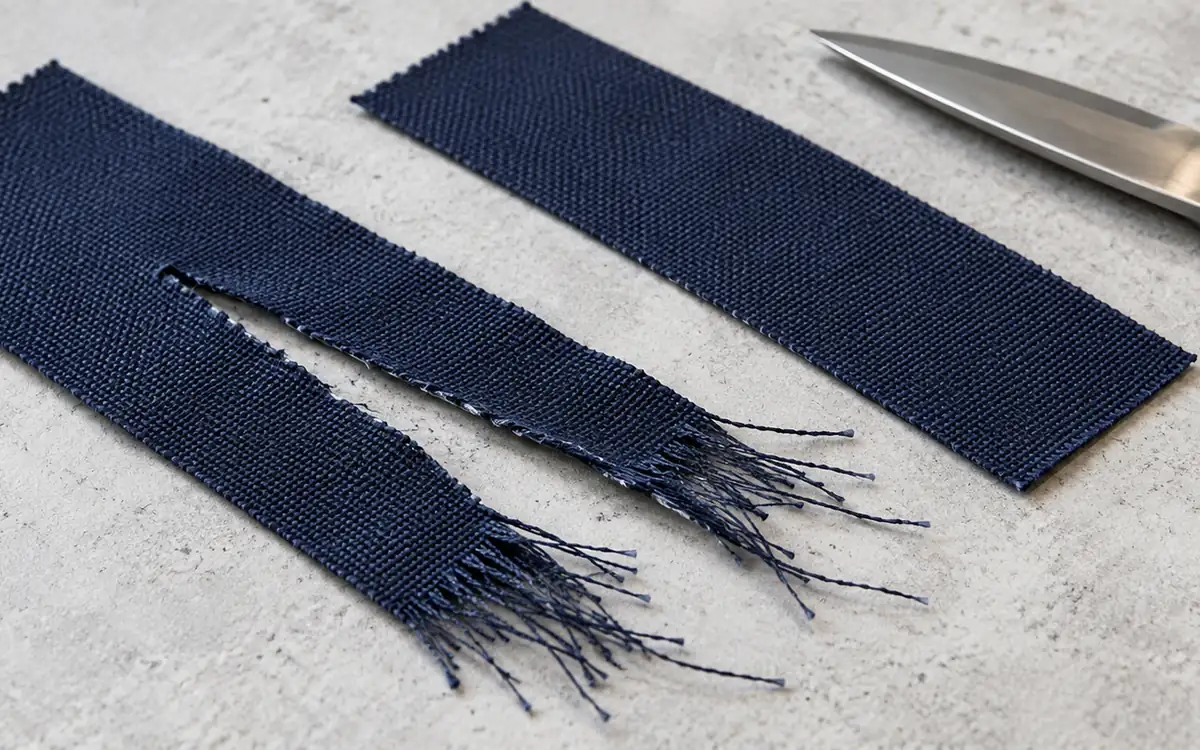
The starting slit establishes the geometry from which the measured tear grows. A poor cut can create a ragged starting edge or alter the available tear length. Use the required cutter or knife arrangement and check its condition.
Avoid damaging the remaining test section while inserting the specimen. Check clamping surfaces and closure. Slippage, uneven holding, or a trapped fold changes how the load reaches the tear.
After testing, compare the actual path with the method's validity requirements. Record tears that leave the required region. Also note changes in failure mode or tears that do not complete as specified. A photograph can help explain why the observation was rejected.
Do not retain an invalid result simply because it is close to the expected value. Likewise, do not reject a valid low result merely because it is inconvenient. The reason for exclusion should come from the procedure or a documented test fault.
The James Heal ElmaTear technical guide describes instrument controls and range options. Read the equipment documents alongside the selected standard. Neither the display nor a sales description gives the whole method.
Understand what a tensile-machine tear trace contains
A tongue or trapezoid test run on a tensile machine can produce a series of force rises and falls. The machine records force while the specified geometry develops. The chosen calculation then extracts the reportable result.
ASTM D5587-15(2024) covers trapezoid tearing and provides evaluation options involving a single peak or an average of selected high peaks. ASTM D2261 also distinguishes evaluation options. The option belongs in the test request and report.
A mean of every sampled point is not automatically the same as the required mean of selected peaks. It can give greater weight to parts of the trace where the force falls. A software label such as “average load” does not prove that the correct algorithm was used.
Instron's D2261 application guidance discusses the need to capture the force response and use suitable gripping. Check the method settings and the analysis program together. Save the trace. The lab can use it later to investigate a disputed calculation.
Work through a peak-selection example
Assume a valid hypothetical trace contains eligible peaks of 22, 30, 28, 40, 26, 34, and 24 N. The chosen method option calls for the average of the five highest eligible peaks.
Those five peaks are 40, 34, 30, 28, and 26 N:
Selected peak average = (40 + 34 + 30 + 28 + 26) ÷ 5 = 31.6 N
The highest single peak is 40 N. The mean of all seven listed peaks is about 29.1 N. These three values describe different calculations from the same example.
Suppose a hypothetical requirement were 35 N. The single maximum would pass. The five peak average would fail. The operator cannot choose the favorable option after seeing the data. The requirement must name the option in advance.
The standard defines which part of the trace to assess. It also states which peaks qualify. This small example isolates the arithmetic. The example does not replace those rules. It does not show that every visible spike should be included.
Explain why construction can change method rankings
Tearing depends on how the material redistributes force near the growing cut. Some constructions let yarns gather and share load. Others hold the yarns more tightly. Their tear behavior may differ. This makes tear performance more complex than a simple count of yarns per centimeter.
Seaman Corporation's technical note on tear resistance discusses the role of yarn movement in coated fabric tearing. This has a practical implication. Stronger bonding or a stiffer construction does not prove a higher result in every tear test.
Avoid extending a mechanism into a universal rule. A finish change may alter several properties at once. The observed tear response must be measured for the actual construction, condition, and method.
When a new finish raises tensile strength but lowers tear resistance, first confirm both tests. Then review construction, handling, and failure appearance. Do not call one result “wrong” just because the properties moved in different directions. The material may involve a real tradeoff.
Do not invent a conversion between tear methods
Imagine two fabrics assessed by two suitable methods under controlled conditions.
Fabric | Method A result | Method B result |
|---|---|---|
Fabric P | 18 N | 32 N |
Fabric Q | 21 N | 29 N |
Method A ranks Q above P. Method B ranks P above Q. The ratio between B and A is about 1.78 for P and 1.38 for Q. A single multiplier cannot reproduce both pairs.
These invented numbers expose a problem with conversion. One factor cannot safely convert every Elmendorf result to a tongue result. Even a strong relationship within a small fabric family needs validation before use. It may fail when the weave, coating, finish, or weight changes.
For routine approval, keep the specified method fixed. A supplier may need to change methods. Obtain paired data on representative materials. Agree on how to set the new requirement. Keep the original method results during that work. Old records must still show how the fabric was actually tested.
Investigate low results without losing the evidence
When a batch gives an unexpectedly low result, first ask whether the test was valid. Review the range, direction, specimen identity, slit, clamping, and tear path. For machine tests, also review the trace and evaluation option.
Then ask whether the sample represents the bulk fabric. A local defect, coating streak or damaged area can affect product quality. It may still be unsuitable for a routine property specimen. Keep the observation and follow the sampling rules. Do not cut around every defect until the lot appears uniform.
For a suspected finish effect, compare samples with the same construction and a clear process history. Identify which stage each sample represents. Check that the before-and-after samples match. A different yarn lot or fabric weight can weaken the comparison.
Use additional testing to answer a defined question. Repeating the same test indefinitely until a passing mean appears is not an investigation. A useful retest plan names the suspected cause. It states what evidence will resolve it. The original result must remain in the record.
Define the condition when checking durability
A dry, conditioned result and a wet result describe different material states. Do not put them in one series and call the spread normal repeat variation. Does the product need wet tear resistance? Select a method and preparation that support that assessment. Label the wet result clearly.
Care testing needs the same discipline. Identify the laundering procedure, drying, cycle count, and conditioning before the tear test. Cut specimens so that the comparison uses equivalent directions and sample locations. Keep enough untested material to resolve an unusual result.
Consider a hypothetical durability comparison for one direction. Mean initial tear force is 52 N. After-care tear force is 42 N. Retention is:
Retention = 42 ÷ 52 × 100 = 80.8%
That ratio is useful, but it does not replace the absolute requirement. Suppose the after-care limit is 45 N. The material fails, though it retains more than four fifths of its initial result. A fabric starting at a higher value can lose a larger fraction and still meet the absolute limit.
Report both the before-and-after forces and the retention when requested. Assess each direction separately. These results help locate the problem. It may be low initial strength, loss during care or both.
Build a report that survives a supplier dispute
A good tear test report connects the result to the material, method, and evaluation. Identify the sample, lot, direction convention and condition. Name the method edition. Add the instrument range where relevant and each valid result.
Record invalid observations and their reasons separately. Add the selected peak option for methods that offer alternatives. State any deviation and its possible effect without implying full standard compliance.
Keep raw data and photographs when they explain the result. A trace can reveal an analysis mismatch. A specimen photograph can show an unusual tear path. Neither replaces the numerical report, but both help resolve disagreements without guesswork.
Finally, use the acceptance rule that was agreed before testing. A requirement based on the minimum individual value differs from one based on a mean. State which rule was applied. Show whether each required direction and condition met it.
Frequently asked questions
Is a high tear result proof that a garment will never rip?
No. A laboratory result represents a defined specimen and load case. Product design, local damage, care, and use can introduce conditions outside that test.
Can a tensile result replace a missing tear result?
No general substitution is valid. The tests apply load and develop damage differently. Obtain the required property directly.
Does the highest pendulum capacity give the best result?
Capacity is a range choice, not a quality ranking. Select a suitable range and follow the equipment and method requirements.
Can results from different tear shapes be averaged?
Such an average would mix unlike measurements. Report each method separately and relate it to its own requirement.
Make tear strength a controlled comparison
Fabric tear testing is most useful when the method, specimen geometry, direction, and evaluation stay visible. A force number without those details is easy to misread.
Choose a suitable procedure. Verify range and preparation, then inspect how the specimen failed. Keep valid observations separate from test faults. Then compare results using the exact rule in the specification.
That discipline turns a tear result into an actionable material decision. It shows whether the fabric meets the requirement. It also helps assess a process change or compare two suppliers on a fair basis.
References
ISO 13937-1:2000: Ballistic pendulum tear method.
ISO 13937-2:2000: Trouser-shaped test specimens.
ISO 13937-3:2000: Wing-shaped test specimens.
ISO 13937-4:2000: Tongue-shaped test specimens, double tear.
ASTM D1424-25: Falling pendulum tear resistance.
ASTM D2261-13(2024): Tongue, single rip procedure.
ASTM D5587-15(2024): Trapezoid procedure.
Thwing-Albert: What Is Elmendorf Tear?.
Thwing-Albert: Elmendorf Tear Strength Tester.
James Heal: ElmaTear Technical Guide.
Discussion0
Loading the discussion…