
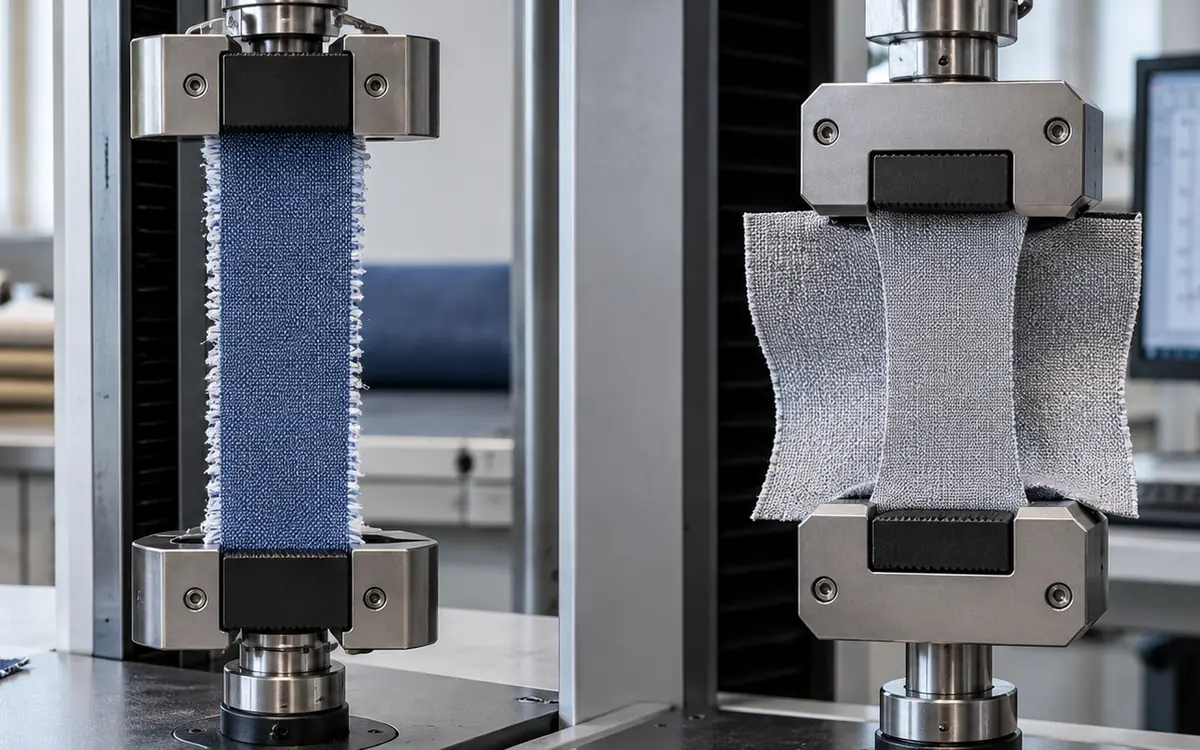
Fabric tensile strength depends on what the test grips and how it loads the cloth. A strip test holds the full specimen width. A grab test holds a narrower central region. Nearby yarns can help carry the load. The results describe different setups. A fixed factor cannot convert one to the other.
A supplier may submit a strong result from the wrong method. It may be valid for that test but not answer the buyer's need. A useful report names the method and fabric direction first. It also states sample preparation and condition before giving the force.
This guide focuses on fabric strip and grab testing for apparel decisions. The examples use made-up data to explain sums and review choices. They do not set pass limits or replace the full test method.
Begin with the type of failure being investigated
A tensile test stretches a fabric specimen along a defined loading direction. It helps assess how that specimen carries increasing force. It does not measure every form of damage that a garment can suffer.
A tear test follows the growth of a prepared tear. A bursting test loads a clamped area in more than one direction. A seam test includes a sewn joint. Each creates a different stress pattern and answers a different product question.
For example, low fabric tensile force may help explain a panel rupture away from seams. An opening beside a seam may involve yarn movement, broken stitches, or damage at the needle line. Test the suspected type of failure. Do not call every complaint low fabric strength.
ApparelDiary's guide to garment seam strength and failure modes covers the sewn-joint decision. The fabric test described here supplies evidence about the underlying cloth.
Understand what strip and grab methods hold
In a strip test, the jaws span the specimen width. The prepared edges define the strip being tested. In a grab test, the front grip is narrower than the cloth piece. Cloth outside that grip remains part of the test.
ZwickRoell's grab-test guidance illustrates this difference in gripping geometry. Use that geometry to understand the measurement. Read each standard for its material scope and required results. Equipment pages sometimes group methods that have different rules.
Feature | Strip test | Grab test |
|---|---|---|
Width directly gripped | Full prepared strip width | Central part of a wider specimen |
Main preparation concern | Correct edge and strip construction | Correct position of the narrow gripping area |
Contribution of adjacent fabric | Restricted by the prepared strip | Part of the measured fabric response |
Typical report identity | Force for the specified strip | Force under the specified grab arrangement |
Direct conversion to the other method | No general conversion | No general conversion |
Calling strip testing “British” and grab testing “American” misses the key distinction. Both ISO and ASTM publish methods for these arrangements. Use the method number, edition, and options. They matter more than a regional label.
Choose the applicable standard
ISO 13934-1:2013 addresses maximum force and elongation at maximum force using a strip method. Its scope mainly concerns woven fabrics and includes stretch wovens. It covers conditioned and wet pieces using constant-rate-of-extension equipment. ISO confirmed the edition in 2024.
ISO 13934-2:2014 addresses maximum force using the grab method. It also mainly covers woven fabrics, including stretch wovens. It requires constant-rate-of-extension equipment. ISO confirmed it in 2025. Do not expand its stated main result just because the machine exports extra fields.
Both ISO scopes list materials they do not normally cover. These include coated fabrics, nonwovens, and some technical structures. Check the actual cloth against those exclusions.
ASTM D5034-21(2025) covers grab and modified grab procedures. Its scope cautions against use for glass fabrics and knits. It also cautions about other fabrics with high stretch above 11%. This differs from the ISO scope. Do not apply that threshold to every method.
ASTM D5035-11(2024) gives ravelled and cut-strip procedures. It also covers wet testing and cautions about high-stretch knits. Choose a method suited to the cloth. Do not choose a machine preset just because it returns a number.
For rubber- or plastics-coated cloth, ISO 1421:2016 provides dedicated strip and grab methods with different stated outputs. ISO confirmed that edition in 2026. A coating may change the method needed, even on a base fabric that looks like ordinary apparel cloth.
Prepare a ravelled strip without damaging its yarns
To make a ravelled strip, remove edge yarns until the required test width is reached. Follow the method for setting that width. Keep the load-bearing yarns aligned and intact.
Mark the loading direction before cutting. Follow the yarn system at the edges, especially if the cloth is skewed. A rectangle cut along the roll edge may not follow the yarns.
Do not nick the retained yarns while removing neighbours. A small cut can create a weak point during preparation. It does not reflect the bulk fabric. Inspect edges under suitable light. Keep preparation records if breaks cluster there.
Take specimens from suitable locations under the sampling plan. Several strips may contain the same set of yarns. They give less independent coverage than the count suggests. Plan a cutting map before using up the sample.
Where the structure cannot be ravelled cleanly, do not force it into that preparation. Review the permitted alternatives and the contract method. Correct nominal width does not make a damaged strip valid.
Use cut strips for an appropriate structure
A cut strip keeps its cut edges. Yarns are not removed to form a ravelled width. This can suit materials that do not unravel like readily ravelled woven cloth.
The public guidance for ASTM D5035 distinguishes the two approaches. It warns that cut edges in readily ravelled cloth may lose yarns under load. It also warns against a simple width conversion. A wider strip result may not be a fixed multiple of a narrow one.
In a trial, record whether material leaves the edge before the main break. This may explain low force or a changed curve. Apply the full method's validity rules. Do not decide after testing that every odd edge event is acceptable.
Keep cutting tools sharp and use the specified specimen dimensions. Do not add edge glue to make a difficult piece easier to handle unless the method allows it. Glue changes the boundary being tested.
When the method must change, create a new result series. Do not hide cut-strip and ravelled-strip readings inside a single column labelled “tensile.”
A wider strip does not justify a simple strength conversion
Suppose a made-up 25 mm strip breaks at 360 N. A separate 50 mm strip breaks at 650 N. Doubling 360 predicts 720 N. This is 70 N above the wider-strip result.
Relative to 650 N, the prediction is about 10.8% high. Conversely, halving 650 gives 325 N. That is not the actual 360 N measured on the narrower specimen.
The point is not that one width is better. Width changes the tested structure and its edge conditions. Report the force for the width actually tested. Use the method's required format. Do not invent a relative substitute.
A label such as “N per 50 mm strip” identifies a width basis. It is not a stress in megapascals. Dividing force by guessed thickness and width gives a different quantity. Those assumptions may be poor for a porous material that compresses.
Keep any engineering normalization separate from the standard result. Show the original force, strip width, and method. A buyer should not have to reverse a hidden calculation.
Preserve warp and weft identity throughout the test
For a woven cloth, identify whether the tensile axis follows warp or weft. Do not rely on an arrow that means one thing in cutting and another in the lab.
A useful sample label states both the direction and the loading axis. Include the roll or piece, location and treatment state. For a nonwoven, use a suitable method and its defined machine and cross directions. Do not assign woven terms by habit.
Suppose a fabric gives mean forces of 720 N in warp and 420 N in weft. Their arithmetic average is 570 N. That average hides the weaker direction. It may answer no requirement in the purchase brief.
If the illustrative limits are 650 N for warp and 450 N for weft, the warp mean passes and the weft mean fails. The combined average cannot rescue the second result.
Keep directional results visible during development as well. A finish or construction change may affect one yarn system more than the other. Combining directions too early may hide the change that needs attention.
Centre the specimen and control the jaws
The specimen must enter the grips in the intended alignment. In a grab test, centring sets which region the jaws hold. In a strip test, poor mounting may load one side before the other.
Instron's strip-testing guidance discusses jaw faces and grip pressure. They help manage slip and breaks at the jaws. Keep these choices within the method and suited to the cloth. More pressure is not always a better test.
Inspect the faces for wear, dirt and damage. Confirm that the selected jaws cover the required area and align correctly. Changing from smooth to serrated jaws may change the failure pattern. Record that during setup.
Look at both the force trace and the broken sample. Slip may show as jaw movement, a sudden trace change, or unusual extension. A break near the grip may point to local damage. Follow the method's rules for it. Do not apply a blanket assumption.
If setup problems recur, pause the run. More results from a doubtful setup do not prove the cloth's tensile performance.
Keep force and elongation endpoints clear
A specimen can reach its highest force before it fully separates. In some structures, different parts lose load at different stages. A machine may export force and extension for several events.
Read the required field name carefully. Elongation at maximum force may differ from elongation at a defined break. Extension at final separation may differ again. A column called “elongation” is too vague without its calculation rule.
The ISO strip method names elongation at maximum force. The ISO grab method's public scope names maximum force. Extra machine outputs may not have the same status under the standard.
For layered or coated cloth, keep the curve if one part fails before another. The first crack, highest force, and final separation may be different events. Use the right material method and report terms to keep them clear.
ApparelDiary's yarn tensile testing guide explains force, extension and yarn tenacity. Fabric tests add yarn interaction, grip geometry, and sample width. Single-yarn results cannot replace them.
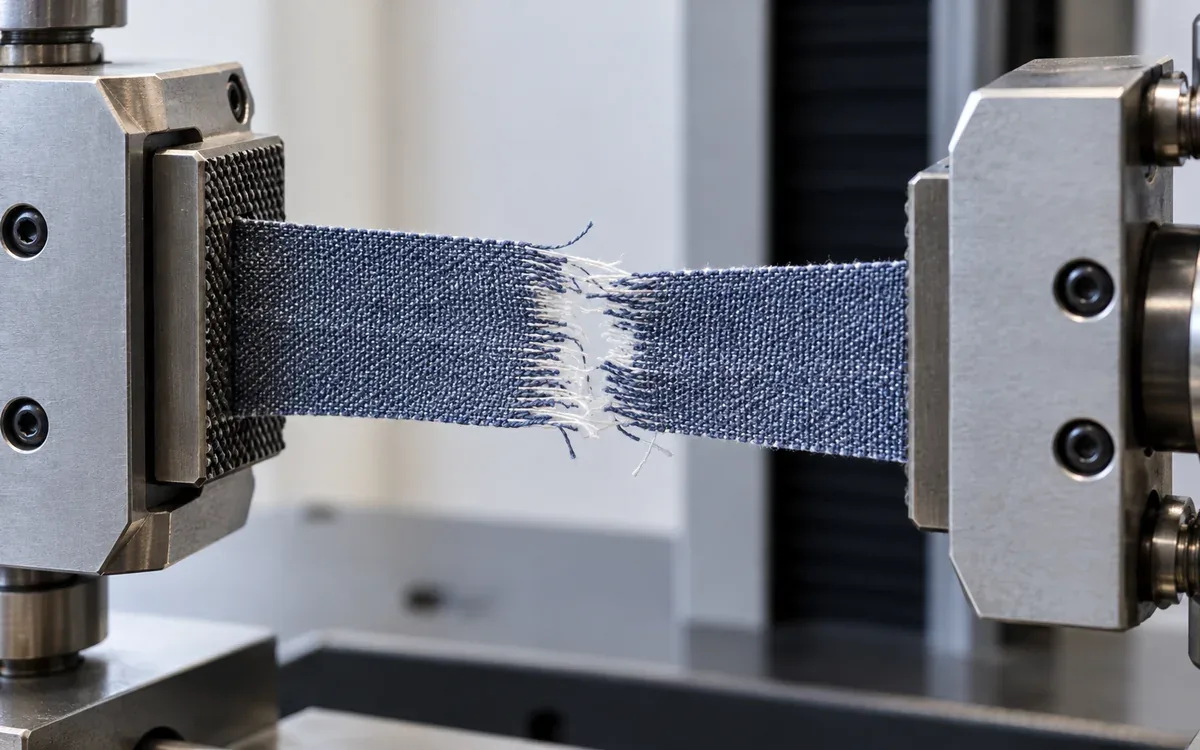
Review the machine program as a complete method
Check gauge length, speed, initial tension, jaw setup, and stop rule against the method. A familiar program name does not prove correct settings. Labs may keep older or customer-specific programs for valid reasons.
The machine principle matters too. Constant-rate-of-extension equipment controls extension rate. Other machine types control a different part of the loading system. The same time to break does not prove equal results.
Do not copy a single speed from a general web article and apply it to all four methods. Record the actual setting and its basis. Use the standard and agreed options to select speed and gauge length.
Confirm that the load cell and frame are suitable for the expected force. Rated sensor capacity is not its verified useful range. Check calibration coverage, resolution, and the lab measurement procedure.
Save the program version with the test record. If settings change during checks, separate those setup trials from the final valid series. Otherwise, one continuous sheet may hide several different tests.
Calculate the mean and variation without hiding the data
Consider five valid force results from one fictional fabric direction: 500, 520, 480, 510 and 490 N. Their mean is 500 N. The deviations from the mean are 0, 20, −20, 10 and −10 N.
The sum of squared deviations is 1,000 N². Using the sample standard deviation:
s = square root of [1,000 ÷ (5 − 1)] = 15.81 N.
The coefficient of variation, expressed as a percentage, is:
CV = 100 × s ÷ mean = 100 × 15.81 ÷ 500 = 3.16%.
NIST's explanation of the coefficient of variation defines it as standard deviation relative to the mean. Here, it describes the spread of these force results on a relative basis.
Now compare 440, 560, 480, 520 and 500 N. The mean is still 500 N, but the sample standard deviation is 44.72 N and CV is 8.94%. The second set is more scattered even though its average matches the first.
These small sets show the sums. They do not set sample size, prove process capability, or give a lot defect rate. Keep individual readings, valid count, and sample map with the summary.
Separate invalid tests from valid low results
Exclude a result only for a recorded reason under the method. Inconvenience is not a reason. A valid low result may be the most useful evidence in the batch.
Create separate fields for the event, validity decision, and replacement reference. A reviewer can then trace why the result was treated differently. Keep the original reading and curve. Do not delete the row.
For example, a run might produce a low value with clear evidence of specimen slip. Apply the validity rule, record the slip, and resolve its cause. Another low value may come from a valid central break. It should not get the same treatment just because it is low.
The issue is broader than the average. A repeated jaw problem may cast doubt on normal-looking pulls too. Review the whole setup before release.
Do not keep testing until a preferred mean appears. Set the required valid tests and replacement rules in advance. This protects buyer and supplier from selective reporting.
Compare processing states with matched directional evidence
Tensile tests can assess a finish change if samples and test conditions stay aligned. Keep linked before-and-after cloth. Separate the process effect from a change in yarn, structure, or source lot.
Suppose the warp mean changes from 800 to 680 N after an illustrative process. Force retention is:
680 ÷ 800 × 100 = 85%.
The corresponding loss is 15%. In weft, assume the mean changes from 500 to 475 N. Retention is 95%, with a 5% loss. The process response is not equally severe in both directions.
Retention also needs an absolute requirement. A fabric may keep 95% of a low starting force and still fail the buyer's minimum. Another may lose a greater share and still pass. Report final force and the defined retention calculation.
Use a matched conditioned state. Wet and conditioned pieces are separate comparisons, even after the same finish. State preparation, treatment history, and elapsed time. A later reader needs that context.
Investigate a supplier disagreement without changing the target
Start with the full test identity. Compare editions, strip preparation or grab option, and sample direction. Check conditioning and machine settings too. Check that both reports refer to the same material state.
Then inspect the raw records. One lab may report maximum force while another uses a different event. A direction may be reversed. One set may also contain more invalid grip events.
If methods align, plan a controlled comparison of similar samples from the material in question. Code and distribute them under an agreed plan. Unrelated rolls cannot separate lab differences from cloth variation.
Agree how the results will be assessed before the comparison begins. Do not invent a universal adjustment such as adding 10% to one laboratory's values. Any correction needs evidence and an agreed basis.
Keep the commercial acceptance rule visible throughout. Resolve the measurement or material difference. Do not swap in a method just because it gives more force.
Include the feature that prompted the test
A uniform base cloth and a finished garment panel may present different test questions. Printing, bonding, or a local treatment may create an area needing its own trial. Decide whether the purchase limit applies to base cloth, treated panel, or both.
For example, a developer might receive a complaint about rupture near a printed motif. A trial could compare unprinted cloth, printed cloth, and the transition area under an approved plan. Keep the motif in the same position relative to the jaws and load direction. Otherwise, one piece may put it in the free test area. Another may hide it in a grip.
Label any custom panel investigation clearly. Using the same tensile machine does not make it a standard acceptance test. Explain what the trial shows and which standard conditions changed.
Retain photographs or location sketches in the laboratory record. Describe the feature and break location in the final report. Keep enough detail in the record for another person to identify the region tested.
This also helps when a reinforcement grid is present. Different positions may include different reinforcing yarns. Plan that coverage before cutting. One good strip may not represent the whole cloth. Match the sampling plan to the structure and use.
Questions that often arise in fabric approval
Is grab strength always higher than strip strength?
The arrangements load the fabric differently. Nearby cloth can help in a grab test. But there is no conversion or ranking rule for every structure, width, and setup. Use the required method for comparison.
Can a strong fabric still have poor tear resistance?
Yes. Pulling intact cloth and growing a prepared tear cause different responses. Use a suitable tear test if that failure matters. Keep its requirement separate.
Does a high breaking elongation mean good stretch recovery?
No. A tensile pull that destroys the cloth cannot show its return after a stretch cycle. Recovery needs a suitable separate test and condition.
Can the fabric be approved from the average alone?
Only if the rule uses that statistic and all validity needs are met. Some briefs also set rules for individual values, directions, or spread. Apply the actual rule. Do not choose a summary after seeing the data.
Make the fabric result usable beyond the laboratory
A sound tensile report preserves the test boundary. It identifies the fabric, direction, strip or grab arrangement, preparation, condition and required endpoint. It keeps valid low results visible and explains any invalid tests.
For sourcing, the most useful number is the one that answers the agreed product question. Keep widths and methods separate. Review each direction. Link process comparisons to retained and absolute force. These steps turn machine output into evidence the fabric team can use.
References
ISO 13934-1:2013: Strip tensile testing; public scope and status.
ISO 13934-2:2014: Grab tensile testing; public scope and status.
ASTM D5034-21(2025): Grab and modified grab procedures.
ASTM D5035-11(2024): Ravelled and cut-strip procedures.
ISO 1421:2016: Tensile properties of coated fabrics.
ZwickRoell: Grab-test gripping geometry and equipment.

Discussion0
Loading the discussion…