
Specify the garment route before choosing the machine
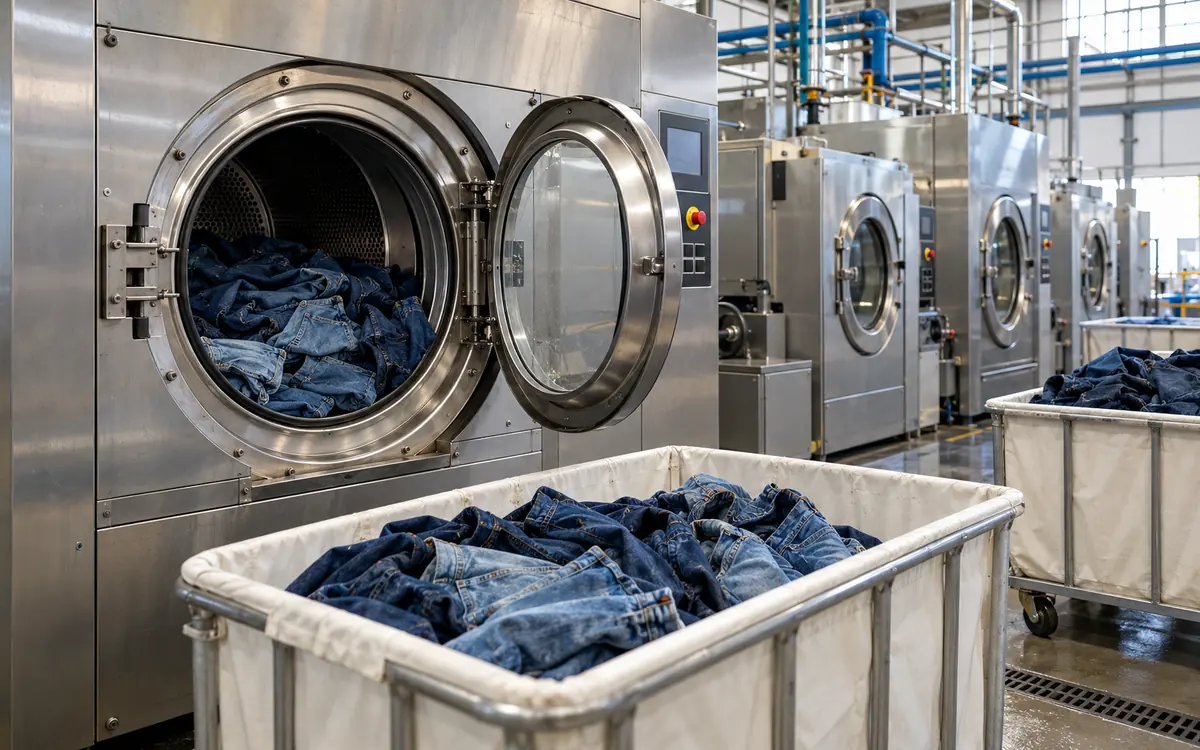
Garment washing machine selection starts with the product and its required finish. A soft wash for a light shirt needs one set of controls. An abrasion treatment for denim or a garment dyeing route may need another.
Write down the complete route. Include loading, treatment and draining. Add extraction, transfer and drying, plus any stages that must follow. Then check which tasks the proposed machine can do under the supplier’s approved conditions.
A list of machine names cannot answer this question. A washer may include strong extraction, or it may need a separate hydro extractor. A dryer may suit the batch mass. It may still be too small for its bulk or lack the required temperature control.
Define the main product families. Record garment mass, construction, fabric blend, trims and the required appearance. Include a heavy style that represents production. Add a difficult light style as well as an easy demo garment.
The aim is a tested and approved load range for each product family. That is more useful than a single maximum number written on a factory wall.
Read capacity with its loading basis
A machine can have a drum volume in litres and a load rating in kilograms. These describe different things. Litres describe available volume. Kilograms describe a textile load on a stated basis.
For example, Jeanologia lists the DB420 with a cylinder volume of 4,184 litres and a 150 kg load capacity. Those figures belong to that design and application. They do not give a general conversion from drum litres to garment kilograms.
A published Electrolux W5300H data sheet identifies a filling factor alongside its capacity. It also states the programme conditions for consumption data. These details matter when comparing offers.
Ask whether the quoted load is dry textile mass. Clarify the reference moisture condition, the intended product and any limits on added materials. Do not add stone, water or other process material to a garment rating. The manufacturer must state which added loads are allowed.
A larger mass rating may reflect a different loading basis. It does not prove that the machine gives better movement for a particular finish.
Calculate loading density, then confirm the load through trials
Two useful expressions are:
Volume per kilogram = drum volume in litres ÷ dry textile mass in kilograms
Loading density = dry textile mass in kilograms ÷ drum volume in cubic metres
Consider a hypothetical 1,800-litre drum. A 90 kg dry garment load gives:
1,800 ÷ 90 = 20 litres/kg
Since 1,800 litres equals 1.8 m³:
90 ÷ 1.8 = 50 kg/m³
A 120 kg load gives 15 litres/kg and 66.7 kg/m³. It occupies the same drum with more textile mass.
These figures help describe a trial. They do not prove that either load is allowed. Nor do they prove it gives the required effect. The supplier’s mechanical limits and the product’s movement needs still apply.
Also distinguish a filling factor from a liquor ratio. A drum allowance of 20 litres/kg is not a water volume of 20 litres per kilogram. The drum allowance describes space for the load. The liquor ratio describes the treatment liquor.
For water and dosing calculations, use ApparelDiary’s liquor ratio guide. Keep that calculation separate from the drum loading calculation.
Convert a garment count using the actual size mix
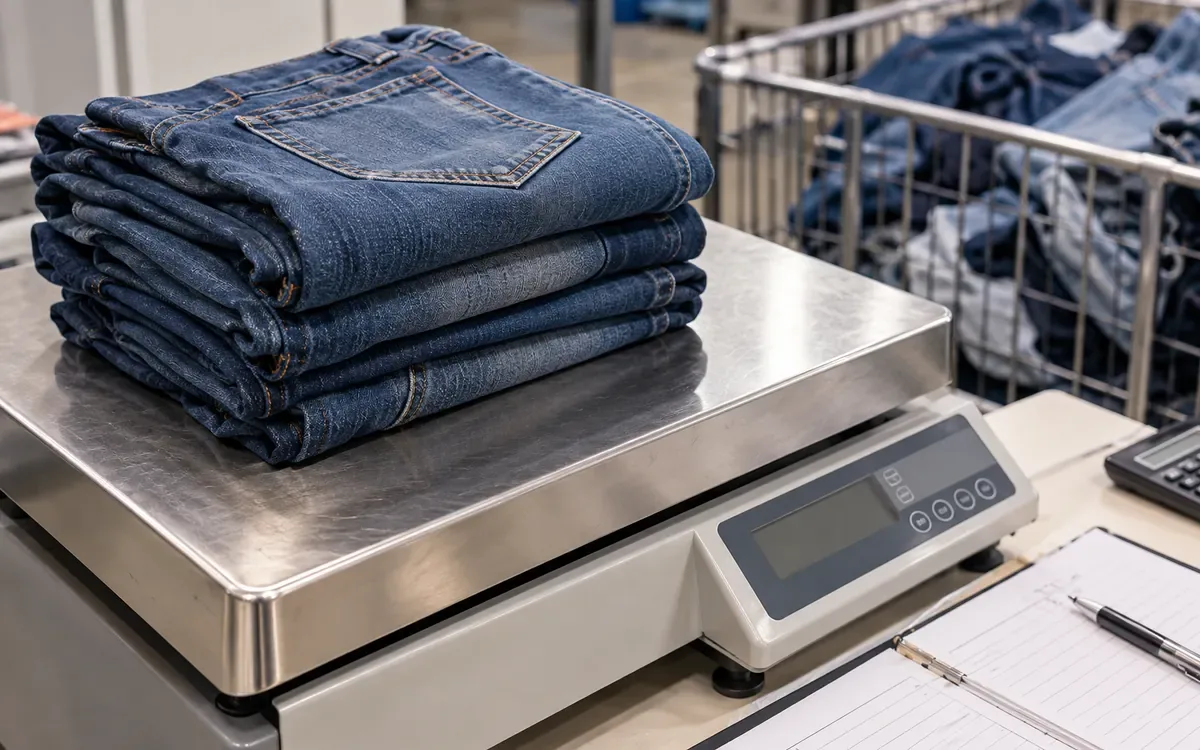
A piece count helps operators load a batch, but its mass basis must be reliable. Weigh a set that represents the actual sizes and styles. Use garments at the same process stage as the planned load.
Take a hypothetical batch of two sizes. It has 100 small jeans at 0.48 kg each and 100 large jeans at 0.62 kg each. Its total dry reference mass is:
100 × 0.48 + 100 × 0.62 = 110 kg
Using a convenient average of 0.50 kg would predict only 100 kg. The error is 10 kg before any process material is added.
The correct weighted mean for this batch is 110 ÷ 200 = 0.55 kg per garment. It is valid for this size mix. It should not become the permanent average for every order.
Mark the weighing stage in the record. A garment may lose material or gain finish during preparation. Its dry mass can therefore change between stages. Compare loads on a consistent basis.
Check scale capacity, resolution and tare practice. Confirm the calibration date before the supplier trial. Guessing the trolley weight can distort the result. So can copying a weight from a different trolley.
For routine loading, give the operator the approved mass range. Add a guide to the expected piece count. The measured mass remains a check. The count is still useful for order control. Also check the actual garment mix by eye. It must match the approved route.
Check the minimum useful load as well as the maximum
Factories often focus on overloading. Underloading can also change the process. A small load may move in a different way and receive a different mechanical action. It may fail to represent the approved bulk route.
Ask the supplier for the intended operating range. Then test the smallest routine production batch, not just a full demonstration load.
Mixed order sizes can make this decision important. A large machine may suit one major order. Many small colour lots may fall outside its useful load range. A sample machine may solve development work without being the best choice for every short production order.
Consider a hypothetical order containing 36 kg of one shade and 72 kg of another. If the qualified range for a route is 60–90 kg, the 72 kg lot fits that range. The 36 kg lot needs a separately approved option. Do not mix it with the other shade just to make a full load.
Record the reason for any minimum. Is it a machine limit, a movement requirement, a dosing limit or a quality finding? The answer determines whether another recipe or another machine can solve the problem.
Observe garment movement and contact
The drum is an active part of finishing. Its diameter, depth, lifters, surface and rotation programme affect how the load moves. Door position alone does not describe that behaviour.
Tonello’s G1 HW3 page describes high-speed extraction and a drum with special beaters for garment treatment. This shows why the inner design matters as well as the motor and mass rating.
During an approved supplier trial, use the garments to assess what movement does. Look for tangled legs, rope marks and trim impacts. Check for uneven abrasion and local shade differences. Use only the equipment’s safe viewing methods to observe the process.
A trial on loose fabric pieces cannot fully represent assembled trousers. Pockets, waistbands and long legs change the shape and bulk of the load.
Record rotation settings and reversals with the recipe. If a finish changes after a speed adjustment, the team should be able to connect the result to that change.
Do not assume that more action is better. Use enough action to produce the approved result. It must not cause damage beyond the agreed limits.
Match the machine to chemicals and solid materials
Specify the intended chemical families, operating conditions and added solids before purchase. Ask the supplier to confirm that all wetted parts suit the process.
The inner drum is only one part. Seals, valves, pumps, pipes and dosing connections also contact the process. A claim that the machine is “stainless steel” does not name the grade. It does not prove that every route is suitable.
If stone or other abrasive media will be used, confirm that the design permits them. Discuss collection, removal, access for cleaning and wear parts. A system designed for liquids may not suit abrasive solids. Confirm this before use.
Ask how a colour change is cleaned out. Residue may remain in a dosing line or drain. It can affect the next light load even when the drum looks clean.
Write the approved chemical and material scope into the purchase specification. Discuss future processes before purchase. A sales presentation alone does not approve them for the machine.
Compare extraction by acceleration, not rpm alone
Revolutions per minute describe speed. Centrifugal acceleration also depends on radius. Two drums may run at the same rpm. If their diameters differ, their acceleration differs too.
The general relationship is:
Relative acceleration, in multiples of g = 1.118 × 10⁻⁵ × radius in cm × rpm²
The radius is the distance from the rotation axis to the point being considered. For a drum-wall comparison, use the relevant drum radius. Eppendorf explains this radius-and-speed relationship for rotating equipment.
For a hypothetical radius of 60 cm at 600 rpm:
1.118 × 10⁻⁵ × 60 × 600² = 241.5 g
At 800 rpm with the same radius:
1.118 × 10⁻⁵ × 60 × 800² = 429.3 g
The speed rises by one third, while acceleration rises by about 77.8%. This shows why a given percentage rise in rpm causes a larger percentage rise in acceleration.
These are explanatory calculations, not permission to change speed. Operate within the machine’s approved limits and the qualified garment programme.
Measure extraction through retained water and product quality
A published extraction figure describes what the machine can do. The garment result still depends on the load and cycle. Tolkar’s Hydra Maxi specification lists extraction performance. It also covers loading, inlets, drainage and handling features. These need to work as a system.
Measure garment mass before and after extraction. Use a defined dry reference. Calculate residual water on that basis:
Residual water (%) = (wet load mass − reference dry load mass) ÷ reference dry load mass × 100
Suppose a hypothetical 100 kg dry load weighs 160 kg after one approved extraction programme. It contains 60 kg of water, or 60% residual water on the dry basis.
A second programme leaves it at 145 kg. It contains 45 kg of water. The dryer receives 15 kg less water.
This does not prove a fixed fuel saving. Drying efficiency, heat losses and the final moisture target also matter. It does establish a real reduction in the water the dryer must remove.
Check garment quality at the same time. Less retained water is not enough for success. The programme must also avoid lasting crease marks and component damage.
Decide whether integrated extraction fits the route
An integrated washer extractor can reduce transfers between machines. A separate hydro extractor can help when the washer lacks the needed extraction.
Compare the full handling route. Include wet load mass, trolley access and operator tasks. Check load balance and the time a batch waits between stages.
A separate machine also needs its own qualified load method and maintenance plan. Confirm how the garment batch stays identified during transfer. One wash lot may be split into several extraction loads. Each part can then have a different wait and residual moisture.
Ask what happens during an imbalance or interrupted cycle. The supplier should explain the approved response and how the event is recorded. A demo may work only with a carefully arranged, ideal load. That is not enough evidence for normal production.
The decision should reflect quality, handling and usable route time. It should not rest on a general claim that one arrangement is always superior.
Size the dryer for bulk and water removal
Dryer selection is not a simple kilogram match with the washer. The garment needs enough space to move. The system must remove the incoming water under suitable conditions.
Electrolux’s TD6-6 specification states the drum volume and filling factor. It also describes residual moisture control. Read larger industrial equipment ratings with the same care. Find out how each rating was set.
Consider a hypothetical washed batch with a 100 kg dry mass. A selected dryer route has been qualified at 50 kg dry textile per load. The batch requires two dryer loads, even if the washer handled it at once.
Suppose each dryer load occupies the machine for 40 minutes. The batch then needs 80 minutes on one dryer, excluding extra transfer delay. Two suitable dryers can process the parts at the same time. The utilities and handling must support this.
Check the final result in the thickest garment zones. A dry outer panel does not prove that the waistband is dry enough. Check the pocket assembly too.
Select heating by control and installation needs
Steam, electric, gas and other heating arrangements can be available within a dryer family. Tonello lists four heating options for its TD 100, along with features for air movement and temperature control.
Do not choose steam just to get a blue denim tone. Do not choose gas just to get a red tone. Fuel type alone is not a reliable shade specification. Assess the product after the actual drying conditions and complete finishing route.
Ask where temperature is measured and how the reading controls the cycle. Inlet air, exhaust air and garment temperature are different quantities. A display value needs a defined sensor location.
Confirm air supply, exhaust requirements and access for lint removal. Poor installation can limit the performance of an otherwise suitable dryer.
Also distinguish drying from curing. A curing stage requires its own validated conditions. A hot dryer is not automatically suitable for every chemical cure or three-dimensional effect.
Choose controls and equipment that fit the product and available services. Check that local staff can maintain them. Use operating evidence to support the choice.
Test utilities under a realistic simultaneous load
The machine trial should reflect the services it will receive in the factory. A supplier may demonstrate the machine with ideal water pressure or steam supply. The installed site may have different conditions.
Record the required supply conditions. Confirm water flow, heating service and power. Check drainage, exhaust and compressed air where needed. The detailed utility design belongs with the site’s qualified engineering team.
Observe fill, heat and drain times during a run that represents production. If several machines share a service, test their demand at the same time. A washer may meet its cycle time when it runs alone. It may miss that time when another machine starts filling.
Use ApparelDiary’s factory utility load register to organise those requirements. This article’s machine choice should feed that register, not replace the engineering design.
Avoid using motor kilowatts as total cycle energy. Installed power is a capacity figure. Energy use depends on how equipment runs over time.
Keep guaranteed supply needs and measured trial use separate in the purchase record. They answer different questions.
Write a supplier acceptance trial around the product mix
Agree the acceptance test before purchase. Define the garments, routes, loads, measurements and decision rules.
Trial item | Evidence to request |
|---|---|
Typical production load | Finished appearance and complete route time |
Lowest planned batch | Stable dosing, movement and product result |
Bulky or heavy style | Loading, extraction, drying and handling evidence |
Delicate component style | Trim condition, surface damage and dimensional result |
Light shade after a dark route | Cleaning effectiveness and contamination checks |
Repeat run | Comparable quality under the same defined conditions |
Interrupted or abnormal event | Supplier’s approved response and recorded status |
Use actual garments or agreed equivalents. State any difference between trial material and planned production.
Set numerical limits where they are useful. For appearance, a vague “satisfactory” clause is not enough. Include an approved reference and defined defect criteria.
Agree who supplies independent tests. Decide how to handle failed results. Keep the original data, not only a signed summary.
A factory acceptance trial checks the supplied machine. A site acceptance trial checks it after installation. Both may be needed. The services and layout can change between sites.
Work through one matched-route example
Assume a factory is comparing two hypothetical arrangements for the same finish. All loads and cycle times below are already qualified for the product.
Item | Arrangement A | Arrangement B |
|---|---|---|
Dry wash load | 100 kg | 80 kg |
Washer occupied time per load | 60 minutes | 45 minutes |
Dryer arrangement | One 50 kg unit | Two 40 kg units |
Dryer occupied time per load | 40 minutes | 35 minutes |
First-pass accepted share | 96% | 97% |
Arrangement A can wash 100 kg per hour. Its one dryer handles 50 kg every 40 minutes, equal to 75 kg per hour. Under these assumptions, the dryer limits sustained route output.
Arrangement B can wash 80 × 60 ÷ 45 = 106.7 kg per hour. Its dryers together handle 80 × 60 ÷ 35 = 137.1 kg per hour. Here, the washer limits the route’s output.
Before allowance for other delays, accepted output is about 75 × 0.96 = 72 kg per hour for A and 106.7 × 0.97 = 103.5 kg per hour for B.
The smaller wash batch produces more accepted output in this example. These figures do not show that one equipment choice is always best. They show why the complete route must be checked.
Include changeover, access and maintenance in the choice
A machine’s production value depends partly on how it recovers from routine stops. Ask which parts need regular inspection and how technicians reach them.
Check door access with the actual trolley. Confirm space for unloading and for tilting where fitted. Leave access to service panels and room to remove parts. A machine that fits its floor outline may still lack enough operating clearance.
Review drain and filter cleaning tasks. Identify where lint, abrasive residue or colour can collect. Ask how the supplier expects those areas to be cleaned and inspected.
For recipe control, confirm user access levels, version records and backup arrangements. The factory must be able to recover approved programmes after a controller repair.
Review local service, spare-part lead times and operator training. Keep these factors visible in the purchase comparison. They affect daily work. Settle them before installation.
Diagnose a capacity complaint before buying more equipment
A reported capacity shortage may have several causes. Separate them before deciding that another washer is needed.
Symptom | Investigation |
|---|---|
Washer waits for empty trolleys | Transfer and unloading flow |
Wet batches queue for long periods | Dryer loading, cycle and availability |
Cycles extend unpredictably | Fill, heating, drainage or imbalance records |
Larger loads need frequent rework | Product-specific load qualification |
Small orders occupy a large machine | Minimum load range and order routing |
Drying takes longer after a style change | Incoming water, garment bulk and endpoint |
Output falls after maintenance | Restored settings, calibration and machine condition |
Keep the discussion tied to observed batches. “The machine is slow” is not a diagnosis.
For broader scheduling across operations and product mix, use ApparelDiary’s machine capacity planning guide. The qualified wash and dry data developed here become inputs to that plan.
Frequently asked questions
Can drum volume be converted directly to garment kilograms?
Only with a stated loading basis. The equipment and product still need trials and approval. The same drum can support different useful loads for different garment constructions and finishes.
Is the highest extraction speed always the best choice?
No. Compare retained water, garment condition and the approved machine limits. Higher acceleration may reduce water, but the complete programme must still suit the product.
Should washer and dryer ratings be identical?
Their nameplate ratings alone do not prove a balanced route. Compare the approved dry textile load and incoming moisture. Check garment bulk and full occupied time at each stage.
Can a sample wash recipe transfer unchanged to bulk?
A sample provides a development reference. Drum design, load movement and services may differ. Use a controlled bulk trial to check them. Keep the intended result fixed while testing the production conditions.
Buy a qualified process capability
Choose equipment that can handle the required garment families within clear load and process limits. Confirm the wash, extraction and drying stages together.
A useful purchase file links supplier data with actual garment trials. It records installed services and accepted output too. This evidence gives the factory a sound basis for its purchase decision.
References
Jeanologia: SmartBox DB420 specifications.
Electrolux Professional: W5300H washer extractor data sheet.
Tonello: G1 HW3 production washing machine.
Tolkar: Hydra Maxi textile washing machine.
Eppendorf: Basics in centrifugation and relative acceleration.
Discussion0
Loading the discussion…