
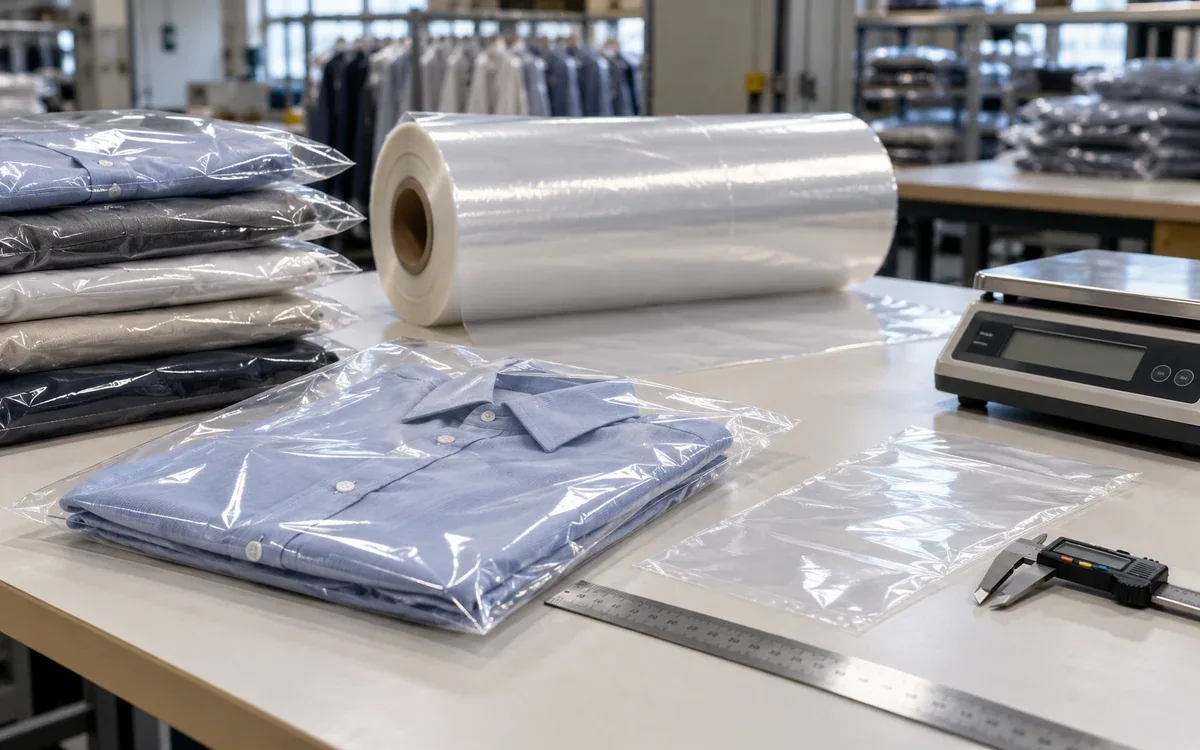
Calculate the film before calculating the price
Two suppliers quote the same garment bag size. One means the usable length below the closure. The other includes the flap. Their prices differ, but the bags do too.
Polybag consumption calculation starts with a drawing that defines the material. Width, length, thickness, gussets, flaps, seals, and closures must describe the same construction in both the estimate and the quotation. A formula cannot repair an unclear dimension.
The core calculation is simple:
Film mass = developed film area × film thickness × material density.
The care lies in the inputs. A flat bag normally has two walls. A closure flap may add only one wall. A folded gusset adds area that is hidden when the bag lies flat. A zipper or adhesive strip adds mass outside the basic film calculation.
This guide builds a material estimate for garment polybags and checks it against physical samples. All numerical examples are hypothetical teaching cases. They do not specify a suitable bag thickness, packaging design, or supplier price for any buyer.
Define what the estimate must include
Start by naming the result you need. Finished bag mass, film required by a converter, and bags required by a packing line are related but different quantities.
Finished film mass is the polymer film left in an accepted bag. Finished bag mass may also include a closure, ink, adhesive, label, or insert. Purchased film includes material lost during setup and converting. Packing-line demand includes bags consumed while producing the required number of packed garments.
Keep those quantities on separate lines. A supplier selling finished bags may already include its converting loss in the unit price. Adding the same loss again to that quote would overstate the cost.
Quantity | Typical unit | What it answers |
|---|---|---|
Film area in one bag | m² per bag | How much developed film forms the bag? |
Film mass in one bag | g per bag | How much film remains after conversion? |
Complete bag mass | g per bag | What does the bag, including extras, weigh? |
Converter film requirement | kg per order | How much input film is needed? |
Packing demand | bags per order | How many bags must reach the packing line? |
Accepted bag cost | currency per bag | What does one usable purchased bag cost? |
Versa Pak's calculators distinguish bag and sheeting calculations and request dimensions, gussets, and thickness. That distinction is useful: one sheet and a two-wall bag do not contain the same area.
Put dimensions on a construction drawing
Identify the opening edge first. Then mark the width across the opening and the length toward the bottom. State whether each value is an inside usable dimension, an outside dimension, or a developed film dimension.
A bag can have enough outside length but too little usable space below a seal or zipper. Conversely, a consumption estimate based only on usable length can omit material in the closure area.
Uline's bag guide shows separate dimension formats for flat, resealable, and gusseted bags. Use the supplier's actual convention. Do not assume that every catalogue uses the same inclusion rules for flaps and seams.
For each feature, ask where its material appears in the drawing. A bottom seal does not automatically create an extra strip if the quoted film length already contains it. A side seal may reduce the interior width without changing the outside film width.
Cut a spare approved sample open if the folds are unclear. Lay the film flat and mark each panel. This is often faster than arguing over a verbal definition of “gusset.”
Keep the approved construction drawing with the calculation. It should show the exact reference points used for measurement and identify any material omitted from the first estimate.
Convert thickness into a clear unit
Film thickness should be stated for one wall. Measuring across the front and back of a flat bag without separating them can double the apparent thickness.
Use micrometres, written µm, or millimetres. A micrometre is one thousandth of a millimetre. A mil is one thousandth of an inch, not one millimetre. NIST's measurement tables give 1 mil as exactly 25.4 µm.
Thus:
40 µm = 0.040 mm.
2 mil = 2 × 25.4 = 50.8 µm.
The word “gauge” needs confirmation. Suppliers may use trade conversions or rounded conventions. For example, Polybags lists one product as 25 µm and 100 gauge. Do not silently convert that label into an exact 25.4 µm specification.
Write the agreed single-wall thickness in µm on the purchase specification. Keep any trade term in brackets for recognition. This removes an avoidable dispute before production.
A tolerance is also needed, together with its measurement and sampling basis. One supplier's published tolerance is not a universal rule for all garment bags. The acceptance requirement must fit the actual contract and product.
Select a density that belongs to the material
Density converts film volume into mass. It must match the film structure being estimated.
A supplier's resin sheet can provide a starting value. ExxonMobil's LD 07523 data sheet, for example, lists a typical density of 0.923 g/cm³ for that named LDPE series. The sheet also states that typical properties are not specifications. The value should not be assigned to every bag called “poly.”
Ask the converter for the relevant finished-film basis when blends, fillers, coatings, or several layers are involved. Recycled content alone does not tell you a film's density. Neither does its colour or apparent stiffness.
For a uniform film, a convenient unit relationship is:
Mass in grams = area in m² × thickness in µm × density in g/cm³.
The conversion works because 1 m² multiplied by 1 µm gives a volume of 1 cm³. Writing that relationship once makes the formula easy to audit.
For a multilayer film, calculate each layer's contribution if reliable thickness and density data are available:
Mass = area × sum of each layer's thickness × its density.
If those data are uncertain, use an approved sample mass for purchasing estimates and keep the geometric estimate as a reasonableness check.
Calculate a flat bag with a single flap
Consider a hypothetical flat bag with these developed dimensions:
Input | Assumed value |
|---|---|
Film width, W | 0.300 m |
Body length, L | 0.400 m |
Extra single-wall flap, F | 0.040 m |
Single-wall film thickness | 40 µm |
Film density | 0.923 g/cm³ |
The body has a front and a back. The flap extends one wall only. The drawing already includes all film retained in the seals.
Body area = 2 × W × L.
Flap area = W × F.
Total film area = W × (2L + F).
Substituting the assumed values:
Area = 0.300 × (2 × 0.400 + 0.040) = 0.252 m².
Film mass = 0.252 × 40 × 0.923 = 9.30384 g per bag.
For 10,000 accepted bags, the film contained in those bags is:
10,000 × 9.30384 ÷ 1,000 = 93.0384 kg.
Round the displayed estimate sensibly, perhaps to 9.30 g per bag and 93.04 kg per order. Keep the unrounded value inside the calculation.
If the flap were incorrectly counted as a double layer, the area would become 0.264 m². The estimate would rise to 9.74688 g per bag. That small drawing error adds about 4.43 kg over 10,000 bags.
Handle gussets by counting developed panels
A gusset is folded film, so its contribution can be hidden in a laid-flat measurement. The safest method is to unfold the construction and count the full panel widths.
For a simple open-top side-gusset tube, define W as the finished front-panel width and D as the full opened depth. There are two face panels of width W and two side panels of width D.
Developed circumference = 2W + 2D.
If H is the actual film length, including retained end-seal material, the simple film area is:
Area = 2 × (W + D) × H.
For hypothetical values W = 0.300 m, D = 0.060 m, and H = 0.400 m:
Area = 2 × (0.300 + 0.060) × 0.400 = 0.288 m².
At 40 µm and 0.923 g/cm³, the film mass is 10.63296 g.
This equation assumes the stated four-panel tube construction. It excludes a separate flap, shaped bottom pieces, removed corners, or other features. Add or subtract their actual developed areas from the drawing.
A supplier may state a gusset as a folded depth rather than the full opened side depth. If so, convert it using the drawing before applying the equation. Do not insert the printed “gusset” number into a formula until its meaning is clear.
For a complex bag, an area schedule with one line per panel is more reliable than a compact formula.
Add closures, print, and removed areas carefully
A film estimate does not automatically include a zipper profile, slider, adhesive strip, release liner, handle, or label. List such items separately when their mass or cost matters.
Flexon Pack's flat-bag estimator explicitly excludes these additional features, along with gussets and conversion loss. That is a useful boundary for any preliminary model.
Do not add an arbitrary percentage for printing unless it is supported by the converter's data. Ink coverage, deposit, colour count, and drying process affect the result. For many buying decisions, the print charge is better shown separately from the film estimate.
A punched hole removes film from the finished bag, but the converter still purchased the film that became the punched scrap. Subtract the hole only when calculating retained finished-film mass. Keep its material within the input-film requirement unless the purchased web geometry already excludes it.
The same reasoning applies to trimmed flap corners. A neat finished shape can contain less film than the rectangular web allocated to it. Both measurements can be correct when their boundaries are stated.
If a release liner is removed during packing, distinguish the bag as received from the bag around the garment. This matters when a weighed sample is used to check the geometric model.
Convert net film into converter input
The 93.0384 kg in the flat-bag example is film retained in accepted bags. It is not yet the film that the converter must issue to the job.
Suppose a hypothetical steady-run yield is 96%. This means 96% of the film issued during the steady run becomes film in accepted bags. Assume a separate fixed startup loss of 2.0 kg.
Steady-run input = 93.0384 ÷ 0.96 = 96.915 kg.
Total input = 96.915 + 2.0 = 98.915 kg.
This example gives startup loss its own line because it does not grow directly with order quantity. A percentage allowance on every bag would treat a short and a long order alike.
Define yield before using it. If the plant's recorded 96% already includes startup, adding 2.0 kg again would double-count that loss. If it excludes print rejects, those rejects still need a place in the model.
A “4% waste” statement is also incomplete. Four percent of input and four percent added to net output are different calculations. In this example, adding 4% to net gives 96.759936 kg before startup, which is lower than dividing by 0.96.
Use a yield denominator that can be reconciled with actual issued film and accepted output.
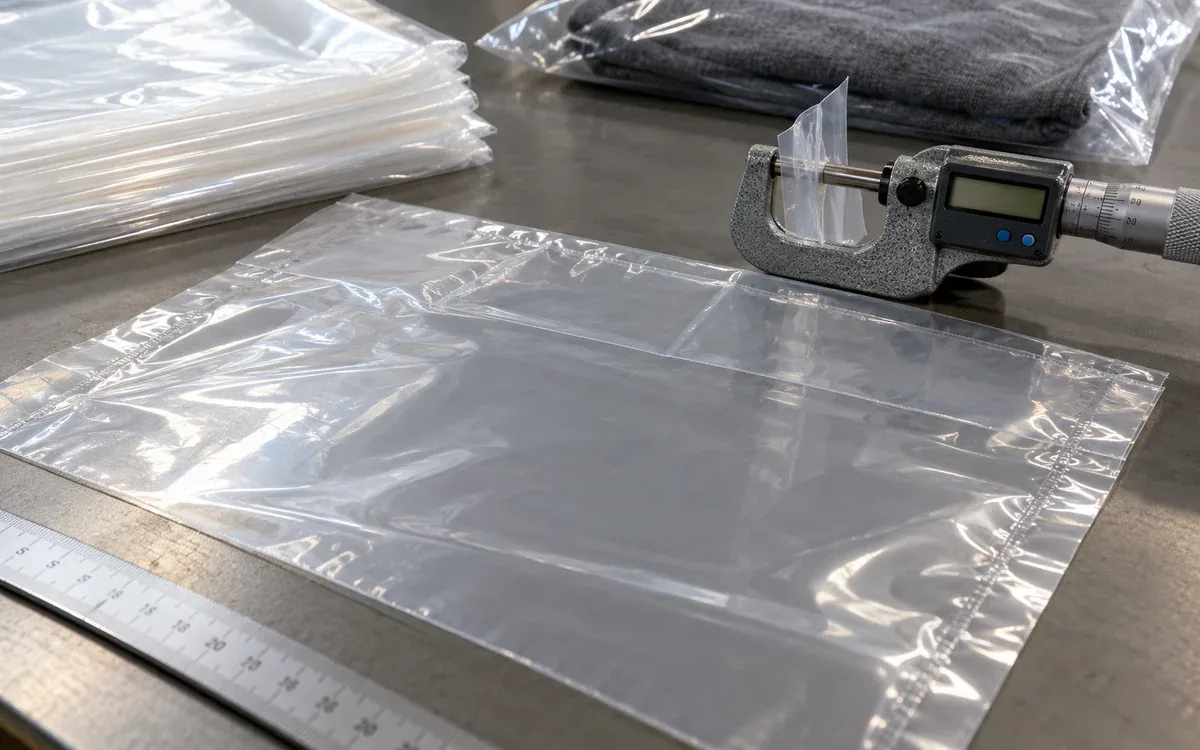
Keep packing demand separate from converter yield
A garment factory may consume bags through torn openings, incorrect labels, packing errors, or approved sampling. These losses occur after bags have been purchased.
Suppose 10,000 garments must leave in accepted bags. A hypothetical packing yield of 98.5% would require:
Bags for packing = 10,000 ÷ 0.985 = 10,152.28.
Because a fraction of a bag cannot be issued, the planning quantity becomes at least 10,153 bags before any separate sample allowance or pack-size rounding.
This does not mean the converter must produce only 10,153 attempts. Its own production yield determines the input needed to deliver that many accepted bags.
Show the two stages in order: garment packing demand sets the required purchased quantity; converter yield sets the material needed to make that quantity. Keep reserve stock separate from expected consumption. A bag held as contingency has not yet been used.
Review allowances against actual records. A blanket extra percentage can conceal a recurring opening problem or a poor closure design. Separate the causes so that improving one operation produces a visible reduction.
Check the model with a weighed sample
Weighing several bags together reduces the effect of scale resolution on a single light item. Use a suitable checked balance, count the sample carefully, and remove any packaging tare.
Record what remains on each bag. A sample with labels and release liners cannot be compared directly with a film-only calculation. Either include their mass in the model or measure a sample that matches its boundary.
Suppose 100 complete bags weigh 960 g, while separately measured non-film items total 35 g. The estimated film mass is:
(960 − 35) ÷ 100 = 9.25 g per bag.
Compared with the calculated 9.30384 g, the difference is about −0.58%. That is a comparison result, not an automatic pass. Acceptance still depends on the agreed dimensions, thickness, structure, and performance requirements.
If the difference is large, check count and tare first. Then check dimensions, single-wall thickness, missing folds, density, and accessories. Do not assume that lower mass proves under-thickness.
ASTM D6988-26 concerns thickness measurements for plastic-film test specimens. Its public scope says it does not define commercial classification or quality-control sampling. A purchase inspection plan therefore needs its own agreed sampling basis and suitable measurement procedure.
Do not let an average hide a local problem
A satisfactory average bag mass does not prove that every region has the intended thickness. A heavy flap or thick band can offset a thin area elsewhere. Keep thickness measurements tied to positions on the film when the acceptance plan calls for them.
Use a measurement map that can be repeated. Identify the opening edge, machine direction if known, and the positions selected across the bag. Avoid measuring through folds, seals, or several walls unless that is the stated purpose.
Record individual readings as well as the mean. If a hypothetical specification sets both an average and a minimum local thickness, each requirement needs its own decision. Passing the average does not cancel a low individual result.
Also separate thickness variation from size variation. A slightly wider bag can have the expected mass even when its film is lighter per square metre. Measuring dimensions and mass together provides a stronger check than either alone.
Use sensitivity to find the important inputs
For fixed area and density, film mass changes in direct proportion to thickness. A 10% increase in thickness produces a 10% increase in calculated film mass. It does not necessarily produce a 10% increase in the complete bag price.
In the flat-bag example, increasing thickness from 40 to 44 µm raises film mass from 9.30384 g to 10.234224 g. For 10,000 bags, that adds about 9.30 kg of retained film.
Area changes behave differently when only one dimension changes. Reducing the single flap by 10 mm saves:
0.300 × 0.010 = 0.003 m² per bag.
At the assumed thickness and density, that is 0.11076 g per bag. The saving over 10,000 bags is 1.1076 kg.
Those figures help rank ideas, but they do not approve the design change. A shorter flap must still close reliably. A thinner film must still meet the needed handling and protection requirements.
Test the proposed change with the folded garment and real packing method. Reducing film that is needed for closure or opening clearance may simply move waste into the packing operation.
Turn material consumption into a clear cost
Use the same boundary for every quotation. A price for film alone cannot be compared directly with a price for printed, converted, packed bags.
Return to the hypothetical input of 98.915 kg for 10,000 accepted bags. Assume film costs 2.40 currency units per kg. Assume conversion and printing together cost 120 units, plus a separate job setup charge of 35 units.
Film cost = 98.915 × 2.40 = 237.396.
Total included cost = 237.396 + 120 + 35 = 392.396.
Cost per accepted bag = 392.396 ÷ 10,000 = 0.0392396.
This is a material-and-conversion example. It excludes any other commercial charges. State the scope beside the total, and do not add a converter's losses again if they are already inside its finished-bag quote.
Ask whether print tooling, extra colours, closure materials, and packing are included. Also confirm the quantity basis: per bag, per thousand, or per kilogram. A rate looks dramatically different when its denominator is missing.
For delivery costs beyond this material calculation, use ApparelDiary's separate guide to packaging decisions and landed cost. Keeping the boundaries clear makes both calculations easier to maintain.
Reconcile actual usage after the order
At job close, compare the same units used in the estimate. Record film issued, material returned, identified scrap, accepted bags, and work still in process. A partly used roll should not be treated as consumed merely because it left the store.
For purchased bags, compare opening stock plus receipts with accepted packing use, recorded loss, closing stock, and any transfers. Investigate unexplained differences before increasing the allowance on the next order.
Separate price variance from quantity variance. Higher spending may come from a film-price change, a heavier approved bag, or lower production yield. Each needs a different response.
Retain the drawing revision with the actual result. If the bag changed during the order, calculate the two versions separately. Averaging them without identification makes the next estimate harder to explain.
This closes the calculation with evidence. The next order can then use measured consumption and a known construction, while still showing where conditions differ.
Frequently asked questions
Why do some formulas divide the flap length by two?
They may combine a single-wall flap with a formula that already doubles the body area. That can be mathematically correct, but it is easy to misread. Counting two body panels and one flap panel directly is clearer.
Can I use one density for all LDPE bags?
Use a supplier-confirmed value appropriate to the film, or a measured mass basis. A published resin value belongs to its stated grade and conditions. Blends and added materials can change the finished-film result.
Is film gauge the same as bag strength?
No. Thickness is one input. Material, orientation, seals, and local features also affect performance. A consumption calculation predicts material quantity; it does not prove that a bag will meet its functional requirements.
Should waste be added before or after multiplying by quantity?
A proportional yield can be applied to the total net requirement. Fixed startup loss should remain separate. More important than the order is using the correct denominator and avoiding overlap between loss allowances.
Why does the supplier's bag weight exceed the calculation?
Check whether its weight includes a closure, ink, adhesive, labels, or release liner. Then verify the dimensions, folds, thickness, and density basis. Compare like with like before deciding that either value is wrong.
Make the estimate traceable
A useful polybag calculation can be followed from the approved drawing to a measured sample and then to the order quantity. It names the film structure, uses clear units, counts every panel once, and separates retained material from process loss.
Keep the formula simple and the assumptions visible. That gives merchandisers a sound basis for quotations, helps converters explain their material needs, and reveals which design changes can save film without creating a packing problem.
References
Versa Pak: Poly bag and sheeting calculators.
Flexon Pack: PE bag weight calculation and exclusions.
Polybags: Example specification using microns and gauge.
ExxonMobil: LD 07523 Series product data.
Discussion0
Loading the discussion…