
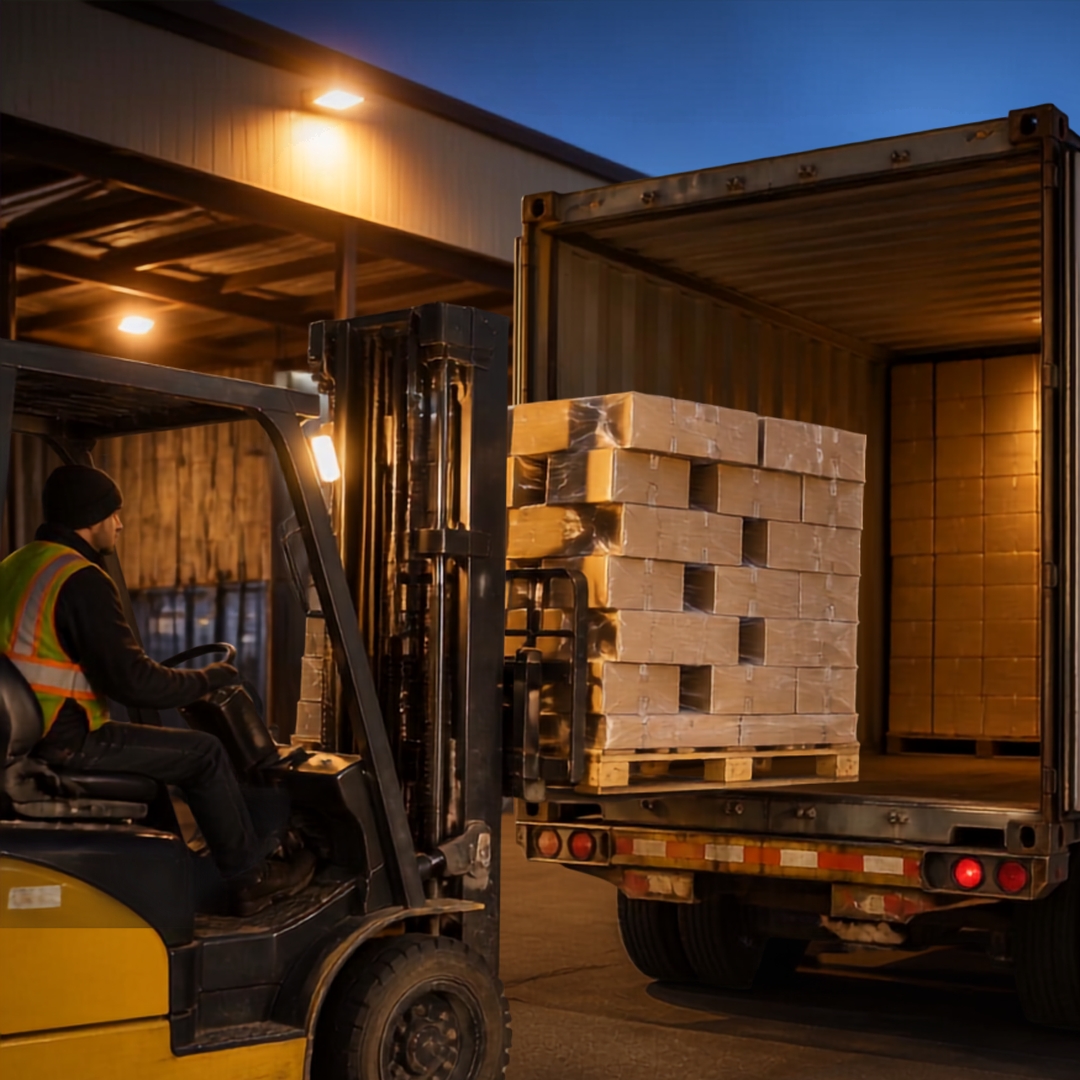
A procurement manager walks into a cost review with good news. The new carton supplier quoted 9% below the incumbent. The packaging line ran the trial without a hitch. Everyone signs off.
Three months later, finance flags a problem nobody asked about: landed cost per unit went up, not down. The new carton's dimensions don't tile the pallet the way the old one did. Fourteen fewer cases fit per container. The freight bill per unit rose faster than the carton savings fell.
This is the trap almost every FMCG and export packaging review falls into. Packaging decisions and landed cost get evaluated as two separate conversations (one owned by procurement, the other by logistics) when they are the same decision viewed from different ends of the supply chain. A carton redesign, a case count change, or a bundling decision can move your landed cost per unit by more than a freight-rate renegotiation ever will, and it can do it silently, because nobody re-runs the pallet math before signing the packaging order.
What Actually Goes Into Landed Cost?
Landed cost is everything it costs to get one unit of product from the factory floor to the point it is available for sale, converted into a single per-unit figure.
Landed cost per unit = Product cost + Freight + Insurance + Duties/tariffs + Port and handling charges + Currency conversion cost + Last-mile delivery
Component | What it covers | Typical driver |
|---|---|---|
Product cost (FOB) | Ex-factory price per unit | Raw material, labour, factory overhead |
Freight | Ocean/air freight to port of entry | Container or chargeable weight, lane, season |
Insurance | Cargo insurance, usually % of CIF value | Product value, claims history |
Duties / tariffs | Import duty by HS code | HS classification, trade agreements, country of origin |
Port and handling | THC, documentation, demurrage, customs brokerage | Fixed per container or per shipment |
Currency conversion | FX spread and hedging cost on the transaction | Invoice currency, bank/broker margin |
Last-mile delivery | Inland trucking from port to warehouse or DC | Distance, fuel, local trucking rates |
Every component except product cost and duty rate is, to some degree, a function of how much product you can physically move per container or per pallet, and that is where packaging decisions and landed cost stop being separate line items, which is exactly the kind of connected number a properly built manufacturing analytics stack should surface on its own instead of waiting for a quarterly finance review.
A Worked Example: Same Product, Two Packaging Configurations
Take a 400g snack pouch, packed 12 pouches to a shipper case, moving in a standard 40-foot container that carries 20 pallets. Ocean freight is quoted flat per container at $3,800, because this product fills the container's cube long before it hits the weight limit.
Scenario A (original case): the case has 2.5 cm of dead space on one edge relative to the pallet footprint. It tiles at 48 cases per pallet. Scenario B (redesigned case): trimming that 2.5 cm overhang lets the same case tile at 54 cases per pallet, a 12.5% improvement, with no change to the pouch, the case material, or the case count per unit.
Field note: I have seen this exact 2.5 cm gap on a client's shipper case survive four packaging reviews because nobody laid the case flat against the pallet drawing before approving it. The fix cost nothing: it was a print-file change to the die-line, not a material change.
Metric | Scenario A (original) | Scenario B (redesigned) |
|---|---|---|
Cases per pallet | 48 | 54 |
Cases per container | 960 | 1,080 |
Units per container | 11,520 | 12,960 |
Freight per unit | $0.330 | $0.293 |
Duty per unit (12% of CIF) | $0.184 | $0.180 |
Landed cost per unit | $1.814 | $1.768 |
The product cost, the duty rate, and the freight quote per container are identical in both scenarios. The only thing that changed was cube utilisation, and it moved landed cost per unit by roughly 2.5%, about $0.046 per unit, which on a 5-million-unit annual volume is over $230,000, with zero material cost invested.
Cube-Limited or Weight-Limited: Know Which Constraint You're Fighting
Before touching a case dimension, work out which wall you hit first in a container or truck: cube (volume) or weight.
Cube-limited products (snacks, tissue, diapers, most dry goods) run out of container space long before they hit the weight limit. For these, every centimetre of dead space in the case or on the pallet is pure freight cost.
Weight-limited products (liquids, canned goods, glass-packed items) hit the container's weight cap before its cube. For these, shaving case volume does nothing for freight; the lever is packaging weight itself.
Get this backwards and you will invest engineering time cutting cube on a weight-limited SKU, or cutting weight on a cube-limited one, and see no freight movement at all.
Case Configuration and the Pallet-First Design Sequence
Most packaging design runs in the wrong order: pick the bottle or pouch first, then design a case around it, then discover the case does not tile the pallet cleanly. Reverse it: start with the pallet footprint the logistics network standardises on, design the case dimensions to tile that footprint without overhang, and only then select primary packaging to fill the case efficiently. Which case sizes matter most here depends heavily on your route-to-market distribution model: a direct-store-delivery network serving traditional trade has very different case economics than one running through modern-trade distributors, and larger case packs that cut handling cost also raise the minimum order quantity per SKU, a trade-off best evaluated with the same EOQ versus periodic review inventory policy comparison used for finished-goods replenishment.
Case size | Retail-side effect | Supply-chain effect |
|---|---|---|
Larger (24–48 units) | Too much inventory per shelf slot for small-format stores; slower turns | Lowest per-unit handling cost, best cube utilisation |
Medium (12–24 units) | Workable across most channels | Reasonable balance |
Smaller (6–12 units) | Preferred by small and traditional-trade retailers; supports freshness | More cases to handle, lower cube efficiency, higher carton cost per unit |
The HS Code Trap: When Packaging Changes the Duty Rate
This is the part almost nobody checks, and it can outweigh every freight saving above. Customs classification under the Harmonized System is sometimes sensitive to how a product is packaged or bundled, not just what the product is.
Bundling changes the classification of the "set." A standalone item and the same product sold as part of a multi-item retail set can fall under different HS headings, at different duty rates.
Packaging materials with intrinsic value can be separately dutiable. A reusable tin or branded gift box can trigger different treatment than a plain shipper case.
Net content declarations tied to pack size can shift tariff-line thresholds. A pack-size change can cross a rate threshold without anyone intending it to.
Run classification review before, not after, a packaging or bundling change ships. Finding out after the shipment lands means an unbudgeted duty bill, and possibly a retroactive review of prior shipments.
Field note: A client once moved from single-unit export cartons to a twin-pack retail-ready bundle to improve shelf presence. The bundle was reclassified under a different tariff line at 3.5 percentage points higher duty. The shelf-presence win was real; the duty increase erased two years of the freight savings from the same packaging redesign.
The Six-Factor Framework for Evaluating Any Packaging Change
Every packaging change should be scored against all six of these before approval, not just the one that made the business case attractive:
Material cost per unit: the number everyone leads with, and often the only one checked.
Line efficiency effect: a thinner film that runs 6% slower can erase its own material savings in labour and machine time.
Damage rate change: verified through transit trials, not lab drop tests alone.
Freight per unit: calculated from actual pallet-pattern math, as in the worked example above.
Retail handling and shelf performance: checked with real trade partners before the change is locked, since a shelf-ready redesign built for a promotional push deserves the same rigor as measuring the real lift from a trade promotion, not just anecdote from the sales team.
Compliance and artwork rework cost: usually one-time, but genuinely material when mandatory label space was not planned for up front.
A packaging change that wins on factor 1 and loses on factors 3 through 6 is not a saving: it is a cost transfer from the packaging line item to freight, returns, and rework, usually landing in a different budget where nobody connects it back to the original decision.
Landed Cost and Packaging Change: Summary Checklist
Case dimensions tile the pallet footprint without overhang.
Confirmed cube-limited vs weight-limited before redesigning.
Recalculated units-per-container for the proposed configuration.
HS classification re-checked for bundling or net-content changes.
Transit damage trial run, not just a lab drop test.
Case size checked against actual distribution channel mix.
Mandatory label and compliance panel space confirmed before artwork lock.
Final Word
Packaging is not a fixed input to the landed cost formula: it is one of the few levers inside it that a manufacturer fully controls, unlike freight rates or duty schedules set by carriers and governments. Treat every packaging change as a landed-cost decision first and a material-cost decision second, and re-run the container math before you re-run the artwork.



Discussion0
Loading the discussion…