
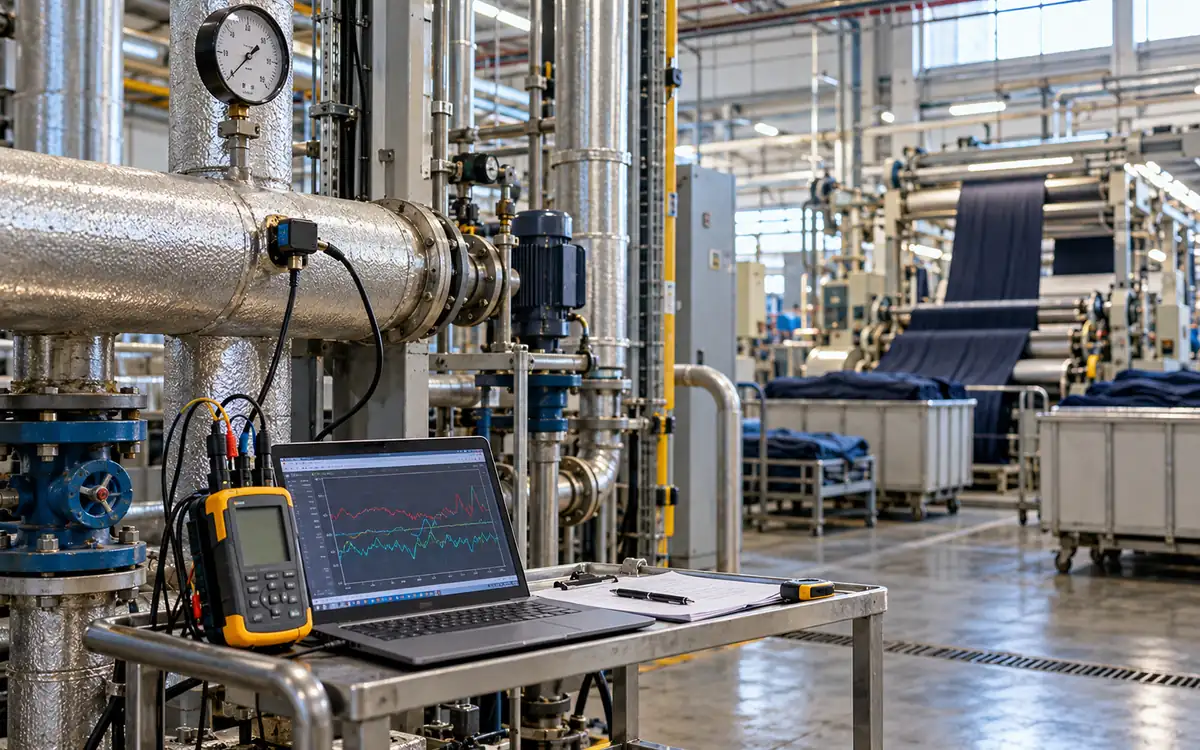
A textile factory can buy an energy audit and still lack the evidence needed to act. The report may list useful ideas but omit operating hours, measured loads or the cost of making a change. The cause often starts in the tender. “Complete energy audit” does not tell bidders what work is required.
A clear energy audit scope defines the decisions the factory needs to make. It names the systems and the data needed. It sets the measurements, operating states and report outputs. It also defines the factory's own duties so the audit team can obtain the evidence.
This guide shows how to write that scope for a textile or apparel site. It includes original example clauses and calculations. All prices, loads and schedules are hypothetical. They are tools for preparing a tender, not market rates or a prescribed audit method.
State the decision that the audit must support
Begin with the business question. The factory may need to rank no-cost changes. It may need to decide whether to replace a boiler. Or it may need to assess several capital projects. Those questions need different levels of evidence.
An audit aimed at finding opportunities can use broader screening. An audit meant to support a large purchase needs more detail on load, duty, costs and risks. Do not ask bidders for an investment decision while paying only for a short walk-through.
ISO 50002-1:2025 sets general requirements and guidance for energy audits. It replaced ISO 50002:2014. Its public description covers planning, roles, competence and deliverables. Name the edition in the tender if it is part of the required method.
Then write the intended output in plain terms. For example: “Provide evidence to rank the listed options. Identify those that need a further trial before funding.” This is clearer than asking for the maximum possible saving.
Define the site and system boundaries
Attach a site plan and a list of included buildings and utilities. Name the fuels and energy streams. Identify imported power, on-site generation, purchased steam and shared services.
For process work, ISO 50002-3:2025 gives guidance for applying Part 1 to processes. A textile scope should consider the process and its utility supply together. A pump audit that ignores the required flow cannot judge the pumping duty well.
Scope item | Include in the tender | Boundary question |
|---|---|---|
Steam | Generation, distribution and named users | Where is useful heat delivered? |
Compressed air | Supply, treatment and selected demand | Which users and shifts are covered? |
Cooling | Plant, pumps and named loads | Is comfort and process cooling shared? |
Electrical loads | Main supply and selected branches | Are generation and export included? |
Production processes | Named lines or machines | Which recipes, styles or batches apply? |
List exclusions with reasons. Check the annual energy total used for comparison. It should not silently include a building outside the scope. Record how shared utility use will be treated.
Specify depth through tasks and evidence
Audit labels such as Level 1, Level 2 or investment grade can help describe intent. They do not replace a written work scope. Ask each bidder to state the tasks, staff time, instruments and analysis behind its label.
The SEAI Energy Audit Handbook links audit detail to purpose and energy impact. It treats preparation, site work and reporting as connected steps. Use that idea to decide where extra measurement has value.
For a first review, it may be sensible to map major uses and select several detailed studies. For a known problem, such as a high night load, focus on the relevant states and causes. The tender can ask for both a core scope and priced optional studies.
Require the bidder to explain what cannot be concluded from the proposed work. A few spot readings may not support a firm recommendation. State that limit. Make further work visible before award rather than discovering it in the final report.
Give all bidders the same data pack
Prepare recent energy bills, tariff details, production records, shift calendars and utility logs. Include the equipment register, plant drawings and known meter details. State the period covered and any known gaps.
Do not send one bidder a full year of interval data and another only the monthly bills. Keep a shared question log. If a clarification changes the scope, issue it to all bidders still in the process.
The LBNL industrial audit guidebook covers preparation, measurement, analysis and reporting. Its technical workflow remains useful. Its older examples do not provide current prices or rules.
ApparelDiary's utility load register guide can help assemble the plant list. Mark uncertain names and ratings. The audit should check key inputs. An old spreadsheet can contain errors.
Require a measurement plan before site work
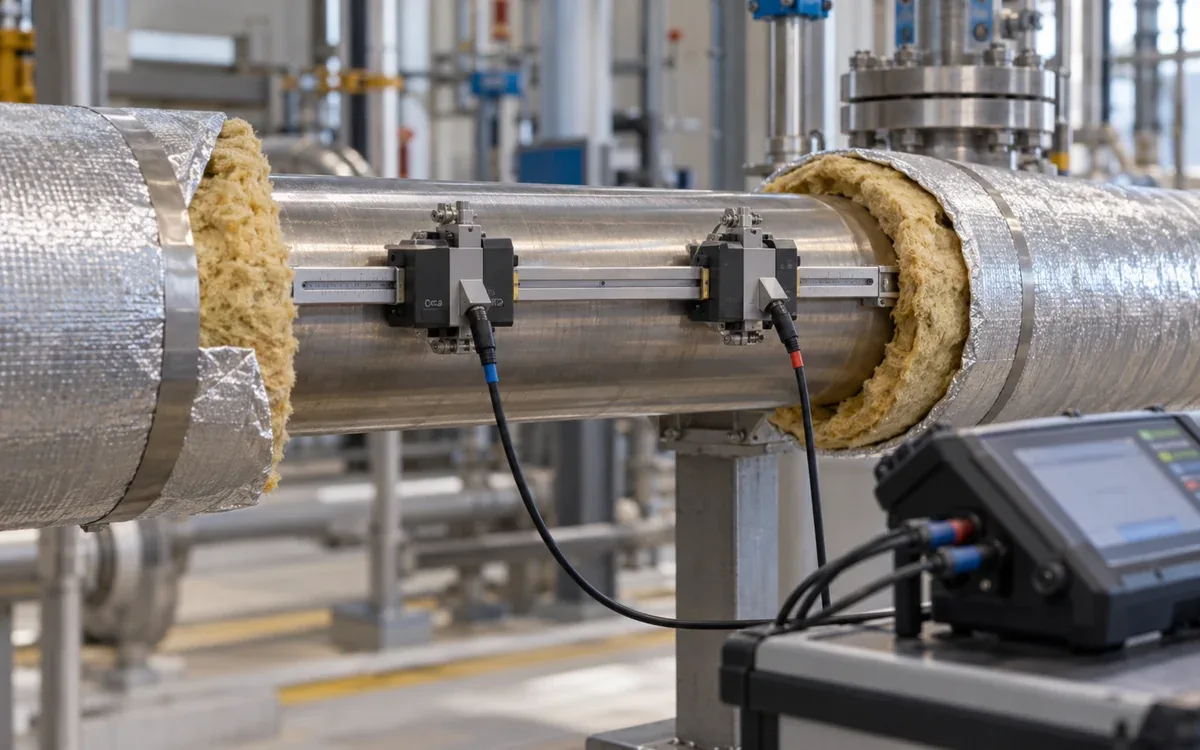
Ask the auditor to submit a draft measurement plan after reviewing the data pack. State the purpose and location of each measurement. Add its quantity, unit, interval and duration. List the expected operating states.
Include the instrument type, range and accuracy needed for the task. Ask for the calibration status and a plan for checking setup. The result should identify the actual instrument used, not only the type promised in the bid.
For power logging, name the load and the period to be captured. For steam work, list the required flow, pressure and temperature information. For a heat recovery study, identify both the heat source and the sink. A hot stream without a useful matching demand does not establish an annual saving.
Require the plan to explain access needs. Temporary sensors, safe isolation, production support and permits may need advance work. State who provides each item. The factory and auditor should approve the plan before the main visit.
Capture the operating states that drive the result
A textile plant does not use energy at one fixed load. It may warm up, run batches, wait for work, clean, change styles and stop. Each state can matter to a proposed saving.
Suppose a hypothetical fan uses 30 kW in production and 15 kW during idle periods. A spot check during production alone cannot show its annual energy. If it runs 3,000 production hours and 1,000 idle hours, annual use is 30 × 3,000 + 15 × 1,000 = 105,000 kWh.
Using 30 kW for all 4,000 hours would give 120,000 kWh. The 15,000 kWh difference comes from the assumed load pattern, not a meter fault. The audit scope should therefore require evidence for hours in each relevant state.
Agree what “representative” means for the site. A week may cover all shifts but miss a seasonal cooling load. A single recipe may miss a high-temperature process. Ask the bidder to justify the chosen period and describe any later checks needed.
Plan night, weekend and shutdown observations
Some of the most useful evidence appears when production is low. A plant walk during the busiest shift may miss unnecessary air flow, steam use or cooling after work ends.
If these states matter, put them in the tender. State the expected out-of-hours visits and the factory staff available to support them. Include them in the quoted fee or as clearly priced options.
A shutdown check is not permission to stop a safety or environmental control. Name the services that must remain on. Have the plant team define the safe limits for any trial. The auditor should observe and propose within those limits.
Ask for a record of the state during each test. “Night load” is vague if one process line was still running. Note the active equipment, production status and any unusual event. That context makes the measurement useful later.
State what the factory will provide
The tender should name a site contact who can arrange access and answer data questions. Name a contact for production records. Add one for tariffs and costs if needed. The auditor should not have to guess who can approve a test or release a drawing.
List the records the factory will supply and their due dates. State which drawings are current and which need checking. Identify the language used in logs and whether staff support is needed to interpret them. Explain any limits on photography, data transfer or access to buyer-specific process information.
Agree how cancelled tests are handled. If a planned batch does not run, the team may need another visit or a different valid sampling plan. Set the decision route and any extra rates before the event occurs. Do not let a missed test silently turn into an unsupported assumption.
Keep a site diary during the work. Record meter installation times, unusual production, power cuts and changes to settings. A short note from the shift team can explain a trend that otherwise takes hours to investigate. Share the diary with the auditor so the final analysis uses the same account of what happened.
Define the required calculations
Each opportunity should show the current condition, proposed change and calculation basis. Require units in the formula and a clear source for every major input. Separate measured values, supplier data and assumptions.
Ask for annualization to be visible. A measured saving of 8 kW becomes 32,000 kWh only if it applies for 4,000 hours. The report must show why those hours are appropriate. It should not use full calendar hours for a process that runs only part of the year.
Include interactions. A steam trap repair can reduce the flow later available for heat recovery. A pressure change can affect both supply power and end-use performance. Separate project estimates may not be additive.
Require a low, central and high case where uncertain inputs can change the decision. Label them as scenarios. Use confidence limits only where the statistics support that term. The tender should seek honest ranges, not a single precise-looking number for every project.
Make uncertainty visible in the report
An audit can contain uncertainty from instruments, sampling, operating hours and future output. Ask the auditor to identify the dominant sources for each major recommendation.
ISO 50015:2014 provides principles for checking energy performance. ISO confirmed it as current in 2025. It can inform the later savings-check plan. It does not turn an audit estimate into a measured post-project result.
Suppose the fan example could avoid 8 kW for either 2,000 or 3,000 hours. The annual saving ranges from 16,000 to 24,000 kWh. At an illustrative USD 0.12/kWh, that is USD 1,920–2,880 before other costs. The hours assumption drives a USD 960 range.
The scope should ask what evidence would narrow that range. Longer logging may be useful. A better production calendar may be cheaper and more relevant. Extra measurement should resolve a decision risk, not simply make the report longer.
Specify a cost basis that finance can review
Require the report to separate equipment, installation, controls, downtime, commissioning and recurring costs. State whether tax, freight and spares are included. Identify the date and source of each estimate.
A vendor budget quote is different from a firm installation price. A historic project cost is different again. Label the estimate type and explain what remains outside it.
The report should use the agreed energy prices and tariff rules. Demand savings need a valid billing calculation. Check how a labour saving affects costs. Count it as cash only if the cost can be reduced or avoided. A saved staff hour may instead release capacity for other work.
ApparelDiary's capital project review guide helps connect a proposal with later operating results. Ask the audit team to leave enough detail for that review. Include the assumed service and production conditions.
Compare audit bids after aligning the scope
Consider two hypothetical quotes. Bid A is USD 4,000 for a daytime visit and a summary report. Bid B is USD 6,200 and includes logging, an out-of-hours visit and editable calculations.
The factory asks Bid A to price the missing work. Logging adds USD 1,200, the out-of-hours visit adds USD 600 and editable analysis adds USD 700. The aligned total becomes USD 6,500.
Required item | Bid A, USD | Bid B, USD |
|---|---|---|
Initial quote | 4,000 | 6,200 |
Logging added to common scope | 1,200 | Included |
Out-of-hours visit | 600 | Included |
Editable analysis | 700 | Included |
Comparable total | 6,500 | 6,200 |
This example does not prove that Bid B is better. It shows why the first price comparison was incomplete. The team still needs to assess method, relevant skills, data quality and the proposed work.
Ask both bidders to identify all exclusions and extra rates. A lower price is useful only when the required output is still covered.
Evaluate the people who will do the work
Ask for the named audit lead and system specialists. Review experience relevant to the included processes. General building experience may not cover a batch dyeing plant or a shared steam system well.
Credentials can support a competence review, but they are not the whole review. ISO 50001 concerns an energy management system. It should not be treated as a personal auditor qualification. Check what each claimed credential actually represents.
Request a redacted sample calculation and report section. Ask the proposed lead to explain the inputs, uncertainty and limits. This tests the work more directly than a list of impressive project names.
State how staff substitutions will be approved. A tender may be won with an experienced lead and delivered by a different team. The contract should preserve the agreed skill mix or require an acceptable replacement.
Address independence and equipment sales
An equipment supplier may know its technology well. It may also benefit from a recommendation to replace a system. That interest does not make every recommendation wrong, but it should be declared.
Ask bidders to disclose sales commissions and links to suppliers. They should also declare fees tied to later purchases. Decide whether the audit needs independent review for major equipment choices. Record the approach in the tender.
Require reasonable alternatives where the scope calls for them. These may include operating changes, repairs, control changes and replacement. The comparison should use the same required duty and cost basis.
Avoid paying the auditor simply for the size of estimated savings. That can reward optimistic assumptions. Tie payment to agreed work, sound evidence and accepted outputs. Any performance-linked arrangement needs a separate, clear method for proving the result.
Define deliverables that remain useful after the visit
Ask for an executive summary and a technical record. The summary should help managers choose the next action. The technical record should let an engineer reproduce the key calculations.
Require the site energy balance and meter list. Ask for raw measurements, quality flags and operating context. Include editable calculation files with formulas and units. A PDF chart alone is not enough to test an assumption later.
Give each opportunity an ID. Request its scope, technical basis and expected saving. Add the cost range, risks and next step. State dependencies on other measures. Identify whether it is ready for a trial, design study or purchase decision.
Also ask for a list of rejected ideas and why they were rejected. A well-supported decision not to install a device can be valuable. It prevents the same weak proposal returning at the next audit with a new title.
Include a proportionate savings-check plan
An energy audit predicts what a change may achieve. The factory still needs a way to check what it achieves after installation. Ask for a brief measurement and verification plan for each major proposed project.
The FEMP M&V guide offers methods for defining baselines and checking savings. Ask which evidence must be captured now. Some will be lost when the old equipment or controls change.
The plan should name the boundary, useful service, baseline data and post-project measurements. Identify the variables that may need adjustment. State the likely cost of checking the result so it can enter the business case.
Do not require a costly verification design for every small housekeeping action. Match the effort to the value and risk. Preserve the key baseline evidence. It may be lost when a major system is removed.
Write acceptance criteria before award
Define what makes a deliverable complete. Check that inputs are traceable and units are correct. Confirm the agreed system coverage. Require a clear account of limits. A report is not accepted merely because it reaches a page count.
Use a review meeting to test several recommendations. Pick one low-cost action and one capital measure. Ask the auditor to trace each from raw evidence to annual savings and cost. Resolve gaps before closing the assignment.
Set a period for comments and corrections. Agree how many review rounds are included and what counts as a change in scope. Link payment stages to the work. They might follow plan approval, fieldwork and final acceptance.
Keep acceptance separate from a promise that every project will be funded. The audit's job is to provide sound decision evidence. A justified finding that a project is not worthwhile can meet that objective.
Example scope wording for a focused utility audit
The following is original sample wording for a hypothetical tender. Adapt it to the actual site, duties and selected standard.
“Assess the steam and cooling systems serving Halls A and B. Include their shared supply plant and the named end users in the attached register. Review the supplied energy and production records for the twelve-month period. State any gaps before finalizing the measurement plan.
“Observe normal production, start-up and one agreed low-load period. Propose logging periods that capture the relevant cycles. Identify any seasonal condition not covered. Record the plant state and production context for each test.
“For each measure, state the current and proposed duty. Provide input sources and formulas. List annual hours and cost assumptions. Separate measured inputs from estimates. Show how measures affect each other. Identify the next evidence needed before a purchase decision.
“Deliver raw data and instrument details. Supply editable calculations and a site energy balance. Rank the proposed actions in a register. Include a short plan for checking major savings after work. Discuss draft findings with plant and finance staff. Correct agreed errors. Then submit the final record.”
This wording defines useful outputs. It leaves room to resolve technical details after the tender. It leaves room for the auditor to propose a sound measurement plan. It also gives the factory a basis for judging whether the promised work was done.
Frequently asked questions
Is a longer audit always better?
No. The work should match the decisions and operating variation. More days without a clear measurement purpose may add little value. A short, well-targeted study can answer a narrow question well.
Must the auditor guarantee the predicted savings?
An audit estimate and a savings guarantee are different services. If a guarantee is required, define the contract, baseline, checking method and remedy. Do not imply one through the word “audit.”
Should every system receive the same measurement effort?
No. Prioritize major uses and uncertain inputs that could change a decision. Explain the screening used for smaller loads and record the limits of the review.
Can the factory use its own meters?
Yes, where their scope, setup, accuracy and data quality suit the task. The auditor should review those conditions. A meter's presence alone does not prove that its records are fit for the planned calculation.
Buy evidence that leads to a clear next step
A useful textile factory energy audit scope starts with its purpose. It links the boundary and measurements to the required outputs. It makes bids comparable and gives the factory a fair way to accept the work. Define the operating states, cost basis and data trail before award. The final report can then support a practical choice: act, test further, redesign or reject the idea.
References
ISO 50002-1:2025: General energy audit requirements.
ISO 50002-3:2025: Energy audits of processes.
LBNL: Industrial Energy Audit Guidebook.


Discussion0
Loading the discussion…