
What a lightfastness result actually tells you
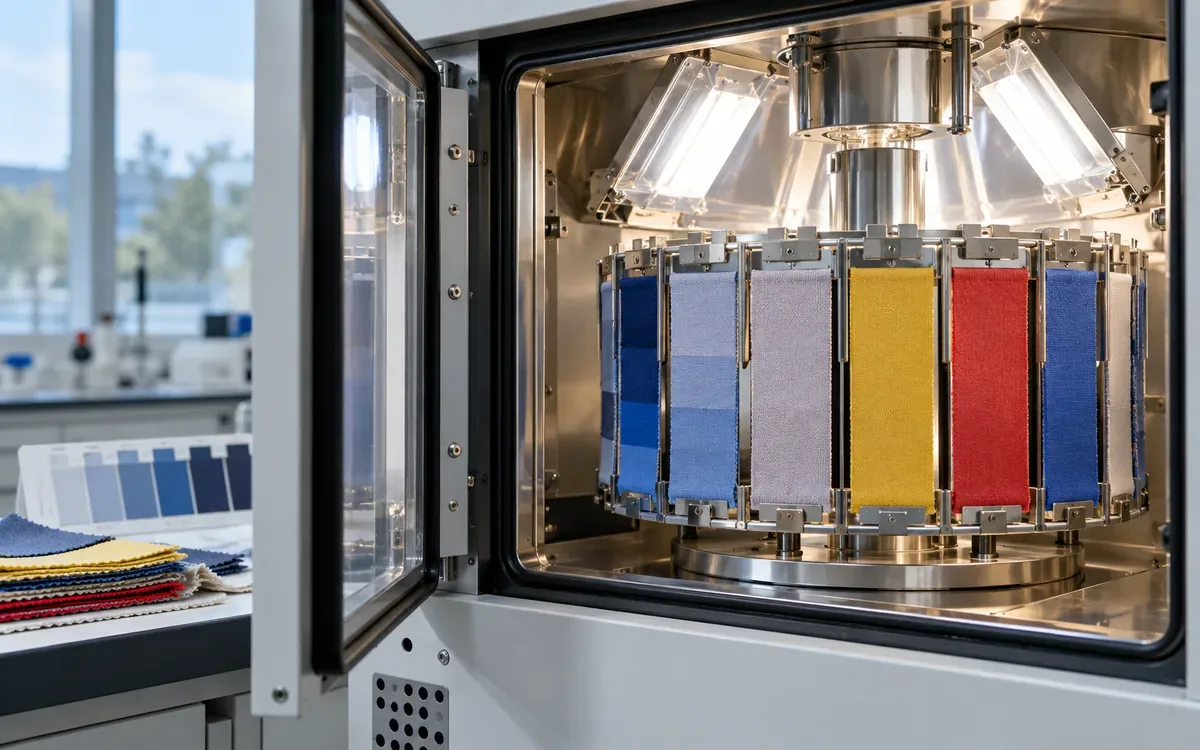
Light fastness testing measures how a textile's colour changes under a defined light exposure. A useful result names the material, exposure method, endpoint and assessment scale. Without those details, a report that says “lightfastness 4” can be misunderstood.
The same number could refer to a blue wool comparison or a grey-scale colour-change grade. An exposure described as twenty units might also be mistaken for twenty hours. These errors can reach the buyer's test brief. They may then cause disputes between labs.
Start with the decision the test must support. Perhaps a pale shirt must retain an acceptable shade after a specified exposure. Perhaps two dye combinations need to be compared on the same fabric. Those are clear laboratory questions. Predicting how many summers the shirt will last is a different task. That needs more evidence.
Define the product question before selecting the exposure
Write down the fabric, colour and finished state. Include any treatment that will be present when the product is sold. A result for uncoated cloth does not automatically cover a coated version. Nor does a result for one shade approve every colour in the range.
Distinguish colour retention from other light-related properties. A fabric may keep its colour while its strength changes. A colour test does not prove ultraviolet protection for the wearer either. Each claim needs its own test evidence.
Consider where the cloth will be used. Light through a window differs from outdoor light with wetting and drying. Weathering tests may combine light with other stresses. Choose a test that answers the product question. The shortest machine cycle may not do that.
Atlas explains that ISO 105-B04 and ISO 105-B10 serve different textile weathering needs. Their comparison of the two methods separates colour tests from broader tests of outdoor technical textiles. Do not treat the method names as labels for the same test.
If the buyer names a method, keep its full code and required option. Discuss any mismatch with the end use before testing. A lab must not quietly replace the named lightfastness test with another weathering program.
Name the standard and the selected option
The public scope of ISO 105-B02:2014 covers textile colour under artificial light that represents natural daylight. It includes white textiles that have been bleached or optically brightened. ISO names two sets of blue wool references. It warns that their results may differ.
AATCC TM16.3-2020 covers xenon-arc lightfastness testing. Its scope lists continuous-light options. Another option alternates light and dark periods. The scope also says the parties must establish how the test relates to actual use.
These public summaries help select a method. They do not provide all the instructions needed to run it. The lab must use the full required edition. This includes the chosen exposure and grading steps.
A test request should resolve at least four choices:
Choice | What to state | Why it matters |
|---|---|---|
Method | Standard, edition and option | Similar names can describe different exposures |
Specimen | Fabric, shade, face and finished state | The result belongs to the material tested |
Endpoint | Required reference response or radiant exposure | Elapsed time alone may not define completion |
Assessment | Named scale or colour-difference method | The number needs a defined meaning |
Add the buyer's acceptance requirement separately. A test method describes how to obtain a result. It does not always set a pass grade for the product.
Keep blue wool references and colour-change grades separate
Blue wool materials provide controlled fading references. Grey scales assess a colour difference. These functions are linked in some methods, but they remain distinct.
Q-Lab's guide to ISO 105-B02 reference materials describes blue wool references numbered 1 to 8 and a grey scale with grades 1 to 5. It also covers methods with known control samples or a defined radiant exposure. Name the exact reference system in the report.
A high blue wool number must not be translated into “no fading under any exposure.” It describes the result under that comparison. A grey-scale grade is not a percentage of dye left in the cloth either.
Consider three fictional statements:
Statement | Information missing |
|---|---|
Lightfastness: 4 | Which scale, method and endpoint? |
Colour change grade 4 after the specified exposure | Which exposure and evaluation procedure? |
Blue wool rating 4 under the named method | Which reference set and test conditions? |
All three need context. Keep the scale with the number in the database. A column of numbers alone may lead to false comparisons.
Keep intermediate grades in the form required by the method. Do not turn a grade such as 3–4 into a claim of 70% colour retention. The arithmetic looks simple, but the scale does not define that percentage.
In development, matched samples tested together often make the most useful comparison. Use one full method. Keep reference details even when all samples share a machine run. A shared run does not fix an incomplete report.
Treat AATCC fading units as exposure units
AATCC explains that its fading units, or AFU, describe exposure rather than clock time. Its blue wool update states that 20 AFU does not mean 20 hours. The time to reach that exposure can differ with the machine or conditions.
The same update explains the use of one current reference fabric at different endpoints. Do not replace the AFU exposure with old L-designations in a modern report. Follow the rules for the actual reference lot. Use its matching standard of fade.
AATCC's current blue wool product information lists material for 5-AFU and 20-AFU tests. It permits the stated L2 material in place of L4 for 20 AFU. This is a specific substitution. It does not permit swapping any two reference fabrics.
Record the reference product and lot when the method requires them. Store and handle the materials as directed. An old exposed reference may still have its label. That does not make it fresh calibration material.
Separate the exposure endpoint from the textile's result. The reference helps show that the required exposure occurred. Then grade the test cloth by the stated method. Reaching the correct endpoint does not mean the cloth will pass.
Calculate radiant exposure without inventing a lifetime
Radiant exposure adds up irradiance over time. For a constant level, the calculation is:
Radiant exposure = irradiance × exposure time.
Keep the units tied to what was measured. Broadband irradiance may use W/m² over a stated wavelength band. Spectral irradiance at one wavelength may use W/(m²·nm). These are different measurements. Do not swap one value for the other.
Here is a hypothetical calculation for a spectral measurement at one specified wavelength. Assume a constant irradiance of 0.40 W/(m²·nm) for 10 light-on hours.
Ten hours = 10 × 3,600 = 36,000 seconds.
Spectral radiant exposure = 0.40 × 36,000 = 14,400 J/(m²·nm).
This is 14.4 kJ/(m²·nm). The sum shows how the units work. It does not recommend a textile exposure or give an AFU conversion.
If the level were 0.80 W/(m²·nm) for five hours, the arithmetic would give the same exposure. It would not prove the same colour change. That conclusion needs evidence. The material may respond differently when intensity and time change.
Atlas calls this question reciprocity. Its technical explanation says this relationship must be checked before using higher irradiance to shorten a test. Control other conditions in that comparison too. These include temperature and humidity.
Account for interruptions and changes in output
For a second made-up example, give a sample six hours at 0.40 W/(m²·nm). Then give it four hours at 0.35 W/(m²·nm). Keep the wavelength the same.
First period = 0.40 × 6 × 3,600 = 8,640 J/(m²·nm).
Second period = 0.35 × 4 × 3,600 = 5,040 J/(m²·nm).
Total = 13,680 J/(m²·nm), or 13.68 kJ/(m²·nm).
That is 5% less than the earlier constant-output example. This comparison concerns measured light exposure only. It does not tell you how much the fading will differ. Follow the method's rules for interruptions and light control. Do not make an informal correction after the test ends.
Control humidity and temperature as part of the test
A lightfastness chamber controls more than light. Name the required temperature measure and humidity control in the report. Different sensors may describe different physical conditions.
AATCC's published options distinguish black-standard and black-panel arrangements. The selected option belongs with the result. A label such as “chamber temperature” may hide which sensor was used.
ISO 105-B02 also uses the concept of effective humidity. Q-Lab explains how a specified moisture-sensitive control material measures this effect. It is not the same as the relative-humidity setpoint shown by the chamber. Its humidity-control guidance describes why these measures must be distinguished.
Use the control checks required by the complete method. Record the relevant settings and the evidence that they were achieved. If a control result is out of range, check the exposure first. Do this before drawing conclusions from a small difference between fabrics.
Do not change humidity to obtain a desired pass grade. The purpose of a controlled test is to compare materials under the agreed condition. A changed condition makes a different trial. Label it that way.
During a dispute, compare actual records rather than only programmed setpoints. Two labs may enter similar settings but use different references or sensors. Their machine histories may also differ. Resolve those differences before declaring one cloth less stable.
Make the specimen represent the product
Submit the fabric in the state covered by the specification. Record whether it has been dyed, printed, heat set, washed, coated or otherwise finished. Keep an unexposed comparison piece from the same material and state.
Include the relevant shades and visible components. A dark body fabric does not establish the performance of a pale trim. A solid background does not establish the stability of each printed colour. Plan the specimen layout so the important regions can be assessed after exposure.
Keep the face and direction the same. Take care with textured surfaces or cloth with a clear direction. A new viewing angle may change the look. That makes comparison harder.
For a finish trial, use matched base cloth. If the dye mix changes along with the finish, you are comparing two whole routes. Any difference cannot be assigned to the finish alone.
ApparelDiary's fabric colour approval guide covers the identity and approval of the initial shade. Lightfastness asks how that cloth changes under the named exposure. Link both records. A shade approval alone does not approve durability.
Separate a shade effect from a finish effect
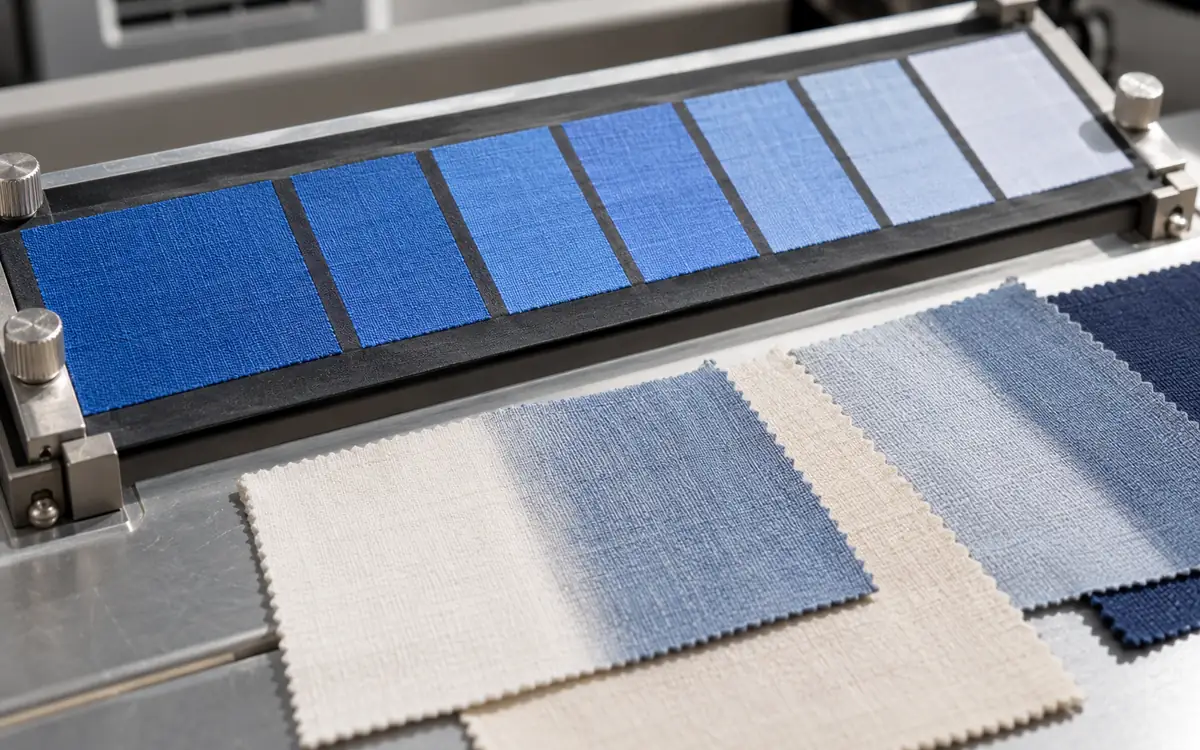
A small comparison plan can prevent a misleading conclusion. Suppose a mill wants to test a new finish on a pale and a deep shade. Does it change lightfastness? Use matched cloth within each shade. Split it between the reference finish and the proposed finish.
The four treatment groups are pale/reference, pale/proposed, deep/reference and deep/proposed. Give all groups the same exposure and evaluation method. Include appropriate unexposed comparison pieces. The shade difference is planned. An unrecorded change of base cloth is not.
For an invented plan with three exposed pieces per group, the count is:
Exposed pieces = 2 shades × 2 finishes × 3 pieces = 12 pieces.
If this plan retains one matched unexposed piece for each, it needs another twelve pieces. The total is twenty-four. This is a planning example, not a standard specimen requirement. The full method sets how many pieces to use and how to prepare and arrange them.
If the new finish does worse only in the pale shade, the result concerns that shade and route. It does not prove a general finish failure. If both shades worsen, the finish change is a stronger lead. Still check other differences in treatment.
Repeat promising or disputed results on cloth from a separate bulk run. Three pieces cut close together show local variation. They do not prove consistency across three batches.
Keep the individual results and specimen positions. Use balanced placement where the method allows it. Do not always put one treatment in the same chamber position. Record the layout before starting. This makes a position pattern visible. It also gives the lab a fairer basis for comparing treatments.
Examine the shape of the colour change
A final grade is useful. In development, planned checks during exposure can help too, if the method permits them. They show whether two candidates change in the same way as the test proceeds.
Use separate specimens or the method's prescribed masking arrangement. Unplanned handling may change the exposure or weaken later comparisons. Choose the check points before the run. Keep the required unexposed references.
Consider a made-up trial using one named instrument measure of colour difference. These numbers illustrate the choice. They are not pass limits.
Candidate | At the earlier agreed exposure | At the final agreed exposure |
|---|---|---|
A | 0.7 | 2.6 |
B | 1.1 | 1.8 |
C | 0.9 | 2.0 |
A has the smallest early change, but B has the smallest final change. Choosing A from the early reading answers one question. Choosing the most stable option at final exposure answers another.
The table does not describe what happens between the two points. Do not fit an exact fading curve from two readings or use them to predict years of wear. If you need a curve, plan enough readings. Check the variation between repeat samples too.
Also inspect the direction of change. Two fabrics may have similar total colour difference yet move toward different hues. That matters when a garment combines body cloth and trims.
Assess exposed and unexposed pieces consistently
After exposure, use the required visual or instrument grading method. Follow its conditioning and handling steps. Mark the exposed area clearly. This is vital when masks divide one piece into several regions.
For visual assessment, use the required light, background and viewing arrangement. Handle both pieces the same way. Do not judge one damp and the other dry. These controls help isolate the effect of exposure from the way samples are shown.
For an instrument result, keep the metric and settings. Record the aperture, backing, and other conditions required by the lab method. A large uniform area and a small print motif may not give comparable measurements.
Photographs can document the specimen layout and the location of a change. An ordinary camera image does not replace the prescribed colour assessment. Automatic exposure and white balance can change the contrast you see.
If reviewers disagree, first confirm that they are rating the same area against the same unexposed reference. Then check the evaluation method and specimen state. Consider why the reviewers disagree before repeating exposure.
Use the result for a defined product decision
Suppose a fictional brief requires a colour-change grade of at least 4 after a named exposure. Candidate X receives grade 4 and candidate Y receives grade 3. Under that brief, X meets this requirement and Y does not.
This does not give X a certain percentage more life in use. It does not prove washfastness, rubbing fastness, or resistance to pool water either. Check each property that matters to the product.
If the buyer accepts Y for limited use, record a concession against the stated rule. Do not make the failed result look like a pass. Keep the original grade. Explain exactly which use the buyer has accepted.
For a multi-material garment, compare how the visible components change together. Two parts may each pass their limit yet change in different directions. If the assembled look matters, include it in the product trial.
Bulk production should use the dyes and finishes that were qualified. A changed route may need a new check. Reusing a colour name does not prove the same light response.
Avoid converting laboratory hours into consumer days
There is no universal factor that turns accelerated exposure hours into outdoor years. Q-Lab's correlation guidance explains that this link depends on the material, lab conditions, and environment of use.
A practical comparison can still be valuable. Test a candidate beside a retained material with known performance under the same exposure. If the candidate performs worse, that may be a useful development warning. If it performs better, the result supports that defined laboratory comparison.
A service-life estimate needs evidence linking the test to the actual use. Consider the site, direction, season, product layout, and other stresses. State the limits of any proven link alongside the claim.
Do not divide lamp energy by estimated daily sunlight to promise a lifetime. That ignores differences in spectrum and other conditions. Equal energy totals do not prove equal damage.
Troubleshoot a disputed lightfastness report
Problem | Check first | Useful next action |
|---|---|---|
Two reports both say grade 4 | Scale, reference set and endpoint | Rebuild the comparison using complete reports |
Exposure ended after a fixed number of hours | Required endpoint and reference response | Confirm whether completion followed the method |
One laboratory gives a different result | Specimen identity, option, controls and assessment | Compare records and retained pieces |
White fabric changes unexpectedly | Actual finish and brightener state | Test the intended finished material |
Print colours behave differently | Which regions were evaluated | Report the relevant colours separately |
A new route passes only under changed settings | Original specification and changed condition | Treat it as a separate trial |
A repeat test should resolve a named uncertainty. If the wrong reference fabric was used, correct that problem. If the submitted cloth had the wrong finish, obtain the right material. Repeating an undefined test adds cost but does not improve the decision.
Frequently asked questions
Is 20 AFU the same as twenty hours?
No. AFU describes a defined exposure. The time needed to reach it can differ. Follow the required reference and endpoint procedure.
Is blue wool grade 4 the same as grey-scale grade 4?
No. They identify different kinds of result. Name the scale and method every time a grade is reported.
Can a good result prove that a fabric will never fade?
No. It establishes performance under the stated test. Broader durability claims need evidence for the relevant conditions and duration.
Can the machine run faster at twice the irradiance?
Only if the method permits it and evidence supports that use. Equal radiant exposure alone does not prove equal colour change.
Must every colourway be tested?
Use a sound plan based on the product needs and material changes. One shade's result does not cover untested colours without an agreed technical basis.
Report exposure and colour change together
A sound lightfastness report keeps the fabric identity, exposure, reference system and assessment linked. It states what changed and under which conditions. That record helps the team choose cloth, qualify a process, and make clear buyer decisions.
Keep the claim within that evidence. A controlled comparison can show which textile retained its colour better in the test. A consumer lifetime remains a separate question.
References
ISO 105-B02:2014: public scope and edition status.
AATCC TM16.3-2020: public scope and xenon-arc options.
AATCC: Blue Wool Lightfastness Standard Updates.
AATCC: 20 AFU and 5 AFU Blue Wool Lightfastness Standard.
Q-Lab: Understanding the Reference Materials Used in ISO 105-B02.
Q-Lab: How to Run the Humidity Control in ISO 105-B02.
Atlas: The Principle of Reciprocity.
Atlas: ISO 105-B04 and B10—Two Different Standards for Weathering of Textiles.
Discussion0
Loading the discussion…