
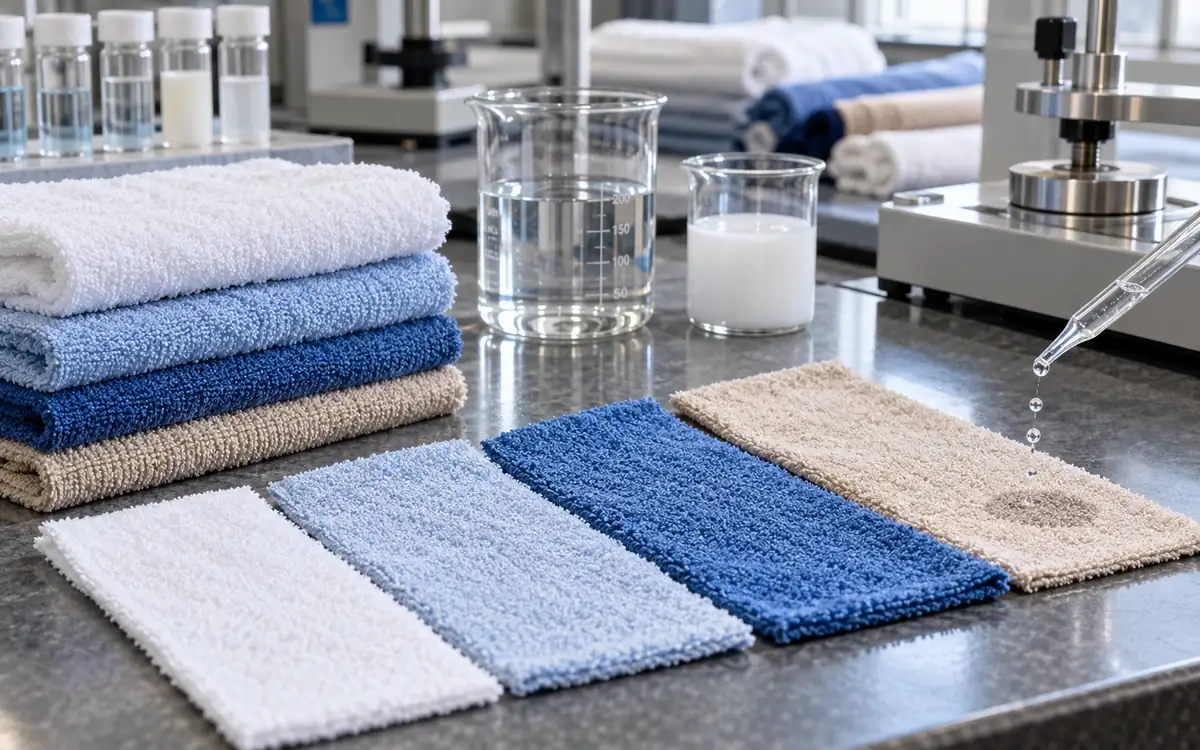
Choose the finished fabric, not just the softest swatch
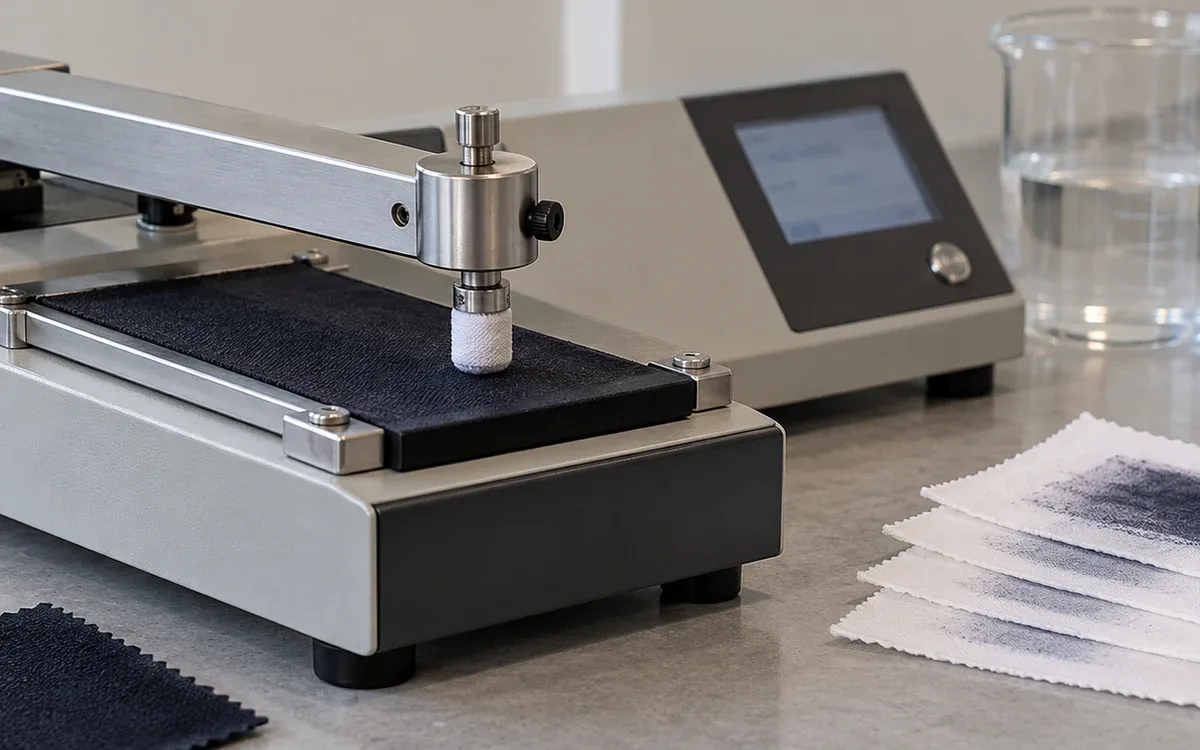
A softener may win a hand-feel trial. It can still produce the wrong fabric. The surface may wet too slowly. A pale shade may change during drying. A dark fabric may transfer more colour when rubbed.
Textile softener selection therefore needs a clear product brief. The finish must give the required touch. It must also preserve the properties that make the fabric useful.
This guide focuses on softeners applied during fabric finishing. It explains the main selection questions, then develops practical trials and calculations. The figures are teaching examples. They are not chemical recipes or test limits for all products. They do not report results for named commercial products.
Describe the touch in terms people can compare
“Soft” can mean smooth, flexible, bulky, springy, or slippery. Two reviewers may use the same word for different sensations.
Start with the end use and a reference fabric. A crisp shirt and a brushed knit need different surface feels. An absorbent towel has other needs. Cloth may bend easily yet feel too slick.
Choose a small set of useful descriptors. For a lightweight knit, compare surface smoothness and flexibility. Add fullness and dry touch if needed. Describe each property separately from whether people prefer it.
NC State's fabric-hand evaluation approach uses selected pairs of descriptors. It also uses a fixed way of handling samples. This gives reviewers a clear task. Simply asking them to pick the “best” sample leaves the target vague.
Use the reference throughout development
Keep the original reference safe from repeated handling and dirt. Protect it from unintended washing. Use a working sample for routine checks where needed.
When the buyer changes the desired touch, record that as a new target. Otherwise, a new preference may look like a loss of mill control.
One person's memory of last month's sample is not a finish specification. Keep a traceable reference. Use an assessment that can be repeated.
Separate chemical family from ionic character
“Silicone” describes a broad chemical family. “Cationic,” “anionic,” and “nonionic” describe ionic behaviour. These describe different features of a product. Do not treat them as rival groups on one simple list.
Cotton Incorporated's chemical finishing guide explains the role of ionic character. It affects affinity and compatibility. Some softeners may also change shade, wetting, or rubbing performance.
Use these principles to ask better questions. Then check the current commercial formula. Products in one family can differ in charge, application route, and stability.
Product description | What it helps explain | What still needs checking |
|---|---|---|
Cationic softener | Explains affinity and possible ionic interactions. | Check compatibility, colour, wetting, and route. |
Anionic softener | Describes charge and interaction with other bath chemicals. | Check whether it suits the route and lasts through care. |
Nonionic softener | Describes a product with no net ionic charge. | Check the full formula and fabric performance. |
Silicone softener | Names a broad chemical family used for surface effects. | Check modification, emulsion type, charge, and hydrophilicity. |
Hydrophilic softener | Aims to preserve or improve wetting. | Test the result and its durability on the target fabric. |
Check product details in the supplier's current data sheet. The trade name and liquid colour cannot establish them.
Treat hydrophilicity as a measured requirement
Some softening treatments can reduce wetting. Modified products can give soft touch and useful water uptake together. Prove that performance on the intended fabric.
Wacker's WETSOFT technical overview describes products that balance softness and hydrophilicity. It also covers how these effects last through washing. Stability and appearance properties differ among products.
A 2024 study by Malwade and colleagues examined several fabrics. The authors treated them with different amino-functional silicone structures. Softening and wetting responses varied with chemistry. Strong softening did not always mean strong hydrophilicity.
Use those findings as a reason to test both outcomes. They do not rank all silicones or every fibre blend.
Choose the moisture test that fits the product
Initial wetting and water-holding capacity are different questions. Wicking and drying differ too. A fabric may wet quickly yet hold little water. Another may absorb water but dry slowly.
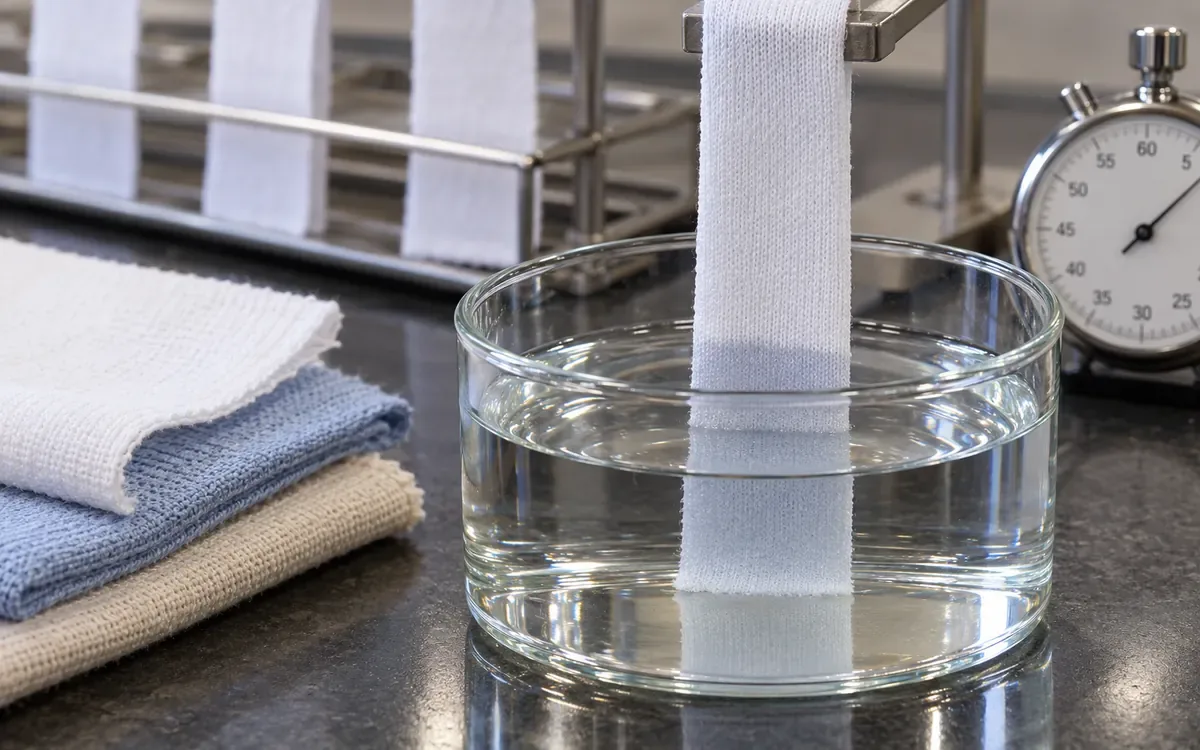
AATCC TM79 gives a water-absorbency method for yarns, fabrics, and garments. Follow the full selected procedure. Report what it actually measures.
A moisture-management claim needs tests that fit that claim. One wetting-time result does not prove “comfort” or “breathability.”
Assess the property after the full finishing and care route. The customer uses the finished textile. A bath or freshly padded lab strip does not represent that full state.
Build a product brief with firm limits
List the requirements before the supplier comparison. These may include touch, absorbency, colour, and rubbing fastness. Stable dimensions may matter too. Later bonding or decoration needs a suitable surface.
Separate firm limits from preferences. Use preferences to rank options that pass the limits. A high hand score cannot cancel a required performance failure.
Ask which fabric and shade groups the proposed finish must cover. A white cotton style may need a different trial from a dark polyester blend. Grouping both under “soft finish” can conceal different risks.
Keep required chemical documentation with the actual product identity. A listing or declaration covers a stated formula. It may not cover another strength, local variant, or substitute.
Make the scope of approval explicit
An approval might cover one product within a tested dose range. Name the fabric family and finish route. State which colours, care conditions, and later operations the trial covered.
If the supplier changes the formula, recheck affected properties. Production may also change drying or curing. Review whether earlier evidence still applies.
Find a usable operating range. Keep each successful swatch linked to its process history.
Screen bath compatibility under realistic conditions
Ionic incompatibility is one possible source of trouble. The bath may face changes in pH, salt content, temperature, or shear. Chemicals left on the fabric can change it too.
CHT's TUBINGAL ISP product information specifically describes pH and shear stability. Use those properties when selecting a product. They do not prove that every softener stays stable under the same conditions.
Use the actual process water in the screening bath. Include the full intended formula. Follow the supplier's dilution and addition instructions. Check the bath through its expected hold time. Check again after the relevant process exposure.
Look for separation, deposits, coagulation, or changes in appearance. Then treat fabric and assess it. A clear bath alone does not prove that the finish will be even or fit for use.
Include carryover from the fabric
Production fabric may bring chemicals into the bath. A clean beaker test may miss them. Residual alkali, salts, surfactants, or fixing agents can change local conditions.
Compare the fabric's incoming state with the conditions used in development. Take suitable measurements. Do not assume the last rinse removed everything.
For a significant risk, plan a trial with the supplier. Include the expected carryover range when checking compatibility. Follow safe lab practice for any simulated addition. Stay within the actual product instructions.
Do not solve every stability concern by adding acid. The right pH and addition sequence depend on the formulation and the material.
Read concentration on the right basis
A commercial liquid may contain softening ingredients, water, emulsifiers, and other components. Product dose and stated solids are different quantities. Neither directly measures retained functional finish.
Take an example bath containing 40 g/L of product. The product has 25% stated solids. Nominal product-solids concentration is:
40 × 0.25 = 10 g/L
Assume 70% wet pickup and a bath density of 1 kg/L. One kilogram of dry fabric carries 0.70 L of bath. It therefore carries:
10 × 0.70 = 7 g of product solids per kilogram of dry fabric
That equals 0.7% on dry fabric mass. The commercial product carried with the liquid is 28 g/kg, or 2.8%.
Do not call every solid the active softener
The example uses stated product solids. Some solids may be emulsifiers or other formulation ingredients. Do not label all solids “active silicone” without evidence from the supplier.
The calculation assumes even pickup. It also assumes no selective uptake before the nip. It does not measure what remains after drying, curing, washing, or other treatment.
A lab extraction may recover more than the softener of interest. Choose a suitable method if retained chemical amount needs measurement. Interpret what the method actually recovers.
The finished-fabric result remains essential. The arithmetic may be correct. It still does not prove the hand, wetting, or colour effect.
Compare product strengths without assuming equivalence
Suppose product A has 20% stated solids and product B has 40%. Apply A at 50 g/L and B at 25 g/L. Each bath then has 10 g/L nominal solids.
That creates a useful comparison basis. It does not prove that the products will give the same fabric performance. Their chemistry and emulsion may differ. They may deposit differently on the fabric too.
Begin within each supplier's supported range. Compare the required results and total process cost. Higher solids alone do not make one product better.
Check working dilutions clearly
Take 10 kg of a 40%-solids concentrate. Dilute it to a total mass of 100 kg. The mixture has 4 kg of solids in 100 kg, or 4%.
“Add 100 kg of water” means something else. Total mass would be 110 kg, with about 3.64% solids. The instructions do not give the same result.
State whether a preparation instruction uses total final mass or added water. Use the required dilution procedure. The arithmetic does not approve a mixing method. It does not replace stability guidance.
Use a fair hand-feel assessment
Condition the samples consistently. Keep specimen size and face the same. Use a fixed orientation and handling sequence. Product names or prices may influence reviewers. Hide those details where they could bias the result.
AATCC EP5 explains how to present fabrics for a standard hand assessment. Follow the applicable procedure. Use a suitable plan to analyse the results.
Use coded specimens and a balanced presentation order. Reviewers may handle one product first and another after many samples. Order and fatigue can then affect the comparison.
Repeat a reference within the session where the design calls for it. This can reveal inconsistent assessments. Repeated ratings of one swatch are not new independent fabric trials.
Report disagreement instead of hiding it
Some reviewers may call a finish pleasantly smooth. Others may call it greasy. This may reflect a real difference in product preference.
Review the descriptor definitions and end-use target. Do not average the words into an unexplained “softness percentage.”
Use an analysis that fits the rating scale and study design. An ordinal scale ranks results in order. A step between grades need not represent an equal physical change at every point.
Keep each assessment available. A buyer may prefer one touch for a casual knit. A structured woven fabric may need another.
Include a control for the treatment route itself
An untreated fabric and a softened fabric may differ in more than chemistry. The trial may also wet, squeeze, dry, and handle the fabric again.
Where these effects matter, add a process control. It follows the same approved route without softener. Define the other necessary bath components. This helps separate the product effect from the extra treatment pass.
Compare the original prepared fabric, a route-only control, and each trial product. The route-only control may already become much stiffer. If so, check drying and handling. Do not assign the whole change to the product.
A product may feel softer than untreated cloth. Yet it may add little beyond the route-only control. This extra comparison can prevent a needless addition.
Use a control that is safe and technically meaningful for the actual process. Do not omit a component needed for bath stability or fabric protection. That could make the control misleading.
Compare candidates against all required outcomes
Consider a hypothetical absorbent cotton-knit project. The project has three firm needs. Wetting must occur within 5 seconds after a defined care route. Wet rubbing must reach at least grade 3–4 by the specified method. The shade must also pass approval.
This teaching case scores hand preference from 1 to 5. Five is most preferred. The table does not set limits for all fabrics. It does not define a standard hand scale.
Candidate | Hand preference | Wetting after care | Wet rubbing | Shade | Decision |
|---|---|---|---|---|---|
A | 5 | 22 s | 3–4 | Acceptable | Fails wetting requirement |
B | 4 | 3 s | 3–4 | Acceptable | Meets the listed checks |
C | 4 | 4 s | 3 | Acceptable | Fails rubbing requirement |
D | 3 | 2 s | 4 | Outside target | Fails shade requirement |
Only B meets all the stated requirements. Reviewers prefer A's hand most. That preference does not make A pass.
This table summarizes the decision logic. For real release, follow the specified sample plan. Review each result and repeatability. Check that production can hold the result.
Check shade and white appearance after heat exposure
Include final drying or curing in the softener trial. Assess matched fabric before and after that stage. Use the correct colour or whiteness method.
Wacker's AF 21 product information describes a modified amino fluid. It is intended for softener formulas with low yellowing. The stated effect depends on normal application conditions. Test the full formula and exposure even with that claim.
For white fabric, include the optical-brightener system. Include any later resin chemistry too. For dyed fabric, assess the approved shade. Test the relevant fastness properties.
Visible depth may change after softening. That alone does not prove dye loss or better fixation. Surface effects can alter appearance. Compare the appropriate test results before deciding on a cause.
Separate improved running from approved sewability
Lubrication can help fabric move through sewing. A softer surface does not prove seam performance. Too much slip or changed handling can still cause problems. Later bonding may also be affected.
CHT's TUBINGAL PURE information lists a nonionic option without silicone. It has hydrophilic and sewability-related properties. This shows that a soft hand need not always rely on silicone.
Select candidates against the required operations. For sewing checks, use ApparelDiary's fabric sewability trial guide. Test the actual garment construction and machine setup.
Link finish selection to garment approval. Keep their different tests clear. A lubrication claim from the chemical supplier cannot replace the construction trial.
Diagnose spots before naming the cause
A dark or oily-looking spot does not prove silicone is present. Other oils or deposits can look similar. Contamination or uneven application can also cause such marks.
Retain affected and sound fabric from known positions. Note when the mark appears. Check before softening, after the bath, and after drying. It may appear only after later handling.
Use safe access procedures to inspect the bath, filters, rollers, and dosing path. Compare deposits with the suspected formula. Use suitable analysis if needed.
Trial any extra emulsifier or stripping chemical before treating the production lot. The trial must be approved. The repair can change shade and strength. It may affect absorbency and the finish left on the fabric too.
Use the pattern to narrow the investigation
Pattern | Evidence worth checking first |
|---|---|
Marks begin after a product addition. | Check dilution, addition order, local mixing, and product identity. |
One width position is affected. | Check nip condition and application spread. Look for deposits and poor fabric contact. |
Fault increases as the bath ages. | Check hold time, carryover, and stability. Review bath replenishment. |
Marks appear only after heating. | Compare matched fabric before and after heat. Check formula stability. |
Several products fail on one lot. | Check incoming fabric and its earlier process history. |
One product fails across matched lots. | Check its formula, storage, dilution, and use limits. |
The pattern guides a comparison. It does not prove one cause. Clean areas do not erase faults elsewhere.
Test durability without changing the question
Run the agreed wash and dry sequence. Then reassess hand and functional properties. Record any domestic conditioner or other additive used in the test.
A household softener added during care can create a new surface treatment. That extra treatment can confuse a test of mill-finish durability.
Use the specified care method for release. A development study may need to isolate the mill treatment. Define that separate route clearly. Keep its result distinct from the buyer's required test.
Retain an untreated control through the same care sequence. Washing can change the fabric itself and affect hand. Softener removal is not the only possible cause.
Judge cost per accepted fabric output
The cheapest product per kilogram may need a higher dose. It may also cause more rework. Compare the defined route and its accepted output.
Take an example 1,000 kg trial. Route A uses 20 kg of product at 2.50 currency units/kg. Its direct chemical cost is 50 units. Suppose 80 kg needs approved repair at 0.80 units/kg. That adds 64 units.
Route B uses 12 kg at 4.50 units/kg, giving 54 units. Suppose 10 kg needs the same repair, adding 8 units.
The selected costs total 114 units for A and 62 for B. The figures exclude other costs. Energy, labour, disposal, and quality costs remain to be counted. They show how repair cost can change the choice based on purchase price.
Preserve the original quality result
If repair succeeds, record that output separately. Keep first-pass output visible too. Do not describe the repaired lot as evidence that the original process was stable.
Confirm the repaired material's full requirements. An improvement in touch may come with a change in shade or absorbency.
Use comparable costing boundaries for both routes. Use measured costs in a real business case. Label assumptions that still need production evidence.
Move the selected route into routine control
Issue the approved product identity, preparation steps, and dose range. State application conditions and required fabric checks. Describe the input material and later finish route covered by the trial.
Keep samples from the approved production run. Link each to the chemical lot and fabric lot. Record bath preparation and key measurements.
Monitor the properties that drove selection. Absorbency may be the limiting requirement. If so, checking only hand will miss the key risk.
A supplier or process may change. Identify which evidence needs to be renewed. Repeat the affected comparisons. A claim that the new material feels about the same is not enough.
Frequently asked questions
Are silicone softeners always water repellent?
No. Modified silicones can provide hydrophilic effects. Test the actual formula on the fabric. Check before and after the required care route.
Is nonionic the same as silicone-free?
No. Ionic character and chemical family describe different features. Read the product information. These terms do not mean the same thing.
Can a higher dose fix a harsh fabric?
It may change the touch. First check preparation, construction, mechanical finishing, and the target. Extra dose can cause other failures. It may leave the cause in place.
Does a stable bath guarantee no spots?
No. Uneven application or deposits can still affect the cloth. Contamination and later handling can affect it too. Assess the fabric through the full route.
Can the best towel softener be used on a shirt?
Only after a suitable trial. Touch, absorbency, and appearance needs may differ. The construction and later operations may differ too.
Keep softness within the product's full purpose
A successful softener makes the textile more useful to its intended customer. Define the required touch. Choose a compatible process and preserve useful performance.
Select the chemistry and dose through matched fabric trials. Check the result after heat and care, and compare cost on accepted output. The mill must be able to repeat the approved finish. It must preserve absorbency, colour, and the next operation's needs.
References
NC State TPACC: Subjective evaluation of fabric hand.
Cotton Incorporated: Chemical finishing.
Wacker: WETSOFT textile-finishing overview.
Malwade et al.: Block copolymer silicone softeners, hydrophilicity, softness, and durability.
AATCC TM79: Absorbency of textiles, public scope.
CHT: TUBINGAL ISP product properties.
AATCC EP5: Fabric hand evaluation, public scope.

Discussion0
Loading the discussion…