
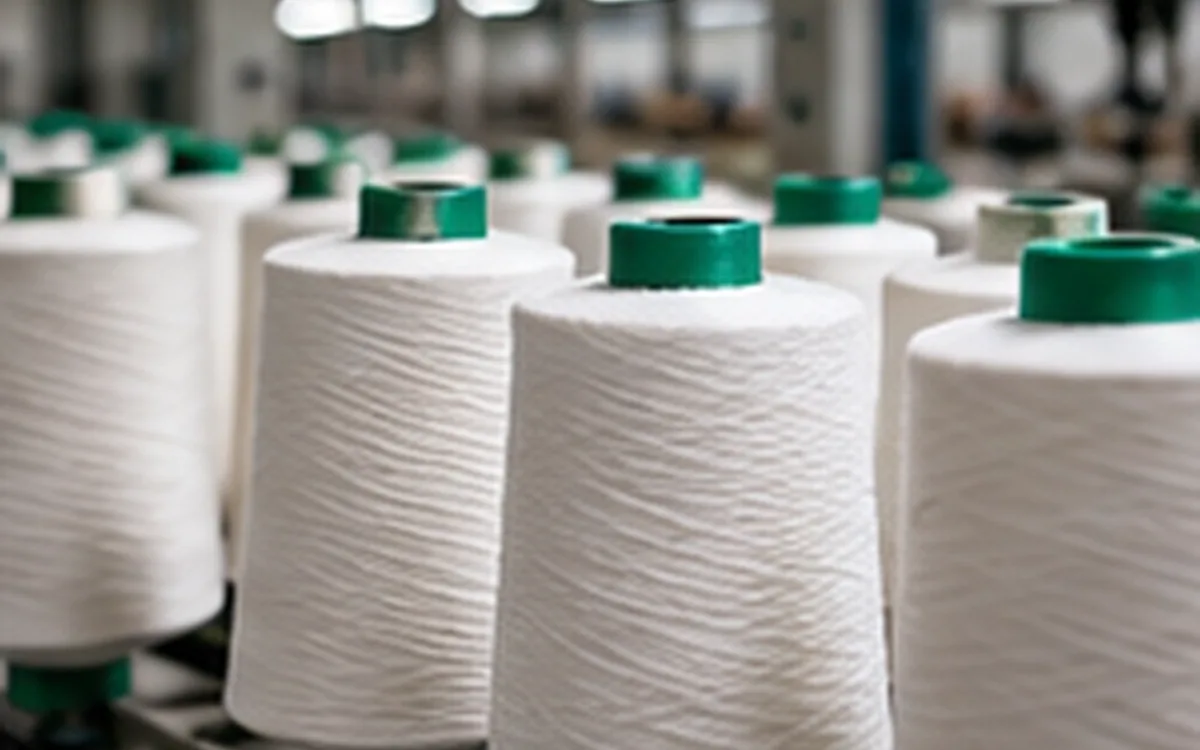
What changes when pulp becomes viscose fibre?
A viscose fibre starts as cellulose from wood or cotton. It does not keep the shape of that source. The process first makes a solution. This flows through a spinneret in fine streams, which turn back into solid cellulose. This is why viscose is called a regenerated fibre.
The useful question is what changes at each stage. Pulp quality affects the solution. Solution quality affects spinning. Spinning and drawing affect the new fibre. Washing and finishing then prepare that fibre for its next use. A good result at one stage cannot make up for every fault in another.
Viscose uses a temporary chemical derivative called cellulose xanthate. The derivative dissolves in dilute alkali. An acid bath later turns it back into cellulose. Lyocell uses a different route, based on direct dissolution in a solvent system. Lenzing's production technology overview describes both routes. Their shared cellulose base does not make the two processes interchangeable.
Spinners, buyers and students can follow the process through three questions. What material enters? What leaves? Which property needs control? These questions also help explain what a claimed percentage means.
Pulp quality is more than a purity number
Dissolving pulp is a prepared cellulose raw material. It must suit the fibre producer's process. A sheet may look clean yet react poorly. Its appearance does not show the range of chain lengths. Nor does it tell us how well the final solution will pass through filters.
Research on pulp reactivity shows why several tests are needed. A 2019 study of dissolution and rheology compared ways to assess pulp behaviour. Reactivity depends on both the test and the process. One useful lab measure cannot predict the whole viscose process.
Think of two hypothetical pulp deliveries with the same stated cellulose purity. One dissolves smoothly in the mill's trial. The other leaves more material that blocks the filter. Their purity figures match, yet their production value may differ. The trial has revealed a property that the purity figure did not describe.
That does not justify rejecting a supplier from one poor result. Check the sample, storage condition, test preparation and process settings first. Give each pulp the same defined treatment for a fair comparison. Then check the results needed for the intended fibre grade.
Compare mass on the same basis
A pulp delivery includes moisture. Suppose a fictional lot weighs 1,100 kg and contains 10% water on a wet-mass basis:
Dry pulp = 1,100 × (1 − 0.10) = 990 kg
The missing 110 kg is water, not a processing loss. The 990 kg is dry pulp, which should not automatically be called pure cellulose. A separate composition result is needed for that claim.
This distinction matters when offers use different moisture bases. A heavier bale may contain no more useful dry material. It also matters when a mill compares incoming pulp weight with finished fibre weight. Without a common basis, apparent yield changes can come from water alone.
There are two distinct ways to express water content: as a share of wet mass, or relative to dry mass. ApparelDiary's moisture and weight guide explains both. State which basis each calculation uses.
Accessibility can change without the same change in chain length
A study of Hollander beating tested a particular dissolving pulp. Its reactivity and filterability improved. Its measured intrinsic viscosity changed little. It shows that physical access to cellulose and chain-length measures describe different features.
The result is a reason to investigate the cause of poor performance. It is not a rule to beat every pulp more heavily. Judge the treatment for the actual fibre source. Include its energy use and effect on the rest of the process. A laboratory gain loses value if it creates another problem at production scale.
Making cellulose temporarily soluble
The first chemical stage treats pulp with sodium hydroxide to form alkali cellulose. Pressing removes excess liquid. Ageing then adjusts the cellulose chain length to suit later processing. Carbon disulphide reacts with the prepared material to form cellulose xanthate. This derivative dissolves in dilute alkali.
Fechter and colleagues studied alkaline steeping. They examined pulp purity, yield and conversion to alkali cellulose together. The findings support choosing conditions for the specific process. A condition that improves one measure can change another in an unwelcome way.
Consider a trial intended to remove more unwanted material from pulp. A higher purity result may look promising. However, the trial must also account for the dry material removed. If extra purification costs useful cellulose, the decision needs both figures. Purity alone cannot show whether the change is worthwhile.
The same logic applies to ageing. The aim is a chain length that works for the intended process and product. “More ageing” is not a quality target. A mill needs a defined result, a way to measure it and evidence that the resulting solution spins well.
Ageing and ripening are different checks
Ageing concerns the prepared cellulose before the viscose solution is formed. Ripening concerns the solution's later development toward a suitable spinning state. They should not be treated as two names for the same holding period.
On a process sheet, identify the material being tested at each point. A pulp test, a prepared-cellulose test and a viscose-solution test answer different questions. A report may say only “viscosity.” Ask which material and method it means, and under which test conditions. A number without that context cannot reliably guide a process change.
For example, a lower value could reflect changed cellulose or solution makeup. It could also come from changed test conditions. The next action depends on which cause is supported. Simply copying a viscosity target from another plant hides these differences.
Carbon disulphide also requires serious industrial controls. The ILO/WHO safety card lists major fire and health hazards. Exposure can occur through breathing or skin contact. Enclosed equipment, controlled capture and competent plant engineering are central to this process. A general article cannot serve as an operating recipe.
Why solution preparation affects the spinneret
Before spinning, the viscose solution must be prepared for controlled flow. Filtration removes unwanted material, while deaeration removes entrained air. Neither step should be judged only by whether the liquid looks smooth.
Lenzing Filtration describes recovery from filter rejects. These contain unwanted particles and gels, but can also hold valuable product. This makes reject handling a separation problem. Reject volume is not the same as lost dry cellulose.
Suppose a trial reduces the volume discharged from a filter. That could mean less useful material is being lost. It could also reflect a thicker discharge or a changed cleaning cycle. Compare the discharge mass over the same period. Also check what its solids contain. Then check the quality of the solution sent onward.
Reusing a recovered stream needs the same care. A unit may recover useful material. The returned stream must still suit the process that receives it. Its value depends on both quantity and suitability. One kilogram returned may not replace one kilogram of fresh material. Assuming that it does can overstate the saving.
Diagnose a filter change before changing the pulp
If filtration becomes harder, start with the change that was actually observed. Was it a faster pressure rise, a shorter run between cleaning cycles or more retained solids? These are related observations, but they are not identical.
Compare the same filter area, solution throughput and test duration. Check whether the incoming solution changed at the same time. A different flow rate can change the load placed on the filter even when the pulp is unchanged.
A useful trial compares one defined change at a time where practical. Suppose the pulp source, solution makeup and filter conditions all change. A better outcome cannot show which change caused it. State that uncertainty in the result. Do not assign the whole gain to the new pulp.
Forming a new fibre in the spinning bath
A spinneret divides the solution into fine streams. In the bath, coagulation and regeneration turn those streams into solid cellulose fibres. The emerging material is drawn as the process develops its structure. This is a wet-spinning process; the bath does more than cool or dry a ready-made fibre.
The European Commission published a polymer production reference in 2007. Chapter 11 describes viscose staple and filament routes. It covers gas collection, after-treatment, washing and finishing. This is a dated technical source. Its old consumption figures are not current plant targets or legal limits.
A simple fineness calculation
The following example is invented to explain mass flow. It is not a proposed spinning recipe.
Assume a stream of solution feeds a bank of spinnerets at 8 kg/min. Its cellulose content is 8% by mass. There are 80,000 active holes, and the final fibre delivery speed is 40 m/min. Assume steady flow, shared equally by the active holes. All the cellulose counted here is retained in the fibre.
First find the dry cellulose flow:
8 kg/min × 0.08 = 0.64 kg/min = 640 g/min
Then find the combined length produced each minute:
80,000 × 40 m/min = 3,200,000 m/min
The mass per metre of one filament is therefore:
640 ÷ 3,200,000 = 0.0002 g/m
Since dtex means grams per 10,000 m:
Filament linear density = 0.0002 × 10,000 = 2 dtex
Use the final delivery speed because the calculation concerns the final length. Using an earlier speed before drawing would answer a different question. For actual tests, state what the mass includes. Moisture and finish may be part of the measured weight.
Now raise the final speed to 60 m/min and keep the other assumptions. The calculated value becomes about 1.33 dtex. The dry cellulose output remains 640 g/min. More length has been produced from the same mass; mass output has not increased.
This explains why a faster line may produce no more kilograms. It also does not prove that the new setting is feasible. Fibre formation, drawing and breakage must still be assessed in a real trial.
For related units, see ApparelDiary's yarn count guide. It explains tex, denier and other systems. Keep single-filament fineness separate from the count of a yarn containing many filaments.
Solution output and fibre output are different measures
The same calculation can expose a false production gain. Keep the example's solution flow at 8 kg/min, but suppose its measured cellulose content falls from 8% to 7.5%. Dry cellulose flow is now 0.60 kg/min. The pump still moves the same total mass each minute, yet cellulose delivery has fallen by 6.25%.
At the same hole count and final speed, the calculated dry linear density falls from 2 to 1.875 dtex. This is an arithmetic comparison under the earlier assumptions. It does not predict whether the changed solution will spin successfully.
A report that records only solution tonnes would miss this change. A report that records only fibre length could also miss it. Use a mass-flow measure and a composition measure together when checking dry output. Allow for uncertainty in either measurement. Report only the precision that the inputs support.
What the equation leaves out
The calculation assumes equal sharing of cellulose flow. If some holes stop delivering, that assumption no longer holds. The effect depends on how the feed and pressure respond. Do not divide by the original hole count and present the answer as a measured fibre property.
The equation also says nothing about strength, surface form or variation between filaments. Two lots can share the same mean dtex yet behave differently in a later process. Fineness is one part of a fibre specification, not a substitute for the rest.
Staple fibre and filament yarn take different finishing routes
Staple production creates fibres of a chosen cut length. Continuous filament production preserves long filaments for winding. Cutting belongs to the staple route. Final winding of continuous filaments belongs to the other route. Neither product needs every step from both routes.
After-treatment removes process residues and prepares the material for use. The exact sequence depends on the plant and product. Follow the specified route. Bleaching and finishing needs can differ between products.
For a staple order, ask how cut length and its variation are checked. For a filament order, ask how package and yarn properties are assessed. A staple length report cannot approve a filament package. A winding result cannot confirm staple length either.
Finish should also be considered in relation to the next operation. A fibre supplied for one processing route may not behave the same way in another. Use a trial to check this fit. Use the actual equipment and planned blend where possible.
Check strength on a stated test basis
Avoid assigning one wet-strength loss to every viscose grade. The product, test conditions and reference state matter. A claim that one sample is stronger than another needs comparable measurements.
ASTM D3822/D3822M-14(2020) covers tensile tests on single textile fibres. It includes conditioned and wet states. Its public guidance also notes that wet tests in air and tests with the fibre immersed can differ. The complete method is needed to conduct the test; a public scope is not a substitute for it.
Suppose two fictional reports give wet-to-conditioned strength ratios of 65% and 75%. Check that both reports use the same tensile property and test basis before ranking the fibres. Also inspect the original conditioned values. A larger ratio can result from a smaller denominator.
For illustration, one sample has conditioned tenacity of 24 units. Its wet tenacity is 18 units, so it retains 75%. Another with values of 30 and 21 retains 70%. The first has the higher retention percentage, but the second has the higher wet tenacity. Read the actual values beside the percentages, as this invented example shows.
Neither result predicts the performance of a finished garment on its own. Yarn construction, fabric structure and processing also need evaluation. Use fibre tests to answer fibre questions, then test the product at the level where it will be used.
Build a dry-cellulose balance before reporting yield
A material balance needs a boundary, a period and one consistent basis. The following fictional balance tracks dry cellulose equivalent through a defined process. It excludes water, salts and finish from the cellulose figures.
Destination during the period | Dry cellulose equivalent |
|---|---|
Accepted fibre | 900 kg |
Off-specification fibre | 40 kg |
Material in a purge or retained residue | 15 kg |
Dissolved material leaving the boundary | 25 kg |
Increase in material held inside the process | 20 kg |
Total accounted for | 1,000 kg |
With 1,000 kg entering, first-quality yield is 900 ÷ 1,000 = 90%. Total fibre output is 940 ÷ 1,000 = 94%, if both accepted and off-specification fibre are included. The two values answer different questions.
The 20 kg increase inside the process is not yet a loss. It is a change in inventory. Ignoring it would create an unexplained gap in the balance. A longer reporting period may reduce its relative effect, but does not remove the need to account for it.
Off-specification fibre also needs a clear label. It may have another use, but that does not make it first-quality output for the original order. Report both quantities rather than hiding the distinction in one “recovery” figure.
Internal recycling creates another trap. A stream may leave one machine and return to an earlier stage. If both stages lie inside the chosen boundary, this is internal flow. It is not fresh input to the boundary. Counting it again can make throughput appear larger without creating more saleable fibre.
The balance is useful even when measurements are imperfect. List the measurement limits and investigate a material gap. Do not force the difference into “process loss” merely to make the columns add up.
Chemical recovery needs its own boundary
Cellulose yield and chemical recovery are separate measures. A plant can achieve one target while still needing to improve the other.
ZDHC's recovery guidance describes several routes. These include condensation and activated-carbon recovery. It also discusses treatment of different sulphur-bearing streams. To assess a recovery claim, check both the technology and the measured boundary.
Imagine that 100 kg of carbon disulphide enters one recovery unit. The unit recovers 90 kg for reuse. On that stated basis, unit recovery is 90%. This does not establish a 90% recovery rate for the entire factory. Other streams may never pass through that unit.
Nor should the remaining 10 kg automatically be called an air emission. Its destination must be measured or otherwise established. It could include material in other outlet streams or a change in inventory. A balance identifies the question; it does not invent the answer.
Be careful with sulphur units as well. Carbon disulphide and sulphate contain different shares of sulphur by mass. Their kilogram values cannot be added as if both were pure sulphur. Convert each compound to one stated sulphur basis first.
A useful claim names the substance and input stream. It states the recovered output and reporting period. It also explains how changes in stock were counted. Without a clear denominator, the percentage cannot support a fair plant comparison.
What a new feedstock claim must demonstrate
Research has shown routes for turning post-consumer cotton into viscose fibre. A 2024 study used a defined cotton-waste treatment. It assessed both the resulting solution and spun fibres. The work demonstrates that particular route. It does not show that an existing plant can accept mixed textile waste without preparation.
For a proposed feedstock change, separate three questions. Can the material be prepared for the process? Can it form a suitable spinning solution? Does the resulting fibre meet the intended product needs? Success at the first question does not settle the next two.
A small successful trial is valuable evidence, but its scale should remain visible. Compare the trial's feedstock range with the range expected in supply. Then assess which results need confirmation at larger scale. This states what the research shows and where further proof is needed.
The same discipline helps with any viscose offer. Read the fibre specification alongside the process and environmental evidence. Each should answer a defined question. Use them together when choosing a product. A process name or a single favourable percentage cannot give the same depth of evidence.
References
Assessing wood pulp reactivity through its rheological behavior under dissolution, 2019.
Zhou and colleagues: enhanced reactivity of dissolving pulp by Hollander beating.
Fechter, Brelid and Fischer: industrial alkaline steeping of wood-based cellulose, 2020.
ILO/WHO International Chemical Safety Card 0022: carbon disulphide.
European Commission: Production of Polymers reference document, 2007, Chapter 11.
ASTM D3822/D3822M-14(2020): tensile properties of single textile fibres.
ZDHC: recovery technologies and mass balances for viscose production.

Discussion0
Loading the discussion…