
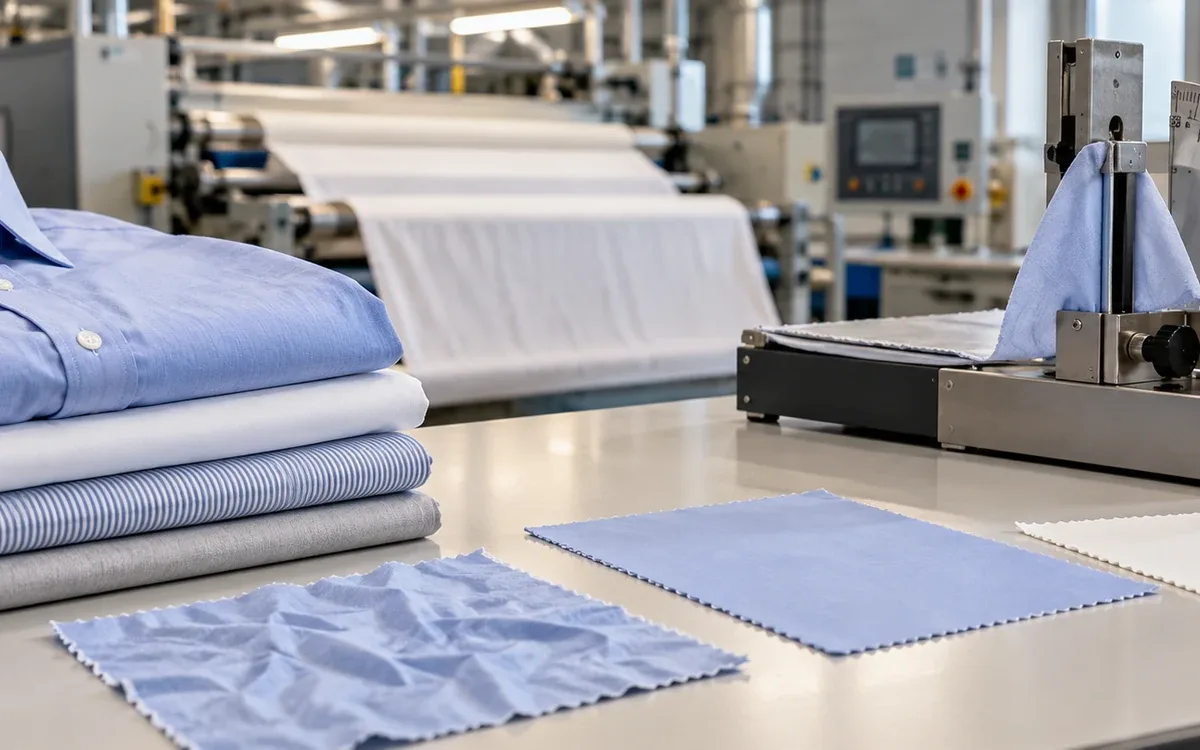
Develop wrinkle resistance with a strength budget
A cotton shirt fabric can leave a trial looking smooth but weak. This is the main problem in wrinkle resistant finishing. The cloth must stay smooth through care. It must also stay strong enough for use. A finish that solves only one of these needs still leaves a problem.
The strongest crease-recovery result is therefore not always the best route. A useful finish also needs suitable strength, tear resistance, handle, colour, and chemical test results.
This guide focuses on fabric finishing for cotton and cotton-rich materials. It explains the chemistry at a practical level, separates the main appearance tests, and develops an original trial decision. Numerical values are hypothetical teaching examples, not universal recipes or product limits.
What the finish changes in cotton
Cotton cellulose has long chains with many hydroxyl groups. Water can change how these chains interact. So can bending and pressure. The cloth may keep a new shape after it is folded or pressed.
Crosslinking treatments make chemical links that limit some of this movement. These links help the cloth recover its shape and stay smooth. They do more than coat the surface. They do not fill each crease like a layer of paint.
The existing ApparelDiary guide to cotton fibre structure explains the underlying material. Here the practical question is how much useful finishing effect can be achieved while preserving the fabric's other requirements.
Crosslinking and damage can both affect strength
Kang and colleagues' research on durable-press cotton studied polycarboxylic-acid systems. The researchers separated two sources of strength loss. One was damage to cellulose from acid. The other was the effect of crosslinking.
That distinction matters. A lower breaking force does not identify one cause by itself. Chemical damage may be one cause. Limits on chain movement or other changes in the cloth may also play a part.
The study does not prove that any finish can be reversed or repaired. A mill must study its own blend of chemicals and process. It must then test the cloth. Do not assume that all lost strength can be brought back.
Compare complete finishing systems
Traditional easy-care finishes include N-methylol systems such as DMDHEU. Other choices include polycarboxylic-acid routes. A product sold by a supplier may have several active parts.
The choice is more than the name of a crosslinker. The catalyst, concentration, bath pH, application, drying, curing, and later treatments all belong to the system.
CHT's shape2stay information lists both formaldehyde-free and low-formaldehyde products. It also covers blends with selected additives that alter feel. Keep these differences clear in purchase and trial records.
Modern resins are not all the same. Nor is every tradeoff gone. Get the current product data and test the blend that the supplier will provide.
Read the qualification behind a product claim
Archroma's ARKOFIX product page links its formaldehyde-free claim to test detection limits. A claim like this needs a clear basis in measurement.
Ask which product and use the claim covers. Check the method, sample state, and reporting limit too. Confirm that the finished cloth meets the buyer and market rules that apply.
A chemical declaration and a fabric test serve different purposes. Keep both, and avoid extending a result from one formulation or route to another without evidence.
Define the end-use claim before selecting tests
“Easy care,” “wrinkle resistant,” and “non-iron” can mean different things. State what the claim should mean for this cloth. Set clear test goals and care conditions.
Does the customer want improved recovery after wear-like compression? A smooth appearance after washing and tumble drying? A pressed crease that remains sharp? A garment that needs less ironing?
These questions overlap, but they are not interchangeable. A fabric can recover well from one controlled fold and still look poor after a particular wash-and-dry route.
List the cloth and garment tests before making the recipe. A lab result may differ from the look of the finished shirt. Agree who will judge that gap and accept the product.
Keep the main appearance measurements separate
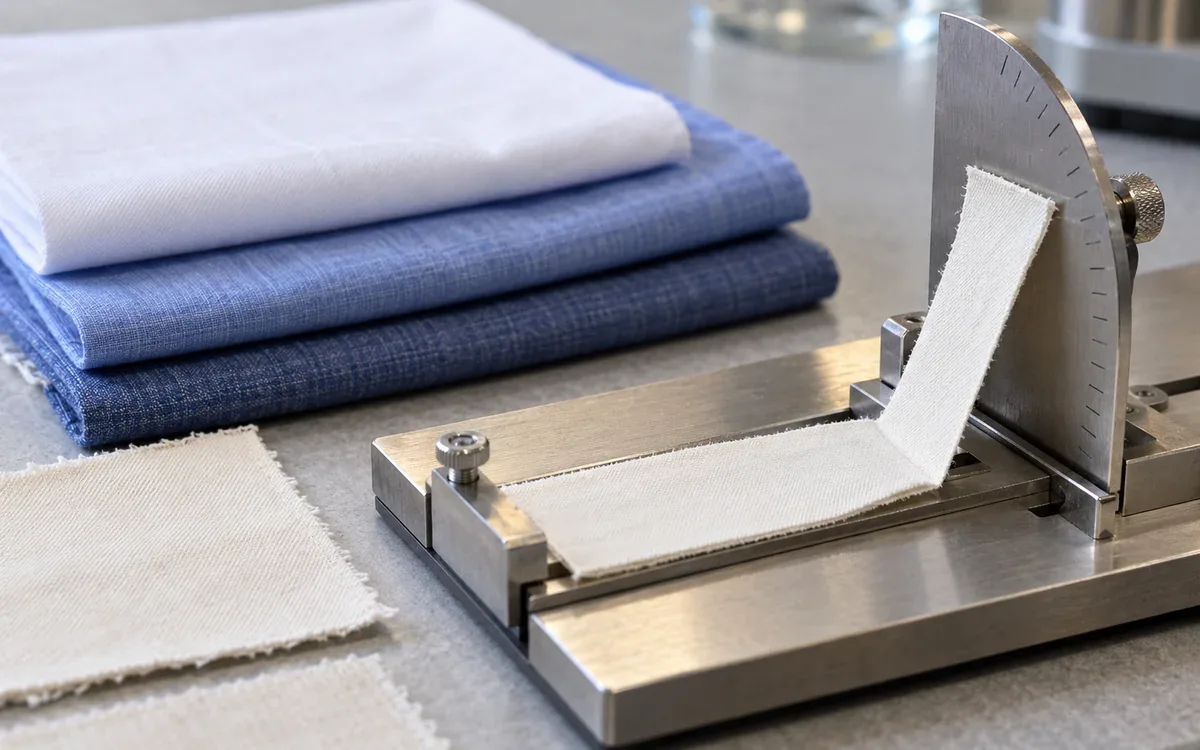
AATCC TM66 measures recovery from a controlled folded wrinkle in woven fabric. The public principle describes compression, a defined recovery period, and an angle measurement.
AATCC TM128 evaluates appearance after induced wrinkling. It uses a different deformation and an appearance comparison with reference standards.
AATCC TM124 evaluates smoothness after home laundering. Its result depends on the selected washing and drying route.
Question | Suitable measurement family | Result to preserve |
|---|---|---|
How far does a controlled fold recover? | Recovery-angle test | Angle, direction, and test conditions |
How does fabric look after induced wrinkling? | Wrinkle-appearance test | Grade under the specified method |
How smooth is it after care? | Smoothness after laundering | Grade, care route, and cycle count |
Does a designed pressed crease remain? | Crease-retention evaluation | The relevant crease result, separately |
Use the complete selected standards. A short online method description is not a substitute for specimen preparation, timing, equipment, or reporting instructions.
Do not convert angles into appearance grades
If a test reports 145 degrees in one fabric direction and 135 in the other, their arithmetic sum is 280 degrees. Preserve the two results even if the specified report also uses a sum.
That total is not a single physical fold opening through 280 degrees. It is also not 77.8% “wrinkle-free” because 280 has been divided by 360.
You cannot scale this angle to get a grade from another method. Choose the test that answers the product question. Do not invent a conversion between the two.
Establish the incoming fabric's margin
Measure the fabric state that will actually enter finishing. Earlier strength loss from preparation or dyeing reduces the margin available for later treatment.
Keep fibre blend, construction, yarn characteristics, mass per area, and previous processing linked to the trial. A stronger development swatch can conceal a risk in a weaker bulk lot.
Test the relevant directions and mechanical properties. Tensile force shows how the cloth withstands a pull. Tear force and abrasion tests ask other questions. One passing value does not prove that all will pass.
Keep matched input cloth. Do not compare the finish with an old average from other material. That could make the treatment look better or worse than it is.
Use both absolute performance and retention
For a property measured on matched conditions:
Retention (%) = finished result ÷ input result × 100
Retention helps describe the change. The finished value shows whether the product meets its requirement.
For example, a weak input may retain 90% of its strength and still fail. A stronger input may lose more and still pass the final limit. That second result may also reveal a process loss that could be avoided.
Keep both numbers and the comparison basis. Do not choose whichever one gives the most favourable story.
Control the catalyst as part of the formulation
The catalyst affects the rate and conditions of the intended reaction. It should be selected and dosed as part of the supplier-supported system.
A USDA research abstract by Welch and Peters compared two catalysts: sodium hypophosphite and hypophosphorous acid. It used specific BTCA and citric-acid systems. The catalysts gave different cure and strength results in those tests.
Related chemical names do not mean the products work in the same way. This study is not a recipe for a different resin.
Check the basis of the catalyst dose. Does it refer to the bought product, active content, resin mass, or full bath? Write that basis on the recipe sheet.
A percentage needs a denominator
Suppose a made-up recipe uses 80 g/L of resin product. It calls for catalyst product at 10% of the resin-product mass.
The corresponding catalyst concentration is:
80 × 0.10 = 8 g/L
This does not make the catalyst 10% of the whole bath. It also does not tell you the active chemical content of the catalyst.
A new resin strength or catalyst blend may change the treatment at the same ratio. Ask the supplier which basis to use. Then test the cloth from the new recipe.
Keep application uniform before optimizing cure
A cure setting cannot fix a large difference in dose across the cloth. Check incoming moisture and bath condition. Measure wet pickup and how evenly the finish is applied.
Keep samples from several points across the width during trials. The centre may pass while an edge fails. That edge may receive a different dose or heat exposure.
Use the approved bath preparation sequence and working life. Check compatibility with softeners, brighteners, and other additives before combining them in production.
Do not assume that extra softener repairs the cellulose. It may improve feel or some strength results. The full set of properties still needs testing.
Separate application amount from reaction extent
The dose carried onto the cloth does not count the links formed. The number of links also depends on the chemistry and heat exposure.
A low dose with a suitable cure may survive washing well. A high dose with a poor cure may behave quite differently. The same initial feel or look does not prove equal life through care.
Use cloth test results alongside any sound chemical test data. Bath dose is not a direct measure of crosslink density.
Measure the fabric's thermal exposure
The air setpoint is not the full curing history. Fabric temperature changes as moisture leaves, and different parts of a range may contribute differently to the reaction.
Mahlo's dwell-time measurement guidance describes sensors at several dryer points. They measure the product surface temperature. This helps find how long the cloth is at a required temperature.
Use an appropriate, validated measurement approach for the installed equipment. Confirm what the sensor measures and where it represents the cloth.
Keep cloth temperature, speed, and incoming moisture records together. Add the air settings and finish recipe. A speed used for a different cloth weight may not give the same cure.
Residence time and effective cure time differ
Consider a hypothetical range with 30 m of fabric path and a speed of 20 m/min:
Total residence time = 30 ÷ 20 × 60 = 90 seconds
Suppose a checked trace shows when the cloth reaches the chosen process threshold. It reaches that point only in the last 12 m. At this speed, that part of the path takes 36 seconds.
Do not report this as 90 seconds at the threshold. The first part of the path heats and dries the cloth. That time still matters, but the exposure is different.
This example is not a cure model. The real reaction depends on the whole heat history and chemistry. Slowing the line changes that history. Measure it again. Do not just scale the 36 seconds and assume the result is valid.
Develop a window with more than one response
Use matched cloth and stay within ranges supported by the supplier. Change the factors needed to answer the trial question. These might include dose and cure exposure.
The wetting, drying, or heating pass may itself change the cloth. In that case, include a control that gets the same pass without the finish. Keep the current approved route as a reference too, if one exists.
Evaluate appearance after the required care sequence. Measure mechanical properties at the specified stages and in the required directions.
Choose a route that passes all limits with some margin. A single good specimen that barely passes gives little confidence for bulk work.
An original strength-and-appearance decision
Assume a project sets three limits for the direction shown. Smoothness must be at least grade 3.5 after the stated care route. Tensile force must be at least 500 N. Tear force must be at least 15 N. These are invented limits for this example.
Matched untreated input gives 600 N tensile force and 20 N tear force. The table sums up made-up valid tests. A real report must keep all required individual results.
Route | Smoothness grade | Tensile force | Tensile retention | Tear force | Tear retention |
|---|---|---|---|---|---|
Untreated reference | 2.0 | 600 N | 100% | 20 N | 100% |
A | 4.0 | 480 N | 80% | 12 N | 60% |
B | 3.5 | 510 N | 85% | 16 N | 80% |
C | 4.5 | 450 N | 75% | 14 N | 70% |
Route B is the only finish that passes all three limits. Route C looks smoother. It still fails the strength tests.
Keep tensile and tear retention separate. Route A keeps 80% of its tensile force. It keeps only 60% of its tear force.
Compare routes at a similar useful appearance level
Equal bath doses may not make a fair comparison of two systems. One may react more easily. The products may also differ in active content.
In a study comparing crosslinking agents, Yang and colleagues studied wrinkle recovery alongside tensile loss. They did not assume that equal doses give equal results.
First find routes that give the required look. Then compare their strength, chemical test results, process needs, and cost.
For example, a slow-reacting finish may keep more strength at a low dose. But it may also give very little wrinkle resistance. Calling it the best finish for strength would miss the point. It has not yet met the appearance goal.
A strong finish may give more recovery than the shirt needs. It may use up strength margin with no useful gain. Check whether a supported lower dose or milder cure still meets the appearance target.
Stay within the proven working range for each system. A deliberately undercured sample does not prove a durable, milder route.
Include abrasion where use demands it
Repeated surface contact can matter at cuffs, collars, and other exposed areas. A tensile test alone does not describe that behaviour.
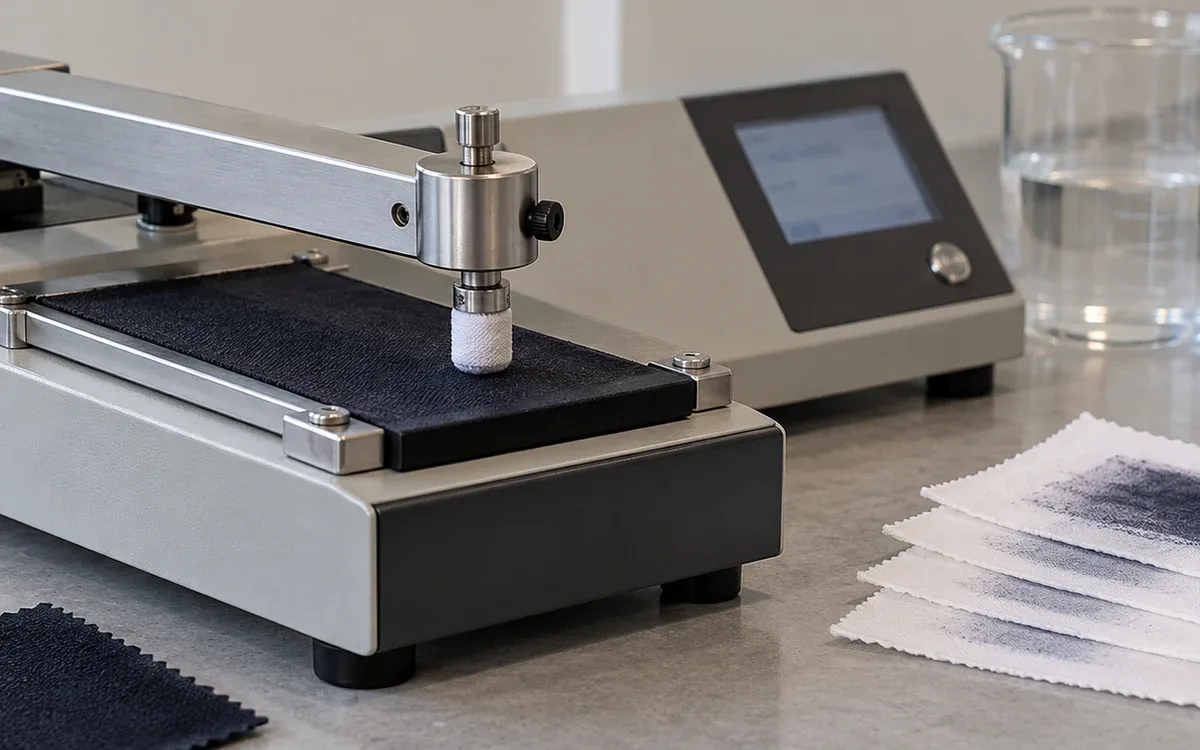
Yang and colleagues' abrasion study on durable-press cotton studied both cellulose damage and crosslinking. It also found differences between cloth directions in the warp-faced twill tested.
Select the relevant abrasion evaluation for the fabric and claim. Preserve its method, load, abradant, endpoint, and sample state.
Do not use this old study to set a fixed allowed loss for a modern finish. Its useful lesson is to test abrasion on its own when wear matters to the product.
Match formaldehyde results to the required method
Formaldehyde tests treat and measure cloth in different ways. Two results may both use mg/kg. That does not mean they can stand in for each other.
ISO 14184-1 addresses free and partly hydrolysed formaldehyde measured by water extraction.
AATCC TM112 addresses formaldehyde released under accelerated storage conditions using a sealed-jar procedure.
Name the method required by the product rules and buyer. Ask the lab for the sample state, result, units, and reporting limit. Include any note that affects what the result means.
Below a reporting limit does not mean zero
Suppose a hypothetical report states less than 16 mg/kg. That does not mean an exact value of zero. It also does not prove that the cloth meets a separate limit below 10 mg/kg.
Tell the lab what decision the test must support before sending samples. Check that its method can measure low enough for that purpose.
Avoid inventing a conversion between extraction and release results. If both are required, obtain both under their specified methods.
Assess workplace air on its own. A cloth result does not measure the air around mixing or curing equipment.
Assess the complete care sequence
State washing, detergent, drying, cycle count, and any permitted pressing. A smoothness result after one route cannot automatically support another.
If the claim concerns a look without ironing, do not press the sample before judging it. Follow any pressing step required by the chosen method. Check that the test still supports the claim being made.
Check early and later stages when studying finish life. A finish may start well but lose its useful effect during the required care sequence.
Keep the untreated or route-only control through the same treatment. Cloth structure, shrinkage, and handling can change the look even without the finish.
Preserve the direction and specimen identity
Separate warp and weft results where the method requires them. A combined number can hide the direction with little remaining margin.
Use separate samples for tests that destroy the cloth. A piece pulled until it breaks cannot also give an untouched after-care result.
Label retained samples with their care stage. A fresh finished piece may look like one washed many times. They still represent different evidence.
Check colour, white appearance, and handle
Inspect the fully finished fabric under the agreed viewing conditions. Include any optical brightener and softener in the final trial, because each can interact with the route.
Compare a matched sample before cure with one after cure to locate a change. A yellow cast may come from preparation, recipe, heat, or later storage. Colour alone does not reveal the cause.
Assess handle against the approved reference. A stiff fabric with a good recovery angle may still miss the intended shirt quality.
If the cloth has stretch fibres, test stretch and recovery too. Each other fibre still has its own heat and chemical limits. A cotton finish does not remove those limits.
Troubleshoot the combination of symptoms
Observed result | Useful next evidence |
|---|---|
Good initial appearance, poor result after care | Full care route, application, cure history, and retained controls |
High smoothness with low strength | Input margin, formulation level, catalyst basis, and exposure |
One edge fails while the centre passes | Width-position application and temperature records |
Shade changes only after cure | Matched before/after samples and complete chemistry |
Results change after a resin substitution | Product strength, catalyst compatibility, and new trial evidence |
Fabric passes but garment looks poor | Construction, seam effects, pressing, and garment care assessment |
Treat these as investigation paths. Several causes can give the same result. Preserve the original material and process record before changing the route.
Avoid repairs that erase the appearance gain
Washing, chemicals, or another heat pass may change the finish and the cloth. Test a repair as a new route. Remember that its input has already been treated.
Check the failed property and those that passed before repair. A better chemical result may come with worse smoothness. Better feel may come with less absorbency. The product could still fail.
Research may show that a certain crosslink can be removed. That does not prove a bulk lot can be restored safely. The blend of chemicals and the damage already present may differ.
Retain the first result, the repair conditions, and the final evidence. The repaired material is not evidence that the original route was under control.
Make the production release useful
The approved recipe should identify the complete formulation, product strengths, ratio bases, application conditions, and validated thermal exposure. Include the fabric scope and required incoming checks.
Link the recipe to appearance, strength, colour, and chemical results. Use the required finished state. Keep the care steps and individual readings behind each summary.
List changes that need a new trial. These may include a new cloth structure, weaker input, or a new resin or catalyst. A changed cure or later finishing step may need a trial too.
A smooth roll at the machine is only one observation. Before release, check the full set of needs. Test after the process and care sequence that the claim covers.
Frequently asked questions
Is wrinkle resistance the same as zero wrinkles?
No. Describe the measured performance and intended use. A promise of no wrinkles is much wider than a result from one lab test.
Does a formaldehyde-free finish prevent strength loss?
No. Other crosslinking systems can still affect strength. Test the full recipe and heat exposure.
Can extra softener restore tensile strength?
It may change feel and some cloth responses. That does not prove that damaged cellulose is repaired. Test each required property.
Why does a high recovery angle not guarantee a smooth shirt?
The angle test uses a specific deformation. Washing, drying, seams, cloth structure, and garment handling add other effects. Match the tests to the claim.
Should the cure temperature be raised when appearance fails?
First check the dose, actual cloth heat, chemistry, and test conditions. More heat can change colour or strength. It may not solve the cause.
Approve the balance that the garment needs
Develop the look and useful life of the finish together. A good route gives the required wrinkle recovery through care. It also leaves enough strength for the garment to work.
Control the full recipe and measure the cloth heat history. Keep each test result distinct. This gives the mill a useful working range. It also gives the buyer evidence for the specific claim.
References
Kang et al.: Strength effects of acid degradation and cellulose crosslinking.
CHT: shape2stay easy-care finishing systems.
Archroma: ARKOFIX product information and claim qualification.
AATCC TM66: Wrinkle recovery angle, public scope.
AATCC TM128: Wrinkle recovery appearance, public scope.
AATCC TM124: Smoothness after laundering, public scope.
USDA ARS: Catalyst comparison in BTCA and citric-acid durable-press finishing.
Mahlo: Product temperature and dwell-time measurement.
Yang et al.: Abrasion resistance of durable-press cotton.
ISO 14184-1: Free and hydrolysed formaldehyde by water extraction, public scope.
AATCC TM112: Formaldehyde release by sealed jar, public scope.
Yang et al.: Crosslinking-agent structure, wrinkle recovery, and tensile strength.
Discussion0
Loading the discussion…