
Read the test before accepting the saving
A boiler test sheet may show a high efficiency and still tell little about annual fuel use. The value may describe stack losses at one load. It may use a different fuel heat basis from the plant's records. It may also omit losses during starts and stops.
For a textile mill, the useful question is clear: how much fuel can the installed plant avoid while delivering the same required steam service? A sound answer needs a stated test boundary, reliable readings and a fair comparison.
This guide focuses on combustion evidence and excess air. It explains what the readings mean, how to check the heat basis and how to value a proven gain. All numerical cases are hypothetical. They are examples for reviewing an audit, not burner settings or emissions limits.
Separate three meanings of efficiency
Start by asking what the reported percentage includes. Similar labels can hide different boundaries.
Measure | Main question | Important limit |
|---|---|---|
Combustion or stack-loss result | How much fuel heat remains after the assessed flue losses? | May omit shell, blowdown and cycling losses. |
Fuel-to-steam result | How much input fuel heat becomes useful exported steam heat? | Depends on the chosen water and steam boundary. |
Period or annual result | How much useful output is delivered over the whole period? | Includes the real mix of loads, starts and idle time. |
The DOE steam sourcebook defines combustion efficiency as a steady-state measure of stack losses. It does not include shell or blowdown losses. That distinction is central to an honest audit.
An analyser's result can help find a burner problem. It does not replace a complete fuel-to-steam balance. Retain both when they answer useful questions, but do not compare them as if they were the same measure.
Explain excess air in plain terms
Fuel needs oxygen to burn. The theoretical air amount is the amount required for complete reaction under ideal mixing. Real burners need some extra air because the mixing and flow are not perfect.
Too little suitable air can leave fuel partly burned. Too much air adds gas that the flame must heat. That gas then leaves through the stack with heat that could otherwise be useful.
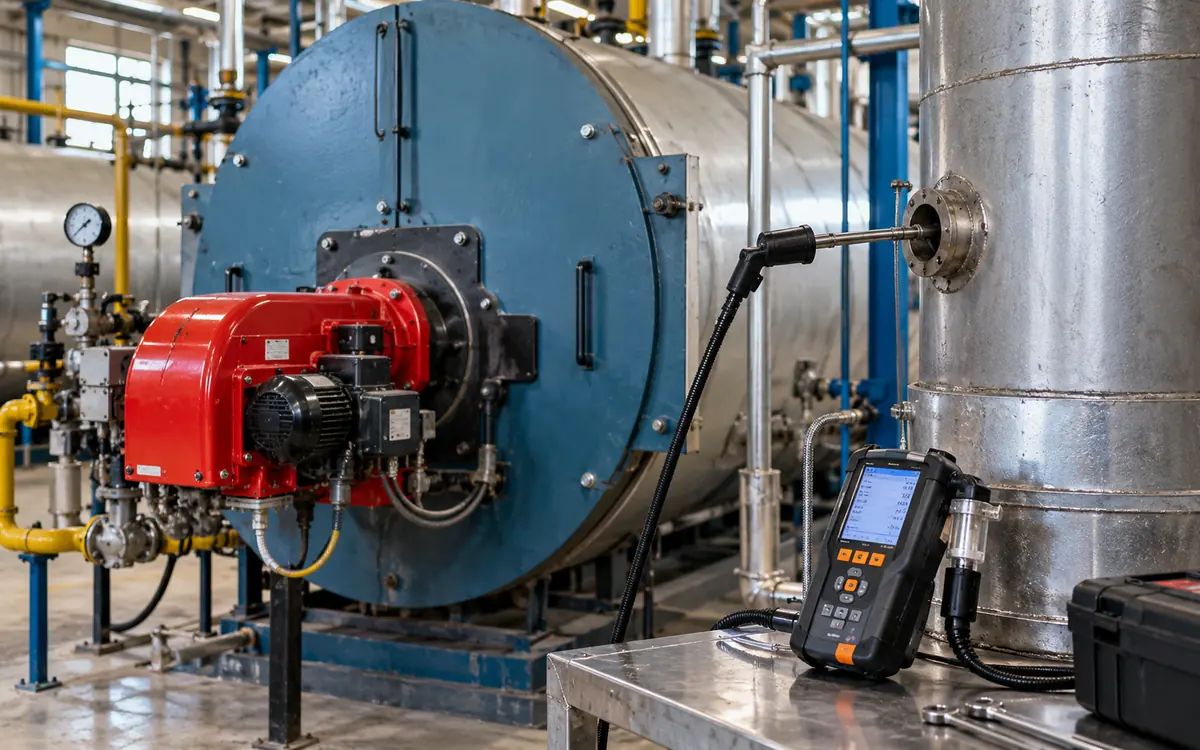
The DOE combustion tip sheet identifies stack temperature and flue-gas oxygen or carbon dioxide as useful indicators. It also links inadequate air with unburned material and excess air with added flue losses.
The aim is stable, complete combustion within the approved burner and emissions limits. It is not the lowest oxygen reading that an operator can obtain. The right operating range depends on the fuel, burner, controls and load. Keep the maker's requirements and competent service advice beside the test record.
Define the air ratio before using a percentage
Let the air ratio, often written as λ, equal actual combustion air divided by theoretical air. Then:
Excess air, % = (λ − 1) × 100.
If a simplified fuel case needs 10 units of theoretical air and receives 12, λ is 1.2. Excess air is 20%. Both air quantities must use the same mass or volume basis and the same reference conditions.
That 20% is not the oxygen percentage in the flue gas. Oxygen forms only part of air. Much of it reacts with the fuel. Water and other products also affect the final gas mixture.
For a chemical illustration, consider pure methane with complete combustion. Assume dry air contains 3.76 units of nitrogen for each unit of oxygen. With λ = 1.2, one unit of methane leaves 0.4 units of unused oxygen. The dry products total 10.424 units. Dry oxygen is therefore about 3.84%.
This example explains the distinction, but it is not a fuel setting. Natural gas composition can vary. Other fuels have other balances. Use the analyser's approved fuel model and verified fuel data for the actual boiler.
Record oxygen, carbon monoxide and load together
An oxygen value without a load is hard to judge. A burner may behave well at one firing point and poorly at another. The same is true of a carbon monoxide reading taken during a brief change in load.
Plan tests across the normal operating range. Record stable low, middle and high duties where these are valid for the installed equipment. Include the normal conditions that operators find troublesome. Do not force an unsafe or unsupported test point for the sake of a complete table.
Keep each set of readings together. Include fuel type, fuel rate, steam rate, steam pressure, feedwater temperature, oxygen, carbon monoxide and stack temperature. Note the burner state and any relevant control action.
A high oxygen result does not prove that air reached the flame in the right place. Air can enter downstream through leaks. Poor mixing can also leave both oxygen and unburned material in the gas. Review the whole pattern before assigning a cause.
Make the sampling point part of the evidence
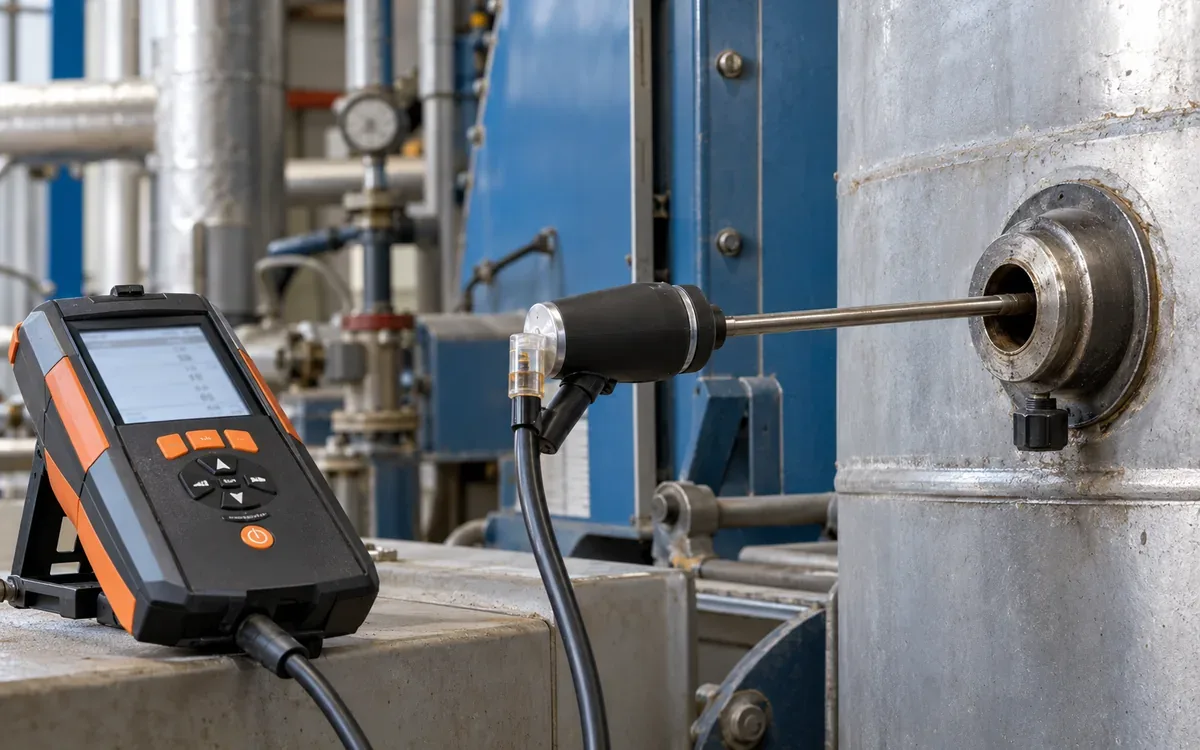
Write down where the probe was placed. A reading after air enters a leaky duct may differ from the gas leaving the boiler. A point near a bend may also fail to represent the whole flow.
Use the instrument and equipment instructions to choose a suitable test location. Keep that location consistent for later comparisons. If a different point is needed, explain the change and assess whether it affects the result.
Check the sample hose, filters, seals and moisture handling as required by the analyser. Fresh air entering the sample path can alter a gas result. A display that settles quickly does not prove that the sampled gas is correct.
Record calibration and function checks with the test. Include instrument identity, fuel selection, units and any oxygen-reference setting. Ask the service provider to keep raw readings, not just the final efficiency number. Raw data make later review possible when an assumption is questioned.
Compare emissions on the same basis
Carbon monoxide may be reported in parts per million or in a mass per gas volume. A report may also correct it to a reference oxygen level. These values cannot be compared without their basis.
Testo's flue-gas analysis guide explains how air dilution affects gas readings. It notes that results need the same oxygen reference for direct comparison.
Suppose two reports show different carbon monoxide values. Before judging the burner, check whether both are dry or wet gas results. Check their reference oxygen, volume reference and averaging period. Confirm whether a value is measured or calculated from another reading.
Use the site's applicable emissions conditions and approved test method. A general guide cannot supply a universal pass limit. The audit should name the actual criterion used and show who checked it. If formal emissions testing is required, a routine service analyser may not supply all the necessary evidence.
Distinguish gross and net fuel heat
Fuel heat can be stated on a higher heating value basis, HHV, or a lower heating value basis, LHV. These are also called gross and net calorific values.
HHV includes heat associated with condensing the water formed from the fuel. LHV excludes that part. A calculation with LHV has a smaller input denominator, so it reports a higher efficiency for the same useful output.
The Spirax Sarco explanation of boiler efficiency describes these two fuel heat bases. The practical rule is to label the basis on every comparison.
In a hypothetical period, useful steam heat is 72 GJ. The same fuel has an HHV input of 90 GJ and an LHV input of 81 GJ. Efficiency is 72 ÷ 90 = 80% on HHV. It is 72 ÷ 81 = 88.9% on LHV.
The boiler did not improve between those calculations. Only the stated basis changed. Never compare an 80% gross figure with an 88.9% net figure and claim an 8.9-point saving. Obtain matching bases before ranking equipment or approving a project.
Build a useful fuel-to-steam cross-check
For a simple steady boundary, useful steam heat rate is:
Q_useful = steam mass rate × (steam enthalpy − feedwater enthalpy).
With mass in kg/h and enthalpy in kJ/kg, the result is kJ/h. Divide by 3,600 for kW. Divide by 1,000,000 for GJ/h.
The NIST steam and water tables provide thermodynamic properties for a stated pressure and temperature. Use the correct steam state. Do not assume dry saturated steam if the measured process needs a different state.
Fuel input requires a matched fuel quantity and heat value. For gas, retain the volume reference conditions and the supplier's calorific-value basis. For liquid or solid fuel, keep mass, moisture and heat-value assumptions clear as applicable.
Then calculate useful output divided by fuel input over the same period. Explain whether blowdown, auxiliary electricity and other outputs are inside the boundary. A more complete performance test may be needed for a guarantee. This cross-check is useful only when its inputs are fit for the decision.
For capacity and peak-demand work, use ApparelDiary's boiler capacity guide. The present task is to test fuel performance at an existing duty.
Use stack temperature as a clue, not a verdict
A high stack temperature can mean that useful heat is leaving the boiler. Its cause still needs to be found. Possible causes include changed load, heat-transfer fouling and altered gas flow.
Compare stack temperature with combustion-air temperature. Record both at the same time. The difference is often more useful than a stack reading alone when room conditions vary.
Check the operating context before calling a lower stack value an improvement. A lower firing rate can reduce the value without fixing the original fault. A different probe location can also change it.
There are limits to lowering flue-gas temperature. Condensation, corrosion and chimney performance depend on fuel and equipment design. Heat recovery that intentionally condenses flue gas needs a suitable design and materials. A burner adjustment does not turn an ordinary stack into a condensing system.
Use the observed trend to select the next inspection or test. It should help distinguish a burner-air issue from a heat-transfer issue. That distinction avoids paying for a control upgrade when the main cause lies elsewhere.
Calculate savings at constant useful output
Suppose a verified project raises fuel-to-steam efficiency from η_old to η_new on the same heat basis. For the same useful output, annual fuel saving is:
Fuel saved = old fuel input × (1 − η_old ÷ η_new).
The formula follows from holding useful heat constant. It does not assume that percentage-point gain equals percentage fuel saving.
Consider a hypothetical boiler using 22,000 GJ of fuel per year. The old efficiency is 0.80. The supported new annual efficiency is 0.83. Fuel saved is:
22,000 × (1 − 0.80 ÷ 0.83) = 795.2 GJ per year.
That is a 3.61% fuel reduction. The efficiency rose by three percentage points, from 80% to 83%. Those are different ways of expressing change.
At 9 currency units per GJ, gross annual benefit is about 7,157. Allow 600 per year for added service and checks. Net benefit is about 6,557. A complete installed cost of 9,000 gives a simple payback near 1.37 years.
The result is conditional on the measured gain lasting across the expected load pattern. If only a short full-load test supports 83%, the annual claim needs more work.
Weight the result by the mill's real load pattern
A dyehouse may have short steam peaks and long lower-load periods. Pressing or finishing may follow another schedule. The boiler's annual fuel use reflects that mix.
Divide the operating record into useful load bands. For each band, retain hours, useful output and fuel input. Use valid before and after performance for that band. Then sum fuel over all bands.
Do not take a simple average of several efficiencies unless the weighting makes it valid. A small low-load test should not count as much as a band that consumes most annual fuel. For a fixed useful-heat calculation, compute fuel for each band as useful heat divided by that band's efficiency.
Include starts, standby and shutdown where they matter to the chosen boundary. A steady burner test does not measure every loss in those periods. If a project leaves those losses unchanged, retain them in both cases.
This method also tests vendor claims. Ask where the quoted gain occurs and how often the plant operates there. A strong peak-load improvement may have a modest annual value in a mill that seldom reaches that load.
Test a smaller improvement before committing funds
Repeat the example with a new efficiency of 81.5% rather than 83%. The fuel saving is 22,000 × (1 − 0.80 ÷ 0.815), or about 404.9 GJ per year.
At the same fuel price, gross benefit is about 3,644. After 600 in annual service, net benefit is about 3,044. The same 9,000 project then has a simple payback near 2.96 years.
This is a useful sensitivity test because the uncertain gain drives the decision. Do the same for annual load and fuel price. Keep the assumptions visible so management can judge whether the project remains worthwhile under less favourable conditions.
Do not assign a large saving to a sensor alone. A sensor provides information. A control system or service process must use that information to change performance within the approved limits. Include calibration, maintenance and the response to a failed sensor in the cost case.
Check whether measurement error could hide the gain
Small claimed gains need good input data. Suppose true useful output is 80 units for every 100 units of fuel heat. The true efficiency is 80%. If the output meter reads 2% high while fuel measurement is correct, the reported output becomes 81.6 units. The calculated efficiency becomes 81.6%.
That meter bias creates a 1.6 percentage-point error. No burner improvement has occurred. This example does not assign an error to any real meter. It shows why a gain of one or two points needs a sound measurement plan.
List the main sources of uncertainty. They may include steam flow, steam state, feedwater temperature, fuel quantity and fuel heat value. Ask whether each source stays the same between tests. A stable bias may affect the absolute value differently from a changed meter setting between the two periods.
Use repeat tests to judge normal variation. Keep enough digits during calculation, then round the reported result to match the evidence. Do not report an annual gain to four decimal places when the input flow is a rough estimate.
Where the evidence cannot distinguish a small change, say so. A longer matched trial or a better meter may be cheaper than a project based on a false gain.
Define the work scope for the service provider
The order should ask for more than a favourable final printout. State the boiler and burner models, fuels, load range and known issues. Include the test boundary and the criteria for a valid comparison.
Ask for before and after raw results at agreed duties. Require the provider to explain any changed settings and the reason for them. Retain the approved settings and software or control revision where relevant.
Burner work needs people with the right skills and equipment. The HSE guide to safe boiler management stresses competent personnel and work that follows the maker's instructions. Its legal context is the UK; use the applicable local requirements for the actual site.
Keep protective controls in service. Do not bypass a flame safeguard or other trip to obtain a desired test result. If the plant cannot reach a proposed duty safely, record that constraint and resolve it through the approved engineering process.
Make acceptance cover more than efficiency
Acceptance item | Evidence to retain |
|---|---|
Stable service | Required steam pressure and output at agreed loads. |
Combustion quality | Oxygen and carbon monoxide on stated bases. |
Emissions | Results against applicable site criteria. |
Controls | Approved response across normal load changes. |
Fuel performance | Matching heat basis and measurement boundary. |
Handover | Raw records, settings, manuals and open actions. |
Agree which tests happen during the visit and which need later operating data. Some annual claims cannot be proved in one morning. Keep those items open with an owner and a review date.
Production staff should confirm that steam service still meets the process need. A fuel reduction caused by slower heat-up or reduced output is a different business change. It must not be reported as a pure efficiency gain at equal duty.
Troubleshoot conflicting readings
When oxygen rises but stack temperature barely changes, check load, fuel and sample conditions first. The pattern may be real, but it does not identify one cause by itself.
When carbon monoxide rises after a claimed tuning improvement, stop treating the efficiency figure as sufficient evidence. Have the competent provider review the result against approved combustion and emissions limits. Lower fuel use does not excuse poor combustion.
When the analyser result looks good but fuel per tonne of steam worsens, inspect the boundary. Feedwater may be colder. Starts may be more frequent. Steam quality or meter performance may have changed. The burner test and the period result may both be correct for different questions.
When only one instrument shows a change, compare calibration, sampling points and settings. Do not average conflicting values to make the disagreement disappear. Find the reason or state the uncertainty in the report.
Preserve the gain through routine records
Keep a small trend set that operators can use. Record load, fuel rate, steam conditions and the relevant combustion readings. Attach service and calibration dates so a sudden change has context.
Use the same measurement definitions over time. A revised gas meter factor or a change from gross to net heat value can create a false trend. Mark such changes in the record and restate earlier comparisons where needed.
Connect follow-up work to the plant maintenance programme. Assign checks for the burner, sample system and sensors based on equipment instructions and actual duty. Track overdue actions rather than relying on a one-time service certificate.
Review the result when production or fuel changes. A control map that worked for one range may need competent review after a change. The original test remains evidence for its conditions, not a permanent guarantee for every future operating state.
Frequently asked questions
Does lower flue oxygen always mean better performance?
No. The result must remain within the approved operating range. Read oxygen with carbon monoxide, load, temperature and fuel data. Check for sample dilution and poor mixing. The lowest number is not a valid universal target.
Can a handheld analyser prove annual boiler efficiency?
It can provide useful test evidence at the sampled conditions. Annual performance also depends on load, starts, standby and the full heat boundary. Use matched operating records to support an annual claim.
Why do two suppliers quote different efficiency values?
They may use different heat bases, load points or boundaries. Ask for HHV or LHV, test conditions and included losses. Compare only after those definitions match.
Should every mill install oxygen trim?
Assess the actual control problem and duty first. An upgrade needs suitable integration, upkeep and a verified benefit. Some faults need repair or better basic control before a further control layer is useful.
Make the audit result reproducible
A useful combustion audit leaves a clear chain from measurements to action. It states where the gas was sampled, which fuel and heat basis were used, and what output stayed constant. It also shows the approved limits that the work respected.
Use that record to judge the annual case. Keep raw data, test the uncertain inputs and verify the result over the real load mix. The mill can then claim a fuel saving that its engineers and finance team can both reproduce.
References
DOE: Improve Your Boiler's Combustion Efficiency.
DOE: Improving Steam System Performance.
Spirax Sarco: Boiler Efficiency and Combustion.
Testo: Industrial Flue Gas Analysis.
NIST: Water and Steam Thermodynamic Properties.
HSE: Safe Management of Industrial Steam and Hot Water Boilers.

Discussion0
Loading the discussion…