
Specify the air that reaches the machine
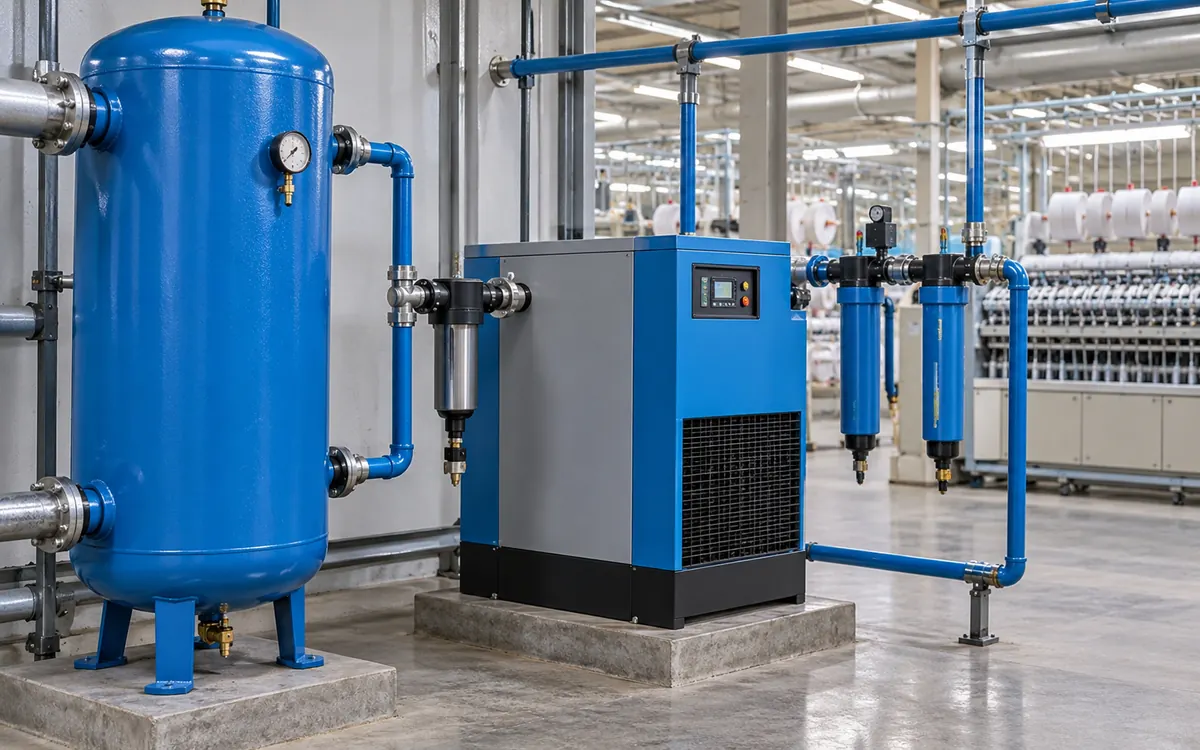
Water at a pneumatic valve can stop a garment line. The compressor may still deliver enough pressure. A dryer display may look normal. Yet a cold branch or open bypass can cause trouble downstream. Water left in a receiver can also cause faults. Does the air stay dry enough at the machine? Check this under the conditions the factory actually sees.
Begin with the air user's requirement. How does the machine use the air? It may touch fabric, drive a cylinder, or supply an instrument. Record the actual use. Record the moisture limit and its pressure basis. State where it will be checked. A statement such as “dry air required” leaves too much open for purchasing and acceptance.
This guide concerns moisture quality and dryer selection. For cylinder demand, leaks, and delivered-air cost, use ApparelDiary's pneumatic-system guide. The examples below are hypothetical design checks. All temperatures, flows, factors, and margins are assumed. They explain the method. They are not fixed rules for textile equipment.
Understand pressure dew point
At the pressure dew point, water vapour starts to condense. This temperature applies at a stated air pressure. Suppose air has a pressure dew point of +3°C. Keep its pressure the same. If it meets a colder surface, water can condense. A warm compressor room cannot protect a pipe in a colder space.
The pressure basis matters. Air can expand as it enters a sample system. Its dew point at atmospheric pressure differs from its value at line pressure. Do not compare the atmospheric reading with a line-pressure limit. That error can make wet air seem acceptable. Record both the reading and the measurement pressure.
The CAGI air-drying guide explains the link between moisture, temperature, pressure, and drying. It also distinguishes removing condensed liquid from removing water vapour. An aftercooler and separator remove bulk liquid. Vapour can remain and condense as the air cools further.
Relative humidity is not a substitute for a dew-point requirement. Relative humidity changes with air temperature. State the dew point and its pressure basis. Use them to check the coldest part of the route. Keep temperature, pressure, and moisture records together. One reading cannot describe the whole condition.
Separate moisture from other air-quality requirements
ISO 8573-1:2010 classifies compressed-air purity for particles, water, and oil. These are separate characteristics. A dryer may meet the moisture limit. Oil or particles may still exceed the process limits. An oil-free compressor does not prove final air quality at every machine.
Write the required characteristics separately in the equipment schedule. A supplier may request an ISO class. Keep its full designation and edition. Record the sampling point too. Confirm the relevant limits from the standard and the machine specification. Do not select a class simply because another factory uses it.
Requirement | Question to resolve before purchase |
|---|---|
Moisture | What pressure dew point or other water limit is required? |
Particles | What particle sizes and concentrations matter to the equipment? |
Oil | What aerosol and vapour limits apply to the process? |
Pressure | What minimum pressure is needed during peak demand? |
Flow | What maximum simultaneous flow must treatment pass? |
Measurement | Where, when, and by which method will acceptance occur? |
This avoids a common buying error. A costly dryer may not solve the whole air-quality problem. Filters or changes elsewhere may also be needed. Each treatment stage should have a stated purpose and an acceptance measure.
Find the coldest credible condition
Walk the route from the dryer to the air users. Check outdoor pipes and unheated stores. Include chilled rooms and exposed metal joints. Check surfaces that the process itself cools. Ask about night operation, shutdown, seasonal weather, and restart. The coldest condition may occur outside the survey period.
Make the moisture requirement protect the whole route and the end-use requirement. These may differ. The machine may need a lower dew point. Pipe temperature alone does not set the limit. Use the stricter supported requirement. Allow for variation and measurement error. Have the responsible engineer agree that allowance.
Consider a hypothetical factory. Its team chooses a 7 K design margin. This is the gap between the coldest pipe surface and the highest allowed pressure dew point. This margin is a local example, not an ISO rule.
Branch | Lowest assumed surface temperature | Proposed maximum pressure dew point | Difference | Local 7 K criterion |
|---|---|---|---|---|
Warm production hall | 12°C | +3°C | 9 K | Met |
Cold service route | 0°C | +3°C | −3 K | Not met |
Cold route with local treatment | 0°C | −20°C | 20 K | Met |
One central drying level may suit most users. A small branch may still need further treatment. The example explains why. It does not prove that the branch needs −20°C. Review the machine needs and risk before final selection.
Choose a drying method from the duty
Refrigerated dryers cool air so that moisture condenses and can be removed. Adsorption dryers use a material that holds water vapour and is then regenerated. Membrane dryers use another separation mechanism and can be useful for selected duties. The technology name is not enough. Ask for the guaranteed flow, dew point, and air loss. Check operating cost too.
Atlas Copco's dryer-selection guidance starts with the required air quality and dew point. That sequence is useful: establish the duty before asking which product is cheapest. A lower dew point may need another treatment method. Regeneration needs may change too.
Compare each suitable method at the same conditions. Specify inlet pressure and temperature, ambient conditions, and flow basis. Use the same outlet moisture limit. Include the full load range. A catalogue may use favourable test conditions. Check performance in the hot compressor room at peak production.
Choice to compare | Evidence that makes the comparison useful |
|---|---|
Central refrigerated drying | Guaranteed moisture performance at worst stated inlet conditions |
Central adsorption drying | Net delivered flow, regeneration air and energy, cycle performance |
Local treatment for selected users | Branch demand, local quality, maintenance access, pressure drop |
Duty and standby arrangement | Capacity and quality while one unit is unavailable |
Avoid buying a single extreme specification for every user without checking the consequence. Give local treatment a named owner. A small dryer beside a machine still needs service and testing.
Put all flow figures on the same basis
Compressed-air volume changes with pressure and temperature. Flow may be stated as free air or actual line volume. Normal and standard volumes also occur. Check the reference used for each. Two numbers that both say m³/min are not necessarily comparable.
Ask for the reference pressure and temperature. Confirm the humidity convention. Does the flow describe the inlet or net outlet? Keep those details beside the number in the selection sheet. Use the maker's method to convert flow or apply a capacity factor.
Peak dryer inlet flow can exceed average plant demand. Compressor sequencing, receiver position, short bursts, and regeneration air can affect it. A receiver smooths some events. It does not create unlimited dry-air capacity. Check the flow through the actual proposed treatment location.
For a new machine, use the factory utility load register to connect the equipment's pressure, flow, and quality demands. Then test whether the existing dryer still covers the combined duty. More compressor capacity can overload the existing dryer. Check treatment before adding supply.
Apply the exact manufacturer's correction factors
Dryer capacity depends on its rated conditions. Suppliers may publish capacity factors. These can cover pressure, inlet temperature, ambient temperature, or dew point. The factors and their direction are product-specific. Some tables adjust available capacity; others adjust required nominal size. Read the instructions before multiplying.
Consider a hypothetical refrigerated dryer. Its rating is 18 m³/min on a stated reference basis. Assume the supplier uses this rule. Multiply nominal capacity by the relevant factors to find available capacity. At the proposed site conditions, the assumed pressure factor is 0.82 and the temperature factor is 0.90.
Available capacity = 18 × 0.82 × 0.90 = 13.284 m³/min.
The required flow is 14.5 m³/min on the same reference basis. The unit does not cover that duty, even though its headline rating is larger than 14.5. Under these assumed conditions, the minimum nominal rating is:
Required nominal capacity = 14.5 ÷ (0.82 × 0.90) = 19.65 m³/min.
A nominal 21 m³/min option would provide 21 × 0.82 × 0.90 = 15.498 m³/min under the same model. This is a screening result. Check the dew point and pressure drop. Confirm the inlet limits and supplier guarantee before selection. Do not reuse these invented factors for an actual product.
Distinguish gross flow from net dry air
Some dryers use part of the compressed air for regeneration or purge. Define the purge percentage. It may refer to inlet flow, outlet flow, or rated flow. It may describe a cycle average. Each basis gives a different result.
Suppose a hypothetical dryer loses 12% of inlet flow as purge. The machines need 14.5 m³/min of net dry air. Ignoring other losses in this example:
Net flow = inlet flow × (1 − purge fraction).
Required inlet flow = 14.5 ÷ 0.88 = 16.477 m³/min.
Purge flow = 16.477 − 14.5 = 1.977 m³/min.
Multiplying net demand by 1.12 gives 16.24 m³/min, which is too low under the stated definition. The difference arises because the 12% is a fraction of inlet flow. This small algebra check can prevent an undersized supply arrangement.
Ask for cycle-average and peak requirements where they differ. Include heater, blower, and control electricity as applicable. Compare alternatives at equal net dry-air delivery and equal moisture quality. A low price can hide a high regeneration demand. A low purge claim may omit heater energy. It may also use a different test condition.
Use a performance standard for the right question
ISO 7183:2007 addresses dryer performance data and tests within its stated scope. It covers pressure dew point and flow. It also covers pressure drop, air loss, and power use. This supports a more complete procurement comparison than a dew-point value alone.
A brochure may cite the standard. That does not mean each quoted figure was tested at your conditions. Ask which performance data follow the cited method, which are calculated, and which are guaranteed. Retain the supplier's conditions and tolerances with the bid.
Create one comparison sheet for all offers. If a vendor leaves an item blank, keep it blank and request clarification. Do not fill it with another vendor's typical figure. Complete every part of the comparison. The cheaper unit may supply less net air. It may need a larger power connection.
Give pressure drop its own acceptance condition. Check for low pressure downstream of the dryer. Do not leave operators to solve that fault by raising the whole system pressure. Confirm available pressure at the critical air user during the relevant operating state.
Plan moisture measurement before commissioning
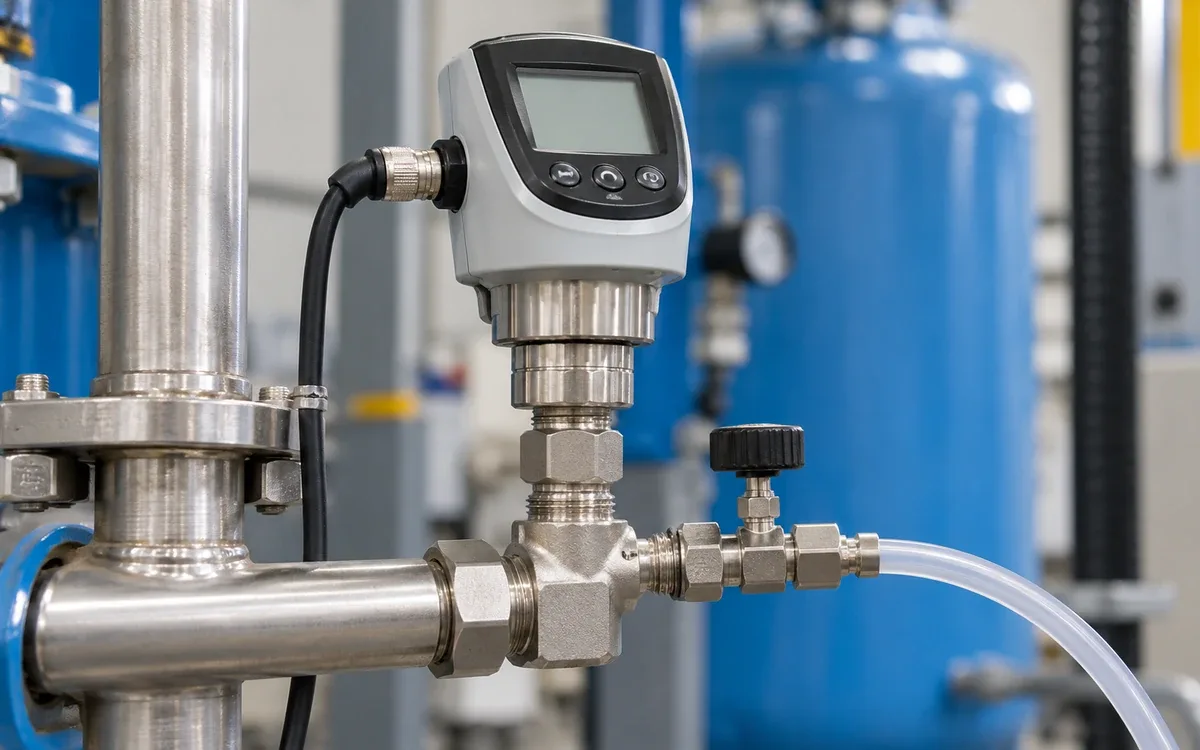
ISO 8573-3:1999 covers humidity test methods. It includes sampling, evaluation, uncertainty, and reports. It concerns water vapour; a dew-point measurement should not be treated as a complete test for every form of water contamination.
Choose a sensor with a suitable range and uncertainty for the intended limit. A device may suit modest dew points. It may be less useful at a much lower limit. Record calibration status, installation pressure, and the sampling arrangement. Let the sensor and sample path stabilise. Follow their instructions.
A reading after a pressure regulator needs its pressure basis identified. A wet sample tube can distort the result. So can room air leaking in or an unsuitable sample flow. Use the instrument supplier's sampling guidance. Do not improvise a long flexible tube and assume it is neutral to moisture.
Retain the raw trend rather than just its average. A changeover or startup can cause a moisture peak. That peak may matter to a sensitive machine. A good shift average can hide it. Define the permitted limit, any agreed transient allowance, and the response to an excursion before the trial.
Resolve readings close to the limit
Suppose the agreed maximum pressure dew point is +3°C. A portable instrument shows +2°C, and the stated uncertainty for the actual test conditions is ±2°C. The reading is below the limit, but the uncertainty interval extends above it. Apply a defined decision rule to that result. It does not prove that the true value is below +3°C.
The team has several options. It could use a better instrument or improve the sample setup. It could apply an agreed acceptance guard band. The choice should match the consequence of a wrong decision. Record the rule before testing. Do not change it to suit the result.
Also distinguish uncertainty from real variation. Suppose a two-hour trend moves from −1°C to +5°C. Even with an accurate sensor, this shows an operating excursion. Repeating a single spot measurement cannot erase that excursion. Investigate the time pattern and its relation to load, temperature, and dryer state. The measurement must be stable and traceable. The moisture service must also be stable. Both matter at acceptance.
Measure both production and use points
The dryer outlet is a useful place to check treatment performance. A critical use point is useful for checking what the machine receives. These answer related but different questions. A distribution fault can occur between them. One good outlet reading cannot rule it out.
Vaisala's compressed-air measurement guidance describes monitoring on both the supply and demand sides. Use that distinction to design a small, purposeful measurement plan. Keep fixed sensors at points that protect critical service. Use planned checks where continuous sensing is not justified.
Suppose the outlet trend stays within its limit but a remote branch becomes wet after shutdown. Investigate the route, stored water, bypass status, branch temperature, and restart sequence. Replacing the dryer without locating the problem may leave the same fault in place.
Moisture may rise at both the outlet and distant users in hot weather. In that case, examine dryer capacity and inlet conditions. The time pattern helps choose the next test. It is more useful than a general statement that “the air system is wet.”
Write an acceptance test around difficult conditions
Define the hardest duties for the dryer. Include peak flow and the highest inlet temperature. Check the lowest approved supply pressure. Include regeneration changeover and restart after a planned stop. Normal operation may cover some cases. Others need a test with supplier support. State any condition that needs a later check.
For each case, log inlet and outlet pressure, inlet temperature, flow, dew point, and the dryer's operating state. Add power and purge information where needed for the comparison. Note which machines were operating so that the test can be repeated.
Acceptance item | Example of a complete record |
|---|---|
Moisture quality | Dew-point trend, pressure basis, limit, sensor uncertainty |
Capacity | Net delivered flow at stated inlet conditions |
Pressure service | Treatment pressure drop and critical-user pressure |
Regeneration | Cycle state, purge or heater demand, changeover behaviour |
Recovery after stop | Time to acceptable quality and release rule |
Alarm response | Named responder, affected users, isolation or hold action |
Do not invent a universal test duration. It must cover the relevant cycle and range of conditions. If seasonal extremes are absent, record that limitation and arrange the remaining check. Acceptance can be staged, but the open condition should remain visible.
Give wet-air alarms a useful response
An alarm needs a defined consequence. List the users served by the monitored point. Decide what an alarm means for them. Production may need to stop or switch to a qualified reserve. Affected material may need a hold and review. The correct action depends on the process and quality risk.
Do not set the alarm at the product limit without review. Allow for measurement error, response time, and variation. A warning level can allow investigation before the acceptance limit is crossed. Its value should come from the system's needs and sensor performance, not a convenient round number.
Record the start and end of an excursion, the operating state, the cause found, and the recovery evidence. If product contact is involved, link the incident to the affected production period. This makes the air-quality record useful to quality staff as well as maintenance.
Test the alarm path during commissioning. A sensor may work but fail to alert the right person. Also test loss of signal. A frozen display or missing data proves nothing about moisture quality. Flag the gap and investigate it.
Troubleshoot without jumping to a replacement
Observed pattern | First questions to investigate |
|---|---|
Moisture rises only at peak production | Is actual inlet flow above corrected capacity? |
Moisture rises on hot days | Are inlet and ambient conditions within the guarantee? |
Outlet is acceptable but one branch is wet | Is there stored liquid, a cold route, or untreated cross-connection? |
Dew point spikes during regeneration | Are cycle controls and regeneration conditions correct? |
Reading changes after sampling changes | Did sample pressure, flow, leakage, or tubing condition change? |
Quality is good but user pressure is low | Are filters or treatment stages creating excessive pressure drop? |
Treat the table as a way to choose evidence, not as an automatic diagnosis. More than one fault can exist. A blocked drain may accompany an overloaded dryer; a failed sensor may hide a real moisture problem. Record the facts that support the conclusion.
After correction, repeat the operating case that exposed the fault. The outlet may be dry at low load. That does not prove a peak-load fault is fixed. Close the work order only when the relevant quality and pressure service have been restored.
Keep the specification current as production changes
Dryer performance can drift when a factory adds machines, changes shifts, moves a pipe, or replaces a compressor. Review the duty record after such changes. Check the effect on flow, inlet conditions, route temperature, and required quality. Do not wait for visible water to announce the mismatch.
Maintain the whole treatment route according to the equipment instructions. Include drains, filters, cooling surfaces, sensors, valves, and regeneration components as applicable. Keep the dew-point requirement in the asset record. Use it to assess replacement parts and rental units.
Frequently asked questions
Is a lower dew point always better?
A lower value can protect a colder or more sensitive use. It may need more equipment and energy. Specify the moisture level that the process and route require, with a justified margin. Do not assume that the lowest available figure gives the best factory decision.
Does a dryer's display prove point-of-use quality?
It provides evidence at its sensor location and pressure. Confirm that the sensor is suitable and functioning, then check critical points downstream. Check the distribution route and stored liquid. Problems can arise after air leaves the dryer.
Can a filter replace a dryer?
A filter selected to remove liquid droplets does not necessarily remove water vapour. The required treatment depends on the contaminant and its state. Define the moisture requirement first, then select the combination that achieves it under the real duty.
What is the most useful purchase document?
Use a duty sheet. State net flow, reference conditions, and inlet limits. Add pressure dew point, pressure drop, and regeneration demand. Define the acceptance method. Buyers can compare offers on that basis. Production can check the promised service.
Close the moisture-control loop
A successful dryer project connects the air user's need to a measured result. It identifies the coldest credible route and states the pressure basis. It corrects capacity for site conditions. It also checks net dry-air delivery. It then proves the result at the outlet and at the users that matter. Keep those records together. They help the team maintain the required moisture service and check it over time.
References
ISO, ISO 8573-1:2010: Contaminants and Purity Classes.
CAGI, Compressed Air and Gas Drying.
Atlas Copco, Basics for Compressed Air Dryer Sizing.
ISO, ISO 7183:2007: Compressed-Air Dryers, Specifications and Testing.
ISO, ISO 8573-3:1999: Test Methods for Measurement of Humidity.
Vaisala, Measuring Moisture in Compressed Air.

Discussion0
Loading the discussion…