
Start with the property you want to change
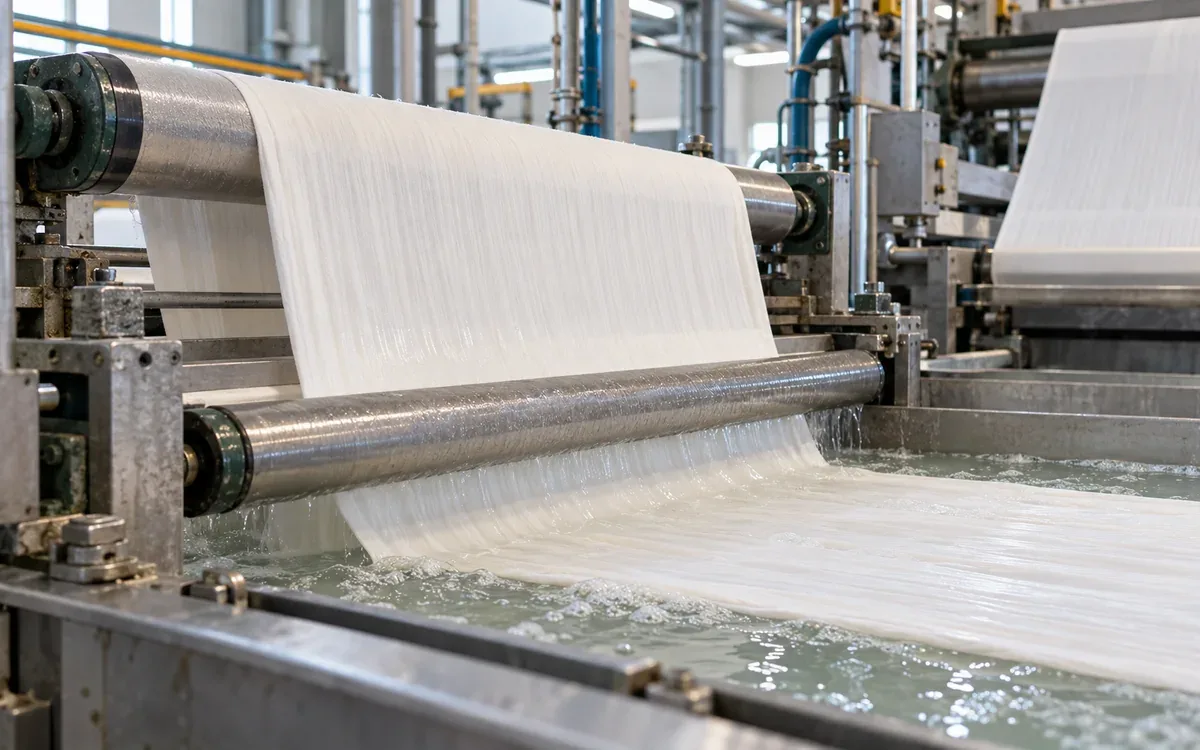
Cotton mercerization uses a strong sodium hydroxide solution. The treatment takes place under controlled conditions. The process changes the fibre and can improve dye response and lustre. The result depends on several controls. How is the fabric held? Does the liquor reach it evenly? How is the alkali removed?
Start with a practical question: what should the treatment achieve for this fabric? A shirting may need more lustre. Another fabric may need deeper colour or a planned contraction. Each goal needs its own approval checks.
Cotton Incorporated's mercerization definition links the swelling treatment with dye affinity and lustre. Those benefits provide a reason to trial the process. They do not replace a product specification. Nor do they prove that every treatment gives the same result.
This guide covers process controls, barium activity testing, and fabric-level verification. Its figures are teaching examples. They explain decisions and calculations. They do not provide operating recipes.
Define what “mercerized” means in the purchase specification
A purchase order may just say “mercerized cotton”. It may not name the expected look or performance. The buyer and supplier can then disagree after delivery.
Clarify what the buyer wants to know. Was a treatment done? Has the fibre changed? Does the finished fabric have a stated property? When the buyer requires a measured result, agree on the test and acceptance basis.
A useful specification separates these questions:
Question | Evidence to request |
|---|---|
Has the cotton undergone the expected modification? | A suitable mercerization test. Include the method details. |
Does the fabric have the required appearance? | An approved physical reference. Agree on the viewing conditions. |
Does it give the intended shade response? | A controlled dye trial against the reference route. |
Are dimensions suitable? | Width, length, and required dimensional-change results. |
Is the product durable enough? | Relevant strength and other specified performance tests. |
Is it ready for the next operation? | Appropriate residual-alkali and preparation checks. |
Do not make one result stand in for the whole table. A lab test may show that cotton was mercerized. That does not approve the cloth's width, handle, or shade.
Confirm which stage was treated
Cotton can be treated at different production stages, including yarn or fabric. Keep that distinction in the material record.
Yarn and fabric treatments use different mechanical settings. They also offer different ways to control the finished dimensions. A supplier may change the treatment stage. If so, review the approved reference and the scope of earlier trials.
Also check fibre composition. Review a pure-cotton route before using it on a blend. Check that the other fibres can withstand it. The cotton response alone cannot define their limits.
Separate chemical treatment from mechanical restraint
Mercerization combines a chemical action with a mechanical condition. The cloth can swell and change size. The machine controls how freely that change occurs.
Tension is not one number for the entire range. Lengthwise restraint and width control both affect the result. The move into washing can affect it too. Record the relevant machine settings and where they apply.
Benninger makes textile machinery. It describes impregnation, dwelling, stentering, and stabilization within its mercerizing system. That sequence shows why a process record needs more than the trough concentration.
A trial may change both chemical exposure and fabric width. If the width changes are not controlled, the two effects become hard to separate.
Slack treatment is a different product decision
Cotton Incorporated's technical bulletin on filling stretch describes a woven cotton route. It uses slack mercerization. The examples focus on fabric width and the later finishing route.
The lesson is that allowing contraction may be intentional. It is not necessarily a process fault. Other routes aim for lustre or a required width. A small relaxed specimen cannot prove those results on its own.
Treat those as different development goals. A slack trial uses different restraint from a production range. Test the actual construction before transferring settings or expected results between them.
Make the incoming fabric condition visible
The liquor has to reach the cotton consistently. Record whether the fabric enters dry or wet. State how it was prepared. Check whether remaining material could affect the treatment.
Use an input sheet to record fibre content and construction. Add width, mass per area, and preparation history. Measure incoming moisture or pickup where relevant. Include known size or lubricant details if the route requires them.
Inspect the cloth for folds and contamination. A crease present at entry may complicate both contact and later appearance. Mark its location before deciding that the mercerizing stage created it.
Retain untreated material from the same lot. It provides a matched reference for chemical testing, dye trials, and dimensional comparisons.
Dry and wet entry need different controls
Wet entry carries water into the system. Check how much water enters. The liquor exchange and control response affect what happens next.
Consider a simplified hypothetical inventory. A trough initially holds 1,000 kg of liquor at 24% sodium hydroxide by mass. It contains 240 kg of NaOH.
If 60 kg of water enters and nothing else enters or leaves:
New mass fraction = 240 ÷ (1,000 + 60)
New concentration = 22.64% by mass
This example assumes a closed inventory. It does not model a running mercerizer. Real systems exchange liquor and add material all the time. The calculation shows why the team must account for incoming water.
Take a dry fabric mass of 100 kg. An incoming water pickup of 60% adds 60 kg of water. An error in that input affects the control task. This remains true even when the dry fabric mass is correct.
Control caustic concentration with the right units
Check the units on mercerizing records. They may use mass percent, grams per litre, or specific gravity. Other records use degrees Baumé or degrees Twaddell. These labels do not mean the same thing.
A value of 25°Bé does not mean 25% NaOH. A grams-per-litre value uses the solution volume. A mass percentage uses the solution mass.
OxyChem's Caustic Soda Handbook provides concentration and density data. It states the conditions and gives methods for analysis. Use data for the correct chemical grade and temperature.
For reused liquor, ask whether other dissolved material affects a density-based reading. Check the concentration signal against a suitable chemical analysis. Follow the check interval in the quality plan.
Write the basis beside the number
State the unit and method on the control sheet. Add the sample location and condition. “Caustic 24” does not give the next shift enough information.
Keep the instrument's reference temperature and calibration basis in its controlled procedure. If the controller compensates for temperature, confirm what the displayed value represents.
When two methods disagree, do not average them automatically. First check whether they measure the same quantity. Then check the assumptions used in their conversions.
Use a documented action limit and response. Tell operators when to hold the fabric. State which measurement to repeat. Name who can approve a process correction.
Keep contact time linked to line speed
A steady line has a nominal residence time in a defined zone:
Residence time = fabric path length in the zone ÷ line speed
Suppose the relevant fabric path is 45 metres. At 30 metres per minute, the nominal contact time is 1.5 minutes. At 25 metres per minute, it is 1.8 minutes.
That is a 20% increase in nominal time. It does not mean a 20% increase in mercerization. The response also depends on chemistry, temperature, contact, restraint, and the substrate.
Record speed changes and stops with the fabric position. Identify the transition sections. Judge their test results separately from steady production.
For a trial, verify the path length being used. A machine's total threaded length may include sections outside the intended treatment zone.
Verify the reaction with a suitable mercerization test
AATCC TM89 tests for the presence of mercerization. It covers dyed and undyed cotton yarns and fabrics. Its official TM89-2025 scope and principle describe the comparison. It measures how much barium hydroxide the prepared test cotton takes up. It compares this with uptake by an unmercerized reference.
The resulting barium activity number is a relative index. At the principle level:
Barium activity number = test uptake ÷ reference uptake × 100
The full method defines how to prepare specimens. It also sets out the reagents, measurements, and report. Follow those rules when testing. This outline cannot replace them.
A number above 100 is not a conversion percentage
Suppose an assay gives a normalized uptake of 0.135 for the test cotton. The unmercerized reference gives 0.100. Both results are accepted and corrected. They use the same units and the basis required by the method.
The activity number is:
0.135 ÷ 0.100 × 100 = 135
That means the measured uptake ratio is 1.35 under that assay. It does not mean that 135% of the cotton has been mercerized.
A value of 135 does not predict 35% extra lustre. It does not predict 35% more strength or 35% dye savings either. Those are separate measured properties.
The reference and test preparation matter because the index is a comparison. A number may look precise. Yet a poor reference or uneven preparation can make it misleading.
Use the current method, not an old copied procedure
AATCC's 2026 manual change notice records a 2025 revision to TM89. Among the changes, the endpoint procedure replaces phenolphthalein with a pH meter.
A worksheet copied from an older article may use the old procedure. Check the required edition before ordering a test. Record that edition on the report.
The test uses laboratory chemicals that require appropriate controls. Have trained staff follow the method and the laboratory's safety and waste procedures. Do not convert an online summary into an improvised floor test.
Read the barium result with the product evidence
A barium activity result can support a process investigation. It is most useful when the sample position and other fabric results are known.
Follow the sample plan across the width and along the lot. Where required, compare left, centre, and right samples. Keep separate results visible. Then decide whether an average is useful.
One region may give a different result. Check its liquor contact and fabric restraint. Review records of process changes. The number alone does not identify the cause.
When a small shift drives an expensive decision, ask the laboratory about repeatability. Keep portions of the same cloth for later checks. They can help separate a process change from a measurement problem. Coding their identity can reduce bias in a comparison.
A repeat measurement does not erase the original result. Keep both, investigate any large disagreement, and apply the agreed reporting rule. Do not keep testing until one value passes. This does not explain the process. It weakens the basis for release.
A published study of hot mercerization examined the effects of temperature and restraint. It measured barium activity, dye response, and mechanical properties. Its results varied with the treatment conditions. It supports checking several outcomes. Temperature alone cannot directly predict them all.
The study's particular cotton, treatment, and test procedures define its scope. Its preferred conditions are not universal production settings.
Verify lustre under a controlled comparison
Lustre is an appearance property. It needs a consistent viewing or measurement setup and an approved reference.
Compare fabrics in the same state of preparation and finishing. Calendering or softening can change what the buyer sees. That can happen even when both fabrics have similar mercerization-test results.
Keep fabric direction consistent during comparison. Use the agreed lighting and viewing geometry. Label the face and direction on retained samples. This helps a later reviewer repeat the assessment.
If appearance is a key purchase requirement, describe the comparison clearly. “Looks silkier” is hard to enforce on its own. Both parties need a shared physical standard and an agreed assessment method.
A trial may pass the chemical test yet miss the approved appearance. The team still needs to decide what happens to that fabric. Do not use the chemical result to dismiss a visible mismatch.
Measure dye response without inventing dye savings
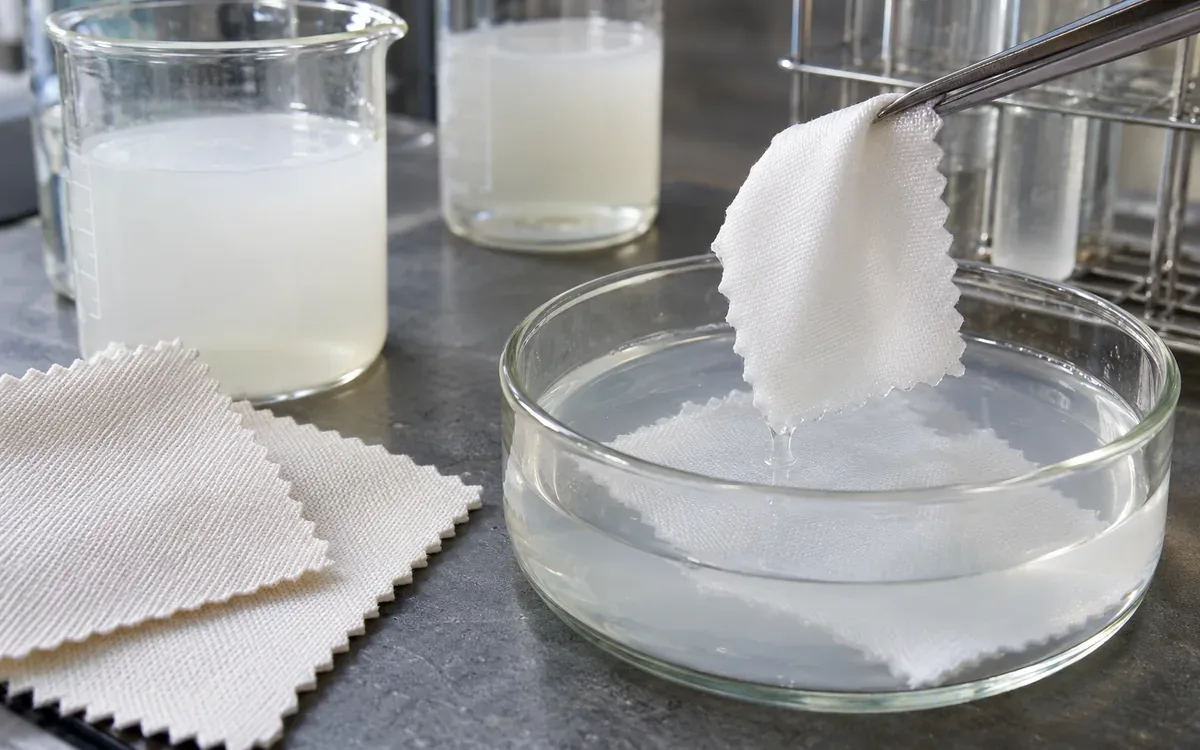
Mercerization can change dye response. Demonstrate the useful effect with a controlled trial on matched material.
Use the same dye lot, route, and measurement conditions for the first comparison. Record shade depth and hue, not just one strength number. A deeper result with an unwanted hue shift may not meet the target.
If the trial uses K/S or another colour-strength measure, state the method and conditions. A colour-strength index may rise by 20%. That does not prove that dye dose can fall by 20%. Compare dose and response for the actual colour system.
Prove the lower-dose route separately
Take a teaching example in which the reference dye dose is 2.0% of fabric mass. A separate controlled trial tests mercerized fabric. It reaches the approved shade at 1.8%.
The relative dye reduction is:
(2.0 − 1.8) ÷ 2.0 × 100 = 10%
For 2,000 kg of fabric, the amounts are 40 kg and 36 kg, a difference of 4 kg.
This shows dye mass saved for that example. It does not establish total process savings or colourfastness. Check mercerizing cost and usable fabric yield. Include the required fastness results too. Use these to choose the commercial route.
Use a clear shade approval and sample-control process. ApparelDiary explains one in its lab dip and buyer sign-off guidance.
Track width, length, and area together
A chemical treatment may change the amount of usable fabric area. A cost comparison based only on the input kilograms can miss that effect.
Use a consistent conditioned state for dimensional comparisons. State whether width includes the selvedges and how usable width is defined.
Consider this hypothetical trial:
Measure | Before treatment | After the defined route |
|---|---|---|
Length | 1,000 m | 970 m |
Usable width | 1.50 m | 1.46 m |
Usable area | 1,500 m² | 1,416.2 m² |
Area after treatment is 970 × 1.46 = 1,416.2 m².
Area reduction = (1,500 − 1,416.2) ÷ 1,500 × 100 = 5.59%
Adding the length and width percentage changes gives only an approximate area change. For square metres, multiply the actual dimensions.
This is a process-yield comparison. It is not a laundering-shrinkage result. Later dimensional stability needs its own specified test.
Recalculate cost on accepted area
If the route costs 450 currency units for the example lot, its cost per accepted square metre is:
450 ÷ 1,416.2 = 0.318 currency units/m²
Using the input area would give 0.300. The difference matters when comparing routes with different contraction or defect loss.
Keep the cost boundary clear. A treatment that costs more per kilogram may still suit a higher-value product. The calculation should reveal that choice rather than hide it.
Finish the washing and residual-alkali checks
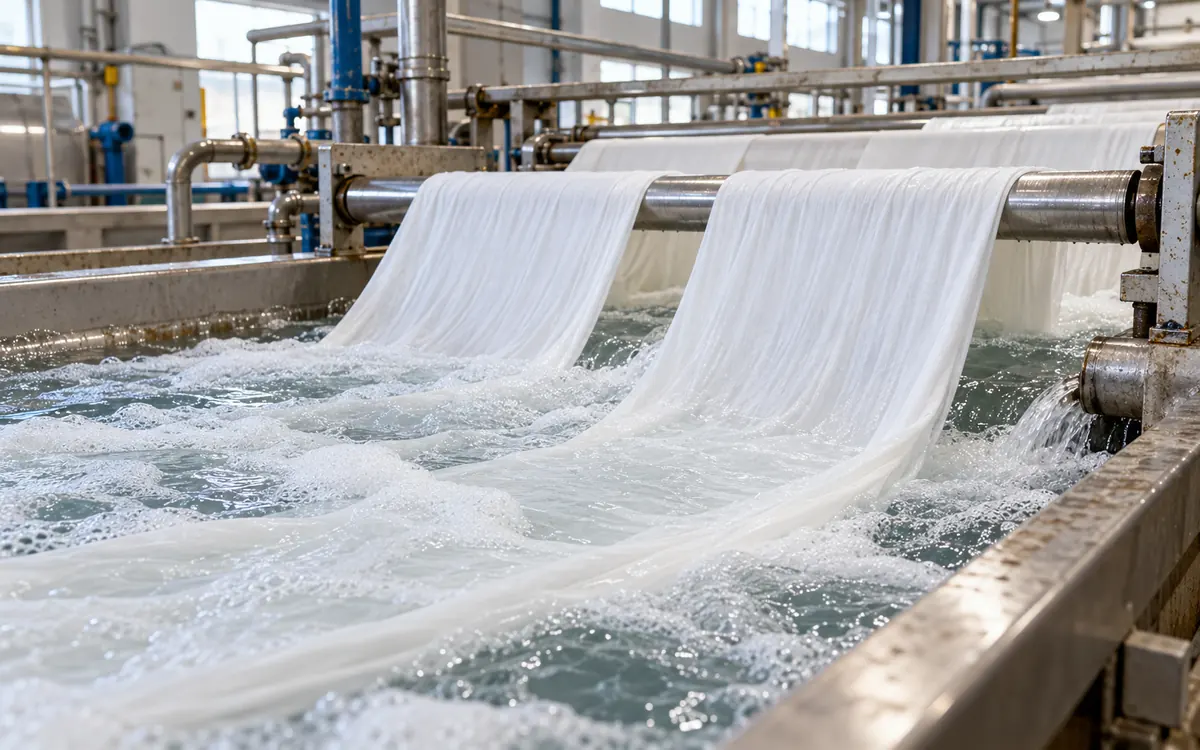
The fabric must leave the route in a condition suitable for the next operation. Define the washing and any neutralization steps as controlled parts of that route.
Do not use one easy pH reading as proof of every residue requirement. An extract pH and a total-alkalinity result answer different questions. Use the tests and limits required by the next process.
Record the sampling stage and specimen preparation. A result from a wash liquor is not automatically a result for the fabric.
Some processes hold the fabric under a defined restraint during washing. Keep that sequence in the approved procedure. Releasing the cloth at a different stage changes the process. An unchanged chemical dose does not cancel that change.
Link the preparation record to subsequent dyeing. ApparelDiary's right-first-time reactive dyeing guide explains the link. A stable starting state helps later shade control.
Judge recovered caustic by both chemistry and performance
Caustic recovery returns useful material to the process. The recovered liquor needs its own quality checks. Concentration alone may not prove that it suits the intended use.
Researchers explored waste-alkali recovery in a 2024 mercerizing study. They compared recovered liquors in different textile uses. The reported performance differed between mercerizing and peroxide bleaching. This supports testing recovered liquor for its intended use.
Ask the chemical and equipment specialists to define the required analysis. Agree on contaminant limits. Keep records of the source and reuse history.
In a trial, use matched fabric and the same controlled conditions. Compare recovered liquor with fresh liquor. Record both chemical and fabric results. Do not ignore an unexplained change just because the liquor costs less. Check changes in appearance and process stability.
Calculate recovery on an active-mass basis
Suppose a hypothetical recovery stream weighs 2,000 kg and contains 10% NaOH by mass. It contains 200 kg of NaOH.
If processing returns 800 kg at 22% NaOH, the recovered active mass is 176 kg:
Active recovery = 176 ÷ 200 × 100 = 88%
The returned solution has a higher concentration but a lower total active mass than the feed. Concentration increase is not the same as recovery yield.
A full plant balance includes all streams and inventory changes. Account for sampling and measurement uncertainty too. The simple example shows which quantity belongs in the yield calculation.
Troubleshoot by comparing matched evidence
A useful fault record connects the fabric map, test results, and machine history. Decide what the comparison needs to show. Then choose the trial variables. Changing tension and chemistry together can obscure their separate effects.
Observation | First comparison to make |
|---|---|
Chemical result passes. Lustre differs. | Check the viewing setup, restraint history, and later finishing. |
Edge and centre give different results | Map the samples. Check contact and control across the width. |
Trial dye strength rises but approved shade fails | Check hue and dose response. Compare matched dyeing conditions. |
Width is low despite good chemical results | Check input width and restraint settings. Measure size changes at each stage. |
Results drift during a wet-entry run | Check incoming water and the concentration trend. Review the control response. |
Recovered liquor changes product performance | Check active content and impurities. Run a matched fresh-liquor trial. |
Keep trial changes limited enough to interpret. Once a likely cause is found, verify the correction on a new set of matched specimens.
Release the process within its proven scope
State the scope of the validation. Which fabrics and machine arrangements does it cover? Which entry conditions and chemical sources? Do not extend one successful trial to unrelated products.
For first production, preserve the location map and check the next process outcome. A laboratory specimen may not reproduce full-width restraint or contact.
Use actual test values and clear limits on the release sheet. Keep the reference samples and the method edition traceable.
Use the current safety data for caustic handling. The equipment must be compatible, and operators must be trained. OxyChem's handbook gives handling guidance. The mill still needs an approved procedure for its own system. A concentration calculation does not prove that mixing or maintenance is safe.
Frequently asked questions
Is barium activity number a percentage mercerization?
No. It is a relative uptake index under the specified test. It can indicate whether the reaction occurred and its extent. It is not a direct percentage of cotton converted. Nor is it a percentage gain in finished performance.
Can a high activity number replace a lustre check?
No. Chemical response and appearance are different evidence. Approve the fabric against the actual purchase requirement.
Does slack mercerization mean poor process control?
No. It can be an intentional route for a particular construction. The input design, dimensions, and later finishing must support that goal.
Can recovered caustic replace fresh caustic by concentration alone?
No. Qualify the recovered liquor's chemistry and performance for the intended use. Check the full process, not just a density or concentration reading.
Will mercerization always reduce dye cost?
A particular target may need less dye. Prove that with a controlled shade trial. Total cost also depends on the mercerizing route and fabric yield. Quality and product value matter too.
Verify the result that the customer will use
A well-controlled mercerizing route connects chemistry, restraint, washing, and fabric performance. Barium activity testing provides useful evidence. Also check the intended appearance, dimensions, shade response, and strength before deciding.
Keep the comparisons matched and the units clear. Judge the full result when choosing a route. The mill can then show what value it adds. It can explain the evidence behind the “mercerized cotton” claim.
References
Cotton Incorporated: Mercerization.
Benninger: Mercerizing solutions.
Cotton Incorporated: Processing 100% cotton woven fabrics for filling stretch.
OxyChem: Caustic Soda Handbook.
AATCC: TM89-2025, Mercerization in Cotton, scope and principle.
AATCC: Changes in the 2026 Manual.
Experimental investigation of hot mercerization of cotton fabric.

Discussion0
Loading the discussion…