
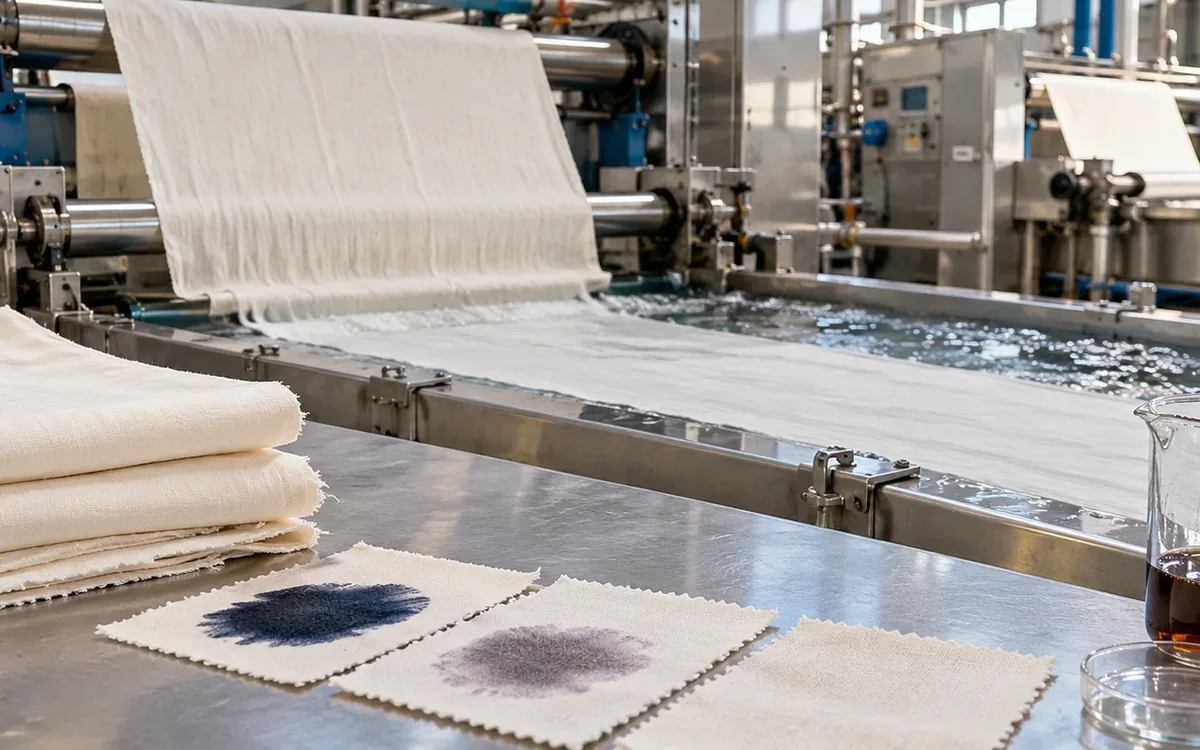
Enzyme desizing has two aims. First, break down the starch. Then wash the resulting material out of the fabric. Those are two separate jobs. A bath may contain the correct amylase yet leave the cloth poorly prepared. Uneven wetting, contact or washing can cause this.
The starting point is the size recipe used at the weaving mill. Cotton fabric may carry starch, modified starch, synthetic size, waxes or a mixture. Do not expect amylase to remove every part of an unknown coating. Find out what is present. Choose a route, then test cloth that represents the lot.
This guide develops that sequence for woven cotton. It explains what an enzyme does. It shows how to trace reaction and wash-off problems. It also explains residual-starch checks. The examples compare fabric mass loss, starch removal and total size removal. These measures can give very different percentages.
Ask for the size history before writing the recipe
During weaving, size helps the warp withstand repeated contact and tension. The coating is useful at that stage but may obstruct later wet treatment. CottonWorks defines desizing as a preparation step to degrade and remove warp size. This helps dyeing or finishing proceed evenly.
Ask the fabric supplier what the size contains. Get the product grades and the basis used to report the amount applied. Also request any after-waxing or other treatment used to improve loom running. A trade name alone may not reveal whether the recipe contains a starch blend.
Keep this record with the greige lot. The weaver may have changed the size amount to help the loom run well. The fabric construction number could still be the same. Repeating last month's desizing route could then produce a different result.
If these details are missing, use the mill's test methods to study the size system. Do not turn an uncertain test into a guessed complete formulation. Record what the tests show. Note what is still unknown before choosing a production trial.
Separate starch breakdown from physical removal
Alpha-amylase acts on starch chains. It forms smaller fragments that are easier to wash away. It is not a general solvent for all textile coatings. Novonesis describes this starch-specific action in its Aquazym information.
Think of the process as a sequence. Liquor must wet the sized yarn. The enzyme must reach the starch under suitable conditions. The reaction must proceed far enough. Washing must then carry the loosened and degraded material away from the cloth.
A failure at any stage can leave a residue. Adding more enzyme cannot correct every later washing fault. It may also be wasteful when the real issue is that the centre of a dense fabric never wets as well as its edges.
Synthetic sizes need their own removal plan. Cotton Incorporated's textile dyeing booklet distinguishes preparation operations and size removal routes. Use the size supplier's instructions for the grade present. This is vital when a blend contains both starch and a synthetic polymer.
Select the enzyme as a product with defined conditions
Commercial amylases differ. The product name, concentration and recommended process conditions belong in the recipe. One kilogram of a new product may not match one kilogram of the old one. The activity delivered to the fabric may change.
For example, CHT lists an optimum pH range of 5.0–7.5 for BEISOL T 2090. It gives a range of 6–9 for BEISOL PRO. These are product-specific descriptions, not interchangeable limits for all amylases.
Obtain current technical and safety information for the selected grade. Confirm the suitable temperature, pH and exposure time. Check the water needs and whether the other ingredients work with the enzyme. Ask which process measurements the supplier expects during a trial.
An enzyme activity unit also needs its assay definition. Two suppliers may use different substrates, temperatures or timing to measure activity. A larger unit value on a label does not prove better performance in the proposed bath.
Store and dispense the product according to its instructions. Record the batch and expiry or retest status. If a stored product performs differently, review its storage history first. Do this before changing the fabric or machine settings.
Match the route to the fabric and equipment
Consider an exhaust treatment, a pad-batch route and a continuous range. Each creates different contact conditions. They cannot be compared by chemical concentration alone. Check the fabric form, wetting and liquor movement. Time at the required conditions also matters.
On a continuous route, check two times. One is nominal line time; the other is actual reaction exposure. Suppose a defined fabric path is 90 m. At a steady 30 m/min, nominal residence time is 3 minutes. That arithmetic does not show how quickly the cloth reaches the intended conditions.
For a batch route, record loading and fabric movement. Mark the start of the validated treatment period. The first water fill may start before the bath reaches its required temperature and pH. Time from that fill is not the same as treatment time. State the timing rule clearly on the batch record.
Fabric construction changes access. A heavy, tightly woven cloth may be hard to wet or wash. A light open weave can behave quite differently. Trial the actual material. A convenient sample of other cloth cannot approve this route.
Check wetting across the fabric width
Take samples from the left, centre and right of the cloth, with a defined distance from the selvedge. Include more than one length position when the lot is long or a process fault is suspected. Label the face and direction before handling the pieces.
Before treatment, note uneven size, oily marks and visible contamination. After treatment, use the agreed absorbency test and residual-starch method. These checks answer related but different questions. A fast wetting result does not identify every remaining size component.
In a fictional trial, samples from both edges wet quickly. The centre remains slow. The pattern suggests an across-width issue worth investigating. The cause could be padding, fabric density, size distribution or later washing. The pattern alone does not identify it.
Keep the map of individual readings. Reporting only the average can conceal a strip of poorly prepared fabric. That strip may become a visible shade band in the next treatment. By then, it can be harder to trace the original preparation pattern.
Make washing part of the desizing specification
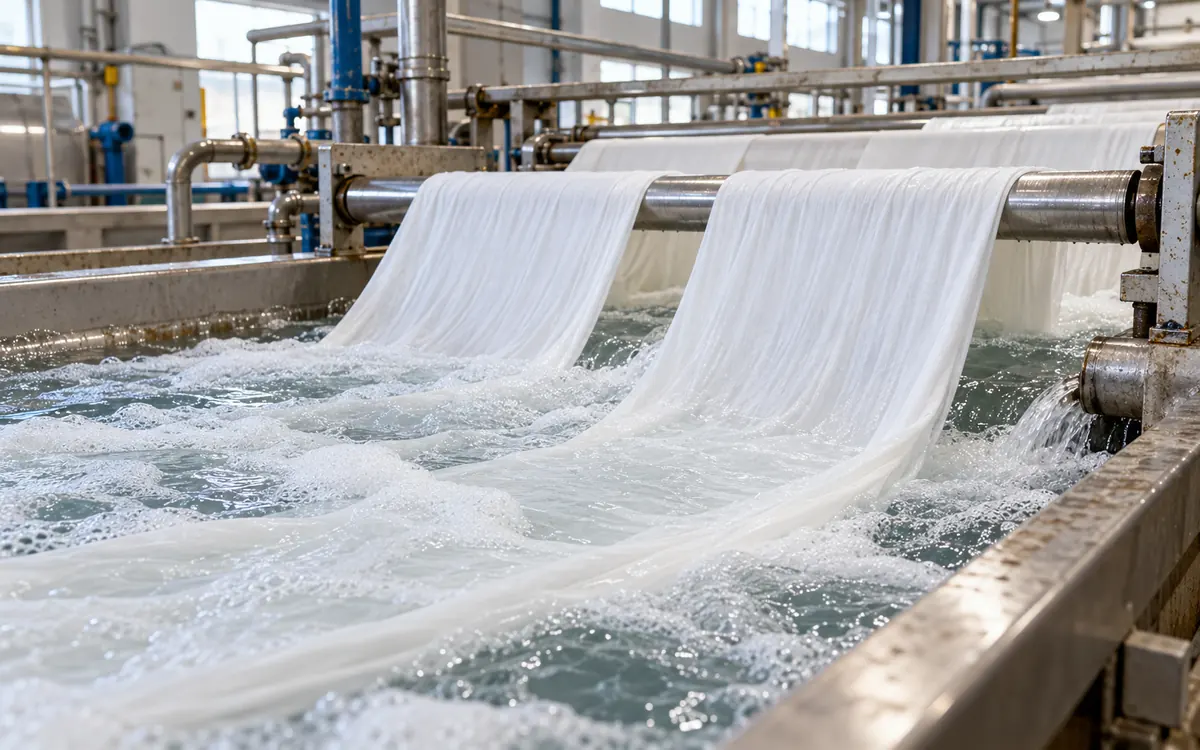
The wash stage should be defined as carefully as the enzyme stage. State the equipment route. List the approved controls for fresh water, liquor replacement, mechanical action and temperature. Record stoppages or departures that could change removal.
Washing moves degraded size from the fabric into the wash liquor. The system must then remove that liquor. Heavily loaded liquor may be less able to take up more size. Material may also return to the fabric. Validate any plan to reuse this liquor.
A clean-looking final bath does not prove that every part of the cloth has been cleaned. Conversely, cloudy wash water is not a direct measure of remaining starch. Use the defined fabric tests to release the lot.
When a trial fails, retain a piece after the enzyme stage and another after the wash stage. Suitable intermediate testing can help show where the route stopped working. Keep the sample states distinct. A wet intermediate piece differs from a dried final sample. Use a defined method if the two are to be compared.
Use the iodine check for the question it can answer
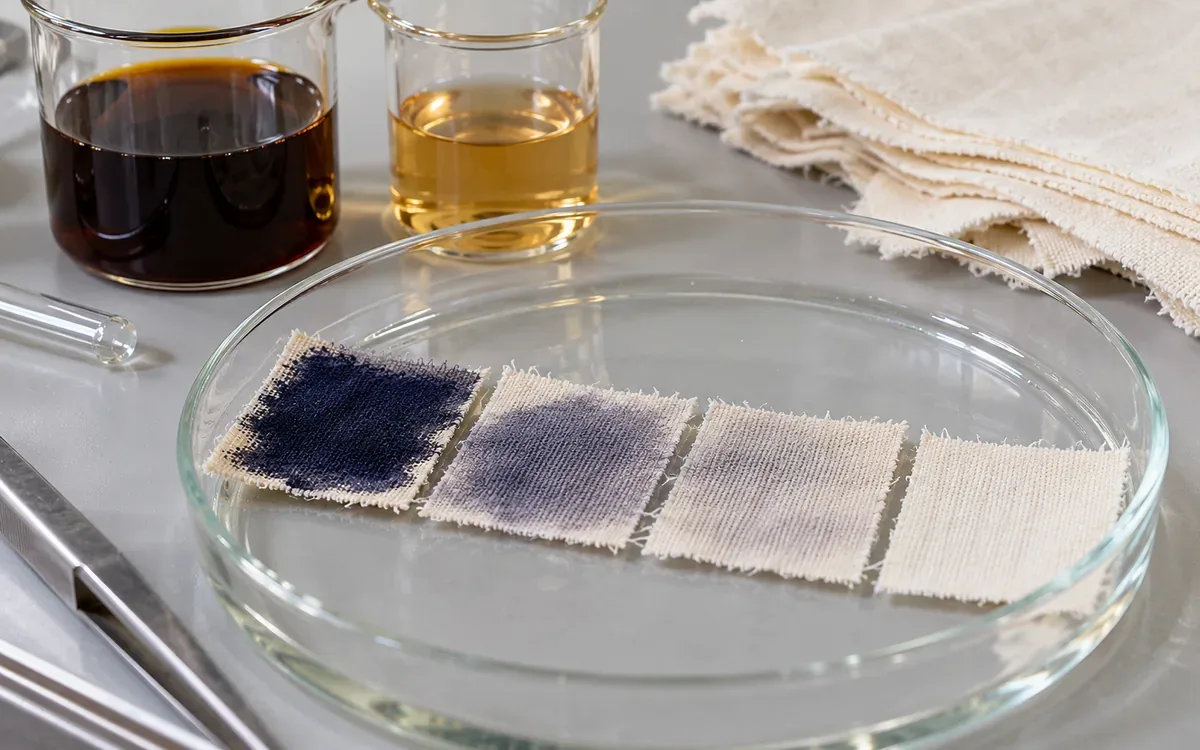
An iodine-based residual-starch test is a useful screen when starch is part of the size. The lab should follow its controlled method. This covers sample preparation, reagent, contact and comparison. Record the rating system and the required acceptance rule.
Rehman and colleagues used several checks in an original desizing study. They combined a TEGEWA comparison with weight loss, water absorption and microscopy. The value of that design is the use of several observations. Those trial conditions apply to the study. Do not copy them as a production recipe for a different enzyme or fabric.
A starch rating covers starch. A passing result does not prove that PVA, wax or other materials have been removed. It also does not prove suitable strength or even dye uptake. Keep the test's chemical target clear when reporting the result.
Use fresh, controlled reference material where the method requires it. Follow the specified viewing conditions, too. A phone image can help identify a sample. Its colour processing may change the view. Keep the approved rating procedure as the basis for the result.
Do not turn visual grades into exact percentages
A visual scale places a specimen in a defined category. It does not automatically provide a precise chemical concentration. If the lab reports a TEGEWA rating, record that rating and its method. Do not turn it into an invented removal percentage.
Suppose five positions receive ratings that include one below the agreed lot rule. Averaging the grades may hide the location that needs attention. Follow the acceptance plan for the individual results and the sampled lot.
A quantitative test measures how much size remains. If that result is needed, choose a suitable method for the material present. Ask the lab how well the method extracts the size. Check its selectivity and reporting basis, too. Simple mass loss answers a different question. To interpret it as size removal, first establish what makes up that mass.
Avoid reporting “all size removed” from a negative starch screen. Name the sampled positions. State the residual-starch requirement. Say whether the results meet it. Add the other release results separately.
Work through three different removal calculations
Consider an original mass-balance example. Assume a sized sample contains 100 g of dry cotton, 8 g of starch and 1 g of another size component. Its initial dry mass is 109 g. These component amounts are assumed known for the calculation.
After treatment, assume the cotton remains at 100 g. Residual starch is 0.5 g and the other residue is 0.5 g. Final dry mass is therefore 101 g. The total measured loss is 8 g.
Fabric mass loss = (109 − 101) ÷ 109 × 100 = 7.34%.
Starch removal = (8 − 0.5) ÷ 8 × 100 = 93.75%.
Total size removal = (9 − 1) ÷ 9 × 100 = 88.89%.
All three percentages are correct for the stated assumptions. They use different denominators and answer different questions. Calling the 7.34% mass loss a 7.34% desizing efficiency would misdescribe the result.
Measure | Numerator | Denominator | Example result |
|---|---|---|---|
Loss from the complete sized sample | 8 g | 109 g initial sample | 7.34% |
Removal of starch | 7.5 g | 8 g original starch | 93.75% |
Removal of all assumed size | 8 g | 9 g original size | 88.89% |
The example assumes no cotton loss and no unmeasured deposit. A real mass-loss test cannot establish those assumptions by itself. Retain that limitation when interpreting a production sample.
Control moisture before comparing sample mass
Water can be larger than the residue difference under investigation. Compare masses at the same defined dry or conditioned state. Use the lab procedure that fits the analysis. Record its conditioning or drying requirements.
Imagine that the true dry masses before and after treatment are 109 g and 101 g. If the first weighing includes 6 g of moisture and the second includes 9 g, the observed masses become 115 g and 110 g. Apparent loss is only 5 g, although dry material loss is 8 g.
The difference comes from unequal moisture. The assumed size-removal performance has not changed. The example shows why the weighing state matters. An untreated piece from storage is a weak reference for a hot, freshly dried treated piece.
Use separate, identified test specimens where the method requires them. Do not keep drying and rewetting one piece through an improvised sequence. That cannot be reported as the standard test.
Design a trial that can distinguish reaction and wash effects
Start with matched fabric and one reference route. Does the main question concern enzyme exposure and washing? A small planned comparison can vary those factors separately. The actual trial conditions must remain within the approved product and machine limits.
For illustration, compare two approved exposure options with two approved wash options. That gives four route combinations. Take three independent pieces for each combination at each of two fabric positions. The plan needs 4 × 3 × 2 = 24 pieces for the stated checks.
These counts are an example, not a standard sampling rule. Additional material may be needed for strength, chemical analysis or retained controls. Ask the lab to allocate the material. One destructive test must not use up the pieces reserved for another.
Keep the order of trials balanced where practical. Suppose every reference runs first. The new route always runs after the machine warms up. Time and machine condition could then be confused with the process change. Record unavoidable differences rather than concealing them.
Interpret the pattern before increasing the dose
Trial observation | Useful next question |
|---|---|
Residual starch is high at every location | Check product identity and activity. Were pH, temperature and time correct? |
Residue is concentrated across one strip | Was that strip wetted evenly? Was application uniform? |
A stronger wash improves the same enzyme treatment | Was removal limiting the result? |
Starch result passes but absorbency remains uneven | Could another size remain? Check for wax or contamination, too. |
Final strength is unexpectedly low | What changed in material, treatment or testing? |
The table directs an investigation; it does not diagnose the cause. Preserve the failed and reference pieces. Review their production histories and the original test observations before changing several settings.
A stronger enzyme dose might be justified in one case. In another, it may add cost while the cloth still carries the degraded material into the next process. A useful trial identifies which stage needs the change.
Check compatibility instead of assuming it
The bath may contain wetting agents, salts and residual chemicals. The fabric can carry other material into it, too. Confirm their compatibility with the selected enzyme. A lab assay measures activity under its own conditions. It does not establish activity in every production bath.
A 2026 study examined a thermostable recombinant amylase. Surfactant choice affected desizing performance in that study. The abstract names the enzyme studied. This supports testing the actual combination. It does not prove that one surfactant class always gives the best result.
Review what the incoming fabric may carry into the bath. Check for relevant residual oxidants or other treatments. Use the supplier's compatibility guidance and appropriate tests. Two products may both be sold for cotton preparation. That does not prove they can work together in one bath.
For a proposed combined process, identify the job assigned to each component. If the route changes desizing, scouring and bleaching together, judge the whole route. It cannot isolate the enzyme's benefit on its own. The trial design must separate those effects.
Follow start and stop sections through a continuous range
Startup and stops change exposure on a continuous route. Every metre may not receive the same treatment. Identify the cloth that was in each section when speed changed. Record the time and length marks. The affected cloth can then be sampled apart from the steady-running material.
Suppose a range stops with one section of cloth in the reaction zone and another in the wash section. Their histories are different even though they belong to the same roll. Restarting at the usual speed does not erase the extra exposure or holding time.
Use the equipment's approved stop and restart procedure. After an unplanned event, investigate the affected length under the mill's release plan. Keep the uncertain section on the sampling map. Later fabric may look uniform, but that does not clear the earlier section.
Establish whether the test can distinguish the trial options
A lab method or investigation may call for two references. One is known untreated cloth. The other is suitable prepared cloth. Include both where needed. These references check the test itself. Can it detect the relevant difference under the current conditions? They should have stable identities and known storage histories.
If every reference gives the same unexpected rating, first examine the test setup. Check the reagent condition and sample handling. An unsuitable comparison may also limit the result. Resolve these test problems before increasing the enzyme dose. The trial needs a measurement that can be trusted.
Also distinguish repeat readings from independent specimens. Rating the same spot three times checks reading consistency. It does not provide three separate observations of the fabric lot. Use each form of evidence for its intended purpose. Report how the samples were taken.
Compare resource use at the accepted fabric stage
A shorter enzyme stage can still require more washing or create extra repeat work. Compare complete routes through the same release point. Record water, energy, products, time and accepted output on a consistent basis.
Suppose route A treats 1,000 kg and uses 12 m3 of total process water. Route B treats the same mass and uses 10 m3, but needs an extra 4 m3 wash to meet the agreed checks. Their final water use is 12 and 14 L/kg respectively, assuming all fabric is accepted.
Counting only B's first 10 m3 would suggest a saving. The complete route did not achieve that saving. Some fabric may still be on hold. Keep that output separate until its acceptance is known.
The same approach applies to enzyme cost. Compare cost per accepted kilogram and note any differences in quality. A lower dose may leave size on the cloth. This may lead to shade correction or repeat finishing. Those costs can outweigh the initial saving.
Keep enzyme handling within the site control system
Enzymes are process chemicals with defined handling needs. Avoid treating the word biological as a claim of unrestricted safety. Use the current safety data sheet. Follow suitable transfer methods and the site's exposure controls for the supplied form.
AMFEP and TEGEWA publish guidance on enzymes in textile manufacturing. Their guidance points to safe handling through the supply chain. Control exposure during dispensing, transfer and cleanup. Follow the relevant supplier and site instructions for each job.
Do not create a mist to make a small trial easier. Keep any sampling and cleaning procedure within the approved system. Record any change in equipment or handling as part of the trial. Include it in the technical review.
Release the lot with a defined evidence package
Identify the greige lot and known size system in the release record. Add the enzyme product and batch. Record the route revision and actual process conditions. Include the sample map and the residual-starch results. Add absorbency and the other properties required for the next operation.
State the acceptance scope clearly. A lot may be released for further preparation. That does not necessarily approve it for final dyeing or customer use. Keep any remaining scouring, bleaching or finishing work visible in the route.
ApparelDiary's warp-sizing control guide helps the preparation team use the upstream size record. Its reactive dyeing guide explains the link between preparation results and the dye batch.
Common questions about enzyme desizing
Does amylase remove every size used on cotton?
No. Amylase is selected for starch breakdown. A mixed size needs a route that addresses the other components. Confirm the actual formulation. Do not assume that all coatings on cotton are starch.
Is a negative iodine result enough to release the cloth?
It supports a residual-starch decision within the method's capability. It does not establish removal of every synthetic size or wax. The other required release checks still apply.
Can more enzyme compensate for poor washing?
Not reliably. Reaction and removal are separate stages. Use a controlled comparison. Find out whether the weak step is starch breakdown, wash-off or both.
Should the largest mass loss win the trial?
No. Mass loss may include more than size, and unequal moisture can distort it. Judge residue removal, uniformity, retained fabric properties and resource use together.
Build the route around removal and verification
Good desizing starts with the size that was actually applied. Match the enzyme to that material and the operating conditions. Give washing a clear role, too. Release the cloth from representative results with honest test limits. A good average can hide a poorly treated strip. So can a clean-looking swatch from the wrong place. The release checks should find these problems before the cloth reaches dyeing.
References
Novonesis — Aquazym Desizing Enzymes.
Cotton Incorporated — Textile Dyeing.
Rehman and colleagues — Eco-friendly Textile Desizing with Amylase.
Bioprocess and Biosystems Engineering — Thermostable Recombinant Amylase for Textile Desizing. Public abstract and correction history.
Discussion0
Loading the discussion…