
Start with the desired finish, not the wash name
A buyer may request a biowash while a laundry offers an enzyme wash. The two parties may mean the same treatment. They may also mean quite different results.
Enzyme wash describes the use of enzymes in a washing or finishing process. Biowash is a trade term. It often means an enzyme treatment used to improve the fabric surface. Neither name alone defines the enzyme or working conditions. Neither sets the acceptable change.
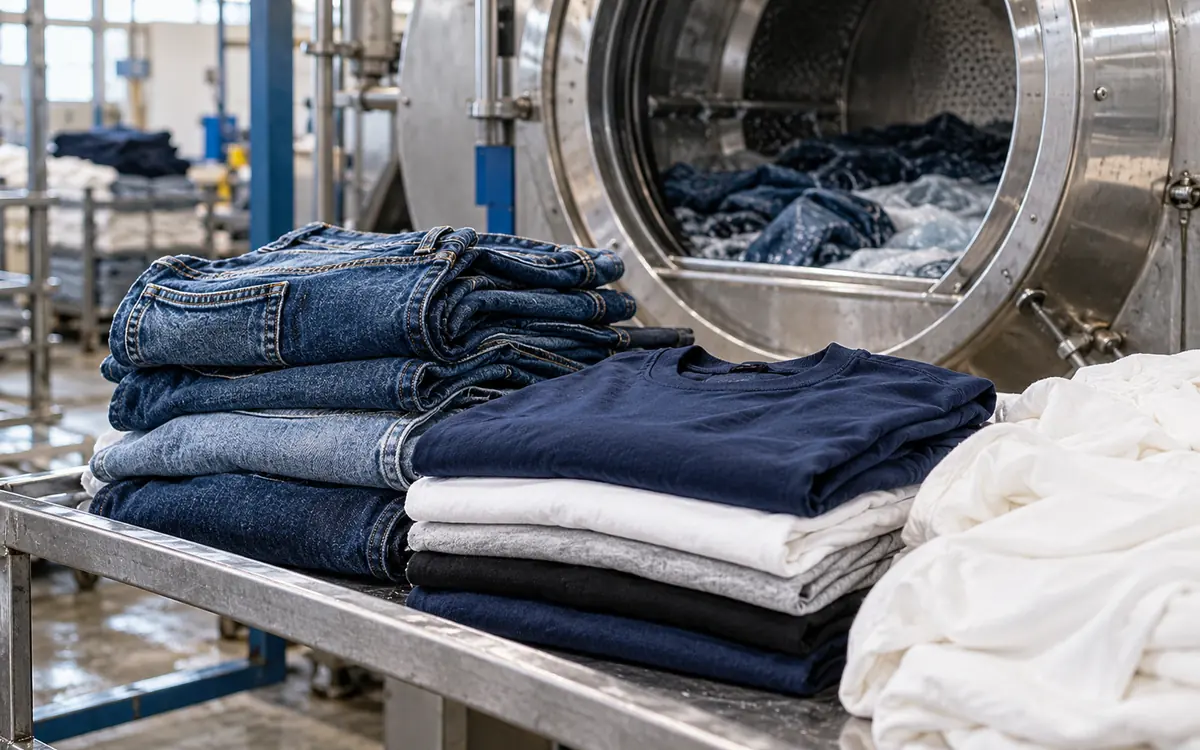
For a cotton T-shirt, the aim may be a cleaner surface with less loose hair. For indigo denim, the aim may be a worn appearance and a change in colour contrast. Both can involve cellulase. Each needs its own product brief.
The useful comparison is therefore about purpose. Ask what material should change. State what must remain intact and how to judge the result. That makes the request clear enough to develop and repeat.
Distinguish three different jobs
Three tasks in cotton garment processing are easy to confuse. They are starch desizing, surface biopolishing and denim abrasion.
Treatment goal | Typical enzyme role | Main result to verify |
|---|---|---|
Remove starch-based size. | Amylase acts on starch. | Check size removal and unwanted damage. |
Improve a cotton surface. | Cellulase acts on exposed cellulose at the surface. | Check for reduced fuzz or better pilling performance. |
Develop a denim wash effect. | Cellulase supports controlled surface abrasion. | Check shade and worn effect. Confirm adequate strength and sound construction. |
This is a practical distinction, not a complete list of textile enzymes. A commercial product may combine functions. A process may also contain more than one stage.
Novonesis identifies Aquazym as an amylase product family for starch-based size removal. Its Cellusoft cotton biopolishing range serves a different purpose. That range is based on cellulase.
A cellulase-only treatment is not a guaranteed way to remove starch size. If desizing is needed, identify the size system and select the appropriate route.
A denim process sheet may include starch desizing. That alone is no reason to assign the same step to a knit garment. Establish what is actually present.
Understand the overlap between biopolishing and enzyme washing
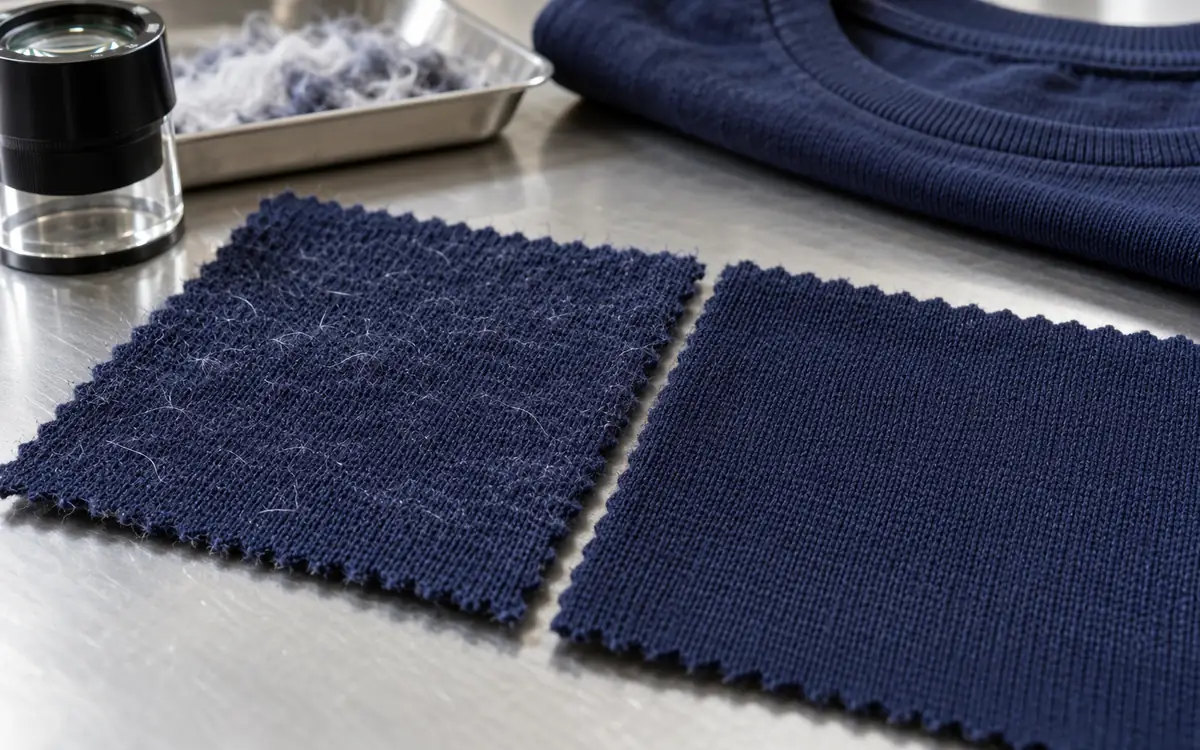
Biopolishing is a useful name for a surface improvement goal. On cotton, the treatment can reduce material that sticks out from the surface. This may give a less fuzzy appearance.
It does not define one universal recipe. The chosen product and fabric construction affect the result. Prior processing and mechanical action also matter.
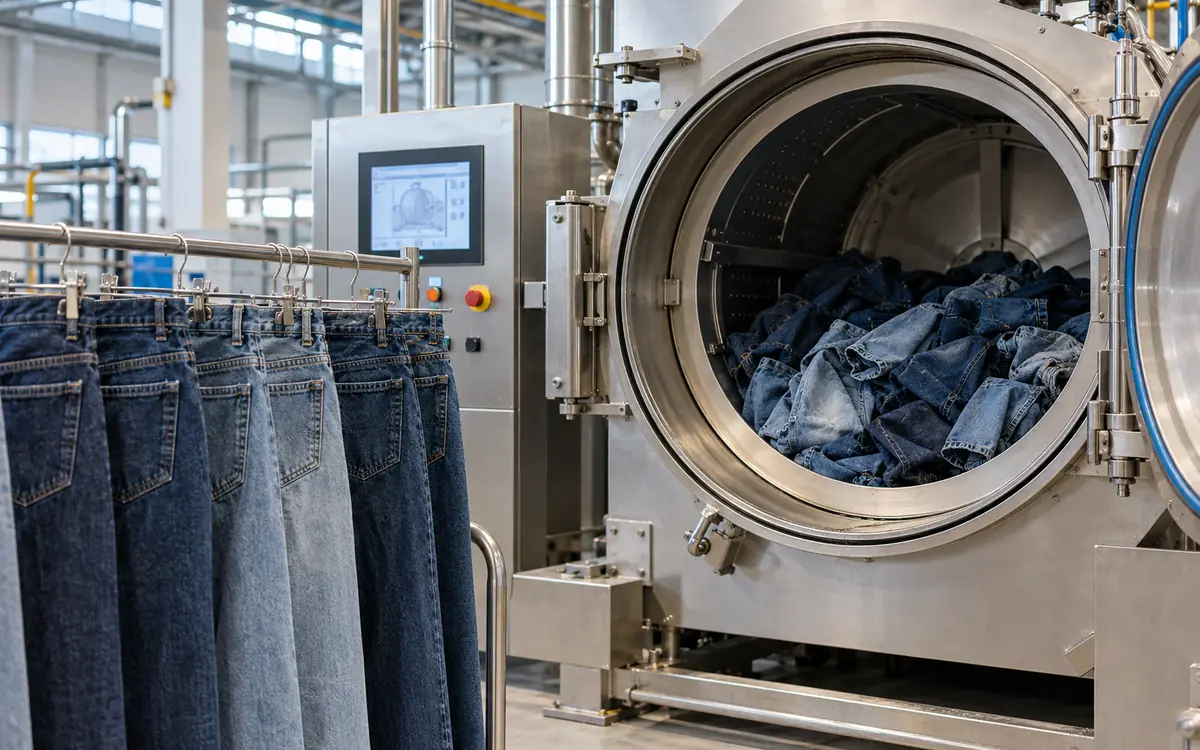
A denim enzyme wash can also alter the surface. Its visual brief may focus more on colour removal and worn areas. Novonesis markets cellulase products for denim abrasion separately from its cotton biopolishing offering. The intended use thus matters even within a related enzyme family.
Do not use an unsupported claim about enzyme molecule size to separate the two terms. A wash name does not define the molecule size or behaviour of a given product.
Also avoid saying that biopolishing can never affect colour. A change in surface texture can alter visual depth or brightness. Treatment and washing may also change the actual shade. Test the intended garment instead of promising no change.
Mechanical action still needs control
Enzyme activity and physical movement work together in many garment treatments. The word bio does not remove the need to control garment movement.
Rudolf's garment finishing information includes cellulase biopolishing products. Their performance depends on controlled temperature, pH, time and surface mechanics. It also identifies distinct amylase and combined enzyme products.
During development, record the machine and load basis. Add the movement settings used. Contact in a laboratory container differs from contact in a production drum.
A folded collar may receive a different local effect from a flat body panel. A dense seam can respond differently from an open knit surface. Check those areas rather than judging only the centre of the back.
Do not increase mechanical severity simply because the expected effect is weak. First confirm the product identity, preparation and operating conditions. Extra movement may create holes or seam wear. It may leave the real cause unresolved.
Write a cotton garment effect brief
A good brief describes an outcome that someone else can judge. It should be more precise than biowash required.
Consider a hypothetical cotton polo. Its brief might call for a cleaner body surface and no obvious change in the approved navy shade. It might also set a pilling test limit and require the collar to retain its shape.
State whether the rib, collar and body should look alike. These components may have different yarns, constructions and finishes.
Identify the comparison sample. This could be an approved untreated garment or a selected development sample. It could also be a physical surface standard. Label it clearly and protect it from handling damage.
Specify the stage of assessment. A garment may be examined before final softening. Its feel may then differ from the packed product. A surface seen while damp may not represent its dry appearance.
Define unacceptable changes too. These may include exposed stitch holes, worn edges or print damage. Distorted rib and shade shifts beyond the agreed limit may also be unacceptable.
Read the product information before choosing conditions
Obtain current technical and safety data. Make sure they cover the exact enzyme product. Record its name, lot and storage requirements.
Check the intended fibre and use. Confirm the activity basis and working range. Products in one trade family may need different conditions. Do not transfer the instructions from one member to another.
Commercial enzyme products can differ in concentration. Equal masses of two products may not provide equal activity. Even activity values need the same assay basis. Check this before comparing them directly.
Ask the supplier to explain any proposed substitution. A supplier may say the new product is twice as strong. Ask what that means. Check it in an application trial.
Check compatibility with other materials in the bath. Two products may work well separately. That does not prove that they remain effective together.
Consider a hypothetical offer for a lower-priced product. It might need more kilograms per batch to reach the same approved effect. Compare the total cost of the qualified process. Include stopping and finishing stages. The price per kilogram alone leaves those costs out. Keep this cost comparison separate from product activity. A cheaper result does not prove equal enzyme strength. Base the purchase decision on the actual accepted output. Include extra treatment time as well as the product price.
Keep the chosen instructions attached to the approved route. A process sheet that names only enzyme leaves the product choice open. Staff could then substitute a different product without review.
Control the starting garment
Before interpreting treatment results, examine the untreated material. Record cotton content and yarn construction. Describe the surface and previous wet processing.
A hairy surface may result from the fabric construction. A local patch may come from contamination. Those causes may need different development decisions. The same wash cannot be expected to correct every starting defect.
Keep a matched untreated control from the same lot. A control from another lot may already differ from the test garment. The difference could predate the enzyme stage.
For a blend, state which part of the surface is the target. Cellulase may act on the cotton component. That does not establish the same response for a synthetic fibre in the blend.
Check decoration and trims separately. An enzyme may suit the shell. The whole route could still harm a badge, print or elastic component.
ApparelDiary's guide to reactive dyeing control covers the earlier stages. It explains the checks needed for preparation and shade control. Know the material's starting state before a finishing trial.
Define the treatment endpoint
Elapsed time is a process setting. The endpoint is the required final state. At that point, the treatment has achieved its goal without unacceptable change.
During development, relate the two. Examine samples at planned stages. Use the same stopping and finishing procedure each time. Otherwise, a specimen may keep changing while it waits for assessment.
Do not treat the first attractive sample as the complete answer. Check that it retains enough strength. Does its appearance survive the intended care route?
An endpoint record should identify the product and conditions. Link them to the surface grade, shade result and strength checks. It also includes the garment's final drying and finishing route.
The effect may keep improving while strength falls. Continuing until the surface is smoothest may be the wrong decision. The product brief sets the acceptable balance.
Once the route is chosen, state what to do if the process stops unexpectedly. A delay during an active stage may change the garment. The same delay after stopping the enzyme may have a different effect.
Stop and finish the process as a defined stage
The method used to stop an enzyme depends on the product. Use the supplier's validated method. Confirm that it suits the garment.
“Raise temperature” or “add a chemical” gives an incomplete instruction. It omits the required conditions. It also leaves open whether the method suits the materials and how to confirm its effect. Do not improvise a stopping method from a different product sheet.
Record the process evidence needed for the review. This may include the actual time and conditions used to stop the enzyme. Add any confirmation checks specified by the supplier.
Complete the defined rinse and extraction steps. Then follow the set drying and finishing sequence. Different finishing routes can distort the surface comparison. An apparent enzyme effect may come from drying or softening.
Use the same softener during a comparison. Keep its application method fixed too. A change in lubrication or handle can make one garment feel smoother. That garment may still have more loose surface fibre than another sample.
For that reason, assess both appearance and touch. Neither check alone gives a complete picture of the treatment.
Choose tests that match the claim
Different claims require different evidence. A smoother appearance, less pilling and greater durability are related ideas. One result does not prove the others.
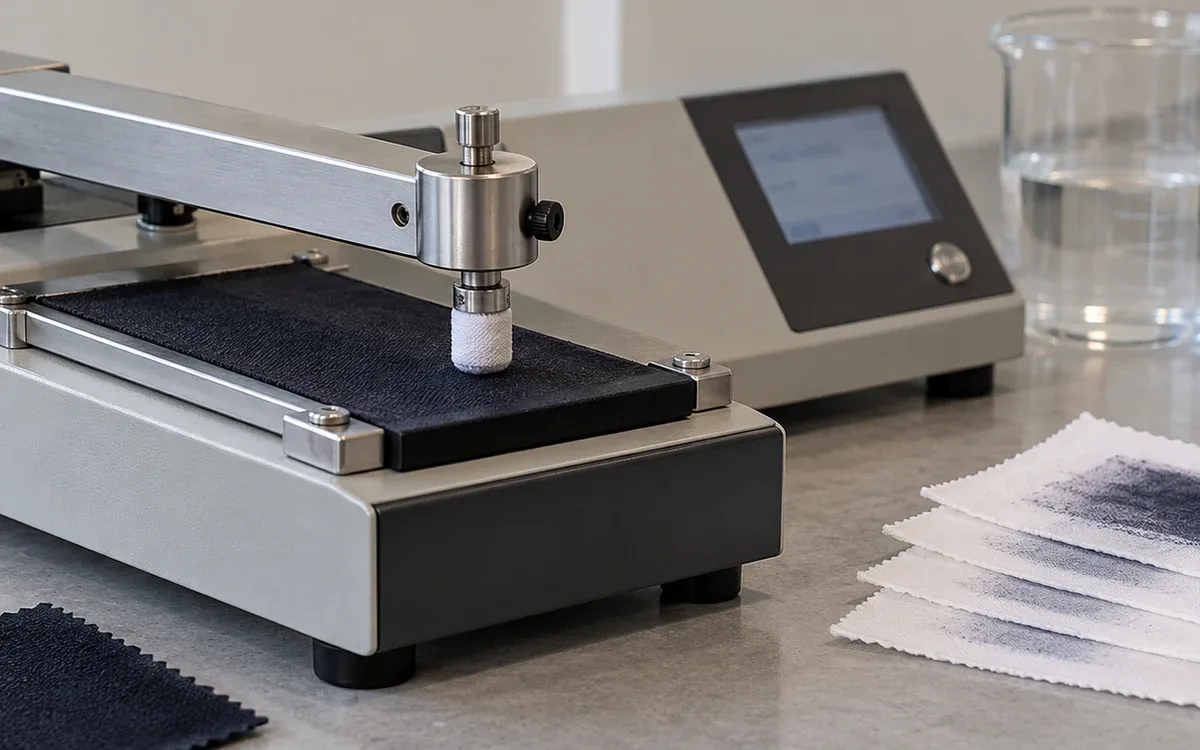
ISO 12945-2 describes a modified Martindale method for fabric pilling, fuzzing and matting. When this result is specified, use the agreed method. Keep the test stage and assessment conditions fixed.
A new garment's photograph cannot replace a pilling test after a defined exposure. One laboratory grade also leaves some details out. It cannot describe every visual feature of a washed garment.
For a knit product, ASTM D3786/D3786M provides a diaphragm bursting strength method. Choose a strength test that suits the construction and end use. A knit test does not suit every product.
Agree where specimens will come from. Samples may all come from the least stressed garment area. This could miss weak spots near seams or decoration.
Use the full method through a competent laboratory when compliance is required. A workshop comparison can support development. Label it according to what was actually done.
Read a worked comparison without choosing on feel alone
Consider a hypothetical cotton jersey programme. The buyer requires a pilling grade of at least 4 under its specified method. It also sets a mean bursting strength of at least 400 kPa. These are invented project limits, not universal textile requirements.
Three development routes are tested under the same agreed conditions.
Route | Pilling grade | Mean burst result | Shade observation |
|---|---|---|---|
Untreated control | 2–3 | 520 kPa | Approved starting shade |
Mild treatment | 4 | 468 kPa | Within the project's limit |
Stronger treatment | 4–5 | 390 kPa | Visible change needing review |
For the mild treatment, strength retention relative to the matched control is:
Retention = 468 ÷ 520 × 100 = 90%.
For the stronger treatment, retention is 390 ÷ 520 × 100 = 75%.
The stronger treatment gives the higher pilling grade. Yet it falls below the stated strength requirement. A smoother surface does not make that failure acceptable.
The mild route meets both listed numerical limits. Its shade result is also acceptable. Before bulk release, complete the remaining garment checks. Confirm the result in repeat trials.
Do not turn the pilling grades into percentages. Pilling grades rank appearance in order. They do not form a linear scale. Grade 4 does not mean twice the performance of grade 2.
Check variation as well as the mean
A mean value can conceal a weak specimen. Keep the individual results and the required decision rule.
Suppose the hypothetical mild route has burst results of 480, 470, 465 and 457 kPa. Their mean is 468 kPa. The range is 23 kPa.
Now suppose a second run gives 510, 500, 450 and 412 kPa. Its mean is also 468 kPa. Its range, though, is 98 kPa. The means match. The spread of the results does not.
Investigate the second run before treating it as equivalent. Check sample location and material variation. Ask whether exposure was uneven or the test was performed differently.
The example does not establish a universal range limit. It shows why the raw results matter.
Also examine different garment regions. A rib cuff may use a different yarn or construction from the body. A body fabric result cannot approve that cuff by default. Base each decision on tests of the material it covers.
Separate shade change from surface clarity
A cleaner cotton surface may reflect light differently. It may look darker, brighter or more even. That visual change can coexist with actual dye loss or staining.
Use the approved shade assessment conditions. Compare the treated garment with the target. Where useful, also compare it with the matched untreated control.
Record whether the change is uniform. A consistent shift across the body is one problem. Isolated pale seams or uneven panels need a different investigation.
For denim, judge the intended abrasion effect. Check unwanted redeposition as a separate result. A more worn face and a dirty pocket bag are different outcomes. Do not average them into a single statement that the wash is stronger.
Keep the colour discussion linked to the brief. An aged denim design may call for strong contrast. The same contrast could fail a solid-colour polo.
The desired surface effect may shift shade beyond the agreed limit. If so, review the product sequence or target. Do not silently approve a new colour because the fabric feels better.
Test the finish after the care route
The packed garment must perform as intended. Its appearance on the finishing day is only one check.
Use the specified care procedure. Follow the stated number of cycles. Record these conditions with the result. Different routes create different comparisons.
Look for renewed fuzz, pilling, distortion and decoration change. Use a suitable control. Put it through the same care route as the treated sample, then compare them.
A supplier's durability claim can guide development. It does not prove performance for every garment construction. Verify the claim relevant to the actual product.
Keep the final care instruction consistent with the evidence. Finishing may leave the garment needing a different care route. Resolve that product decision before releasing artwork.
Retain a treated sample before care. Keep a matching sample after care in the same approval record. Later reviews can then see the effect of the test.
Troubleshoot the treatment by symptom
Symptom | Useful first check | What to avoid |
|---|---|---|
Little surface change. | Check product identity, storage and actual process conditions. | Do not increase severity before checking the basics. |
Uneven effect. | Check starting material, folds and load movement. | Do not judge only one flat body area. |
Excessive strength loss. | Check the matched control and exposure history. | Do not accept on soft handle alone. |
Shade change. | Check lighting, surface change and colour results. | Do not assume every difference is dye removal. |
Renewed fuzz after care. | Check the care comparison and test method. | A new sample alone cannot prove durable performance. |
Trim or print damage. | Check whether the complete process suits these parts. | Shell approval does not approve the whole garment. |
Where practical, change one part of the investigation at a time. Choose a change whose effect can be interpreted. The purpose is to learn which control is missing.
A fresh enzyme lot may behave differently. Retain its identity and compare it under the established conditions. Do not adjust the process to hide the difference. Record and explain any change.
A problem may occur in only one material lot. Inspect its untreated control before revising the standard route. The starting material may explain more than the process setting.
Handle enzymes according to their actual hazards
The word bio does not mean harmless. Use the handling controls stated in the enzyme product's safety information. Also follow the workplace assessment.
The UK Health and Safety Executive lists alpha amylases among causes of occupational asthma. Its list includes their use in textile processing. Avoid creating dust or mist. Use the supplier's recommended transfer and exposure controls.
A liquid product is not permission to spray it through any available nozzle. Check the product formulation for the intended use. Confirm that it suits the equipment.
Use cleaning and spill procedures suited to the product. Include operators and maintenance staff in the review. Cover anyone who handles residues too.
This is a practical process requirement. An acceptable garment is only one requirement. The treatment also needs controlled methods for charging, running and cleaning the equipment.
Describe environmental benefits with a defined comparison
An enzyme treatment may change chemical use or temperature. It may also change the number of process steps. Measure those changes before making a product claim.
Define the comparison route and the finished result. A low-water process may create more rejected garments. Its result per accepted piece can then differ from what the per-batch figures suggest.
State which stages the comparison covers. Include treatment, rinsing, stopping, drying and any repeat work. Do not compare one short stage with another route's complete cycle.
Supplier information can identify a possible improvement. Use local results to check the improvement on the actual machine and style.
Enzyme use alone cannot support a broad environmental claim. The product, process and energy source affect the result. So do water treatment and accepted yield.
Write an instruction that purchasing and production can share
Replace a vague finish name with a short, controlled specification. State the purpose and exact approved product. Identify the material and set the finished-garment acceptance limits.
For example, a statement might name a cotton surface standard and pilling method. It might also set the project's minimum strength and agreed shade tolerance. It would also name the approved route. It would link to the care-validation evidence.
The buyer may use a commercial wash name. Keep it as a convenient label. The technical record must still define that label for this order.
Purchasing may change the enzyme product. Review the evidence before production adopts it. Design may change the fabric. Check whether the existing finish still applies.
This closes the gap between a merchandising description and a repeatable factory result.
Frequently asked questions
Are enzyme wash and biowash always different?
No. Their use overlaps in trade language. Confirm the enzyme and substrate. Define the desired effect and pass limits. The name alone leaves these open.
Does biopolishing always use cellulase?
Cellulase is widely used for cotton surface biopolishing. The process specification must still identify the actual product. Do not infer the formulation from a label alone.
Can cellulase replace amylase for starch desizing?
They target different materials. Confirm the size system and use a suitable desizing route. A combined commercial formulation must be identified as such.
Will a bio finish leave the shade unchanged?
That cannot be promised from the name. Assess the actual garment. Surface and colour changes can both affect its appearance.
Should the smoothest sample be approved?
Only if it also meets the strength, shade and size limits. It must pass the other garment performance checks too. Smoothness is one part of the decision.
Specify the outcome behind the label
The enzyme wash versus biowash question becomes useful when it leads to a clear product goal. Separate starch removal, cotton surface improvement and denim abrasion. Then choose the treatment that fits the goal.
Control the starting material and product identity. Define the process endpoint and finishing route. Judge the appearance and shade. Check strength, sound construction and care performance too. That gives the finish a meaning that design, purchasing and production can all use.
References
Novonesis: Cellusoft for cotton biopolishing.
Novonesis: Cellusoft for denim abrasion.
Novonesis: Aquazym for starch desizing.
Rudolf: Garment finishing enzyme applications.
ASTM D3786/D3786M: Diaphragm bursting strength.
Discussion0
Loading the discussion…