
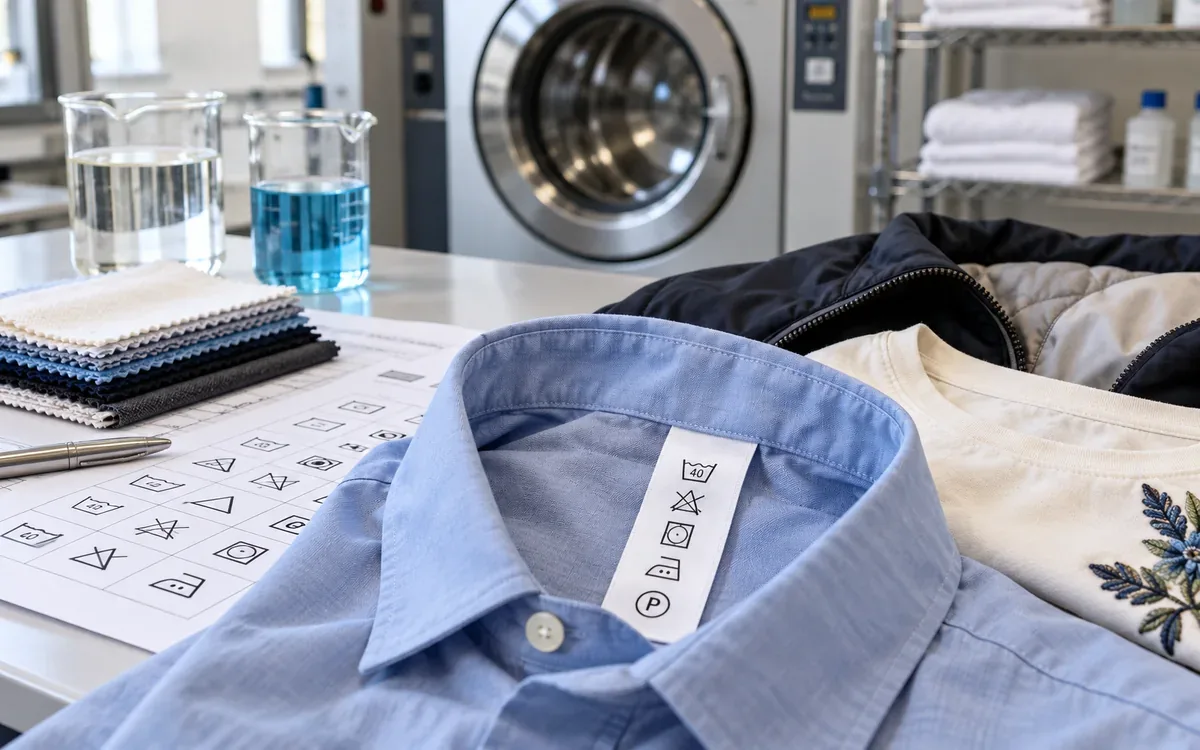
Approve the care route before drawing the label
A cotton shirt may wash well while its printed badge peels. A jacket shell may retain its size while the lining pulls the hem upward. A label may reflect only the main fibre. In that case, it could tell the customer to use a care method that harms the finished product.
Garment care label validation checks the full instruction that the customer will receive. Does the evidence support each part? The answer must cover the garment as sold and the rules of the intended market.
Start with a proposed care route. Then test it or gather other sound evidence to support it. Convert the supported result into clear wording and the correct symbols. Finally, check the printed label after sewing and normal care. Can the customer still read the approved instruction?
This sequence puts the technical work before the artwork decision. It also keeps a passed fabric test from being stretched beyond its scope. All numerical examples below are hypothetical. They show how to review results. Their pass limits do not apply to every product.
Define the garment that the claim covers
List the parts that could respond in different ways to care. Start with the shell, lining, interlining and sewing thread. Add elastic, closures, prints, embroidery, patches and coatings. Include parts that the wearer can remove. Include the intended colours and construction.
Each part does not need endless tests on its own. Find the parts that could limit the proposed care route. Then check what evidence already exists for them.
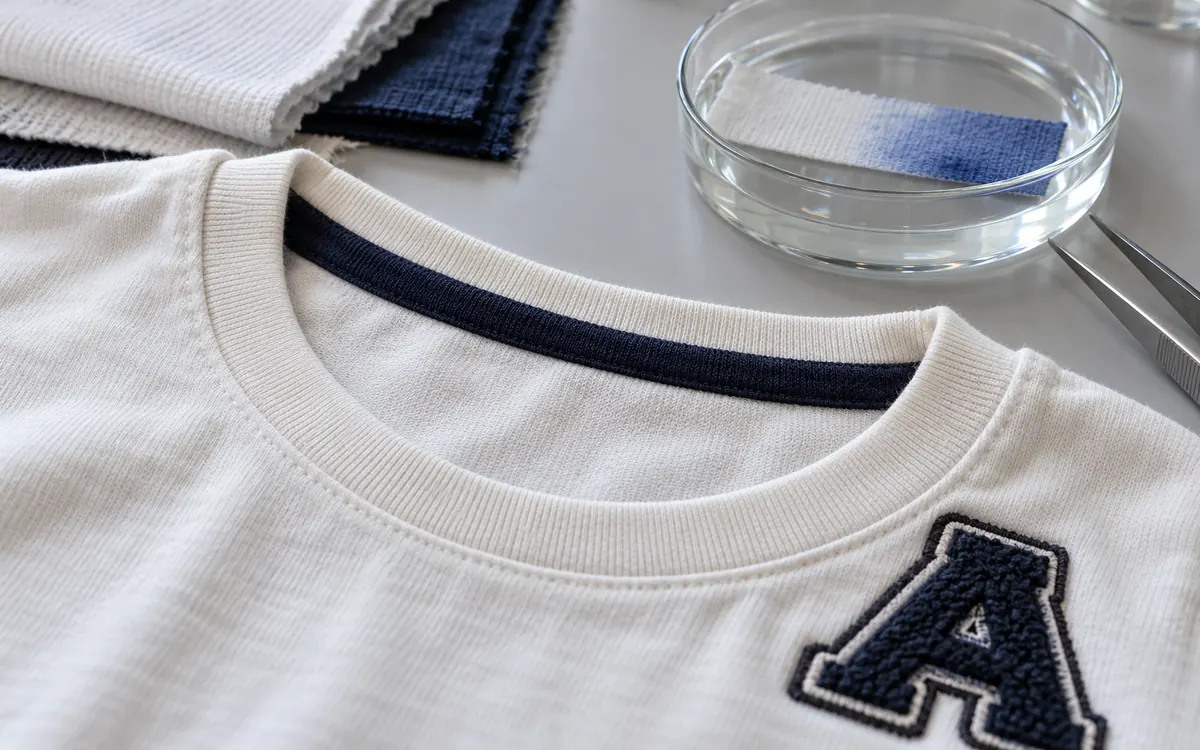
A care claim for a plain shirt may not cover a later decorated version. A white lining can reveal colour transfer that was invisible in a dark sample. A new adhesive badge may need a lower heat limit. This can happen even when the fibre content stays the same.
Record the exact assembly used for evaluation. A sample may use substitute thread or a temporary trim. State that limit before accepting its results.
Part or feature | Care question to resolve |
|---|---|
Shell and lining | Do size and shape remain compatible? |
Dark and pale sections | Does colour transfer within the same garment? |
Bonded decoration | Does the bond survive cleaning, drying and finishing? |
Elastic | Does the intended function remain acceptable? |
Closures | Do they operate and retain acceptable appearance? |
Care label itself | Does the instruction remain attached and readable? |
Use this map to focus the review. Each report should help answer a question about the garment. A large folder of unrelated reports may leave the main questions open.
Check the selling market and the adopted edition
Care-label rules differ by destination. A global symbol chart is not proof that one artwork satisfies every market.
For covered US apparel, 16 CFR 423.6 sets care-information rules. It requires a reasonable basis for the care claim before sale. Evidence can take several forms. It need not always be a particular laboratory report. The scope and reliability of that evidence still matter.
Canada's Competition Bureau guidance states that care labelling is voluntary at the federal level. When supplied, care information must be accurate. It also points to additional French-language requirements in Quebec. Voluntary care information does not mean all textile labelling is voluntary.
Australia's mandatory-standard guidance permits English care instructions for covered products. It also permits the specified international symbols, or both forms together. Check its cited standards and exclusions for the actual product.
Record the destination and rule that applies. Add the adopted edition, language requirement and review date. A standard may have changed while the law still refers to an older edition. That makes the edition check crucial.
Complete the market review before sending final artwork to the label supplier. Otherwise, an apparently minor symbol change can force a reprint.
Separate current symbols from symbols accepted by a rule
ISO 3758:2023 defines a care-symbol system for textile articles. Its scope covers domestic washing, bleaching, drying and ironing, plus professional textile care. It does not cover industrial laundering as the same symbol system.
Each country's rules may adopt a different edition. The latest published edition does not apply everywhere by default. For example, the US symbol exemption in 16 CFR 423.8 names ASTM D5489-96c. Australia's cited mandatory-standard basis includes ISO 3758:2012. Check the rule in force at the destination. Do not assume it adopts every new edition.
GINETEX's current symbol guidance identifies ISO 3758:2023. It explains what each symbol variant means. Its licensing guidance states that the main symbols are protected trademarks in most countries. It also explains the licensing requirement.
Use an authorized artwork source and the correct system. Do not redraw a symbol from memory or borrow a poor-quality picture. Keep the meanings from different editions separate.
Keep the technical meaning in a text field beside the artwork during review. The reviewer can then compare the team's intent with the symbol's meaning.
Build one complete care route at a time
A care route is more than a washing temperature. It covers the cleaning method and how much mechanical action it uses. It also covers bleaching, drying, ironing or finishing, and any needed warnings.
Write the proposed route in plain language first. Consider an illustrative decorated cotton top. The team might study a mild domestic wash and a specific natural-drying method. It might also check limits on ironing around the decoration. That is a trial proposal, not a label ready for sale.
Identify the uncertainty behind each part. The shell may already have useful washing evidence. The decoration may lack data from repeated care. The drying route may be limited by shape retention. The ironing instruction may depend on both colour response and the decoration.
Do not add extra routes just to make care seem easy. Each advertised route needs support. A successful wash route does not prove a professional cleaning route, and the reverse is also true.
Consider whether a route is practical for the intended customer. The only supported care method may be hard for the customer to use. The team could then choose to change a component. The technical review should reveal this choice while the team can still make changes.
Use component evidence without overextending it
A fabric supplier's care recommendation is useful input. It is not automatically a finished-garment conclusion.
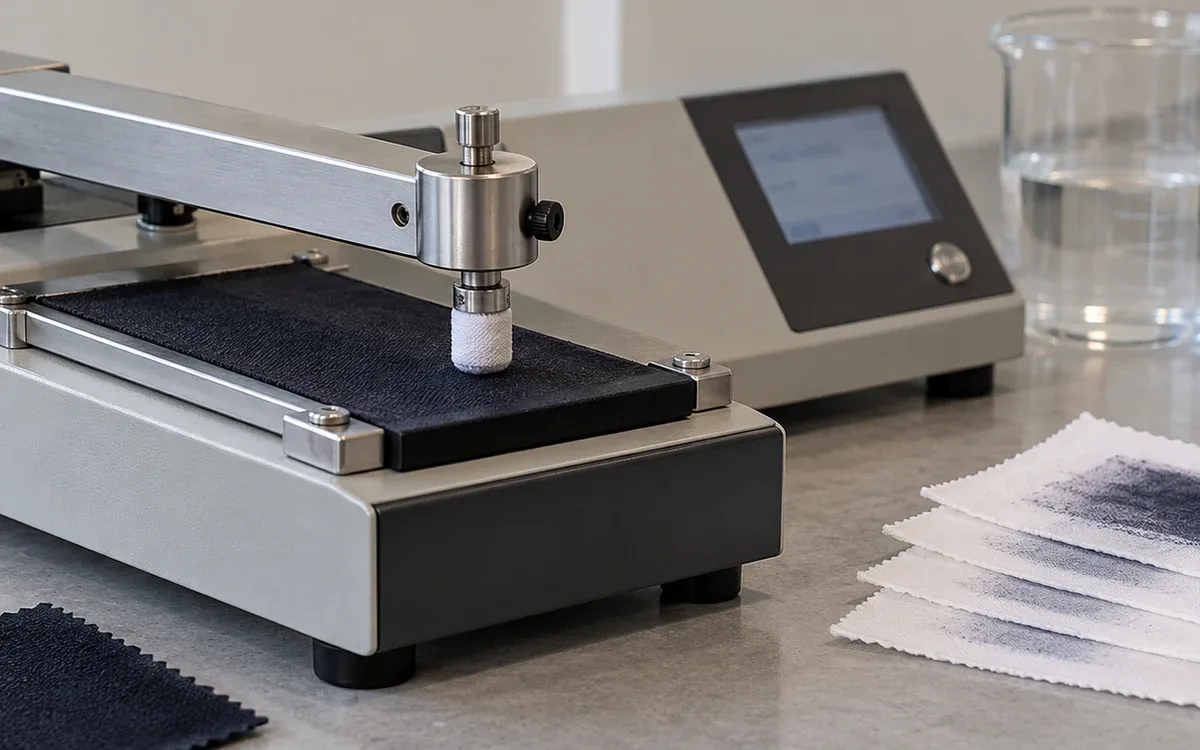
Read the report. Check the sample identity, process, measured property and result. A colourfastness report might measure colour change or staining under stated test conditions. It may not cover garment size or print adhesion. Closure function and readable labels may also fall outside its scope.
The US rule recognizes evidence for both components and the whole garment. Use valid component data to focus the work that remains. Then check how the parts affect each other in the assembled garment.
A dark shell and pale binding illustrate the problem. Each may perform acceptably when tested separately. In the garment, the shell can transfer colour to the binding during care. A label might say to wash with similar colours. That warning cannot protect a pale section sewn into the same item.
Keep the scope of reused evidence clear. If a report covers one colour or finish, explain why it represents another. A darker shade is not always the worst case. This depends on the property being checked.
Where evidence is incomplete, record the specific gap. For example, “care test pending” gives little detail. “Bonded badge still needs a check after the proposed drying route” identifies the gap.
Send the laboratory a decision-focused request
Tell the laboratory which claim you want to support. Explain which failure questions remain. Provide the complete garment and proposed care wording. Include the relevant component reports.
Before testing, agree the method and edition. Set the process options, cycle count and specimen range. State the limits used to judge the results. A test name alone leaves too many choices open.
ISO 6330:2021 specifies domestic washing and drying procedures for textile tests. These include reference detergents and ballast. Its public scope describes washing and drying together as a complete test. It also states that equipment and other test settings can affect the results.
“Washed at 40°C” therefore leaves out much of the laboratory exposure. Machine type, action, detergent and load all matter. The drying procedure can also change what the result means.
Ask the laboratory to assess the properties relevant to the garment. Checks may cover size, appearance, colour transfer and seam condition. Others may assess bonds, elastic function and closure operation. Use the applicable methods and agreed product limits.
There is no single cycle count in this article that proves every care claim. Base the test programme on the product, its intended use and the destination's rules. Decide what evidence is needed for the claim under review.
Evaluate the garment as a system
Inspect the garment before care. Inspect it again after the stated recovery or conditioning period. Keep an untreated reference where practical. Record the same points and viewing conditions each time.
Check function as well as appearance. Open and close the zipper. Operate the buttons. Examine the elastic in its intended use. A garment may look fine on a flat table yet fail in use.
Look at connections between materials. A lining may restrict the shell. A print may remain attached but become stiff or cracked. A label may survive while the text becomes unreadable.
Do not average unrelated properties into one pass percentage. The size may pass while the badge detaches. That failure still prevents approval of the proposed route. The technical owner must address that failure or revise the claim with evidence.
Use photographs to record change. Keep physical samples when feel, movement or small surface changes matter. A photograph cannot fully record a stiffened print or a closure that catches.
Record the point at which each failure appears. A change after the first cycle may have a different cause from one after repeated care. It may also call for a different design response.
Worked example: passing dimensions is not enough
Assume a hypothetical top is evaluated under a proposed washing and drying route. For this example, the buyer permits no more than 3% reduction at the two stated points. Other requirements cover appearance and decoration integrity.
The initial chest width is 520 mm. After the agreed test and conditioning, it is 509.6 mm.
Chest change = (509.6 − 520) ÷ 520 × 100 = −2.0%.
The initial body length is 700 mm. The final length is 679 mm.
Body-length change = (679 − 700) ÷ 700 × 100 = −3.0%.
Both measurements meet the assumed limits. Body length is exactly at its lower boundary. That does not create extra tolerance for another property.
Review item | Hypothetical result | Decision under the assumed requirements |
|---|---|---|
Chest width | −2.0%. | Meets the stated size limit. |
Body length | −3.0%. | Meets the stated limit at its boundary. |
Pale neck binding | Visible staining. | Fails the appearance requirement. |
Bonded badge | Edge lift. | Fails the bond requirement. |
Care-label text | Readable. | Meets the legibility requirement. |
The care route remains unsupported for this assembly. A shrinkage-only report would miss two relevant failures.
The team could change the binding or badge system. It could also study another complete care route. Any revised combination needs its own supporting evidence. Keep the failed results in the report. Removing them does not solve the problem.
Interpret drying and ironing as separate decisions
A garment may tolerate washing yet fail during drying. Keep washing and drying linked in the claim. Then examine which step causes the damage.
A sample may pass after natural drying but fail after tumble drying. Those results support different conclusions for the two routes. It does not mean the wash itself is unsuitable. Likewise, a piece that survives a gentle wash may lose shape if hung while wet.
Ironing needs its own attention. The main fibre may tolerate high heat. That same heat may harm a surface finish, print, adhesive or trim. Past factory pressing alone does not prove the proposed ironing instruction. The customer may iron the garment many times.
When reviewing temperature values, verify both the symbol edition and any conversion. Current GINETEX guidance lists different iron temperatures from many older charts. A copied old table can thus be wrong even when its arithmetic is sound.
For a simple conversion exercise, 200°C equals:
°F = °C × 9 ÷ 5 + 32.
200 × 9 ÷ 5 + 32 = 392°F.
This example shows arithmetic only. It does not recommend an ironing temperature or assign a current symbol. A conversion alone cannot justify a care instruction. Check the product evidence and the correct symbol meaning.
Treat professional care as its own route
Drycleaning and professional wetcleaning involve more than a choice between “wet” and “dry.” Both cleaning and finishing conditions can affect the garment.
ISO 3175-1:2017 addresses assessment of textile articles after procedures in the related professional-care series. Its scope includes changes to fabric and garment properties after cleaning and finishing.
Specify the route being assessed with the laboratory or professional-care specialist. A component may be described as drycleanable. That does not mean it suits every solvent, finishing temperature or steam treatment.
The FTC's care-labelling guide explains two separate claims. One is a supported drycleaning instruction. The other is a warning that washing must not be used. It states that a “Dryclean Only” warning needs evidence. That evidence must show that washing would harm the product.
A restrictive phrase should therefore have a reason. It is not a substitute for investigating an uncertain garment. If no practical route works, the team may need to redesign the product. Resolve this before finalizing the label.
Review omissions and warnings deliberately
The customer reads the complete label, including what it leaves unsaid. In some systems, an omitted restriction can imply permission for a broader treatment.
For covered US apparel, omissions have meaning under the current rule. This includes omitted washing and drying temperatures. Bleaching instructions also need a careful review. Review the complete wording against the rule, not only the conditions explicitly printed.
Avoid adding prohibitions automatically. A clear care route can remove the need for some warnings about other routes. Other warnings may still be needed to prevent a foreseeable harmful step. The correct result depends on the market and the supported care method.
Write warnings close to the action they qualify. Keep “Do not iron decoration” beside the ironing guidance. Do not put unrelated marketing text between them. A removable part may need separate care. Explain that action clearly so the customer can carry it out.
Can a reader follow the steps without knowing how the product was developed? Check this during the wording review. An internal phrase such as “use approved process B” is meaningless to a customer.
A warning may protect other items in the wash. Check whether it also protects the garment itself. Preventing transfer to a separate white shirt does not solve transfer to an attached white collar.
Keep unsuccessful routes in the evidence file
A failed trial can explain why the final instruction contains a limit. Retain its garment identity and complete process description beside the successful route.
Suppose a decoration remains sound under one drying procedure but cracks under another. The comparison is useful only when the garments and other conditions are alike. The second trial may also use a new decoration supplier. If so, it cannot isolate the drying effect.
Record what the trial establishes and what remains uncertain. One sample may fail. That does not prove that every hotter or harsher process will cause the same failure. Use the evidence at its actual scope.
This saves time during later reviews. A new team can see why a restriction exists before removing it to simplify the label.
Proof the artwork against a text master
Create a short text master. State the approved meaning of each care instruction in it. Review the symbols and translations against that master.
Check the symbol system, edition, number of bars, dots, lines, and any cross-out mark. Small differences can change the meaning. A distorted font or the wrong character may produce an unrelated mark.
Check temperatures digit by digit. Verify any Celsius and Fahrenheit pair independently. Check punctuation. It must not join two instructions in a misleading way.
Read the translation as a complete care instruction. A literal word swap may change its meaning. Errors can affect terms for natural drying or professional cleaning. They can also change the meaning of restrictions. Use a competent language review for the intended market.
Then print a proof at the actual finished size. A large screen proof may hide cramped wording or weak contrast. A line of text might also disappear in a fold. Include the seam allowance and label fold in that proof.
The artwork reviewer should see the complete label as the customer will see it. Care information may share a label with fibre content and other details. Each required item must remain clear.
Validate the attached label after care
The instruction must survive the care it describes. Assess the label in its actual attachment position and construction.
Check whether a seam covers the text. Does a fold hide part of the care route? If both sides carry information, verify that the reader can access them. A legible loose label can become unreadable after sewing.
Put the final label material and print into the relevant care trial. Look for fading, transfer, fraying, curling and loose labels. Check any change that makes the text hard to read. The text must still be usable. Ink that remains on the label may no longer form clear words.
The label supplier may change the substrate, coating, ink or print process. Review whether the existing evidence still applies. Artwork identity alone does not prove physical durability.
Link the accepted care content to the broader garment trim approval and bulk-release process. That existing control can track the supplier and lot. Keep the technical basis for the instruction in the care-validation record.
Resolve changes before bulk printing
A late product change can make approved care artwork wrong for the garment. Review changes to parts that may affect care before releasing the label order. These include the decoration, lining, elastic and finish.
Describe what changed. State which part of the care claim it could affect. A change may have no credible effect on a given route. Record the technical reason for keeping the existing evidence. If it introduces uncertainty, obtain the missing evidence.
Keep old and new artwork visibly distinct. Give the new label a distinct stock description. Staff must be able to tell it from labels with the old instruction. Check the labels already printed or attached. This tells the factory which garments need review.
Do not treat a design approval as proof of care performance. Likewise, a laboratory result does not automatically approve the translated artwork. The final release joins these decisions for the defined garment and market.
Frequently asked questions
Can fibre content determine the care label?
It provides useful background, but the finished garment can contain parts with different limits. Construction, colour, decoration, bonding, and finishes also matter. Use evidence for the actual assembly and intended route.
Does a passed washing test prove the whole label?
Only if its scope supports the full claim. The review must also cover all relevant properties. Drying, ironing, bleaching and professional care may need more evidence. Warnings and the label's durability may need their own checks.
Must every garment be individually laboratory tested?
The US rule recognizes several forms of reliable evidence. A practical programme can use valid prior and component evidence where justified. The evidence must represent the product and support the claim. Grouping products without a sound basis is not enough.
Can the latest ISO symbols be used in every market?
Do not assume so. Check the system and edition accepted by the destination rule. Check licensing and language requirements too. A newer technical standard does not automatically amend a regulation.
What should happen when one component fails?
Identify the failure and its effect on the garment. Consider a component change, a supported alternate care route, or redesign. Recheck the affected assembly and artwork before release.
Release an instruction the product can support
A care label is a promise about how the garment can be maintained. It needs a clear link to the finished garment and the proposed care route. The evidence must support the instruction that the customer sees.
Make the technical decision before final artwork. Check the selling market and symbol edition. Check how the garment's parts affect each other. Proof the actual label. Confirm that it remains readable after care. This produces a usable instruction and a record that explains why it belongs on that garment.
References
FTC: Complying with the Care Labeling Rule.
eCFR: 16 CFR 423.6, textile wearing apparel.
eCFR: 16 CFR 423.8, exemptions and symbol provisions.
GINETEX: Current care-symbol meanings.
GINETEX: Care-labelling principles and licensing.
ISO 3758:2023: Care labelling using symbols.
ISO 6330:2021: Domestic washing and drying procedures.
ISO 3175-1:2017: Assessment after professional care.


Discussion0
Loading the discussion…