
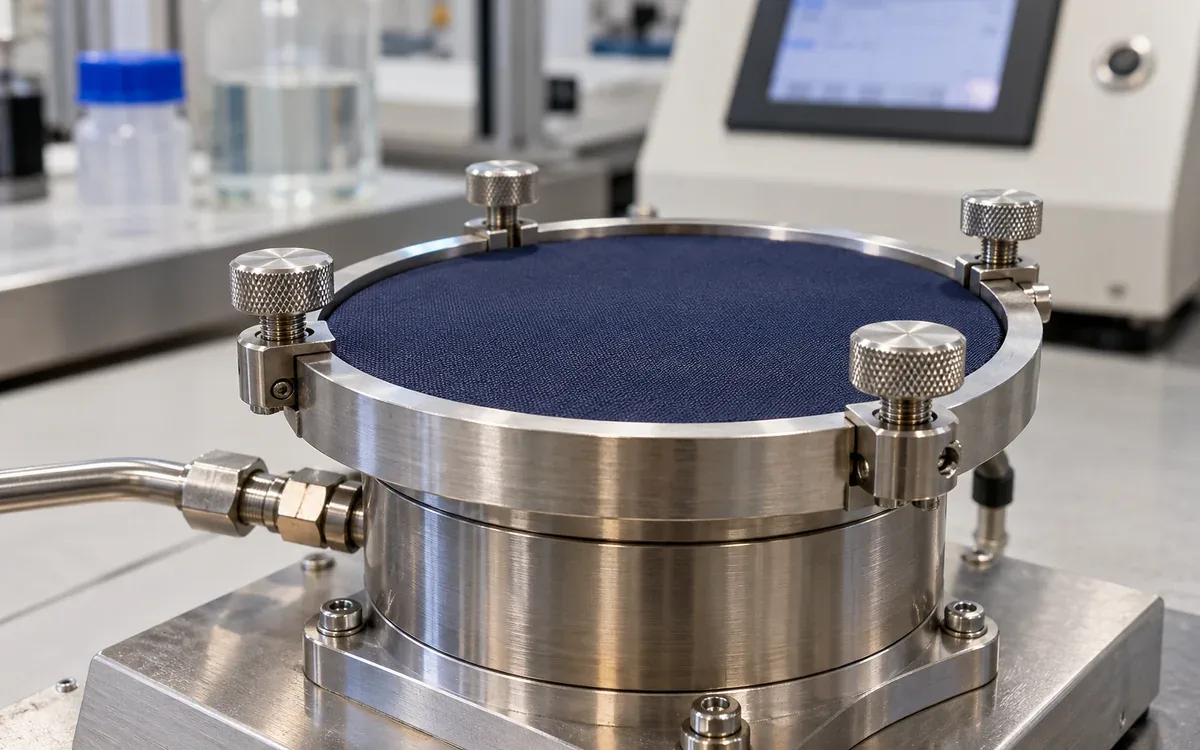
Read a water column rating as a test result
A shell fabric advertised at “10,000 mm” has not been tested under every kind of rain. The number normally refers to a water pressure expressed as an equivalent column height. The report must give the method, sample state, and test endpoint for the number to be useful.
Hydrostatic pressure testing asks how a material resists water being forced through it. It differs from a surface spray rating, which judges wetting, and from a rain exposure, which uses its own impact conditions. It also leaves water vapor transport to a separate test.
For a fabric buyer, the main task is to make the number comparable. Two results may share a unit but differ in pressure rate, exposed face, or support. A larger value from one setup may not outrank a smaller value from another.
This guide explains the test choices, unit conversions, and decisions that matter in apparel fabric approval. All worked examples are hypothetical. They do not set a waterproof limit for all products. They also do not replace the controlled method for a named standard.
Understand pressure and equivalent water head
Pressure is force divided by area. Water at the bottom of a column creates pressure because of its weight. The familiar hydrostatic relationship is:
Pressure, Pa = water density, kg/m³ × gravitational acceleration, m/s² × column height, m
In symbols, p = ρgh. For a column open to air, this gives the pressure above atmospheric pressure at that depth. This difference pushes water through the test cloth.
A modern tester does not need a tower as tall as the quoted head. It can apply controlled pressure and report it in equivalent water-column units. The height states pressure. It does not describe the machine's physical height.
Do not confuse water head with the thickness of water left on a fabric surface. A 10,000 mm rating is not a measurement of a wet film. It does not mean the cloth stays dry for 10,000 minutes. It also does not prove resistance to 10,000 mm of storm rainfall.
Convert units on a stated basis
The NIST conversion table gives 9.80665 Pa for one conventional millimeter of water. This is a defined conversion. The pressure from a real column also depends on water density and local gravity.
For conventional water head:
Pressure in kPa = head in mm H₂O × 0.00980665
Head in mm H₂O = pressure in kPa ÷ 0.00980665
A made-up result of 10,000 mm H₂O equals 98.0665 kPa. At a sensible reporting precision, this is about 98.1 kPa.
Conventional water head | Equivalent pressure |
|---|---|
1,000 mm H₂O | 9.81 kPa |
5,000 mm H₂O | 49.03 kPa |
10,000 mm H₂O | 98.07 kPa |
20,000 mm H₂O | 196.13 kPa |
Keep unrounded values during the calculation. Round only the final result to the precision supported by the method and machine. Six decimal places do not make a coarse reading more accurate.
Catch the common centimeter and millibar errors
Millimeters and centimeters of water differ by a factor of ten. A result of 1,000 cm H₂O equals 10,000 mm H₂O. Copying the number without changing its unit can therefore create a tenfold mistake.
Millibars are pressure units. One millibar equals 100 Pa, or 0.1 kPa. On the conventional water basis, this is about 10.197 mm H₂O. It is close to 10 mm. The two are not exactly equal.
Suppose a report gives 500 mbar. That is 50 kPa, which converts to about 5,099 mm H₂O. Reporting exactly 5,000 mm may be a rough description, but it is not the precise conversion. Near a contract limit, use the stated units and conversion rule.
Store three fields in the sheet: original number, original unit, and converted result. Protect the formula and keep the source report. If a value looks ten times too strong, check units first. This may resolve the issue before a technical dispute.
Select the method by scope and test design
ISO 811:2018, confirmed in 2025, covers hydrostatic water penetration testing of fabrics intended to resist water. AATCC TM127-2017(2018)e also addresses hydrostatic penetration and explicitly uses no restraint.
AATCC TM208-2017(2019)e uses an acrylic restraint. ISO 1420:2016 addresses rubber or plastics coated fabrics under a specified pressure held for a fixed time.
Method route | Distinction to resolve before testing |
|---|---|
ISO 811 | Increasing pressure, with declared method conditions |
AATCC TM127 | Hydrostatic test without a restraint |
AATCC TM208 | Hydrostatic test using the specified restraint |
ISO 1420 | Coated fabric test at a specified pressure for a fixed period |
The word “hydrostatic” does not make these methods equal. Record the full code and edition. Check the buyer's options. Do not replace a named method just because the lab has a convenient fixture for another.
A test standard describes how to obtain a result. It may not give the pass limit for the product. The brief must set that limit and the condition where it applies.
Separate an increasing pressure test from a hold test
In a rising-pressure test, pressure rises to the defined endpoint or a stated limit. The result may be pressure at penetration. A hold test keeps the cloth at one stated pressure for a fixed time. The report records the outcome required by that method.
The TEXTEST HydroTester description lists dynamic, static, and programmed test modes. This illustrates why the machine name alone is not enough to identify the test. One instrument can run several pressure histories.
Imagine a fabric that shows no leakage while pressure rises through 40 kPa, but leaks after several minutes held there. These observations can both be correct. They answer different questions about pressure and time.
A report should therefore show the pressure history relevant to its result. “Passed at 40 kPa” leaves several questions. Was pressure held? For how long? What counted as failure? A ramp test does not support a long-duration claim without the relevant exposure evidence.
Keep the pressure rise rate visible
ISO 811 gives nominal rise rates of 10 or 60 cm H₂O per minute, with set tolerances. Report which rate was used. The two rates may give different results. The published ISO method text provides those requirements.
Consider a hypothetical target head of 3,000 mm, starting from zero. At 10 cm/min, the rate is 100 mm/min. Reaching that target takes 30 minutes. At 60 cm/min, or 600 mm/min, it takes five minutes.
Time = change in head ÷ head rise rate
The difference is a sixfold change in time to that pressure. This arithmetic does not predict which fabric will fail first. It shows that load and water contact last for different times.
Do not multiply a result by six to convert between the two rates. Changing time history changes the physical test. A unit conversion keeps the same measurement. A rate change does not. Get comparable tests when rates differ.
Define the endpoint before the test starts
ISO 811 normally records penetration at the third distinct place. By agreement, the first appearance may be reported instead. State that choice. Repeated drops at one spot do not count as new penetration places.
A made-up test piece first leaks validly at 36 kPa. A second place leaks at 40 kPa and a third at 44 kPa. The first and third endpoint values differ by 8 kPa. If the product limit is 42 kPa, the choice of endpoint changes the decision.
This is not a reason to select the favorable endpoint after testing. State the endpoint in the request. Keep any additional observed pressures clearly labeled as supporting data.
Use the selected method's rules for fine droplets, growth, edge effects, and other ambiguous observations. A visible spot can require judgment. Use a defined endpoint. Do not use the moment the operator decides the cloth looks wet.
For automatic detection, check that settings and output match the required event. Automation helps record what happened. It does not remove the need for a valid method.
Distinguish specimen leakage from a clamp problem
Water at the clamp edge may come from a poor seal. It may not have passed through the intended test area. ISO 811 rejects tests with penetration at the clamp edge. Record the reason and follow the prescribed retest process.
Inspect clamping surfaces, seals, and specimen placement. Check for folds, trapped thread, gasket damage, and uneven closure. Do not tighten beyond the approved setting. Too much force may damage the cloth or cause another problem.
Also check whether the fabric slipped or developed an unusual shape during loading. Preserve a photograph when it explains the observation. A numerical reading alone may conceal why the test was invalid.
Keep this separate from a genuine local flaw within the test area. A pinhole or damaged coating in the sampled material may be important quality evidence. The sampling rules decide if it belongs in the routine sample, a defect study, or both. Do not call every low result an edge leak without evidence.
Control the face, support, and exposed area
A layered cloth may have a textile face on one side. The other may be a coating or membrane. Mark the exposed side before cutting pieces from their source. Record which side touches water.
The direction from which the apparatus applies water is another field. Water from below and the cloth face are related setup details. They are not the same label. Show both in the report.
Restraint can limit how a flexible specimen deforms. TM127 and TM208 make that distinction explicit. Adding a support plate to reduce ballooning changes the test arrangement. Report the method used. Do not call a supported result an ordinary unrestrained result.
The exposed area also belongs in the record. A new test head changes the amount of cloth tested and the fixture shape. It may include more or fewer local defects. Do not change area just to avoid a weak spot or get a preferred number.
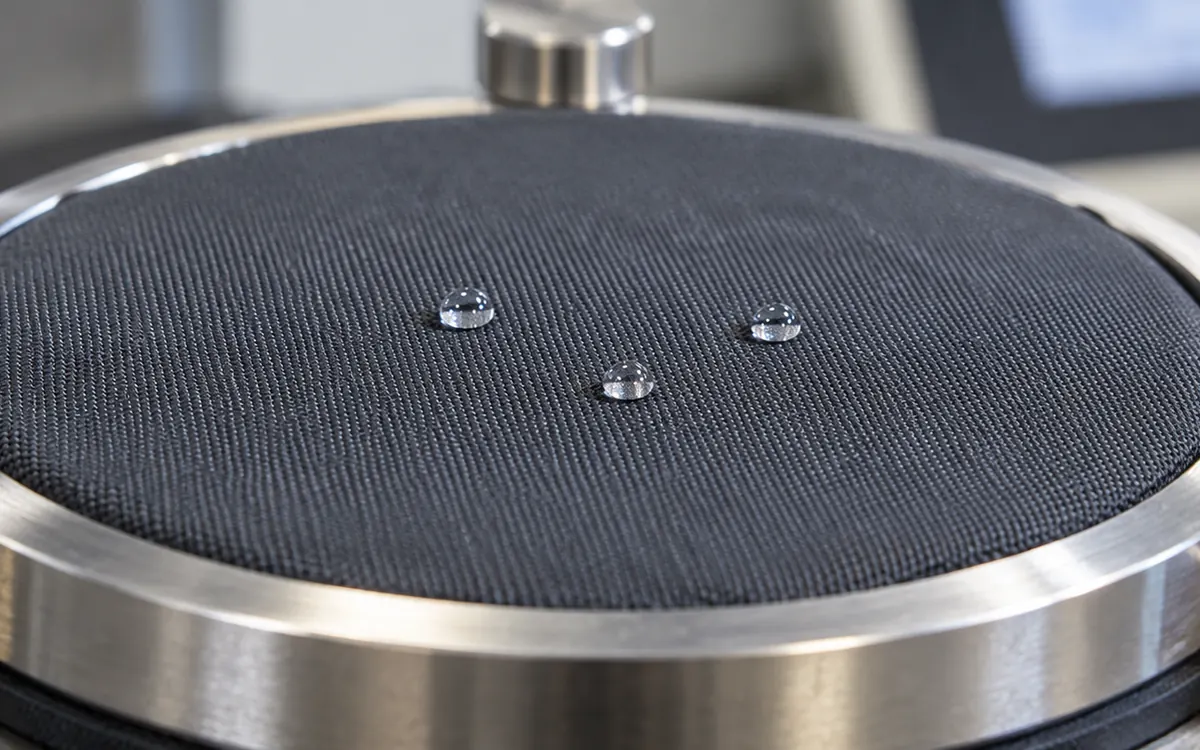
Explain why pressure is not total force
At a uniform pressure, total force on a flat exposed area is:
Force, N = pressure, Pa × area, m²
For a hypothetical 100 cm² area, the area is 0.0100 m². At 30 kPa, the total normal force is:
Force = 30,000 × 0.0100 = 300 N
A 10 cm² area at the same pressure has a total force of 30 N. The pressure is unchanged even though total force is one tenth as large.
This helps explain fixtures and cloth deformation. It does not convert results between test areas. A smaller area may change the cloth response and edge restraint. It may also change the chance of including a flaw.
Do not divide a pressure result by specimen area to “normalize” it. Pressure already includes area in its definition. That creates another quantity with the wrong units for this requirement.
Control water and specimen condition
A hydrostatic test needs the water conditions specified by its method. Temperature and contamination belong in the setup record. Do not wait for a dispute to reconstruct them.
Follow the required water quality, temperature range, replacement practice, and preparation. Keep the test reservoir and contact surfaces in suitable condition. Do not add detergent or a wetting agent to speed the test. A changed liquid asks a different test question. It needs its own stated procedure.
Handle specimens so that the tested area represents the intended material state. Keep track of creases, prior pressure tests, or accidental wetting. A piece already tested to penetration must not quietly become a fresh replicate.
When comparing an initial fabric with an after-care fabric, prepare both states deliberately. Condition them as required and identify each one. The pressure result should always remain linked to the history of the actual specimen.
Check pressure measurement and pressure control separately
A correct pressure reading does not prove that the machine followed the intended ramp. Review both the pressure measurement and the control record. Even a calibrated sensor may record a run with an uneven pressure rise.
For a made-up check, a 6 kPa per minute ramp should add 3 kPa in 30 seconds. If the record goes from 12 to 17 kPa, the actual rise is 5 kPa. Check this gap against the allowed tolerances. Do not ignore it just because the final display looks plausible.
Use the instrument's approved verification and calibration procedures. Keep these records linked to the test date. TEXTEST recommends periodic calibration. The lab must also keep the method checks needed for the actual test.
Report results above the instrument limit honestly
A piece may reach the machine limit without the defined failure. This gives a lower bound. It does not reveal the actual penetration pressure above that limit.
Suppose a tester reaches 100 kPa and the endpoint has not occurred. The report may say the result exceeds the achieved limit. State the endpoint and conditions. Do not enter an exact failure pressure of 100 kPa.
Now suppose five records are 78, 84, 91, greater than 100, and greater than 100 kPa. Replacing the last two with exactly 100 gives a numerical mean of 90.6 kPa. This is a calculated lower bound. It is not the measured mean of five known failure pressures.
If every piece only needs to exceed 70 kPa, these data may meet that need under the agreed rule. An exact mean or 120 kPa minimum needs more range. Use suitable equipment or state what remains unresolved.
Evaluate variation as well as the average
Local defects and material variation can produce a spread in penetration pressures. A high average may hide a specimen that fails the actual acceptance rule.
Assume five valid results are 42, 44, 45, 46, and 73 kPa. Their mean is 50 kPa. If the hypothetical requirement is an average of at least 50 kPa, the series reaches it. If every specimen must reach 45 kPa, two fail.
Those are different specifications. The lab must not choose the rule after seeing the numbers. Keep each value, the defined summary, and the limit.
A large spread also gives a reason to investigate. Map the sample positions across the roll and along its length. Check whether low values align with a visible coating streak, crease, or process record. The pattern may help define the next test. It does not prove the cause without supporting evidence.
Avoid averaging different faces, care states, or methods into one result. Such a mean may look stable while hiding failed conditions.
Test durability with a complete care history
A new-cloth result cannot prove performance after washing, flexing, or another exposure. Define the durability stage needed for the product. Test that stage directly.
ISO 6330:2021 provides domestic washing and drying procedures for textile testing. Record the chosen washing and drying conditions and any other permitted treatment. “After ten washes” is too vague when the drying process and detergent are unknown.
Keep the assessment focused on pressure resistance. Maintenance may restore surface beading while another part of the barrier stays damaged. Surface appearance cannot replace a hydrostatic result.
For the care plan, ApparelDiary's fabric shrinkage testing guide offers useful context on controlling treatment conditions. Size change and water penetration are separate properties, even after the same care.
Agree how material changes will trigger review. A different membrane, coating weight, adhesive, or finishing route may need fresh evidence. An old report should remain linked to the material it actually tested.
Keep breathability and garment performance separate
A hydrostatic test does not measure how readily moisture vapor leaves a garment. ISO 11092:2026, for example, addresses thermal and water vapor resistance under specified steady conditions. Its scope warns that the test does not represent every real comfort situation.
A fabric selection may need both a water penetration requirement and a vapor performance requirement. Record each method and result. Do not rank shells by head alone if the product also needs a defined vapor response.
Likewise, a flat fabric specimen does not represent every route by which water can enter a finished garment. Openings, joins, closures, and design features need their own checks. The James Heal performance guide describes hydrostatic testing as applying pressure to one side of a material specimen. Keep claims within that tested boundary.
ApparelDiary's seam failure testing guide addresses mechanical seam performance. That is a separate requirement. Seam strength or shell pressure resistance alone does not prove garment watertightness.
Resolve a disagreement between supplier reports
Before retesting, place the two reports side by side. Compare edition, pressure rate, endpoint, restraint, and exposed face. Check area, water condition, and sample history too. Then review units. Are some values limits rather than measured failures?
Ask for the individual observations when a summary hides the difference. A supplier may have reported the best specimen while the buyer used the mean. Another report may use a first leak endpoint while the comparison uses the third.
If the conditions match, review sample identity and position. Pieces with one fabric name may come from different rolls or finish batches. A shared name does not prove the samples were alike.
Design the follow-up test to resolve the identified difference. Use matched material and agreed conditions. Keep the original reports. New evidence should explain the dispute, not replace its record.
Frequently asked questions
Does 20,000 mm mean twice the waterproof life of 10,000 mm?
No. On the same conventional basis, it represents twice the pressure head. It does not establish twice the service life or rain exposure time.
Can a spray grade be converted into hydrostatic head?
No general conversion exists. A spray grade describes surface wetting under its procedure, while hydrostatic testing concerns penetration under pressure.
Can a test stop once the buyer's minimum is reached?
Only when the agreed procedure and reporting rule permit that approach. State that the endpoint was not reached and report the achieved bound correctly.
Is a higher pressure result always the best fabric choice?
It helps only in relation to the product requirement. Weight, vapor response, flexibility, durability, and other properties still need their own evidence.
Make the pressure rating useful for approval
A defensible hydrostatic result contains more than a large number. It names the method, pressure history, endpoint, specimen state, and units. It also shows variation and flags results limited by the machine.
Use those details to decide whether the tested fabric meets a specific requirement. Convert units carefully, compare like conditions, and keep surface wetting, vapor transport, and garment leakage as separate questions. The result then supports a clear material decision and focused process checks.
References
ISO 811:2018: Hydrostatic pressure test.
ISO 811:2018 published method text, public preview.
AATCC TM127-2017(2018)e: Hydrostatic Pressure.
AATCC TM208-2017(2019)e: Hydrostatic Pressure Using a Restraint.
ISO 1420:2016: Water penetration resistance of coated fabrics.
NIST: SI conversion factors, Appendix B.8.
TEXTEST: FX 3000-IV HydroTester.
ISO 6330:2021: Domestic washing and drying procedures.

Discussion0
Loading the discussion…