
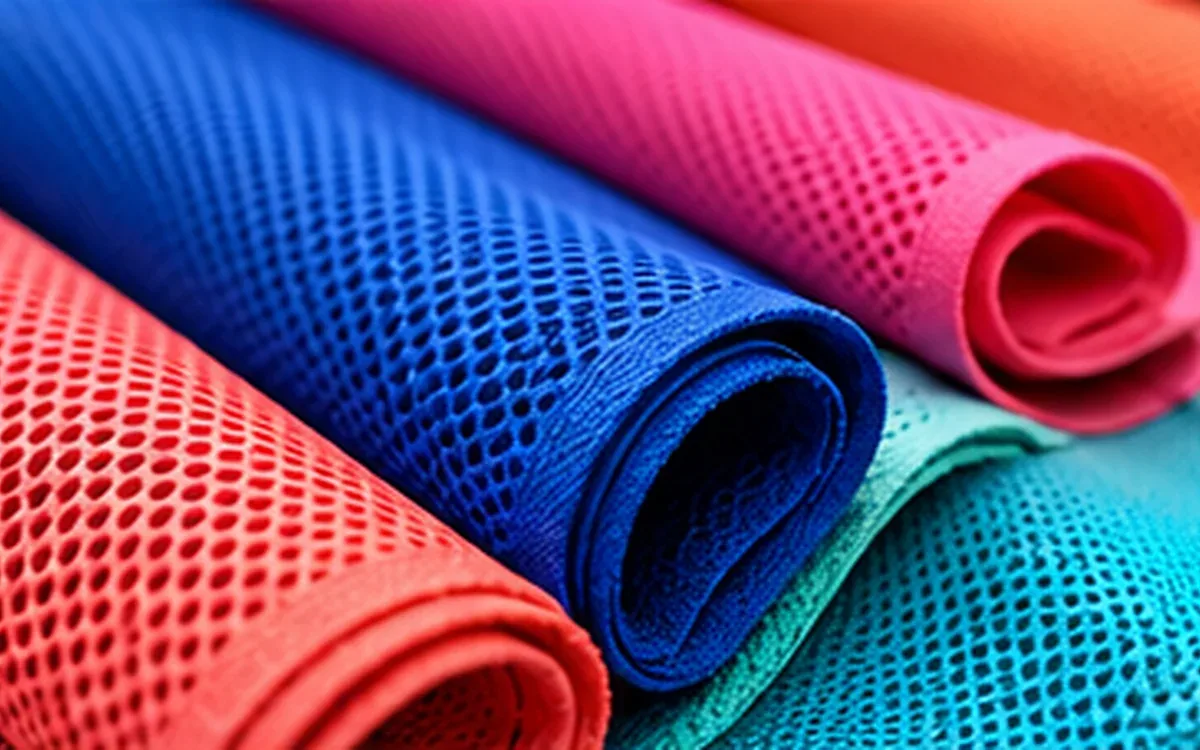
What the word microfibre actually tells you
Microfibre describes a very fine fibre or filament. It does not, by itself, specify a polymer, a fabric structure or a cleaning result. A knit lining may use fine polyester filaments. A cleaning cloth may use split filaments. Both may carry the microfibre label. Their uses and performance still need separate evidence.
Start with the size of one filament. Ask for its linear density, usually stated in dtex or denier. Then ask how that filament is made, how it is arranged in the fabric and what the finished product must do.
Decitex makes cleaning textiles. It defines microfibre as a strand below 1 dtex. A specification using a different unit must be converted before comparison. The label should lead to a measured value, not replace one.
This distinction prevents several common mistakes. A total yarn count is not a single-filament count. A blend percentage does not show whether splitting is complete. A soft handle does not prove high water uptake, and a high water capacity does not prove rapid drying.
Read filament size from the yarn specification
Dtex is the mass in grams of 10,000 m of fibre or yarn. Denier uses 9,000 m. Both measure mass per unit length, so the two values are related but not equal:
dtex = denier × 10 ÷ 9
A 1-denier filament is about 1.11 dtex. A 1-dtex filament is 0.9 denier. A limit written as “1 denier or 1 dtex” thus gives two cutoffs. Any intended tolerance needs to be clear.
Total count divided by filament number
For a yarn whose filaments have equal linear density:
Dtex per filament = total yarn dtex ÷ number of filaments
Consider two fictional yarns, each with a total count of 75 dtex:
Yarn specification | Calculation | Mean dtex per filament |
|---|---|---|
75 dtex, 36 filaments | 75 ÷ 36 | 2.083 |
75 dtex, 144 filaments | 75 ÷ 144 | 0.521 |
The yarns have the same mass per unit length. The second has four times as many filaments. Each therefore has one quarter of the first yarn's mass per unit length.
This arithmetic assumes equal filaments. If the yarn combines different filament sizes or polymers, the division gives a mean. It cannot show the full distribution. Ask for component details when that distribution matters to the application.
Do not use the fabric's GSM in this equation. GSM measures mass per area and includes the fabric structure. It cannot reveal single-filament size without much more information. ApparelDiary's yarn count guide explains the wider count systems. Its fabric GSM guide covers mass per area.
Check the notation before ordering
A supplier may write count and filament number as a short pair. Confirm which unit the first number uses. Does the count describe the yarn being supplied? Or does it refer to a stage before further treatment?
For instance, 75 denier and 75 dtex do not describe the same linear density. Converting 75 denier gives 83.33 dtex. Treating the two as equal would hide an 11.11% difference relative to 75 dtex.
A clear order names the polymer and total yarn count. It gives the filament number and the stage at which these apply. It also states how the value will be checked. This helps when two offers use different shorthand for what seem to be similar products.
A fine average can hide coarse filaments
Consider an invented bundle with five parallel filaments of equal length. Four are 0.2 dtex each, while one is 2 dtex. The total is 2.8 dtex, giving a mean of 0.56 dtex per filament.
That mean falls below 1 dtex. It does not mean that every filament does. The coarse filament accounts for 2 ÷ 2.8, or 71.43%, of the bundle's mass. The four fine filaments make up 80% of the filament count but only 28.57% of the mass.
This is a useful distinction when a product claims a percentage of microfibre. Is the percentage based on mass, filament count or another measure? In this example, both 80% and 28.57% describe the fine component correctly, but on different bases.
The example does not establish a legal labelling rule. It shows what information a technical comparison needs. Ask for the range of sizes where it matters, especially in a mixed yarn. Dividing total count by filament number remains a useful check. It cannot prove that every filament meets a fineness limit.
Filament diameter depends on more than dtex
Linear density is not diameter. To convert between them, the calculation needs material density and cross-sectional shape. An ideal solid round filament is a useful model, but it is not an exact picture of every microfibre.
Consider round filaments with the same material density. Their linear density varies with the square of their diameter. Reducing dtex to one quarter therefore halves the diameter. It does not reduce diameter to one quarter.
This explains why a statement such as “four times finer” needs a named measure. It might mean one quarter of the mass per metre. It might instead refer to diameter. Those claims describe different geometries.
What finer strands do to surface area
Take equal masses of ideal round filaments made from the same polymer. Ignore the ends and any surface texture. If filament diameter is halved, surface area per unit mass doubles.
This follows from simple geometry. At a fixed length, outer surface area varies with diameter. The volume varies with the square of diameter. More fine filaments are needed to make the same mass, creating more total outer surface.
The model helps explain why fibre size matters. It cannot tell us how much useful surface the fabric has in service. Filaments touch, pack together and may carry finishes. Some of their surface may not contact the liquid or object being cleaned.
Avoid fixed comparisons with human hair unless the measured diameters are stated. Hair does not provide one universal reference size. A direct filament measurement is clearer and more useful to a technical buyer.
Splitting creates finer elements from a parent filament
A bicomponent filament contains two polymer components. Its cross-section can be designed so that later treatment separates smaller elements. The supplied parent size and the final element size are different specifications.
Freudenberg describes this route for its Evolon microfilament textiles. The process lays continuous bicomponent filaments into a web. Water jets then split and entangle them. That is a specific nonwoven process. It does not mean all microfibre fabrics are woven or that all need the same splitting treatment.
Ndaro and colleagues studied another design. They used modified islands-in-the-sea fibres made from polyamide 6 and copolyester. The work showed mechanical splitting without dissolving the sea component for that design. The fibre design and polymer choice matter. The term bicomponent alone does not define the route.
Equal segments: a simple case
Suppose an invented parent filament is 2.4 dtex and separates into 16 equal elements. Assume all the mass remains, all elements have the same length and splitting is complete:
Mean element size = 2.4 ÷ 16 = 0.15 dtex
This is the simplest case. For unequal sections, check the share of each component before using this calculation.
Unequal components: use their mass shares
Now assume the same 2.4 dtex parent contains 70% polyester and 30% polyamide by mass. It produces eight equal polyester elements and eight equal polyamide elements. Again, assume complete splitting with no mass loss or change in length.
Polyester mass per unit length is:
2.4 × 0.70 = 1.68 dtex
Each polyester element is:
1.68 ÷ 8 = 0.21 dtex
For polyamide:
2.4 × 0.30 ÷ 8 = 0.09 dtex per element
The arithmetic mean of all 16 elements remains 0.15 dtex. Yet no individual element in this example has that value. Half are 0.21 dtex and half are 0.09 dtex.
This is why an average can hide useful design information. Do not assume equal diameters either. The two polymers may have different densities, and their shapes may not be round.
A blend label cannot confirm splitting quality
A polyester/polyamide percentage describes composition. It does not give the segment count or size. Nor does it show what share of them split during treatment. Two cloths with the same blend can therefore have different structures.
Ask whether the reported filament size was measured before or after splitting. Inspect representative areas using a suitable microscopic method. Check for unsplit parent fibres and partly separated bundles as well as fully separated elements.
Define how any splitting result is calculated. “90% split” could refer to counted filaments, visible interfaces or another measure. Without that definition, the percentage cannot be compared fairly with a different report.
A team might set a rule for judging a split parent structure. It could then count those that meet the rule in selected images. That can help compare trial samples. It should not be presented as a standard test unless it follows a named standard method. Image location, scale and sampling still affect what the count represents.
Nor does complete splitting approve the product by itself. The fabric must still be strong enough for its use. Its surface and handling must meet the brief too. Process development should consider the separated elements and the structure holding them together.
Absorption, wicking and moisture regain are different
A cloth can hold water in spaces between its fibres. Water can also move along connected spaces by capillary action. These behaviours differ from moisture taken up within the fibre material itself.
The finished fabric brings together fibre chemistry, surface finish and pore structure. Fine strands change the spaces within the cloth. Their number alone cannot predict water movement. Dense packing may create many small gaps, but it also changes the paths that liquid must follow.
Research on moisture-management finished polyester knits illustrates this limit. Sampath and colleagues compared the same nominal yarn denier with different filament numbers. In their tests, the 108-filament fabric gave the preferred mix of results. These covered wetting, wicking and vapour transfer. The finest-filament option did not simply win every measure.
That result is specific to the tested fabrics and finish. It supports testing the whole textile. It does not make 108 filaments a design target for every fabric. Test the proposed cloth with its actual finish and intended use in mind.
For moisture bases used in weighing, see ApparelDiary's moisture regain guide. Water capacity after immersion should not be confused with regain from air.
Calculate water held by the cloth
Here is a fictional capacity calculation. A cloth has a stated initial reference mass of 20 g. After a defined wetting and draining procedure, its mass is 110 g:
Water retained = 110 − 20 = 90 g
Capacity relative to reference mass = 90 ÷ 20 = 4.5 g/g
It holds water equal to 450% of that reference mass. Its total wet mass is 5.5 times the reference mass. Calling this “5.5 times water absorption” would confuse total wet mass with retained water.
The procedure matters. A brief drain and a long drain can leave different quantities of water. The reference mass must also have a defined condition. A dry mass and a conditioned mass are different bases. Do not treat results on these bases as directly equal.
ISO 20158:2018 covers water absorption time and capacity. It applies to fabrics meant to absorb water, such as cleaning cloths and mops. Use the full method when claiming a result under that standard. The example above explains the arithmetic; it is not a substitute procedure.
Compare capacity per gram and per cloth
Capacity per gram can favour a light cloth, while capacity per item can favour a heavier one. Both figures can be useful, but they answer different questions.
Suppose cloth A weighs 20 g and holds 90 g of water. Cloth B weighs 30 g and holds 120 g, under the same procedure:
Measure | Cloth A | Cloth B |
|---|---|---|
Reference mass | 20 g | 30 g |
Water retained | 90 g | 120 g |
Water per gram of cloth | 4.5 g/g | 4.0 g/g |
A is more efficient by mass. B holds more water per item. If the items also differ in area, report capacity per area where that matters to the task. Do not select the preferred denominator after seeing which one makes a product look best.
Water uptake speed is another measure. A cloth with a high final capacity may be too slow for a quick wiping task. Ask how much it takes up in the relevant time, alongside how much it holds at the specified endpoint.
Drying is a separate test again. An item that starts with more retained water may take longer to reach the same final condition. For a fair drying test, state the starting water load. Record the exposed area, airflow and endpoint as well.
Drying tests need a clear starting load
Suppose two cloths each contain 20 g of dry material. One begins a drying trial with 40 g of water and the other with 80 g. Suppose the first reaches the chosen endpoint sooner. That alone cannot show how the fabrics differ: it started with half as much water.
There are several valid questions. A fixed-water-load trial compares drying from the same initial amount. A trial after a defined saturation and draining step includes each cloth's capacity. A trial after a wiping task includes the amount picked up during that task. Choose the question first and state it beside the result.
Use the same endpoint as well. “Dry to touch” and a stated residual-water mass need not occur together. Record the water remaining over time where that helps explain the result. These details help explain the finding. A change in starting load or judgement cannot prove that one microfibre always dries faster.
Turn “breathable” into a testable claim
Breathability is often used loosely. It can refer to air passing through a fabric, water vapour moving through it or a wearer's overall comfort. These are not interchangeable measurements.
ISO 9237:1995 addresses fabric permeability to air. ISO 11092:2026 measures thermal and water-vapour resistance under steady conditions. ISO 11092 does not simulate a specific comfort situation. Its scope also states that it does not set comfort performance requirements.
Choose the measure that matches the product. A fabric meant to restrict wind may intentionally limit airflow. A cleaning cloth may need high liquid uptake with no claim about clothing comfort. A lining needs evaluation in the clothing system where it will be used.
Layer arrangement can also matter. Eren and colleagues studied this in double-layer knits in 2024. They varied the polyester filament number and the fibre on the other face. More filaments did not ensure better moisture handling or faster drying in those fabrics.
Use such work to guide a trial question. It cannot show that one blend is always best. Nor can it rule out a fibre for all garments. Match the test material, construction and conditions to the decision being made.
Softness is not a promise of safe cleaning
Fine filaments can contribute to a soft surface. Cleaning also depends on the cloth structure, soil and liquid used. The surface being cleaned matters too. A soft new swatch gives no proof of how it will behave once it holds grit.
Develop the trial around the intended task. Use a representative surface and defined soil. Record the cloth's initial condition, wetness, contact load and wiping distance. Inspect both the soil removed and the condition of the cleaned surface.
A useful comparison also checks streaks or residue. A cloth may remove visible dust yet leave a film that matters in an optical or coating application. A single pickup percentage would miss that result.
Keep removal and retention separate. Material lifted during the first wipe may be released during a later pass. A simple development comparison can include a clean second surface to reveal transfer. State the conditions of the test. Its result cannot cover every soil and surface.
An antimicrobial or disinfection claim needs its own suitable evidence. Fibre fineness, water capacity and ordinary soil removal cannot establish it. The word microfibre is a material description, not a biological test result.
Reuse should be judged after the intended care route
A new cloth or fabric may perform differently after repeated care. Put the actual product through its intended washing and drying route. Then repeat the measures tied to its use.
For a wipe, those might include uptake speed, retained water, visible residue and surface integrity. For apparel, shade, handle and relevant fabric performance may matter more. Choose these measures before the trial. A good result on new fabric should not hide a weakness after care.
Keep care conditions consistent with the supplier's instructions and the intended use. One rule cannot cover every microfibre product. Polymer, finish and construction can all differ. A test report should name the route and number of cycles rather than claiming unlimited durability.
Also distinguish an unchanged average from unchanged behaviour. A cloth can retain similar total water capacity while becoming slower to wet. It can remain soft while an edge starts to shed. Inspect the component of performance that the user actually relies on.
Microfibre size and fibre release are separate questions
The term microfibre in a yarn specification describes fineness. A fibre-release test asks how much material leaves the textile under a defined exposure. One measure cannot be calculated from the other alone.
ISO 4484-1:2023 describes collection of material lost during laboratory washing tests. Its scope warns against direct correlation with domestic or commercial laundering. It also distinguishes collecting debris from identifying what that debris contains.
A fineness label therefore cannot prove low shedding or an overall environmental benefit. Lab debris is not always all plastic. Its composition needs to be checked before the mass is called plastic mass. Read the test boundary and material identification beside the number.
This is especially relevant to blended or finished fabrics. Collected material may need further analysis before a conclusion is drawn about its source. Keep environmental claims as specific as the evidence allows.
Write a useful microfibre specification
A practical specification connects material structure with the intended result. It should name the polymers and state how filament size is defined. Describe the yarn or web structure and its finished state too. For a split product, it should also explain the splitting evidence.
Then name the performance measures that matter. A cleaning cloth may need capacity, uptake time and a defined wiping result. An apparel fabric may need handle, strength, moisture transport and care durability. These requirements should come from the product brief, not from a generic list of microfibre advantages.
When comparing offers, align the units and test bases first. Next compare the actual results, including any tradeoffs. A small filament can be a useful design choice. Its value comes from how that choice works in the finished textile.
References
Decitex: its microfibre definition and cleaning-textile description.
Ndaro and colleagues: splitting modified islands-in-the-sea fibres during hydroentangling, 2007.
Sampath and colleagues: filament fineness and moisture-management finished polyester knits, 2011.
Eren and colleagues: moisture behaviour of double-layer knits, 2024.

Discussion0
Loading the discussion…