
Treat the stone as a controlled process material
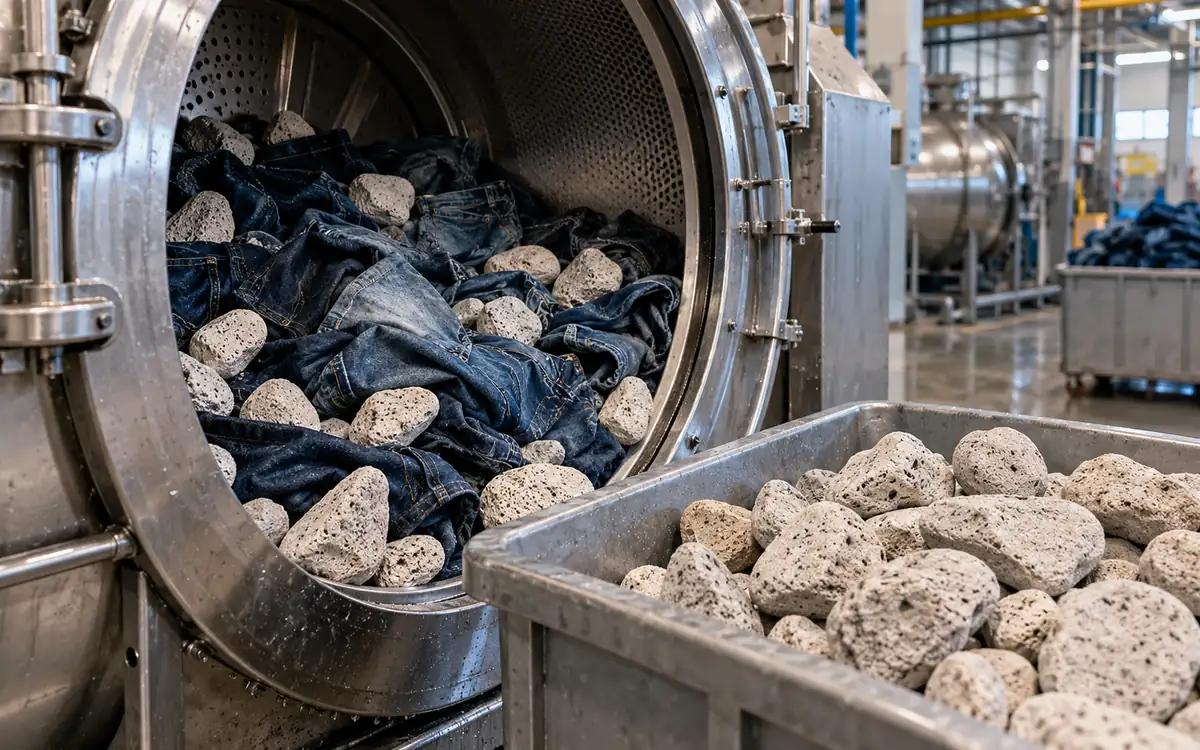
Pumice stone denim washing uses physical contact to develop a worn surface. The stone is not an inert item that can be added by habit and ignored. It changes as it works.
The size mix in a new bag may differ from the recovered material beside the washer. Wet stones can weigh more without providing more solid abrasive. A stone may still look large. Its surface may be smoother than during its first use.
These changes help explain variation in garments given the same named wash. They also explain why one universal stone ratio cannot guarantee a result.
Control begins with the approved effect. Then specify the stone, its condition and its handling route. Compare the finished garment against that effect. Also check the damage that the process can cause.
Understand what pumice contributes
The US Geological Survey describes pumice as volcanic material containing many gas spaces. That porous structure sets it apart from a dense solid rock. Commercial pumice grades still differ.
CottonWorks' denim finishing guidance links the wash effect to stone size and abrasiveness. Stone quantity and machine action also matter. It also notes that stones wear down and leave residues during processing.
A laundry needs to know how the supplied material behaves in its intended process. Geology alone cannot select the right grade for a style.
Do not equate a rough-looking stone with a better result. It may create the desired local wear, or it may damage a light pocket bag. The acceptable balance depends on the complete garment.
A softer finished handle does not prove that the garment is still strong enough. Abrasion can change both feel and strength.
Define the worn effect before choosing the stone
A wash standard should show where the effect is wanted. Mark the areas that should remain unchanged. A general request for heavy stonewash leaves too much open.
Mark the key regions on a garment map. Include the front thigh, back seat and side seam. Check the waistband, pocket edge and hem too. Describe the intended contrast and any acceptable edge wear.
Keep a physical approval garment where possible. Photographs help explain placement. Their apparent shade depends on the camera, lighting and screen.
Record the garment construction used for approval. Fabric weight alone gives limited detail. It does not describe yarns, weave or stretch components. Nor does it describe seams and trims.
Also define unacceptable defects. These may include cut yarns outside the intended effect or damaged pocket bags. Broken stitches, exposed elastic and trapped stone fragments may also be unacceptable.
A stone trial should answer whether it can produce the target within those limits. It should not search for the greatest possible abrasion.
Specify incoming pumice in measurable terms
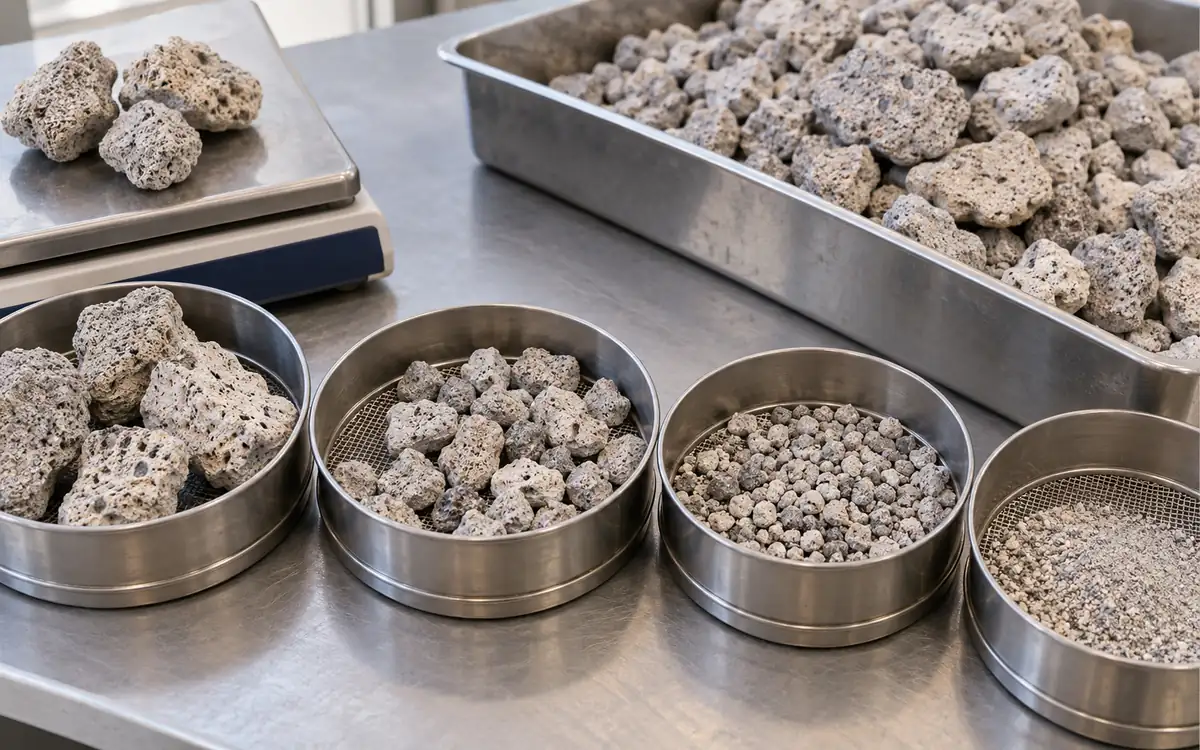
Ask the supplier to name the grade. Request a clear description of its size distribution. A label such as medium is useful only if both parties know its boundaries.
Hess publishes grade-specific technical data sheets. They show why processed grades and size distributions need separate records. Its mine-grade descriptions identify material that has not been dried. That material may retain fines held by moisture.
Use supplier evidence relevant to the material actually purchased. A data sheet for a fine powder does not qualify a coarse garment-washing stone.
An incoming specification can cover:
Property | Useful evidence | Reason for recording it |
|---|---|---|
Grade identity. | Record supplier reference and lot. | Link the wash result to a repeatable supply. |
Size distribution. | Use an agreed screening or measurement method. | Find oversize pieces and excess fines. |
Moisture basis. | Define the measurement and reporting basis. | Keep water separate from stone solids. |
Cleanliness. | Inspect for foreign matter. | Reduce unwanted contamination. |
Abrasion behaviour. | Run a controlled application trial. | Link the grade to the garment effect. |
Breakage tendency. | Use a defined handling or process trial. | Track how quickly useful pieces become fines. |
Avoid copying arbitrary limits without their test methods. A percentage labelled surface properties has no useful meaning on its own. Define what was measured.
Sample the delivery so that segregation is visible
Stones and fines can separate during handling. Looking only at the top of one bag may miss a different material mix lower down.
Agree a sampling approach suited to the delivery form. Keep the selected bags, positions and sample masses traceable. A bulk delivery may need samples from different stages of unloading. Include that in the plan.
Take care not to change the material while sampling. Too much shaking can create or release fines. This changes their distribution from the original state.
Keep a retained sample of the approved grade. Keep a sample of each trial lot too. Label them with condition and date.
A small sample does not prove that every bag is identical. Its value depends on a consistent method and suitable sampling plan.
If one part of the delivery differs visibly, hold that portion for review. Do not mix it into accepted stock. That would make the cause of a later wash change hard to find.
Read a stone size distribution
Consider an illustrative incoming check. Separate a 10 kg dry-basis sample using agreed size boundaries.
Size group | Sample mass | Share of sample |
|---|---|---|
Above 40 mm | 0.8 kg | 8% |
20–40 mm | 6.4 kg | 64% |
10–20 mm | 2.1 kg | 21% |
Below 10 mm | 0.7 kg | 7% |
Total | 10.0 kg | 100% |
These boundaries and values are hypothetical. They are not recommended universal grades.
This distribution gives more detail than an average stone size called medium. Two deliveries can have a similar average. Their amounts of large pieces and fines may still differ greatly.
Suppose the approved comparison lot had only 2% below 10 mm. A new result of 7% calls for review. Does the fine fraction change residue, useful life or the wash effect?
Removing the fine fraction changes the delivery. Record that step. Screening may be part of the accepted process. If so, record the retained mass and the cost of the discarded portion.
Distinguish solid mass from water mass
A scale measures the mass placed on it. It does not identify how much is stone and how much is absorbed or surface water.
Use a defined moisture basis. On a wet basis:
Moisture fraction = water mass ÷ total wet mass.
In a hypothetical check, take a representative 2.00 kg sample. It gives 1.76 kg of dry material under the agreed measurement procedure. Water accounts for 0.24 kg.
Wet-basis moisture is 0.24 ÷ 2.00 × 100 = 12%.
A 50 kg load in the same condition has the same estimated dry fraction. It contains 50 × 0.88 = 44 kg of dry material. This calculation describes the mass basis. It does not recommend a production load.
On a dry basis, the same sample has 0.24 ÷ 1.76 × 100 = 13.64% moisture. The two percentages describe the same sample with different denominators.
State the basis whenever moisture is reported. Wet-basis and dry-basis values cannot be compared directly. Convert them to the same basis first.
Establish one conditioning rule for comparisons
One batch may begin dry. Another may begin after an uncontrolled soak or drain period. The stone trial is then hard to interpret.
Choose the condition required by the qualified process and define it. Record wetting, draining and other preparation stages. State how they affect the stone before use.
Apply the same rule to new and recovered material when comparing them. Recovered stones may need to enter in a different condition. Treat that difference as part of the process.
Do not create a universal drying instruction from a moisture example. The measurement method must be appropriate for the material and any residues present.
Daily control may use a known relationship between the handled condition and the planning basis. Validate that relationship before using it. Check that relationship again when supply or storage conditions change.
The goal is consistency and clear accounting. It is not to force every laundry to handle stone in the same way.
Keep fresh and recovered stones traceable
Recovered material has a history. Record the style or process it came from. Note its size condition and whether reuse is approved.
Separate fresh material from usable recovered material. Provide separate storage for material awaiting review and rejected fines. Label each area. A mixed pile makes the next charge impossible to describe.
Check for residues from the previous process. The stone may carry chemistry, colour or foreign material. Those residues could affect the next garment.
A recovered stone can still be useful. Judge it by its condition and the intended route. It is not proved by the fact that the piece has survived.
Define how the reusable fraction is separated. The method must avoid extra contamination. It must also control staff exposure to dust.
Record additions of fresh material. The fresh-to-recovered mix may change over time. Without a record, its effect may look like random garment variation.
Measure attrition with a complete balance
Attrition is the loss of useful stone through wear and breakage. Keep separate records for reusable pieces, fragments and material carried elsewhere.
Consider a hypothetical controlled run that starts with 60 kg of stone solids. At recovery, the measured dry-basis amounts are:
Destination | Mass |
|---|---|
Reusable stone | 47 kg |
Separated fragments and fines | 8 kg |
Material accounted for in other collected residues | 3 kg |
Unresolved balance difference | 2 kg |
Total | 60 kg |
Useful-stone loss is 60 − 47 = 13 kg, or 21.67% of the starting useful mass.
The 2 kg difference is not automatically process dust or discharged solids. It may include sampling error or incomplete recovery. Some material may remain in the equipment. Investigate it before assigning a cause.
The 8 kg of separated fines is a physical output. The 13 kg useful-stone loss is an accounting result. Adding them together would double-count part of the same loss.
Compare like runs over time. Starting size mix and recovery method can change the reported attrition. This can happen even when the process stays the same.
Check the cost of the usable fraction
A grade may need screening before use in the approved route. Compare its delivered cost with its usable mass.
In a hypothetical delivery, 1,000 kg costs 400 currency units. After the agreed condition and size checks, 900 kg is accepted for use. The purchase cost per accepted kilogram is 400 ÷ 900 = 0.444 currency units. This excludes screening labour and disposal.
Dividing by the delivered 1,000 kg gives 0.400. That figure is correct for purchased mass. It understates the cost of the fraction that the process can use.
This calculation is not a reason to relax the size limit. It helps purchasing compare supplies on the same basis. Include useful life and garment results before choosing a grade. A supply may have a high initial usable fraction. It can still be poor value if it wears out fast or causes unacceptable local damage.
Control the machine conditions that shape contact
Stone behaviour is tied to the washer and its operation. Record the equipment identity. Add the approved settings that affect movement.
The load must remain within the machine maker's limits for the intended process. A capacity plate may cover garments only. Do not assume it allows extra stone mass.
Check the actual route with the supplier or qualified equipment documentation. Include the load, movement, water conditions and unloading method.
Do not assume that the same drum speed gives the same action in a different machine. Drum size, internal features and load movement can differ.
During development, use the equipment's safe methods to observe the process. Never open or bypass safeguards to watch stone contact.
Keep equipment condition in the record. Worn internal surfaces, damaged lifters or rough edges may damage garments. Staff might wrongly blame the stone grade.
Compare stone trials with a matched garment control
Use material from the same fabric and garment lots where possible. Keep the prior preparation and later finishing route consistent.
A trial may compare the current approved stone with a candidate grade. Include the intended recovered-stone mix too. Define the specific question before running it.
For example, can a candidate grade reduce pocket damage? Does it still give the required edge contrast? That is more useful than asking whether it is better overall.
Assess whole garments and mapped regions. Include both appearance and integrity results.
Repeat the promising route. Use enough trials to understand the variation that matters to the order. One attractive sample can support further work. It cannot establish that every production load will match.
Keep the rejected samples too, at least through the investigation. They often show the failure boundary more clearly than the approved sample alone.
Check strength where abrasion has done its work
A garment can look aged without being fit for use. Test the material and regions relevant to the product specification.
ASTM D1424 addresses tearing strength using a falling-pendulum apparatus. Check whether the method suits the actual fabric and specimen. A tear result is not a complete garment durability test.
Use agreed methods for the other required properties. Depending on the product, checks may cover breaking strength or seam performance. Stretch recovery may matter too.
Inspect local damage that a standard specimen may miss. A flat body specimen may perform well. Damage could still affect a pocket corner, belt loop or thick seam junction.
Suppose a matched fabric gives 40 N before treatment. After treatment, it gives 32 N under the same agreed tear assessment. This is a hypothetical example. Retention is 32 ÷ 40 × 100 = 80%.
That percentage does not determine acceptance by itself. Compare the actual post-treatment result with the project's requirement. Inspect the garment's local condition too.
Remove stone carryover before the next operation
Carryover includes whole pieces, fragments and fine residue. It can remain in pockets, folded hems, waistbands and other enclosed spaces.
Define an inspection route for the actual style. A five-pocket jean and a cargo style have different places where material can hide.
Complete the approved destoning and cleaning stage. Then send the garments to the next machine. Do not rely on the dryer to shake out whatever remains.
Check internal spaces as well as the face. A clean-looking outer surface does not prove that the pocket bags are clear.
Use a documented assessment method when comparing routes. For example, collect residue from a specified number of development garments. Use the same controlled handling procedure each time.
Label such a check as an internal comparison unless it follows a recognized standard. A residue mass without a collection method is hard to reproduce. It is easy to misread.
Interpret carryover results carefully
Imagine a hypothetical check on 20 garments. The controlled collection method finds 18 g of residue after one route and 6 g after a revised destoning route.
The average collected residue falls from 0.90 g to 0.30 g per garment. The measured reduction is (18 − 6) ÷ 18 × 100 = 66.7%.
That result applies to the stated collection procedure. It does not prove that all residue was removed. Nor does each garment necessarily hold the average mass.
Record whether any whole fragments were found. One trapped piece can matter even when the total collected mass is low.
Examine the distribution across garment types and regions. The revised route may clear the body but leave residue in cargo pockets. That remaining problem needs an action suited to the style.
Use the result to improve the process and inspection method. Do not claim residue-free production unless the evidence supports that claim.
Maintain the recovery and cleaning system
Stone handling places demands on screens, drains, filters and collection areas. Assign clear responsibilities for inspection and cleaning.
Look for gradual changes in recovery performance. A damaged screen may allow larger fragments into a downstream system. A blocked collection point may change water removal or create an unsafe spill.
Use the equipment maker's isolation and maintenance procedures. Clearing a blockage is not a reason to reach into moving equipment.
Keep collected residues identifiable. Spent material can contain dyes and processing chemicals. Decide its disposal route from its actual state, not just the description of unused pumice.
The Hess pumice safety data sheet calls for handling that limits dust. It advises against compressed-air cleaning. Use current information for the actual supplied stone. Follow the workplace's exposure assessment too.
Do not generalize one supplier's mineral composition to every pumice source. Obtain the relevant product information. Natural stones can have different dust profiles.
Compare alternatives against the same garment target
Alternative abrasive media can change handling and residue. Stone-free systems may also change equipment needs. They still need an application trial.
Tonello describes its NoStone system as a removable abrasive steel drum used to create a stonewash effect without pumice. This approach needs specific equipment. It cannot be treated as a drop-in stone grade.
Compare candidates against the same approved appearance and integrity requirements. Include difficult regions and the complete finishing route.
For reusable media, measure useful life under the intended conditions. A supplier may claim that a medium lasts longer. Ask how it defines the end of life.
Compare cleaning, handling and rejected garments. Include machine requirements too. A lower purchase cost gives only part of the result. So does a reduction in kilograms of media.
Avoid promising that a synthetic stone always causes less damage. The outcome depends on its material, shape and surface. Its behaviour in the process also matters.
Use a concise stone control record
The working record should make the next run understandable. It need not become a long narrative.
Record the incoming grade, lot and starting condition. Add the size distribution check and fresh and recovered quantities. Name the machine route, garment lot and target effect. State the final decision for the load.
Add the recovered useful mass and the main residue outputs where measured. Keep unresolved differences visible.
Link any deviation to the affected load. The stone mix may change midway through a shift. Record which garments received that mix.
For broader process calculations, keep the established liquor-ratio and dosing controls separate and consistent. Stone control should not create a second, conflicting definition of garment or bath mass.
Review repeated causes, not only isolated failures. Fine content may rise while useful life falls. If pocket damage also rises, look for a material or handling change.
Frequently asked questions
Is there one correct stone-to-garment ratio?
No universal value guarantees a result. Use a qualified route for the actual stone, machine, garment and target effect within equipment limits.
Can wet recovered stones be weighed like fresh dry stones?
Only if the mass basis is clear. The process must also be qualified for that condition. Water content can make the scale reading misleading.
Should small stones always be discarded?
Use the approved size and condition limits. Small pieces may change the effect or carryover risk. Base the decision on the defined grade and route.
Does an acceptable shade prove a good stonewash?
No. Inspect local wear, seams, pocket bags and required strength properties as well as the visual effect.
Can spent stone be treated as clean mineral waste?
Its process history matters. Evaluate the actual residue. Check the disposal rules that apply to it. The unused material's description is not enough.
Make abrasion repeatable and accountable
Pumice control turns an approximate wash input into a traceable process material. Specify the incoming grade. Record moisture and reuse history. Measure useful-stone loss without counting the same loss twice.
Then judge the complete garment. The desired worn appearance must coexist with adequate integrity and clean internal spaces. These controls make the approved effect easier to repeat. They also help reveal the causes of variation.
References
Hess Pumice: Grade-specific technical data sheets.
Hess Pumice: Safety data sheet.


Discussion0
Loading the discussion…