
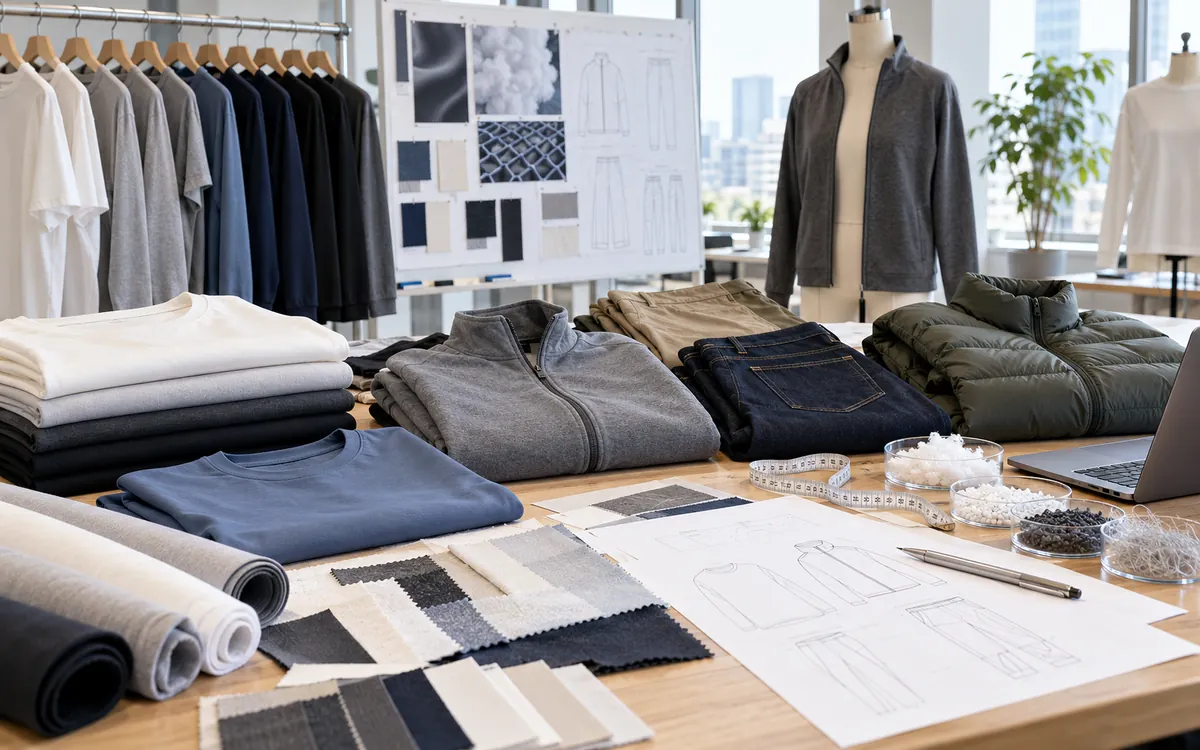
UNIQLO LifeWear is a product idea as well as a brand message. How can everyday clothes serve people better? LifeWear seeks an answer through design, materials and steady changes. The visible result may be a plain T-shirt, a warm inner layer or a pair of jeans. Much of the work sits behind that simple appearance.
Students of fashion brands can look beyond the slogan. How does the promise connect to the business? Why invest in a material partner? Why keep improving a familiar product? How can customer comments change a garment? Must each new season bring a whole new range?
This guide examines those connections. It uses UNIQLO, Fast Retailing and Toray sources, reviewed in October 2026. Company descriptions are identified as such. The development exercises are original teaching examples. So are the calculations. They do not describe UNIQLO's private tests or financial results.
What LifeWear means
UNIQLO calls LifeWear everyday clothing. Its description brings together practical beauty, careful details and steady improvement. Its official explanation groups the offer around technology, utility, quality and culture. This states how the brand approaches design. It cannot certify that every garment will suit every wearer. UNIQLO's LifeWear explanation
That distinction matters. “Everyday clothing” can sound like a narrow category, yet daily needs vary widely. A commuter may want a layer that fits beneath a jacket. A parent may care most about washing and movement. Another customer may want a simple shape that works with clothes they already own.
A useful reading of LifeWear therefore begins with a use, not a fabric name. Ask what the garment is meant to help a person do. Then examine whether its shape, material, details and care needs support that use.
This also explains why a basic-looking item can involve complex development. Each detail presents a design problem. The sleeve must allow movement. The surface should feel pleasant. The collar needs to keep its shape. Making them work together within a price target requires choices.
How the business model supports the product idea
Fast Retailing says UNIQLO manages each stage of its business. These stages run from design and planning to production, distribution and retail. Customer feedback helps shape product changes, according to the company. It also says partner factories make most of its products. Management across stages should therefore not be confused with ownership of every factory. UNIQLO business model
The connection between brand and business can be examined through four questions:
Product promise | Business question | Evidence a reader should seek |
Useful everyday clothing | Which recurring customer need is being addressed? | Product purpose and customer feedback |
Better materials | Who develops and supplies the material? | Named partners and scoped technical information |
Continuing improvement | What changes between versions? | Specific changes to fit, fabric or details |
Accessible value | How do cost, quality and scale interact? | Product specification and properly scoped business reporting |
The table is an analytical framework. It is not an official UNIQLO scorecard.
A company can express a clear philosophy and still face tradeoffs. Adding a useful feature may increase cost. A softer fabric may need a different care routine. A broad size range creates more stock decisions. The strength of a product idea is tested when such choices become concrete.
Why the Toray partnership matters
Toray describes work with UNIQLO on new materials. The partnership also covers manufacturing and the supply chain. Toray also explains why a long commitment helped. Developing a material for just one season could be hard to justify. A longer partnership gave that work more scope. The account draws on a discussion with people in the partnership. It shows how they explain their own decisions. It is not an independent comparison with every other apparel partnership. Toray on co-developing LifeWear
The broader lesson is straightforward. A garment designer can choose an existing fabric. A material partner can also help change the fabric itself. That creates a different set of possibilities and obligations.
Start with the problem in the garment
Suppose the brief is “a thin layer for cool commutes.” The team must define thin. It must also decide how the layer will fit and which clothes will cover it. The expected conditions matter too. A request for a “better fibre” is too vague.
A clearer brief might define a maximum fabric mass, a target fit, a range of movement and a care method. Those requirements can then be discussed with the material team.
These example requirements are proposed development practice. They do not reproduce a UNIQLO specification.
Allow the material and garment to develop together
A fabric sample may feel good on a table but behave differently when cut and sewn. Stretch direction, seam choice and garment ease can all change how the wearer experiences it.
Test the fabric as part of the intended garment. Do this before treating the fabric choice as final. A change in material may require a change in pattern or construction. The reverse is also true.
Product teams need a way to track changes. ApparelDiary explains this in its guide to apparel PLM for fashion product development. In the LifeWear context, the important brand question is what improvement the revision is meant to deliver.
Plan for repeated learning
One material platform can support several product versions. Reuse still needs checks. A new colour, blend or construction may require fresh evaluation.
Keep a record of what changed and why. That history helps when a customer reports a problem. The team can ask whether it stems from the new material, the fit or the care routine.
Reading HEATTECH and AIRism claims carefully
Toray explained HEATTECH in its 2019 LifeWear exhibition material. The account describes how several fibres serve different functions. It describes moisture-related heat generation, heat retention and stretch. It also describes fine fibres used in AIRism. Another part of that work concerns the space between clothing and skin. These are descriptions of the products and versions covered by that material. They should not be treated as the fibre recipe for every item currently sold under either name. Toray's LifeWear technology explanation
A brand family is not a complete technical specification. Products within one family can differ. Check the fabric blend, weight, shape and intended use of each item.
Question | Why it matters when reading a product page |
Which exact item and version is described? | A family-level statement may not apply to every garment |
What function is claimed? | Warmth, drying, stretch and surface feel are different properties |
What comparison is used? | “Improved” needs a stated reference point |
What test conditions are given? | A laboratory result has a defined scope |
What does the care label require? | The consumer must be able to maintain the product as intended |
Avoid turning a technical term into a universal comfort promise. A wearer may find a warm layer useful outdoors and too warm in a heated room. That does not by itself prove a defect. It may show that the chosen item does not match the use.
Likewise, a smooth fabric does not automatically satisfy every need for moisture handling, fit or durability. Each property deserves its own question.
A development cycle built around a familiar product
Fast Retailing's current business-model page describes a concept meeting about a year before launch. Samples follow. The team then makes further changes to colour and silhouette. It also describes material development, merchandising and production teams working together. A simple-looking garment thus involves a planning process. The published account includes several stages before production. UNIQLO product development description
A reader can use the following five-stage method to evaluate a product improvement. It is an original interpretation for learning and does not claim to reproduce UNIQLO's internal process.
Stage 1: Define the existing problem
Begin with a specific observation. “Customers want better quality” is too broad. “Some customers say the sleeve feels tight when reaching forward” gives the team a clearer issue.
Record the product version and the users involved. A comment from one size, climate or use should not be silently applied to the whole range.
Also check whether the problem is frequent enough to justify a change. A rare issue may still be serious, but frequency and severity are different questions.
Stage 2: Write a change hypothesis
A hypothesis connects a proposed change to an expected result. For example: “Changing the sleeve shape will improve forward reach without changing the body fit.”
This is more useful than “make the sleeve better.” It tells the sample team what to change and the evaluator what to inspect.
State what should remain stable. Otherwise, a prototype may solve one problem while creating a different fit.
Stage 3: Build a controlled comparison
Compare the current version with a clearly identified prototype. Keep unrelated features as similar as practical. If the fabric, pattern and seam all change at once, the team may not know which change caused the result.
Where several changes are necessary, record them openly. The aim is useful learning, not an artificial claim that one variable explains everything.
Stage 4: Evaluate use and care
A short fitting session can reveal some issues. It cannot show every result of repeated wear and washing.
Choose an evaluation period and tasks that match the intended use. For an everyday top, that may include reaching, sitting, layering and the stated care routine. Define the observations before the trial begins.
This guide does not prescribe a universal test standard or pass level. The test plan must fit the product and any applicable requirements.
Stage 5: Decide and document
Accept, revise or reject the change against the original brief. Record the reason in plain language. “Prototype B is preferred” leaves too much unsaid. Which requirement improved? Which limits remain? The decision record should answer both questions.
A familiar product can change in small steps. The value of that approach depends on whether each step is understood.
Customer feedback: useful evidence with limits
Fast Retailing discussed its Ariake Project in November 2024. The briefing described a shared management platform. Its purpose includes bringing customer feedback into business decisions. The briefing presents the company's intended direction and reported initiatives. The company aims to make what customers want. That aim does not prove that it has eliminated unwanted stock. Fast Retailing's Ariake Project briefing
For a product team, the practical challenge is moving from comments to a well-defined problem.
A customer may say a shirt “feels small.” That could refer to chest width, sleeve width, length, stretch or the expected silhouette. Before changing the pattern, seek enough detail to understand the concern.
Separate four kinds of feedback:
A preference, such as wanting another colour.
A mismatch, such as a fit that differs from the customer's expectation.
A use problem, such as restricted movement during a stated task.
A possible defect, such as a seam opening during normal use.
These categories can overlap. They are a starting point for investigation, not a substitute for judgment.
Do not assume that the loudest or most recent comment represents the whole market. Equally, do not dismiss a serious problem because only a few people have reported it.
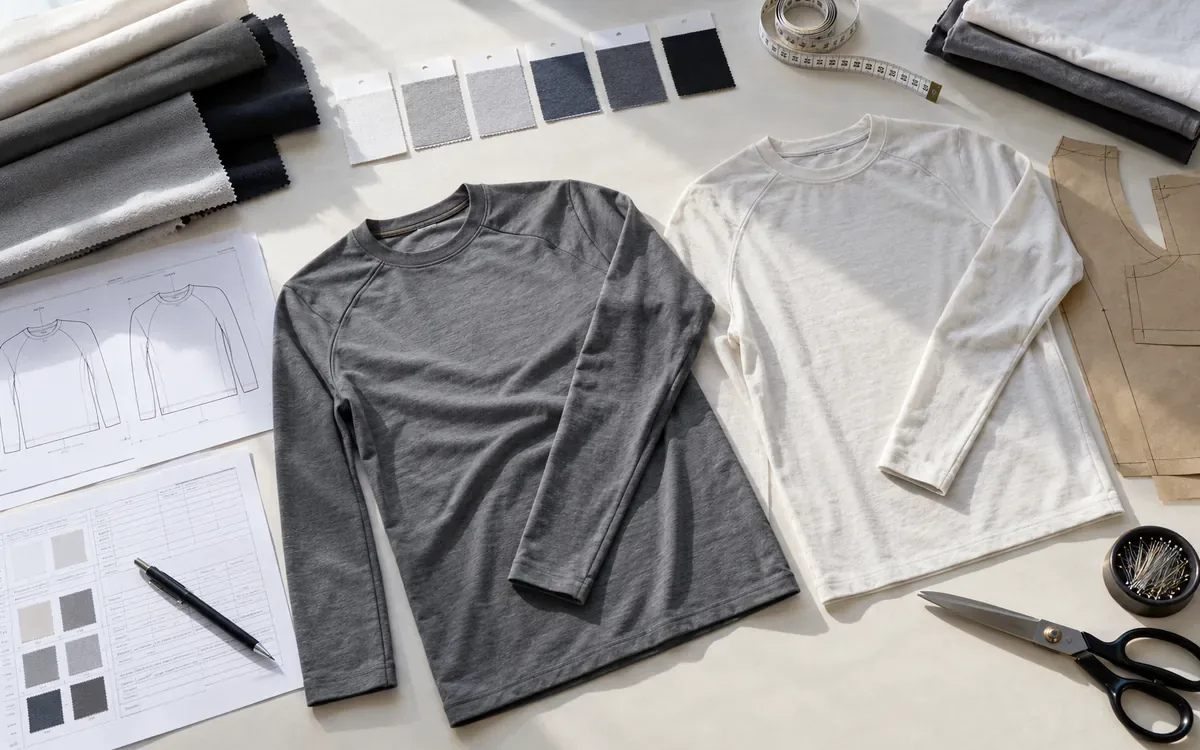
Worked example: interpreting a product complaint rate
Consider a hypothetical everyday top. The figures below are invented for teaching and do not describe UNIQLO.
A retailer sells 20,000 units of Version A. It receives 300 recorded complaints about sleeve movement within a defined follow-up period. Version B sells 18,000 units and receives 180 such complaints over an equivalent period.
First calculate the recorded complaint rate per 1,000 units sold.
Recorded complaint rate = (Relevant recorded complaints ÷ Units sold) × 1,000
For Version A:
Rate A = (300 ÷ 20,000) × 1,000 = 15 complaints per 1,000 units
For Version B:
Rate B = (180 ÷ 18,000) × 1,000 = 10 complaints per 1,000 units
The difference is 5 recorded complaints per 1,000 units. Expressed as rates per hundred units, A is 1.5% and B is 1.0%. The difference is 0.5 percentage points.
The relative reduction in the recorded rate is:
Relative reduction = [(15 − 10) ÷ 15] × 100 = 33.33%
What the calculation supports
The recorded complaint rate was lower for Version B. This finding applies to the stated counting method and periods.
It does not prove that the sleeve change caused the reduction. The customers, channels, size mix or reporting behaviour may have changed. A person who experienced a problem may never have contacted the retailer.
Nor does the calculation show that 99% of Version B customers were satisfied. “No recorded complaint” and “satisfied customer” are different observations.
How to make the comparison more useful
Keep the complaint definition stable. Count the same kind of event in each period. Decide how to handle repeat contacts from one customer.
Check whether both versions had a similar chance to generate feedback. A newly launched garment has had less time to be worn than one sold months earlier.
Then combine the sales-based measure with direct evaluation of the proposed change. The rate can reveal a pattern. A controlled wear trial can help explain why it occurred.
This careful reading makes feedback more useful. The team gets a clearer basis for its next product change.
Quality is more than how a garment feels in the shop
A soft surface is easy to notice. A brief shop visit reveals less about other qualities. How will the garment look after care? Is the fit consistent across sizes? How sound is its construction?
For an everyday product, examine the full experience:
Point in use | Useful question |
First try-on | Does the garment fit the intended activity and layering? |
A full day of wear | Do movement, seams and closures remain comfortable? |
After care | Are appearance and fit still acceptable under the stated care method? |
Repeated use | Does the garment continue to meet the reason it was bought? |
End of use | Could the owner repair, pass on or otherwise keep it useful? |
This is a consumer evaluation framework, not a claim about a particular UNIQLO test result.
The care instruction is part of the product proposition. The owner needs to be able to follow that routine. Otherwise, the garment may offer that person poor value. Product teams also need to check care information before releasing label artwork. ApparelDiary's care label validation guide explains that process.
For shoppers, the corresponding habit is simple: read the actual label and product page. Do not rely only on the family name or the appearance of an older version.
Value: price, use and the risk of a poor match
A low purchase price does not tell the whole value story. Neither does a high price. The relevant question is what the garment contributes to the owner's actual use.
A basic calculation can help make that question concrete. It should remain a personal planning tool, not a claim that one brand is always cheaper to own.
Suppose an everyday layer costs $30 and the owner wears it 60 times. Assume no resale value and exclude washing costs.
Purchase cost per wear = Purchase price ÷ Number of wears
Purchase cost per wear = $30 ÷ 60 = $0.50 per wear
If the same garment is worn only 10 times, the result is $3.00 per wear. The price is unchanged; the use is different.
Now suppose another layer costs $40 and is worn 100 times:
Purchase cost per wear = $40 ÷ 100 = $0.40 per wear
The second item has the higher purchase price and the lower calculated purchase cost per wear. This does not establish its environmental impact or overall quality. It shows why fit with the person's needs matters.
Use this exercise before buying several similar items. Ask whether the new garment fills a real use or simply repeats something already available.
Why LifeWear also includes culture and presentation
UNIQLO's 2024 Paris exhibition presented LifeWear through clothing, material technology and everyday settings. Its 2025 event at New York's Museum of Modern Art again connected design, technology and creative partnerships. Both events show how the company presents its clothing idea. That message extends beyond a single product label. UNIQLO's 2024 Paris exhibition UNIQLO's 2025 MoMA event
The analytical point is not that an exhibition proves technical performance. It is that a clothing brand must help people understand what its products are for.
A fibre innovation is hard to see on a shop rail. A display, a clear explanation or a familiar use can make the idea easier to understand. That communication still needs to stay within the evidence for the actual item.
Art and collaboration can also change how a familiar product is interpreted. A simple shape can carry a new print or colour. It can gain a cultural meaning while keeping the same basic construction. Whether that appeals to a customer is a matter of preference, not a laboratory result.
Turn the philosophy into two clear product briefs
Consider two people who both ask for an everyday layer. One walks to work outdoors, then spends the day in a warm office. The other works in a cool indoor space and rarely removes the layer. Their requests sound similar, but their needs may differ.
For the commuter, ask how easily the garment can be added or removed. Check whether it fits beneath the outer jacket and where it will be stored indoors. A feature that adds warmth may be useful during the walk but unwelcome later.
For the indoor wearer, a stable fit over many hours may matter more. Examine the neckline, sleeve movement and seams while seated. Ask whether the layer works with the required outer clothing.
These are hypothetical briefs, not recommendations for a named UNIQLO item. They show why a brand's broad promise needs a narrower product choice. The same customer may need different clothes for different days.
A product team can use this exercise before selecting material. Write down the intended use in one sentence. Add the main constraint. Then state what you would need to observe to judge the trial a success. If those sentences are unclear, a technical fabric name will not make the brief complete.
Common mistakes when studying UNIQLO
Treating the philosophy as a test certificate
LifeWear explains the brand's intention. Verify performance at the product level. The same applies to words such as comfortable, durable and versatile.
Assuming every technology family has one recipe
Check the exact garment and version. A name can cover several blends, weights or forms. Historical technical material should be dated.
Equating coordination with factory ownership
The company describes management across the value chain and the use of partner factories. Analyse those relationships separately.
Calling all change a fashion trend
A change can address fit, function, care or appearance. Identify which type of change is being made before explaining its business purpose.
Ignoring the user's setting
A layer chosen for one climate, activity or outfit may perform differently in another setting. A sound recommendation begins with the use.
Reading an ambition as an achieved result
A company can describe a desired business model while still working toward it. Keep reported actions, targets and measured outcomes in separate sentences.
Frequently asked questions
Is LifeWear a fabric?
No. It is UNIQLO's broader clothing philosophy. Individual ranges and garments use particular materials and constructions.
Does UNIQLO make all its products itself?
Fast Retailing says it manages the linked stages of the business. It also says partner factories handle most production. The business model is not the same as owning every production site.
Why is the Toray relationship important?
The participants describe a long-term partnership that extends into materials and development. The brand's product idea can thus involve more than choosing a finished fabric. The partners can work on the material itself.
Does HEATTECH mean the same thing on every garment?
Treat it as a product-family name and read the specific item information. Do not apply a historical blend or claim to every current product without checking.
How can a student assess the LifeWear business model?
Choose one product need. Identify the stated solution and the business choices that support it. Then ask how far the evidence supports the claim. A focused analysis is stronger than a list of slogans and sales figures.
What can another brand learn from the model?
Start with a clear use and product brief. Bring in material expertise. Then use feedback to guide specific changes. The suitable scale and process will depend on its own products, partners and customers.
Conclusion
LifeWear links a simple outward product idea to more complex work on design, materials and improvement. UNIQLO's relationship with Toray helps explain the material side. Fast Retailing also describes a link between product planning and customer feedback. Its business accounts explain how that link is meant to work.
The most useful way to judge the model is to move from philosophy to a specific garment. Define its purpose and read the actual specification. Examine the evidence. Consider how the owner will use and care for it. This gives the discussion a practical focus. It also keeps a brand promise separate from a proven product result.
References
UNIQLO. This is LifeWear. Official philosophy; reviewed October 28, 2026.
Fast Retailing. UNIQLO Business Model. Current planning, production and retail description.
Toray. Beyond Manufacturing: Co-Developing LifeWear to Change the World. First-party discussion of the partnership.
Toray. The Art and Science of LifeWear. Technical and exhibition account from 2019; product-version limits apply.
Fast Retailing. “LifeWear = a New Industry” briefing. November 13, 2024.
UNIQLO. The Art and Science of LifeWear, Paris. 2024 exhibition.
UNIQLO. The Art & Science of LifeWear at MoMA. September 2025 event account.

Discussion0
Loading the discussion…